






加密交易所的核心权力,正被OKX亲手交出去


Original|Odaily星球日报(@OdailyChina)
Author|Wenser(@wenser 2010 )
The divide between the old and new investment markets is accelerating: on one side, US stocks, the Korean index, and the Nikkei are all surging dramatically, with numerous popular sectors and individual stocks hitting new highs repeatedly; on the other side, mainstream cryptocurrencies are oscillating downward, with BTC spot trading volume down over 80% since October last year.
Despair is spreading among crypto investors, with capital fleeing; meanwhile, builders are persistently searching for new answers — Hyperliquid, initially positioned as a Perp DEX, has expanded its ecosystem into traditional financial asset sectors, with RWA asset trading volume experiencing exponential growth; prediction markets like Polymarket and Kalshi are also warming up the World Cup topic, with monthly trading volumes hitting new all-time highs — these are the “only two bright spots” in the crypto market, narratives that have passed their initial tests.
And what about CEXs, the industry's liquidity centers? The top players are actively connecting to traditional financial markets and expanding the boundaries of the crypto market. Their initiatives include introducing RWA asset trading channels and adding prediction market entry points. The common goal of these measures is to solve industry-wide problems such as liquidity fragmentation, fragmented user experience, and low capital efficiency in the crypto market.
Listing new assets and adding new entry points are certainly necessary parts of industry development, but some hope to forge a new path for industry building. Recently, OKX's launch of Exchange OS presents us with a new possibility: that is, to **activate the industry ecosystem by redefining the "right to create markets."**
As Crypto Narratives Run Dry, CEXs Proactively Seek Change
Let's detail several major structural challenges currently facing the crypto market:
First, the crypto market has run out of new stories. The narratives of previous cycles — public chains, NFTs, DAOs — have been debunked one after another. DeFi security incidents are frequent. The BTC ecosystem has fallen silent. Meme coins and AI Agent concept coins are languishing. The successive appearances of the Desci concept, the x402 payment protocol, and even the recent Uniswap V4 Hook ecosystem haven't generated sustainable momentum.
Second, liquidity in the crypto market is fragmented. Users are trapped in closed-off DApps and protocol silos, helpless against the complex and high friction costs of moving between different chains, platforms, applications, and protocols.
Third, the crypto market is an "echo chamber." Although mainstream coin ETFs and DATs have pried open channels between the crypto and traditional financial worlds, the capital capacity, along with the high risk and high volatility inherent in crypto assets themselves, further hinders efficient and convenient exchange and circulation between the two. The crypto market is increasingly trapped in the awkward situation of builders talking to themselves.
Over the past decade-plus, the crypto industry achieved decentralized value transfer through Bitcoin, enabled decentralized asset issuance through Ethereum, and unlocked DeFi liquidity through AMM protocols. But old answers clearly cannot be directly applied to the new phase.
It is precisely for this reason that new industry examples are emerging: on-chain Perp DEXs like Hyperliquid and Aster are breaking the ceiling for derivative cross-chain assets; Polymarket and Kalshi are scaling the social act of "prediction" into the financial pricing system; RWA platforms like Ondo are going beyond simply bringing traditional assets on-chain to packaging them as derivative assets.
Facing the impact of these new markets, many industry players have made different choices: Binance recently launched "Event Rush"; Bitget launched its proprietary RWA protocol product, Reality, directly connecting to US stock liquidity and supporting dividend payouts; Bybit has successively listed perpetual contracts like CSCO and RKLB and launched various airdrop events. However, while most platforms are stuck in listing more RWAs (including pre-market US stocks) to maintain traffic, OKX has taken a series of completely opposite actions. Looking at its product release cadence over the past few months, its market role has gradually evolved **from a singular "product builder" to a "system explorer"** :
1. Agent Trade Kit: Aims to solve the "machine trading" problem in the AI era, allowing users to easily connect AI Agents to on-chain execution systems via a native AI trading suite.
2. APP Payment Protocol (Agent Payments Protocol): Aims to define the on-chain payment standard for AI Agents, freeing crypto asset flow from the constraints of complex wallet operations, expanding AI Agent payments into business processes, and supporting multiple payment models.
3. Exchange OS: An open trading protocol built on X Layer, achieving a "protocol-based" upgrade of capabilities like matching, clearing, settlement, and unified accounts. It supports users in independently deploying spot, perpetual, and prediction markets, covering CEX assets and Web3 on-chain markets.
If Agent Trade Kit represents an effort at the infrastructure and tooling level, then the launch of the APP Payment Protocol and Exchange OS reveals OKX's greater ambition. As a leading exchange, instead of choosing an "asset-level breakthrough," it has set its sights on a "holistic approach" combining strategy and tactics. The launch of Exchange OS, in particular, signifies CEXs attempting to bypass the old question of "which assets to list" and instead ponder the crucial proposition of **"who will be the creator of new markets."**
OKX is dismantling the core "trading black box" of a crypto exchange, pushing it down to the protocol layer, and driving the crypto industry from a centralized landscape back towards an active state of decentralized order.
Leveraging the protocol layer capabilities of Exchange OS, the vision of on-chain egalitarianism can be realized, further unleashing users' "right to create markets." Quant teams could open perpetual markets based on arbitrage opportunities. RWA institutions could package assets like stocks, private equity fund shares, or unlisted company equity into on-chain assets. Individual users could launch verifiable social events as prediction market contracts.
Simultaneously, cross-market unified accounts will integrate fragmented liquidity, improving capital efficiency. In terms of fund security and mechanism safeguards, "code-level guarantees" ensure funds are locked within the protocol contract, preventing market creators from installing backdoors or stealing assets. The design where OKX's proprietary markets and external markets follow the same protocol rules also sets a benchmark for on-chain egalitarianism.
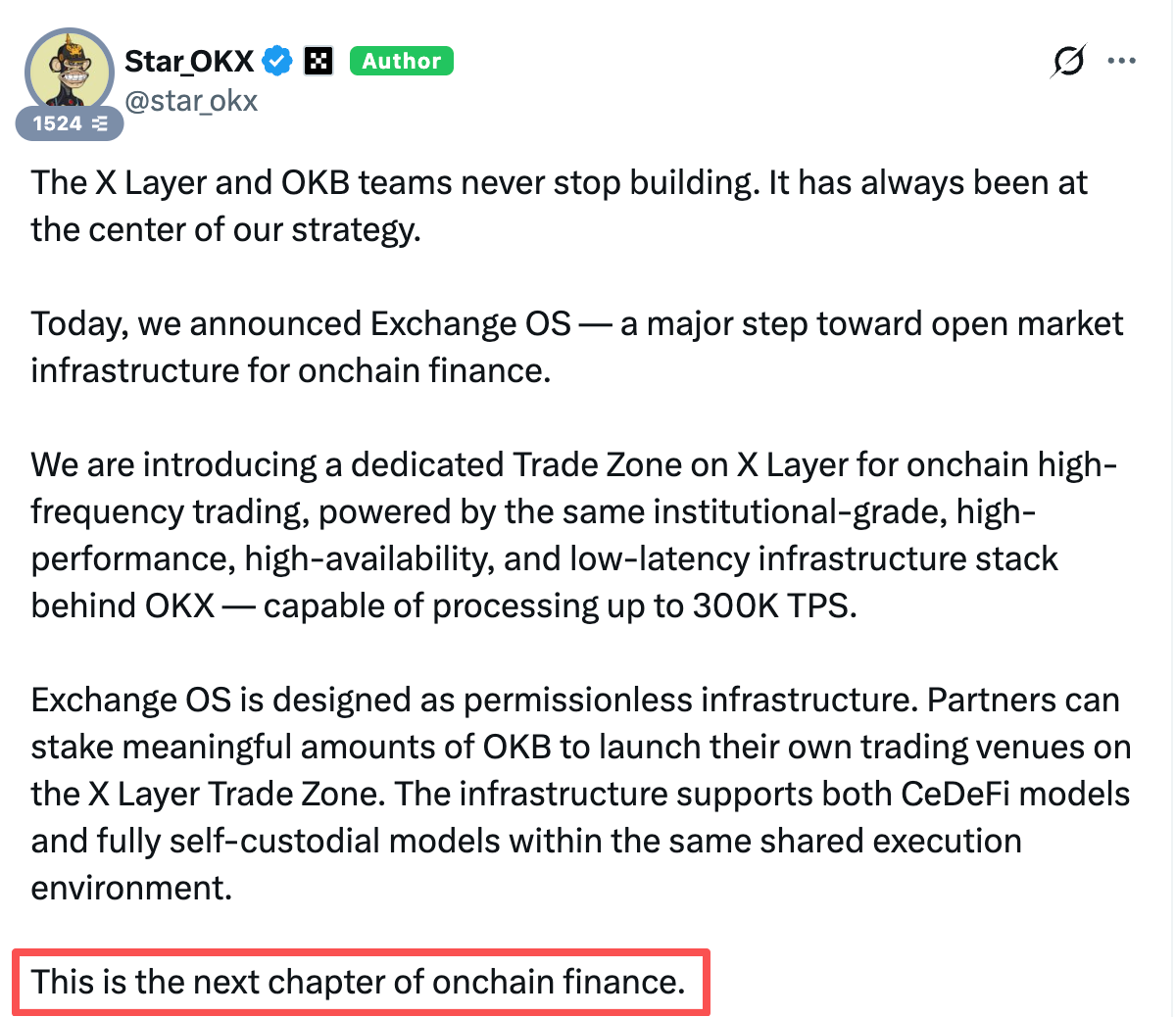
OKX CEO Star also voiced high hopes for the vision of Exchange OS: “The next chapter of on-chain finance shouldn't be written by any single platform. It should be written by everyone who wants to build a market.”
New Industry Coordinates: The "Crypto App Store" Takes Shape
In the past, powers like asset types, asset classes, and asset pricing were all in the hands of CEX platforms. Users and institutions could only comply with platform rules, powerless to provide feedback or push for changes. Now, with the deep coupling of TradFi assets with CeFi and DeFi assets, asset types and issuance models are no longer scarce resources. The real barrier is whether the "right to create markets" can be distributed among various participants.
Now, theoretically, any verifiable event can be transformed into an independent event market via the Exchange OS protocol. The financial participation threshold and market pricing power have been systematically reshaped.
Just as the iOS system activated the vibrant developer ecosystem of the App Store, Exchange OS's underlying trading operating system has the potential to activate the creativity of quant teams, RWA institutions, developers, and even ordinary individual users. It solves not just the problem of "who creates the market," but is also a crucial step in further expanding the boundaries of the crypto market and breaking through the operational capacity ceiling of past CEX platforms.
Based on this transformation, **the production relations of the crypto market will also be restructured.**
From "Investment for All" to "Production for All"
The main evolutionary thread of the crypto market is the leap from changes in productive forces to changes in production relations.
In the early industry stage, blockchain technology solved the productivity problem of "how to issue assets" (How to Launch a Token);
In the second stage, various crypto ETFs appeared, transforming cryptocurrencies into intermediary currencies connecting "traditional financial assets." Productivity was further unleashed, but production relations regressed from the decentralized era back to a stage controlled by centralized institutions;
In the third stage, the emergence of US stock assets, commodities, and event contracts enriched the variety of assets and investment targets. However, the problem the crypto industry needed to solve shifted to "how to efficiently establish market organization forms."
Against this backdrop, market participants, including retail traders, CEX platform users, and crypto investors, must undergo a "role upgrade" — they need to transition **from passive "traders" accepting and investing in platform assets, to "producers" who define market rules and innovate market mechanisms**. Complex asset markets like prediction markets, RWA assets, and pre-market US stocks will rapidly emerge through various **"marketplace APIs."**
However, opportunities come with challenges. OKX's attempt to expand the boundaries of the crypto industry and explore the future of on-chain finance will inevitably face a series of tests. For the Exchange OS protocol and OKX's full product suite to become the "App Store of the crypto world," they must overcome the following bottlenecks:
● First, the liquidity challenge. In the early stages of the market ecosystem, can liquidity activation create an ecological synergy, building an economic closed loop based on spontaneous trading demand within the ecosystem?
● Second, performance capacity limits. Although supported by technical foundations like millisecond matching latency, unified settlement, and throughput up to 300,000 TPS, how can the X Layer ecosystem reliably host a staggering number of "financial applications" over the long term?
● Third, the commercial value capture loop. Creating an ecosystem economic closed loop akin to "Apple App Store - Apple Apps - Apple Tax" is difficult. Can the Exchange OS ecosystem form an effective feedback mechanism similar to "Hyperliquid - HLP Vault - HYPE Buyback - HYPE Price Support"?
Of course, the existence of various challenges confirms the necessity of industry development. Many problems often find new solutions precisely through repeatedly confronting these challenges. Even with short-term setbacks, the steadfast progress in the right direction is commendable. And based on OKX's past brand equity, market position, technical strength, and product capabilities, the long-term vision of "Everything is a Market" is undoubtedly promising.
A Courageous Industry Experiment, A Ticket to a New Era
As an industry participant with a massive user base, the various attempts by top platforms like OKX, in the current market environment, can seem somewhat "thankless" — if they succeed, no one will praise them, as it will be tacitly considered a business move; if they fail, they will inevitably face snarky remarks and kicks when they are down, and the cold words of intra-industry competition can easily chill innovators.
Narratives and rhetoric are always fleeting, with their time ending. Someone must take a different path and shoulder the responsibility of "driving the industry forward" away from the spotlight, exploring, experimenting, and taking risks without any expectation of reward.
I believe the future of the crypto sphere lies far beyond how many new tokens are listed. It lies in how many thresholds for financial investment it levels, how many efficient, fair, and open trading markets it creates. The future direction explored by industry players should not merely be finding the next hotspot or grabbing fleeting headlines. It should be about building a foundational trading operating system capable of accommodating asset flow and realizing financial sovereignty.
Exchange OS, along with more industry experiments, represents a forward-looking trial in the transformation of production relations within the crypto world. In a sense, it's a ticket to the era of "Everything is a Market" and a high-profile return to the crypto spirit of "decentralization, openness, and liberalism."
Whoever can define the new coordinate system for trading will win the dominant position in the future of crypto, and indeed global finance.





