






白宫“御用”提词员,靠内幕消息预测捞金超10万美元


Original: Odaily Planet Daily (@OdailyChina)
Author: Golem (@web3_golem)

Recently, a new insider trading scandal was exposed within the White House.
A White House staff member made hundreds of thousands of dollars in profit by trading on insider information in prediction markets. The true identity of this insider was merely a long-time operator of Trump's teleprompter. The employee has now been suspended without pay.
This teleprompter operator becomes the third insider disclosed by U.S. judicial authorities to have made significant profits in prediction markets using insider information, following the special forces soldier involved in the Maduro capture operation and a Google security engineer. (Related reading: After 4 Months, Polymarket Helped Trump Catch a Military Operation Leaker, But at the Cost of... and Seeing the Answers Before Taking the Test? Google Engineer Caught in Polymarket Insider Trading Case)
Reported by Kalshi, Funds Frozen, But Ultimately Avoided Criminal Liability
The protagonist is named Gabriel Perez, who has been operating Trump's teleprompter since 2016. Perez's journey to this job was also quite dramatic. In 2016, Trump's campaign team urgently needed a teleprompter operator, so they searched Google for "teleprompter" and found Perez's company. That's how Perez was hired by Trump's team.
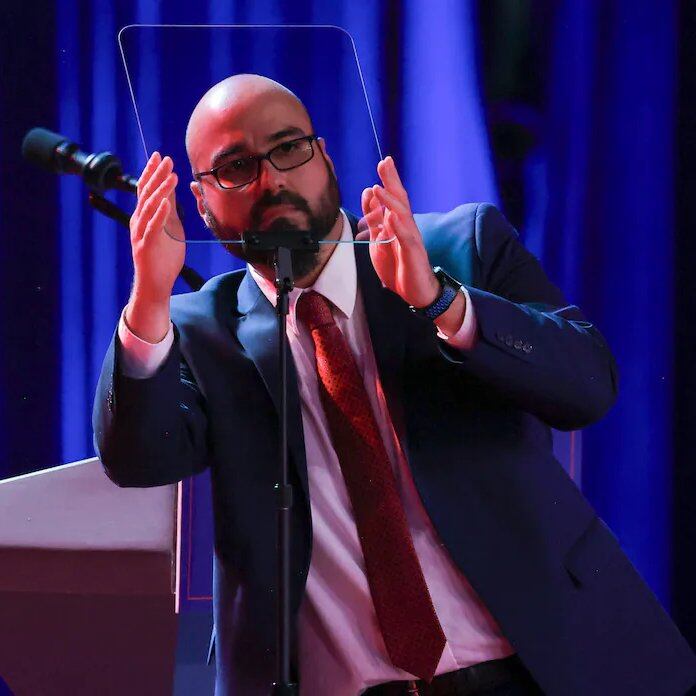
Gabriel Perez
Although Perez was hired by chance, over these 10 years, he gradually became one of Trump's closest aides. U.S. publication *Politico* even stated that "Perez has become the only person Trump trusts," often receiving last-minute revisions of public speeches directly from Trump himself.
Therefore, Perez became one of the few people who could access Trump's complete speeches early and had the final say on nearly all of Trump's prepared remarks. This power was not insignificant. Perez's official title at the White House was Deputy Assistant to the President and Technical Adviser, with an annual salary of $175,000, only $20,000 less than senior staff like Chief of Staff Susie Wiles and Press Secretary Karoline Leavitt.
Such a salary already places him among high-income earners in the U.S., but the greedy Perez was not satisfied.
When prediction markets became popular, countless players began betting on whether Trump would "mention" specific words in a given speech. Perez realized that his "privilege" could bring him even more wealth.
CFTC investigators found that over about three months, Perez placed bets on more than a dozen of Trump's speeches, making a total profit of over $100,000. These included Trump's primetime speech in December last year, his speech at the World Economic Forum in Davos, Switzerland, in January this year, the State of the Union address in February, and his speech at the Medal of Honor ceremony in March.
The法定年薪 of the U.S. President is $400,000, plus various allowances, totaling around $569,000 annually. If Perez hadn't been caught, with his pace of earning $100,000 in three months, his annual income would surpass the President's salary, even if his power was less.
However, even knowing the speech content in advance, Perez couldn't always successfully predict which words Trump would mention, because Trump often goes "off-script" and improvises. When Trump skipped a word Perez had bet on during a speech, Perez would immediately sell to cut his losses. Trump himself admitted during a speech at the Detroit Economic Club in January that he doesn't look at the teleprompter 80% of the time.
Similar to the experiences of the special forces soldier and the Google security engineer, Perez's exposure also came from the prediction market platform's proactive reporting. Perez frequently used Kalshi for insider trading. Starting in March this year, Kalshi's monitoring system detected some abnormal transactions related to specific words mentioned in Trump's speeches, thus flagging Perez.
After completing an internal investigation, Kalshi quickly froze over $90,000 in Perez's account and handed the case over to the U.S. Commodity Futures Trading Commission (CFTC). Upon learning of this, Trump commented that it was "despicable" and personally decided to suspend Perez without pay.
Driven by greed, Perez ultimately lost everything: he couldn't keep the profits from the prediction markets and lost his job. However, compared to the special forces soldier and the Google security engineer, Perez was lucky, as U.S. judicial authorities did not file criminal charges against him, meaning he wouldn't go to jail.
During the investigation, the CFTC notified federal prosecutors in Manhattan, but they declined to pursue a criminal investigation. According to sources, CFTC regulators have indicated a willingness to reach a settlement with Perez and have discussed terms with him. The result would require Perez to return the profits and cease similar trading activities.
Perez is Just the Beginning of Cleaning Up Insiders in "Mention" Markets
The reason Perez avoided prison is that prosecutors did not believe his actions constituted a criminal offense. He did not leak important government information in advance nor endanger national security. As Trump said, it was "merely despicable," tarnishing the image of integrity for public officials.
In March this year, the White House warned staff not to use non-public information to bet in prediction markets. White House spokesperson Davis Ingle stated: "The White House has strict ethics guidelines, and we expect all staff and officials to abide by them."
But Perez is certainly not the only White House staff member profiting from insider information. And Trump, who openly runs his own paid subscription group, is hardly in a position to criticize this teleprompter operator. (Related reading: $100,000 a Month: Trump Starts Selling 'Alpha')
It's no wonder Perez couldn't resist temptation. The "mention" markets in prediction trading are indeed the easiest category to manipulate. When the cost for insiders to participate is extremely low, and the potential returns are extremely high, it's no longer just a moral issue but a problem of mechanism design. Faced with such incentives, even outwardly respectable and seemingly righteous politicians cannot guarantee they will never cross that line.
The way "mention" markets work is that users bet on specific words, phrases, or topics that will be mentioned in public speeches. Compared to other events (like political elections, sports competitions, etc.), the cost of cheating in "mention" markets is incredibly low. It's not just limited to people like Perez who know the speech content in advance; for the speaker themselves, cheating is as easy as saying a single word, turning the phrase "a single word is worth a thousand gold pieces" into reality.
During the Grammy Awards ceremony in February this year, host Trevor Noah, after saying "Welcome back to the Grammys," suddenly shouted "Potato." While everyone was confused, Trevor Noah continued, "If you bet on Polymarket that I would say this word, you're rich," and congratulated a user named "Noah 22." However, in reality, the Polymarket prediction "What will be mentioned at the Grammys" didn't even have "potato" as an option, and the user "noah-22" was entirely fictional.

The Grammy host shouting "potato" at the awards ceremony
Some later analyses suggested this was a Polymarket marketing stunt, but it clearly demonstrated the speaker's ability to manipulate "mention" markets.
There's an even more direct example. During Coinbase's Q3 2025 earnings call, just as the meeting was about to end, CEO Brian Armstrong mentioned he noticed many people were betting on what he would say during the call. So, he opened Polymarket, read out every single word listed in the options, ultimately causing the market result to have a 100% win rate for all options, ending in a tie.
These are just two examples showing the control speakers have over "mention" markets. Undoubtedly, many others are profiting from this while staying hidden. However, as regulatory scrutiny of prediction markets intensifies, it's likely that all insiders in "mention" markets will eventually be purged. Perez is just the beginning.
Last month, Kalshi updated its policy, requiring users to disclose their workplace. Kalshi's Head of Enforcement, Bobby DeNault, explained the reason: "If you possess certain information because of your job or employment relationship, and you have a related legal obligation, you are obliged not to appropriate that information for yourself or use it for private gain." Polymarket has not yet implemented such strict disclosure requirements for its users, but given the increasingly competitive and compliance-focused landscape of prediction markets, stricter compliance rules from Polymarket are likely imminent.
From the special forces soldier to the Google engineer to the White House teleprompter operator, prediction markets are progressively cleaning up insider trading. Simultaneously, the market is undergoing a process of disenchantment. Initially believed to reflect collective wisdom, it is now revealed to be merely an ATM for a few insiders.
While purging insider trading makes prediction markets more compliant, it also distances them from the truth, bringing them closer to being pure casinos.


