






纳指单日跌幅4.2%、“黑色星期五”戳破美股泡沫?


- 核心观点:2026年6月5日、米国株は予想を上回る非農業部門雇用統計(非農)を受けて金利が急騰。AIセクターの高値からの暴落が相場全体を押し下げた。バリュエーション指標や心理指標の多くが歴史的な極限値に位置しており、市場は「ストーリーから現実へ」の転換期にある脆弱な段階と言える。今後2週間のCPI(消費者物価指数)発表とFOMC(連邦公開市場委員会)が調整の性質を決定づけるだろう。
- 关键要素:
- 直接導火線:5月の非農業部門雇用者数は17.2万人増と、予想の8.8万人増を大幅に上回り、インフレ期待を押し上げた。10年物米国債利回りは4.531%まで上昇し、市場は早ければ10月にも利上げがあると予想。
- AIセクターの雪崩:フィラデルフィア半導体株指数(SOX)は10%超急落。エヌビディアは6%超、マイクロンは13.3%の下落。引き金は、ブロードコムのAIチップ向けガイダンスが予想を下回ったことや、クラウド事業者による注文削減の観測。
- バリュエーションの歴史的高値:調整前のS&P500のCAPEレシオ(シャラー・シラーPER)は約39.5倍(過去3番目の高水準)。「バフェット指標」は237%に達し、「深刻な割高」水準を大きく上回る。
- 多空の対立:弱気派はバブル調整の始まりと見なす(例:ソシエテ・ジェネラルのストラテジストはナスダックの調整リスクを警告)。強気派は利益の裏付けを強調する(例:ゴールドマン・サックスはS&P500の年末目標を6900~7600ポイントに据え置き)。
- テクニカル面でのブレイク:S&P500は上昇チャネルの下抜けを確認し、200日移動平均線(7000~7200ポイント)を試す展開。この水準を下回れば、10%~15%の中期的な修正局面入りが確定する可能性。
- 今後の重要な節目:6月10日のCPI発表(コアCPI予想は2.8%~2.9%)、および6月16~17日のFOMC会合(ドットチャートにおける利下げ期待の変化)が、相場の方向性を左右する。
Original | Odaily Planet Daily (@OdailyChina)
Author | Qin Xiaofeng (@QinXiaofeng 888 )
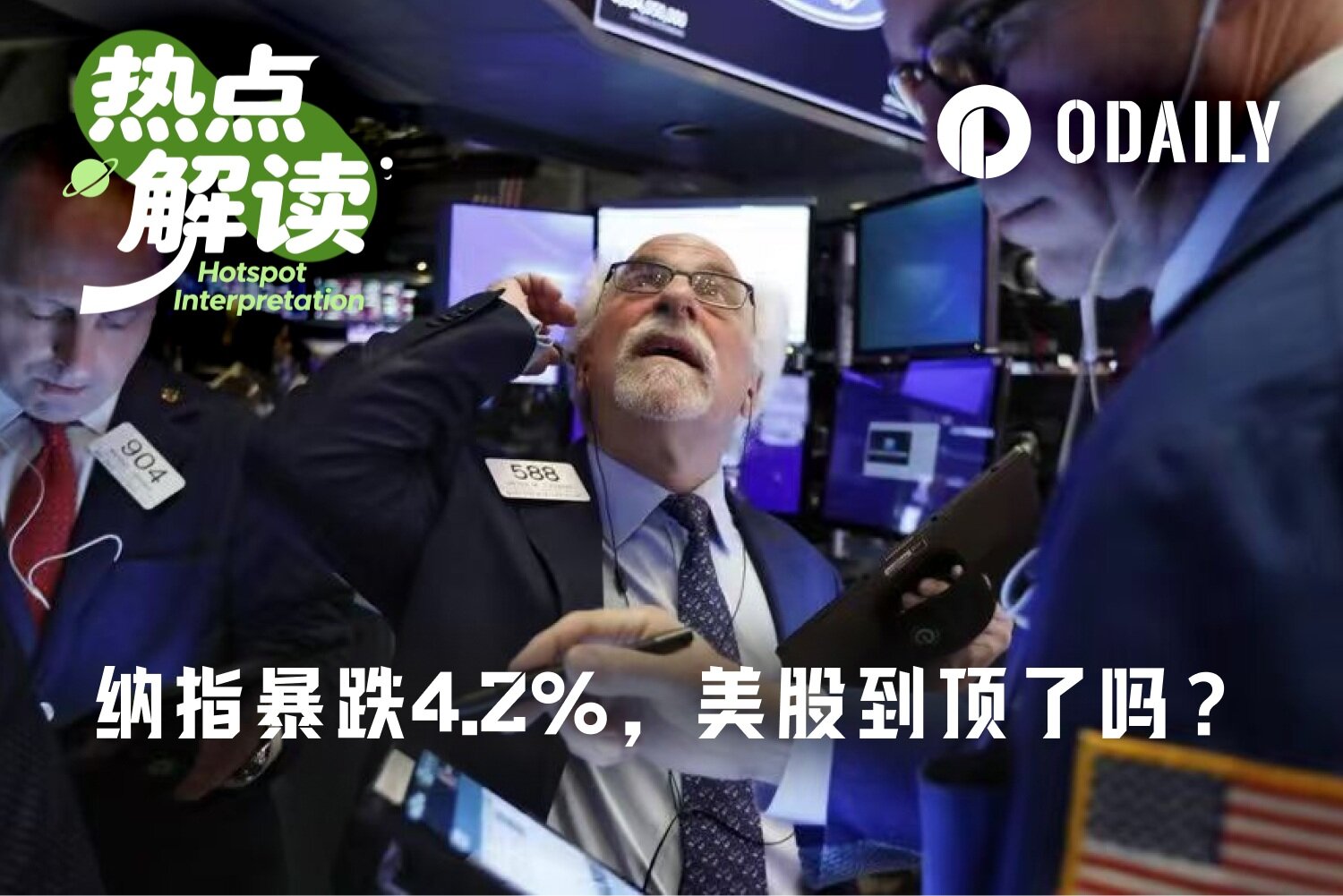
On Friday, June 5th, the U.S. stock market experienced its most severe single-day pullback so far in 2026.
The Nasdaq plunged 4.18%, closing at 25,709.43 points, its largest single-day drop since April 2025; the S&P 500 fell 2.64% to 7,383.74 points, ending a nine-week winning streak; the Dow Jones dropped 695.15 points (1.35%), closing at 50,866.78 points. The Philadelphia Semiconductor Index plummeted over 10%, evaporating approximately $1.3 trillion in market value in a single day, with AI core stocks like Nvidia, Broadcom, Micron, and Marvell leading the decline.
Suddenly, the question of "Has the U.S. stock market peaked?" spread from trading floors to the screens of investors worldwide. Odaily Planet Daily will conduct a rigorous analysis combining recent data and historical comparisons: Is the current valuation of U.S. stocks too high? Is this correction a healthy adjustment or a trend reversal? What are the future drivers?
1. The Panorama of the June 5th Crash: A Data-Driven "Perfect Storm"
The non-farm payroll data released on Friday evening was the direct trigger for this crash.
The U.S. Department of Labor reported that non-farm payrolls increased by 172,000 in May, nearly double the market expectation of 88,000 and significantly higher than April's 115,000. April's employment data had already exceeded expectations. Furthermore, March's employment data was revised up by 29,000, and April's data was revised up by 64,000. The employment growth rate over the past three months has become the strongest in the last two years. This suggests a systematic underestimation of U.S. employment conditions by previous data, enough to fuel market concerns about an overheating economy.
The strong employment data boosted inflation expectations, leading the market to anticipate the earliest possible Fed rate hike in October this year. After the data release, U.S. Treasuries were sold off, with the 10-year yield rising 5.8 basis points to 4.531%. The more policy-sensitive 2-year Treasury yield rose over 7 basis points in a single day to 4.1%.
The jump in bond yields severely impacted technology stocks, which, as high-valuation, high-growth assets, are most sensitive to interest rates.
Although Broadcom posted strong earnings the previous day, its guidance for the AI custom chip business failed to meet the market's extremely high expectations, triggering a chain reaction. Nvidia fell over 6%, Micron dropped 13.3%, Marvell fell 16.7%, and AMD fell 10.9%. The concentrated profit-taking in the semiconductor sector, combined with doubts about the sustainability of AI capital expenditure, created an avalanche effect. Reports that Meta would add tens of billions of dollars in AI investment failed to reverse the sector's decline.
Trading volume surged, and the VIX panic index soared 37% to 21.15, indicating a rapid spread of risk aversion. Bitcoin also fell below $60,000, while gold and crude oil saw adjustments, putting pressure on all risk assets. However, not all sectors fell. Defensive sectors like utilities, healthcare, and consumer staples bucked the trend, with "old blue chips" like Johnson & Johnson and Coca-Cola attracting safe-haven capital. This suggests the market is not in a state of full-blown panic but rather a targeted adjustment of high-valuation sectors.
On a weekly basis, the S&P 500 ended a nine-week winning streak, and the Nasdaq recorded a weekly decline of 4.7%, its worst in over a year. The Dow Jones was relatively resilient, falling only 0.3% for the week, reflecting signs of sector rotation.
"This is an extreme case of 'good news is bad news,'" said Michael Wilson, Chief U.S. Equity Strategist at Morgan Stanley, in a post-market report. "Strong employment data means the Fed's tightening shackles will be fastened tighter. It directly shakes the only pillar supporting the high valuations of U.S. stocks: the imminent expectation of rate cuts."
2. The Fading AI Myth: The Domino Effect of Crowded Trades
If the non-farm data was the fuse, the bubbles and vulnerabilities accumulated within the AI sector itself were the highly explosive gunpowder.
Over the past 18 months, AI has been the sole narrative driving U.S. stocks to consecutive new highs. Nvidia's market cap once exceeded $5 trillion, accounting for over 7% of the S&P 500's weight. The combined market cap of stocks related to the entire AI ecosystem once approached 40% of the S&P 500's total market cap.
However, cracks began to appear in this faith in the second quarter of 2026.
Several cloud service providers, in recent supply chain surveys, have been reported to be cutting some orders for Nvidia's next-generation Blackwell Ultra chips, citing excessive inventory buildup and a significantly slower monetization of enterprise AI applications compared to infrastructure investment. Although Nvidia's earnings report at the end of May was still impressive, its revenue growth guidance has slowed for the third consecutive quarter, with early signs of margin pressure.
The previously extremely crowded long trade in big tech quickly turned into a stampede for liquidation under the impact of rising interest rates. When the non-farm data triggered a surge in rates, the appeal of holding these high-duration, high-valuation growth stocks suddenly diminished. Their fragile marginal buyers—leveraged quantitative funds and retail investors—were the first to collapse, triggering a chain reaction.
"The AI trade has shifted from FOMO (Fear Of Missing Out) to the fear of being trapped." Jeremy Grantham, a renowned value investor and co-founder of GMO, has long warned about overvalued AI. He has compared the current situation to the eve of the 2000 dot-com bubble, pointing out that the revenue of many AI companies may be insufficient to support their current high valuations.
3. Valuation and Historical Comparison: Is the U.S. Stock Market at a Bubble Peak?
The reason this pullback has sparked widespread discussion about whether "the market has peaked" is that it occurs against a backdrop of multiple high-valuation and sentiment indicators converging.
First, valuation is at historically high levels. Before the June 5th correction, the S&P 500's Cyclically Adjusted Price-to-Earnings ratio (CAPE, or Shiller P/E) was around 39.5 times, the third highest after the 2000 dot-com bubble and the 2021 pandemic easing period, significantly higher than levels before the 2007 financial crisis. The forward P/E ratio was also around 22.5 times, well above the long-term historical average of 15.8 times. The "Buffett Indicator"—the ratio of total U.S. stock market capitalization to U.S. GDP—briefly touched a high of 237% at the end of May, far exceeding the "severely overvalued" range (>120%) defined by Buffett himself. Any unexpected negative news could accelerate the mean reversion.
Second, capital and sentiment are at extreme levels. The Bank of America Bull & Bear Indicator rose to 8.5 in late May, firmly in the "extremely bullish" zone, which is often considered a reliable contrarian sell signal. The percentage of bulls in the American Association of Individual Investors (AAII) survey was mostly in the 35%-45% range in May, indicating optimism without reaching extreme euphoria. Retail investors' margin debt balance remained near a historical high of about $1.3 trillion in April-May, suggesting active use of leverage.
Meanwhile, "smart money" appears to be retreating: Berkshire Hathaway's first-quarter 13F filing showed its cash and equivalents reserve reached a historical high of approximately $397 billion, and the company continued to be a net seller of stocks in the second quarter. The ratio of corporate insider selling to buying rose to its highest level since 2021 in May.
Third, key technical breakdown occurred. The S&P 500 not only fell below its short-term moving averages last Friday but also broke through the lower rail of the recent uptrend channel. The index is currently facing a test of its 200-day moving average (around the 7,000-7,200 point range). Technical analysts like Jonathan Krinsky, Chief Market Technician at BTIG, point out that if the S&P 500 fails to quickly reclaim key support levels and further loses the 200-day moving average, it would technically confirm that a medium-term correction may have begun, with a potential adjustment range of 10%-15%.
4. The Bull-Bear Debate: Correction, Adjustment, or the Beginning of a Bear Market?
In response to the market correction, bulls and bears on Wall Street quickly took sides and engaged in a heated debate.
The bearish camp argues this could be the beginning of a bubble adjustment. Some strategists point out potential signs of "stagflation" risk in the U.S. economy—although the May ISM Manufacturing PMI rebounded to 54.0 (expanding from the previous month), inflation indicators remain sticky. They warn that corporate earnings growth may face downward pressure due to financing costs and demand uncertainty, and equity risk premiums are currently at low levels.
Albert Edwards, a star strategist at Société Générale, has long held a cautious view. He warns that the AI bubble is similar to past technology bubbles and may be accompanied by capital misallocation and challenges for some companies, with the Nasdaq index at risk of a significant correction.
The bullish camp emphasizes that this is a healthy, overdue correction within a bull market. David Kostin, Chief U.S. Equity Strategist at Goldman Sachs, acknowledges high valuations but believes the market, driven by earnings growth, still has support. He forecasts that S&P 500 constituent earnings will grow by about 7% in 2026, with productivity improvements from AI starting to improve corporate profit margins in the second half of the year. "The strong non-farm data precisely proves that the economy is not hard-landing, and recession risk is extremely low. Once the interest rate panic subsides, capital will realize the solidity of the earnings base." Goldman Sachs maintains a relatively high year-end target for the S&P 500, previously raising its range to 6,900-7,600.
UBS Global Wealth Management also advises clients to "buy the dip," citing the still-healthy balance sheets of households and corporations, and ongoing corporate share buyback programs that will continue to provide a buffer for the market.
Liz Ann Sonders, Chief Investment Strategist at Charles Schwab, offers a more nuanced and pragmatic perspective: "'Top' is never a point, but a process. Currently, the phase of widespread gains driven by liquidity and sentiment is over. We are entering a stock-pickers' market driven by fundamentals. The overall market index may fluctuate in a range and drift slightly lower in the coming months without witnessing a 2008-style collapse, unless we see a freeze in the credit markets."
5. Key Junctures Ahead: Inflation Data and the Fed's "Verdict"
Undoubtedly, two major events coming this week will be critical watersheds determining the nature of this adjustment. On Wednesday, June 10th, the U.S. Consumer Price Index (CPI) for May will be released. The market generally expects core CPI to rise by around 2.8%-2.9% year-over-year (vs. 2.8% in April). If the data significantly exceeds expectations on the upside, it will further fuel market concerns about "inflation stickiness" and could push expectations for a Fed rate cut further out, thereby intensifying pressure on bonds and stocks.
The Federal Reserve's Federal Open Market Committee (FOMC) meeting on June 16-17 will be an important window for observation. Following the strong June 5th non-farm payroll data, several Fed officials reiterated the need for caution. Officials like Cleveland Fed President Beth Hammack emphasized that while the labor market shows resilience, interest rates may need to remain at their current elevated levels for longer. The Summary of Economic Projections ("dot plot") released at that time will be closely watched. If the median forecast shows fewer rate cuts in 2026 than previously expected, or even hints at holding rates steady for the entire year, the market's expectations for the interest rate path will be significantly reshaped.
In addition, geopolitical and trade policy risks could also introduce extra uncertainty. The U.S. has previously implemented import tariffs and export controls on advanced semiconductors to enhance domestic supply chain security and limit the outflow of key technologies. This persistent policy direction, amidst fragile tech stock sentiment, could still have a long-term impact on the global AI industry chain, raise the inflation baseline, and consequently compress valuations for some companies.
Summary
Back to the initial question: "Has the U.S. stock market peaked?"
For investors, all the necessary conditions to confirm a major long-term top—extreme valuations, policy shifts, cracks in the core narrative, retail investor frenzy, and technical breakdowns—are appearing simultaneously for the first time in over a decade. Historical experience suggests that when these signals resonate strongly, even if the bull market doesn't end immediately, the risk-reward ratio has already deteriorated significantly. The current market is in a fragile transition period from "narrative" to "reality." The long-term productivity promises of the AI revolution must now begin to withstand the rigorous scrutiny of every macro data point and earnings report.
The era of unilaterally betting that the market will always rise may be over. Caution is the most basic reverence for risk. Over the next two weeks, investors need to scrutinize every decimal point in the May CPI report and every potential shift in the Fed's dot plot. Together, they will determine whether this summer is an episode within a bull market or the prologue to a new era.


