日韓株式市場「ブラック・チューズデー」:韓国株式市場がサーキットブレーカーを発動、日経平均が急落、AIブームが一時的な調整局面に


- 核心見解:2025年6月23日、日韓株式市場はハイテク株主導のAIバブルの一時的な崩壊により大幅に調整し、韓国総合株価指数(KOSPI)はサーキットブレーカーを発動した。これは本質的に、前期の評価額の高騰、タカ派的なFRBのシグナル、そして市場の構造的リスクが重なった結果であるが、長期的なAIのストーリーには依然として底堅さが残る。
- 主要要素:
- 韓国総合株価指数(KOSPI)は1日で9.99%急落し、サーキットブレーカーが発動。主要ハイテク銘柄であるサムスン電子とSKハイニックスは12%超下落し、外国人投資家の売り越しが主な売り圧力となった。
- 日本の日経平均株価は約3.5%下落し、ソフトバンクグループや東京エレクトロンなどのハイテク株が下落を主導。8営業日連続の上昇はストップしたが、下落率は韓国株式市場を下回った。
- 直接的な引き金としては、米国の「マグニフィセント・セブン」への資金ローテーションの弱まりや、AIへの設備投資が収益に結びつくのかという市場の疑問に加え、前期に上昇していた日韓株式市場(年初来の最大上昇率は80%超)での利食い売り圧力が挙げられる。
- マクロ的な観点では、米国の堅調な雇用統計がFRBの利上げ観測を強め、金利に敏感なハイテク株に圧力をかけ、世界のリスク資産は流動性引き締めへの懸念に直面している。
- 構造的リスクは、韓国株式市場がサムスン電子とSKハイニックスに高度に集中していること(両銘柄でKOSPIの時価総額の約40%を占める)にあり、半導体サイクルの変動の影響を受けやすい点にある。
Original: Odaily Planet Daily (@OdailyChina)
Author: Qin Xiaofeng (@QinXiaofeng 888 )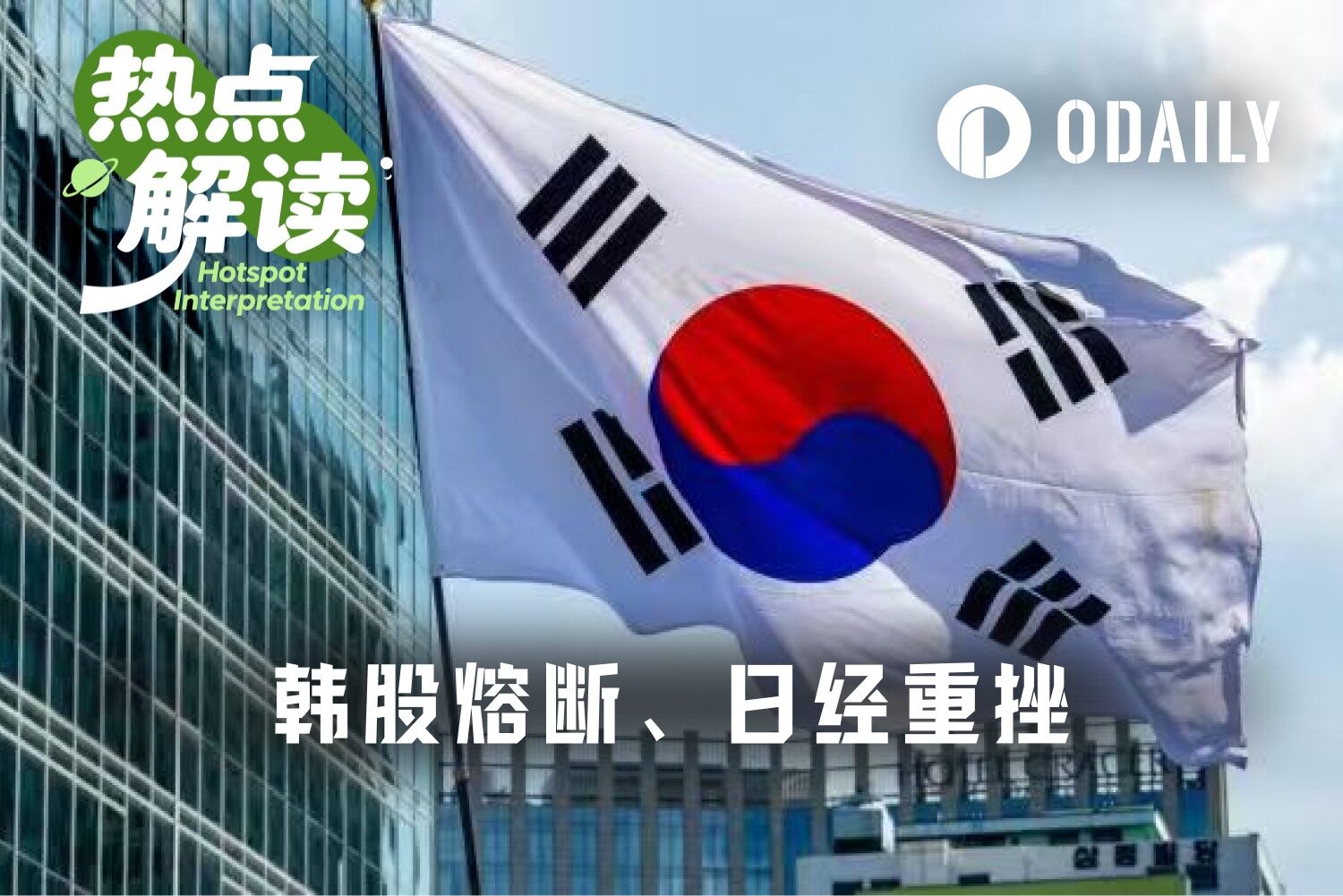
Today, Asian stock markets experienced severe turbulence.
South Korea's KOSPI index plummeted over 8% intraday, triggering a market circuit breaker that halted trading for 20 minutes. It eventually closed down nearly 10% at 8,203.84 points, recording the third-largest single-day decline this year. Japanese stocks also came under pressure, with the Nikkei 225 index falling about 3.5% to close near 69,788 points, ending its eight-day winning streak; the TOPIX index fell about 2.6%.
This correction was heaviest in the tech sector, especially the semiconductor segment, with heavyweight stocks like Samsung Electronics and SK Hynix leading the decline, dragging down the entire market. Foreign capital accelerated sell-offs, trading volumes surged, and market panic sentiment significantly intensified.

Since June, Japanese and South Korean stock markets have been experiencing frequent sharp fluctuations. The Korean stock market has triggered circuit breakers four times this year. Previously driven by the AI and semiconductor boom, the KOSPI had neared its all-time high of 9,385 points, and the Nikkei 225 had briefly stood above 70,000 points. The drastic reversal from record highs to a significant pullback within just a few weeks highlights market fragility and profit-taking pressure. Odaily will analyze the situation from three aspects: market performance, underlying causes, and future outlook.
1. Market Plunge: From Record Highs to Circuit Breaker Alarms
At the opening on June 23, the KOSPI started high at 9,083.54 points and briefly surged to 9,175.45 points intraday. However, driven by foreign sell-offs and follow-on selling, the index rapidly nosedived. Around 2:33 PM, as the decline exceeded 8%, the Korea Exchange (KRX) triggered its circuit breaker mechanism, suspending trading of all KOSPI-listed stocks for 20 minutes. Similar mechanisms had already been activated on multiple days in June, like the 5th and 8th, indicating that volatility has become the norm.
At the close, the KOSPI stood at 8,203.84 points, a single-day drop of 9.99%, with trading volume surging to 48.371 billion shares. Semiconductor giants SK Hynix and Samsung Electronics led the declines, both falling over 12%. The KOSDAQ index proved even more fragile, concurrently dropping over 6%, with small-cap tech stocks falling collectively. Net selling by foreign investors was significant, becoming the main source of selling pressure.

The Japanese market's reaction was relatively moderate but still noteworthy. The Nikkei 225 index fell over 3% intraday, closing around 69,788 points, a single-day drop of about 3.47%. The TOPIX index also declined. Tech and semiconductor-related stocks performed the worst: SoftBank Group fell over 10%, chipmaker Kioxia plunged 15.1%, and Tokyo Electron dropped 6.2%. The AI and semiconductor sectors that had previously powered the Nikkei's rally underwent a broad correction, ending an eight-session winning streak.
Compared to recent highs, the magnitude of this correction is significant. The KOSPI has retreated over 12% from its mid-June peak, and the Nikkei 225 has seen a notable pullback from above 70,000 points.
The global market correlation was evident. US tech stocks came under collective pressure overnight, with the Nasdaq falling over 1% and the S&P 500 edging lower. Rotation was observed among the "Magnificent Seven," with Amazon and Meta leading the decline. Other Asian markets, like Taiwan's, were also affected, creating a regional tech stock sell-off.
Overall, this was a rapid and severe correction led by the tech sector, with the Korean market suffering far steeper declines than Japan due to its higher concentration.
2. Cause Analysis: A Phase Rupture of the AI Bubble Under Multiple Overlapping Factors
The sharp decline in Japanese and South Korean stock markets is the result of multiple factors interacting. It can be analyzed from the perspectives of direct triggers, macroeconomic policy pressures, and structural risks.
1. Direct Triggers: Overnight Weakness in US Tech Stocks and Profit-Taking Pressure
The clear correction in the US tech sector during the previous trading session directly transmitted to Asian markets. The Nasdaq fell over 1.2%, with significant internal rotation among the 'Magnificent Seven', putting substantial pressure on some individual stocks.
Lisa Shalett, Chief Investment Officer at Morgan Stanley Wealth Management, noted: "There is distinct rotation among the Magnificent Seven. News of departures among some executives or analysts has heightened market concerns about the pace of AI commercialization. Investors are starting to demand more evidence that massive AI capital expenditures can translate into sustainable profitability."
This concern quickly spread to the Japanese and South Korean markets, which are highly dependent on the global AI supply chain. South Korean semiconductor exports have consistently accounted for over 20% of total exports for a long time. Samsung Electronics and SK Hynix together represent about 40% of the KOSPI's weighting. On June 23, these two giants fell approximately 8%-12%, directly dragging down the index.
Furthermore, Japanese and South Korean stock markets had accumulated substantial gains since June, resulting in extremely sizable unrealized profits (profit-taking pressure). The KOSPI surged from around 5,000 points at the start of the year to over 9,000 points by mid-June, with a maximum year-to-date increase exceeding 80%. The Nikkei 225 also rose from around 40,000 points at the start of the year to above 70,000 points, hitting an all-time high. Valuations were at elevated levels (KOSPI's forward P/E ratio briefly approached historical highs). Any negative catalyst could easily trigger profit-taking. The concentrated sell-off on June 23 was precisely a natural correction following the excessively rapid early gains.
2. Macroeconomic and Policy Factors: Rising Expectations of Fed Rate Hikes and Economic Data Impact
Strong recent U.S. employment data has further fueled market expectations that the Federal Reserve will maintain high interest rates or even raise them. According to Reuters, non-farm payrolls increased by 172,000 in May, far exceeding economists' expectations of 85,000, while the unemployment rate stabilized at 4.3%. This data prompted some institutions (like Goldman Sachs) to push back their expectations for the first rate cut to 2027. More critically, the Fed's FOMC meeting on June 16-17 decided to keep the federal funds rate unchanged in the 3.5%-3.75% range. The meeting statement emphasized that economic activity is expanding at a solid pace, but uncertainties arising from the Middle East conflict have increased, and inflation remains above the 2% target.
The Fed's latest dot plot released a clearly hawkish signal: the median federal funds rate projection for end-2026 was raised to 3.8% (a significant 0.4 percentage point increase from the 3.4% projected in March), suggesting at least one rate hike is possible within the year. Concurrently, the FOMC raised its inflation projections for 2026: the median core PCE inflation forecast rose to 3.3%, and headline PCE rose to 3.6% (both were previously around 2.7%); GDP growth forecasts were slightly lowered to 2.2%.
Rate-sensitive growth stocks (especially technology and semiconductors) bore the brunt. South Korean stocks, previously viewed as a typical 'high-beta' asset thanks to the AI boom, are extremely sensitive to changes in global liquidity. Japanese stocks are also constrained by global liquidity expectations, although improvements in domestic wage growth data provided some support.
This series of macro signals significantly pushed up U.S. Treasury yields and suppressed global risk assets, directly intensifying the selling pressure on Japanese and South Korean tech stocks.
3. Structural Risks: High Market Concentration and Foreign Capital Outflows
The structural vulnerability of the South Korean stock market is particularly pronounced. The KOSPI is highly dependent on the two semiconductor giants, Samsung Electronics and SK Hynix. Any fluctuation in the semiconductor cycle or global AI demand leads to violent index swings.
Persistent foreign capital outflows are another key factor. Foreign investors had accumulated significant profits during the earlier rally. Since June, they have been net sellers multiple times, especially in the Korean stock market, with some funds potentially rotating into US IPOs (like SpaceX) or other assets. On June 23, the net selling volume by foreign investors notably amplified, becoming the main source of selling pressure.
In contrast, while the Japanese market was also dragged down by tech stocks, its sector diversification is relatively higher, limiting the Nikkei 225's decline to around 3.5%.
Furthermore, company-specific dynamics exacerbated market pressure. According to market sources, SK Hynix recently adjusted its memory capacity allocation for AI chips (especially HBM), converting some production lines to higher-margin traditional DRAM to optimize short-term profitability. This move triggered investor concerns about the short-term supply-demand balance for HBM, sparking sell-offs.
3. Future Outlook: Short-term Volatility Unavoidable, Long-term AI Narrative Remains Resilient
Looking ahead, Japanese and South Korean stock markets are expected to exhibit characteristics of "consolidation with fluctuations and structural divergence." Short-term market volatility will remain high. However, long-term fundamental support persists, and the correction might actually offer a window for deploying capital into quality assets.
Focus on short-term volatility; recovery depends on US stocks and Fed signals. In the short term, the market remains in a highly volatile adjustment period. The performance of US tech stocks is the key bellwether. If the Nasdaq stabilizes or sees a technical rebound, the Japanese and South Korean markets are likely to follow with a recovery. Conversely, if the Fed releases further hawkish signals or Q2 earnings reports from Japanese and South Korean companies disappoint, the correction could extend or deepen. Key events to watch include:
- US inflation (CPI/PCE) and employment data for June-July;
- The Fed's next FOMC meeting (July);
- Q2 results from heavyweight stocks like Samsung Electronics, SK Hynix, and Tokyo Electron.
Strong long-term fundamentals, corrections present opportunities. Global AI capital expenditure continues to grow rapidly, and the fundamental logic of the semiconductor super-cycle remains unchanged. According to forecasts from Goldman Sachs and other institutions, cumulative global AI-related capital expenditure (computing, data centers, electricity) is projected to reach approximately $7.6 trillion from 2026 to 2031. AI CapEx alone in 2026 is expected to be close to $765 billion, climbing steadily to $1.6 trillion by 2031. New data center capacity is expected to add nearly 100GW between 2026 and 2030, with total investment reaching a scale of roughly $3 trillion.
South Korea holds a solid leading position in HBM and advanced process technology. SK Hynix's HBM market share has consistently been maintained between 50% and 62%, and it could achieve a supply share of around 70% for NVIDIA's Rubin platform in the HBM4 era. Samsung Electronics is also accelerating capacity expansion, planning to increase HBM production capacity by about 50% in 2026. The long-term orders for these two giants are largely locked in until 2027, indicating that the super-cycle for AI memory demand is still in its early stages.
From a long-term perspective, AI remains a transformative productive force changing the world's landscape. Periodic adjustments are unlikely to reverse the overarching trend of technological progress. Just like corrections following every past tech bubble, they ultimately paved the way for substantial returns for true infrastructure builders and innovators. This "Black Tuesday" might well be the turning point where AI investment shifts from frenzy to rationality, from hype to implementation. The resilience and potential of the Japanese and South Korean stock markets still merit anticipation.