Gate Research: Directional Trading in Time Windows, Gate Event Contracts Expand from Crypto to Stocks


- Core Viewpoint: Time-slice markets combine price direction, fixed time windows, and outcome settlement, transforming continuous market movements into binary events that can be individually priced and settled. They possess both the information aggregation function of prediction markets and the short-cycle trading attributes of financial markets, and their long-term value depends on settlement fairness, liquidity, and compliance development.
- Key Elements:
- Contract prices reflect the market's collective judgment but are not equivalent to objective probabilities; they also include market makers' risk compensation, liquidity discounts, and trading costs.
- From May to October 2026, Polymarket's 5-minute crypto up-or-down markets recorded cumulative trading volume of approximately USD 1.866 billion, while Predict.Fun recorded approximately USD 481 million, with the latter's October trading volume share rising to 47.93% and trade count share reaching 52.65%.
- Predict.Fun's average trade size was approximately USD 9.69, lower than Polymarket's USD 12.95, indicating a high-frequency, small-amount structure.
- Gate event contracts cover BTC and ETH across 5-minute to 4-hour cycles, adopt Chainlink TWAP settlement, have a price range of 0.01 to 0.99 USDT, and involve no leverage and no forced liquidation.
- Assets in TradFi 15-minute markets are concentrated in QQQ, MU, NVDA, and others, with the top four instruments accounting for approximately 66.9% of the sample, indicating uneven liquidity distribution.
- Second-level markets face fairness challenges such as data latency, timestamp precision, and selection of settlement sources, while the proportion of spreads and slippage rises significantly.
- The expected return formula p-c shows that a trade has positive expectancy only when the true win rate is higher than the probability implied by the purchase price.
Summary
• The time-slice market combines price direction, fixed time windows, and outcome settlement, turning continuous price action into a series of binary events that can be individually priced, traded, and settled. Compared with general prediction markets, its underlying assets, tenors, and settlement rules are more standardized, and trading behavior is closer to short-cycle probability trading in financial markets.
• Short-cycle contract prices can reflect the market's collective judgment of an outcome, but prices are also affected by liquidity, market-maker risk compensation, inventory pressure, trading costs, and user risk preferences, and cannot be directly equated with objective probability.
• As time granularity continues to descend toward the second level, differences among data latency, order confirmation, server time, data-source time, and settlement time will more directly affect trading fairness. The impact of spreads, fees, and slippage in short windows will also rise further.
• Gate has productized short-cycle direction trading, covering 5-minute, 15-minute, 1-hour, and 4-hour up/down events for crypto assets such as BTC and ETH, and has further expanded into stock event contracts.
Introduction
The time-slice market is a trading form that combines price direction, fixed time windows, and outcome settlement. What users face is not a direction view without an expiration, but a clearly bounded binary question: at the end of a 5-minute, 15-minute, 1-hour, or 4-hour window, is the underlying price up or down relative to the window's starting point? Continuous price action is thereby divided into a series of events that can be individually priced, traded, and settled.
This type of market shares an institutional skeleton with general prediction markets: future outcomes are uncertain, participants express judgments through trading, contract prices aggregate dispersed information, and the correct side receives payout according to pre-set rules. The U.S. Commodity Futures Trading Commission (CFTC) summarizes event contracts as contracts with a defined event, limited outcomes, fixed payout, and an expiration time, with prices generally reflecting participants' collective judgment of the outcome.
The particularity of the time-slice market lies in its use of the short-term direction of financial asset prices as the event variable, standardizing tenors to minutes or hours, and relying on continuous price feeds, order books, data sources, and automated settlement systems to operate. Gate already covers 5-minute, 15-minute, 1-hour, and 4-hour direction events for crypto underlyings such as BTC and ETH, and has launched stock event contracts.
1. Concepts and Mechanisms: Time Itself Enters the Contract
1.1 From Continuous Prices to Discrete Events
In traditional spot trading, users buy an asset and sell it at some future point, with returns depending on the price change during the holding period. Time affects returns but usually does not directly constitute the outcome condition of a single trade. Perpetual contracts allow users to build positions around direction but have no fixed expiration; options include an expiration date, strike price, and premium, but their payoff functions are more complex.
The time-slice market writes a future period of fixed length into the product definition and gives a limited outcome at the end of the window. Let the underlying be asset X, the window start be t0, the window end be t1, the starting price be P0, and the settlement price be P1. If P1 is greater than or equal to P0, the outcome is Up; if P1 is less than P0, the outcome is Down. Traders do not need to first predict a specific target price; the focus shifts to judging the direction of sign(P1-P0).
This treatment compresses the decision dimension and lowers the barrier to understanding the product. Users typically only need to determine three variables: which underlying to trade; how long a period to choose; and whether to bet on up or down. Contract price and quantity determine the profit-and-loss structure, and settlement rules determine whether the outcome is valid. The time window is therefore no longer merely an observation interval on a price chart, but part of the contract's rights, risk boundaries, and final payout.
The time-slice market also changes how prices are expressed. Suppose the settlement value of one up share is 1 USDT and the market quote is 0.6 USDT; ignoring fees, spreads, and risk preferences for the moment, this price can be interpreted as the market's collective judgment of an up outcome being approximately 60%. But the price cannot be directly equated with objective probability, because it also includes market-maker risk compensation, inventory pressure, liquidity discounts, trading costs, and user risk preferences.
1.2 Settlement Sources, Timestamps, and Cycle Structure
The credibility of the time-slice market depends on settlement rules. P0 and P1 are not necessarily equal to the traded price at a certain second on a certain exchange; the platform needs to pre-specify the price source, sampling method, timestamp, time zone, handling of missing data, and boundary conditions. If a time-weighted average price is used, the impact of a single extreme trade on the final outcome is relatively limited; if a single-point price is used, settlement is closer to the market state at a certain moment but more susceptible to instantaneous liquidity and anomalous quotes.
Cycle length determines the market's microstructure. The 5-minute window is affected by breaking news, order-book imbalance, funding rates, futures basis, volume, and short-term arbitrage; the 15-minute window can absorb more trades and information; the 1-hour and 4-hour windows more easily reflect trends, macro events, and cross-market linkages. The shorter the cycle, the faster the feedback, and the higher the share of noise, spreads, and execution latency in returns.
The time window also determines the continuity of trading behavior. Continuously rolling 5-minute sessions may share most of a price path, and users will repeatedly adjust positions within the same stretch of price action, so the volume and prices of successive events are not independent of one another. The resulting market is closer to high-frequency trading along a continuous probability curve than to a set of unrelated guessing questions.
2. Boundaries with General Prediction Markets
2.1 Shared Institutional Skeleton
General prediction markets organize trading around the outcomes of future events. Events can be election results, sports matches, weather conditions, economic data, corporate announcements, or whether a financial asset rises within a certain period. Markets usually offer binary or multi-outcome results, users buy shares representing an outcome, prices are formed by order books or automated market-making mechanisms, and settlement is ultimately based on public rules.
The time-slice market shares four characteristics with them. First, both transform an uncertain future into tradable outcomes. Second, market prices perform an information-aggregation function, compressing dispersed judgments into dynamic quotes. Third, the correct side usually receives a fixed or pre-agreed payout, while the wrong side loses its settlement value. Fourth, market credibility depends on clear event definitions, trusted data sources, independent settlement rules, and stable dispute-resolution mechanisms.
From an information-function perspective, the value of prediction markets comes not only from trading returns but also from concentrating dispersed knowledge into an observable price. The CFTC's public explanation treats event contracts as market tools that can be used for prediction, risk management, and information aggregation. Polymarket's product documentation also interprets the price of outcome shares as the market's instantaneous expression of the probability of an event occurring, while emphasizing that prices are determined by supply and demand and are not equivalent to fixed odds provided by the platform.
2.2 Five Key Differences
First, the event variable differs. The event variables of general prediction markets come from politics, sports, weather, policy, and economic data, with financial prices being just one of many event types. The time-slice market directly uses the direction of the underlying price relative to its starting point as the event variable, and the event is highly isomorphic with financial price action.
Second, the tenor structure differs. The tenor span of general prediction markets can extend from a few minutes to several years, and users may wait for a match, an official data release, or an election result. The main feature of the time-slice market is standardized short cycles; sessions can be generated continuously, and users receive outcome feedback quickly.
Third, the settlement data differs. Political or sports markets usually wait for official institutions, event organizers, or public documents to confirm results and may face textual interpretation and confirmation delays. Financial direction markets rely on indices, exchange prices, oracle data, or specified weighted prices, and therefore need to address data synchronization, time zones, trading sessions, trading halts, and anomalous quotes.
Fourth, the skill structure differs. General prediction markets rely on news gathering, event knowledge, and factual judgment; the time-slice market relies more on reading price action, analyzing order books, understanding volatility, execution speed, and capital discipline. The shorter the window, the more prominent the influence of market microstructure relative to macro narratives.
Fifth, the risk profile differs. The main risks of general prediction markets include vague event definitions, information asymmetry, insufficient liquidity, and settlement disputes. The time-slice market also bears behavioral risks brought by high noise, high turnover, and continuous outcome feedback. Users easily mistake a series of short windows for repeated arbitrage opportunities while underestimating the cumulative impact of spreads, fees, slippage, and wrong judgments.
Therefore, the time-slice market can be regarded as a more financialized sub-direction within general prediction markets. It retains the outcome pricing and information aggregation functions of prediction markets while making the underlying, time, and settlement rules into more standardized trading products.
3. Trading Structure of Short-Cycle Prediction Markets: On-Chain and Centralized Platforms
3.1 The 5-Minute Market: Predict.Fun Moves from Marginal Share to Nearly Half of Volume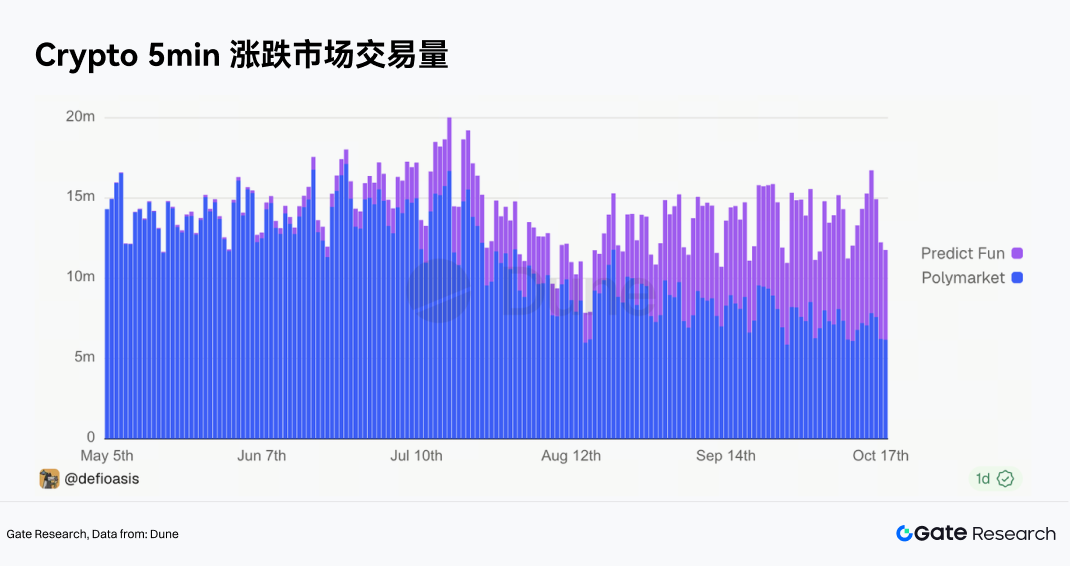
Between May 5 and October 18, 2026, Polymarket's 5-minute crypto up/down market had cumulative trading volume of approximately $1.866 billion, cumulative trades of approximately 144.2 million, average daily trading volume of approximately $11.18 million, average daily trades of approximately 863,300, and average daily unique traders of approximately 13,000; Predict.Fun had cumulative trading volume of approximately $481 million, cumulative trades of approximately 49.6 million, average daily trading volume of approximately $2.88 million, average daily trades of approximately 297,000, and average daily unique traders of approximately 5,138.
The two platforms' combined trading volume was approximately $2.347 billion. Calculated by cumulative trading volume, Predict.Fun accounted for 20.5%; by cumulative trades, approximately 25.6%; and by the sum of daily unique trader counts, approximately 28.3%. Predict.Fun's share rises step by step from capital scale to trade count and then to participant counts, indicating that its users have a lower average trade size and higher trading frequency. Polymarket's average trade size was approximately $12.95, and Predict.Fun's approximately $9.69. Predict.Fun's volume share is lower than its trade-count share, indicating that it has formed a stronger high-frequency, small-amount usage structure rather than gaining share through a small number of large capital flows.
The speed of change in platform share explains what is happening in the 5-minute market better than the total. In May, Predict.Fun's trading volume share was only about 0.72%; it rose to 4.31% in June, reached 16.46% in July, 24.59% in August, 40.46% in September, and further rose to 47.93% in the first 18 days of October. The change in trade-count share was even faster, reaching 52.65% in October. Over the same period, Polymarket still maintained a larger cumulative scale, but its monthly trading volume fell from approximately $373 million in May to $128 million in the first 18 days of October; Predict.Fun rose from approximately $2.706 million in May to approximately $117.8 million in October. Looking only at the total, the market is still dominated by Polymarket; however, in terms of market share, the competitive landscape has shifted from a single platform accounting for the vast majority of activity to two platforms jointly absorbing short-cycle demand.
Trading peaks also show changes in platform structure. Polymarket's highest single-day trading volume was approximately $17.12 million, on June 25; Predict.Fun's highest single day was approximately $8.9 million, on October 15; the combined single-day trading volume peak of the two was approximately $20.03 million, on July 17. Predict.Fun's peak occurred later, and its trade count in October had already surpassed Polymarket's, indicating that its growth was not simply replicating the early capital scale but first accumulating order flow through higher frequency and lower average trade size. For platform competition, whether users can form a continuous trading habit is more decisive for subsequent share.
3.2 The 15-Minute Market: Polymarket Leads, Predict.Fun Accelerates in the Later Stage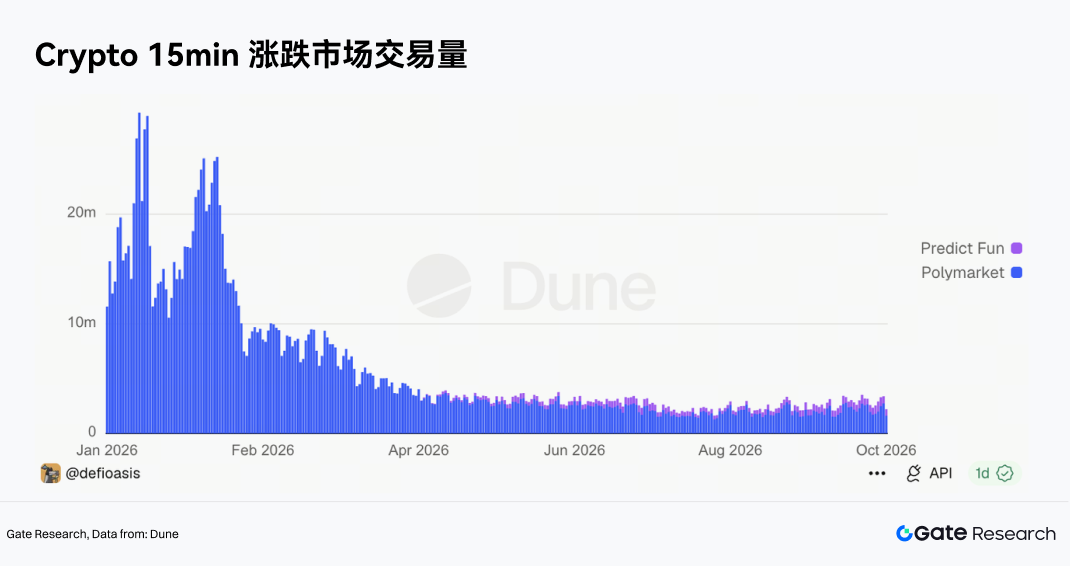
Since the beginning of 2026 to date, Polymarket's 15-minute crypto up/down market has had cumulative trading volume of approximately $1.754 billion, cumulative trades of approximately 118.8 million, average daily trading volume of approximately $6.027 million, average daily trades of approximately 408,300, and average daily unique traders of approximately 7,063. Predict.Fun has had cumulative trading volume of approximately $75.97 million, cumulative trades of approximately 8.3 million, average daily trading volume of approximately $261,000, average daily trades of approximately 28,500, and average daily unique traders of approximately 1,194.
Predict.Fun launched its 15-minute market on April 26, after which trading activity gradually expanded. Its average trade size was approximately $9.15, versus approximately $14.76 for Polymarket. As with the 5-minute market, Predict.Fun's trade-count share is higher than its volume share, indicating that its participants favor small-amount, intensive short-cycle trading; the difference is that the first-mover advantage in the 15-minute market is more obvious, and Predict.Fun has not yet formed the same scale of capital-carrying capacity as Polymarket.
The monthly changes in the 15-minute market show a two-stage structure. At the beginning of the year, Polymarket's trading volume was concentrated in January and February, at approximately $523 million and $442 million respectively, then fell to approximately $254 million in March, and was approximately $56.32 million and $57.77 million in August and September respectively. Predict.Fun had only approximately $204,000 in April, rising to approximately $7.71 million in May, approximately $17.07 million in July, approximately $15.64 million in September, and approximately $12.07 million in the first 18 days of October. Predict.Fun's monthly trading volume share rose from 0.15% in April to 21.31% in September, and further reached 22.81% in October; its trade-count share reached 34.31% in October. Predict.Fun is in a catch-up phase in the 15-minute market, but its order frequency is growing faster than its capital share, and a clear short-term orientation has already appeared in its user structure.
Putting the two cycles together, it can be seen that platform competition is related to time granularity. The 5-minute market provides faster trading feedback, and Predict.Fun quickly gained trade-count and trader share in the latter half of the sample; the 15-minute market has a larger historical cumulative scale, and Polymarket's early accumulation remains evident. A platform's advantage is not replicated simultaneously across all cycles; users' preferences for cycle length, settlement frequency, and trading costs will produce different competitive outcomes.
3.3 The On-Chain TradFi 15-Minute Market: Asset Expansion Starts with Highly Liquid Underlyings
Predict.Fun launched a TradFi 15-minute up/down market for stock and commodity direction markets on August 13, 2026, with an average trade size of approximately $10.12.
The asset distribution shows that the TradFi short-cycle market has not yet formed a balanced product structure. QQQ had cumulative trading volume of approximately $159,700, accounting for 21.1%; MU approximately $128,000, accounting for 16.9%; NVDA approximately $110,100, accounting for 14.6%; and SPCX approximately $108,200, accounting for 14.3%. The top four assets together accounted for approximately 66.9% of sample trading volume, and the two ETFs QQQ and SPY together accounted for approximately 30.3%. Early demand was more concentrated in index-type products, well-known tech stocks, and underlyings that already had high market attention; the expansion in the number of assets did not equate to an even spread of trading demand.
In addition, the cumulative scale of newly added assets is still generally small, indicating that TradFi products need to first rely on highly liquid, highly recognizable underlyings to establish order flow, and then direct user attention toward the longer tail of assets. For platforms, stocks, indices, and commodities share the same trading interface, but this does not mean they can obtain the same liquidity; underlying recognition, trading sessions, and price volatility characteristics will directly determine market depth.
3.4 A Rule Sample of Gate Event Contracts
Gate event contracts turn the same type of short-cycle direction trading into a platformized product. Official materials show that Gate's first batch of crypto event contracts covers underlyings such as BTC and ETH, supporting 5-minute, 15-minute, 1-hour, and 4-hour cycles. Users choose up or down and buy shares through the order book; after the event ends, the correct direction is settled according to the rules, and shares in the wrong direction lose their settlement value. The contract price range is 0.01 to 0.99 USDT, winning shares settle at 1 USDT, and the product does not provide leverage, nor does it involve margin calls or forced liquidation due to price