Gate Research: Crypto Cards Monthly Trading Volume Surpasses $1 Billion, Gate Card Connects Multi-Account Payment Scenarios


- Key Takeaways:The crypto payment card market has entered a phase of explosive growth, with cumulative transaction volume surpassing $10 billion and July 2026 monthly volume exceeding $1 billion. RedotPay leads the market landscape, while Gate Card leverages its exchange ecosystem and capital synergy advantages to compete.
- Key Elements:
- Market Scale Data: Transaction volume reached $828 million in 2024, growing to $3.802 billion in 2025 (a 359% year-over-year increase), and has already reached $5.482 billion in the first seven months of 2026, demonstrating significant growth momentum.
- Competitive Landscape: RedotPay holds a 56% market share with cumulative volume exceeding $6 billion; Ether.fi and KAST follow with $754 million and $684 million respectively, indicating a fairly concentrated market.
- Product Model Evolution: The industry is transitioning from pre-funded models to four types of fund mechanisms — instant conversion, stablecoin backend settlement, smart contract debiting, and collateral-based credit. Capital efficiency and asset control have become key differentiators.
- Gate Card Competitiveness: Supports connecting Gate Pay, Spot, and Simple Earn balances as payment sources, enabling both instant spending and prepaid modes, while binding high-frequency users through a six-tier cashback system (T0 to T5, up to 8%).
- Ecosystem Synergy Advantage: Gate Card benefits from the exchange account system, asset liquidity, and the integration of trading, wealth management, and payment products, allowing users to shorten the path from holding assets to spending without redundant transfers.
Executive Summary
• The cumulative transaction volume of Crypto Cards projects has surpassed $10 billion, with monthly volume exceeding $1 billion and over 10 million transactions in July 2026. Full-year 2025 transaction volume reached approximately $3.802 billion, representing year-over-year growth of roughly 359%.
• The market exhibits high concentration. RedotPay's cumulative transaction volume exceeds $6 billion, accounting for approximately 56% of the tracked market. Ether.fi, KAST, MetaMask, and Gnosis Pay have entered the market through collateralized credit lines, stablecoin accounts, and self-custodial payments, respectively.
• Crypto Cards primarily employ models such as prepaid top-up, instant conversion, stablecoin settlement, smart contract debiting, and crypto-collateralized credit. Product differentiation centers on fund control, conversion costs, payment reliability, issuing regions, and refund handling.
• Gate Card adopts a multi-region, multi-card product structure, connecting to payment accounts, spot accounts, and Simple Earn flexible-term balances. It offers instant spending, prepaid modes, and tiered cashback ranging from T0 to T5. Its advantages stem from the Gate account ecosystem, asset liquidity, and synergies between trading, wealth management, and payment products.
Crypto Cards represent a product suite that bridges digital asset accounts with bank card payment networks. Users can fund payments with stablecoins, BTC, ETH, exchange-issued tokens, or on-chain yield-bearing assets, transacting with merchants through networks such as Visa and Mastercard. Merchants typically receive settlement in USD, EUR, or local fiat currencies, while asset conversion and fund clearing are handled in the background by crypto platforms, wallet providers, card issuers, and partner banks.
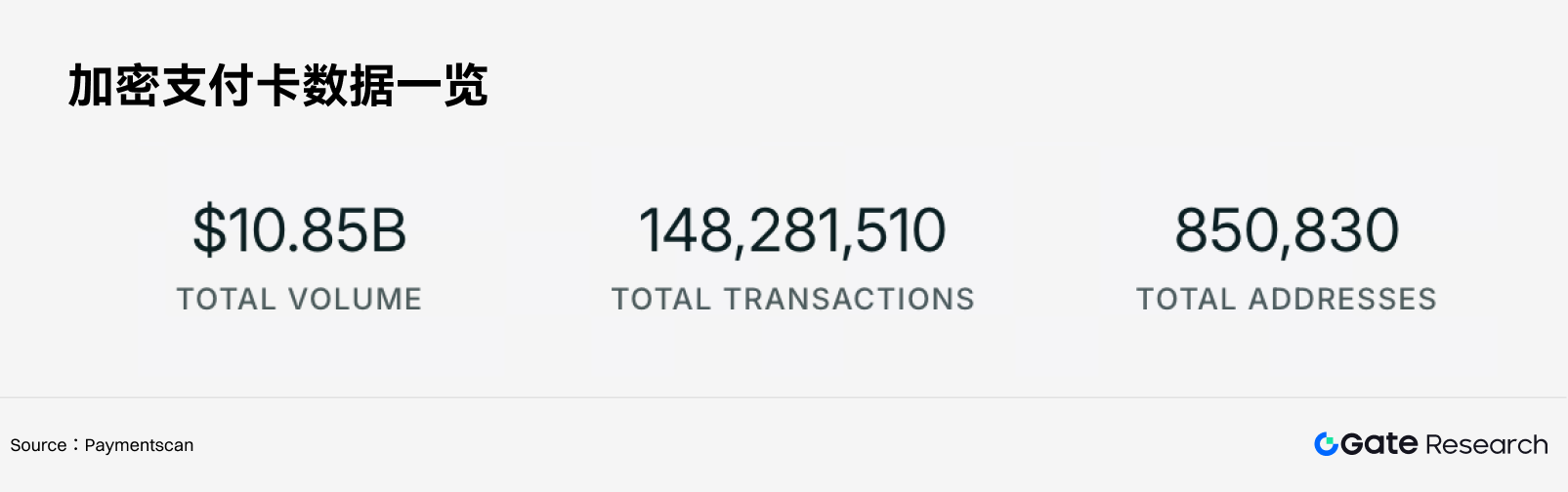
According to Paymentscan data, since March 2023, the cumulative transaction volume of Crypto Cards projects has surpassed $10 billion. Monthly transaction volume has grown from tens of millions of dollars to over $1 billion in July 2026. Monthly transaction counts have correspondingly risen from just over 500,000 to over 10 million, with monthly active addresses exceeding 260,000 and total addresses surpassing 850,000.
On a full-year basis, transaction volume was approximately $828 million in 2024, rising to roughly $3.802 billion in 2025, a year-over-year increase of about 359%. The cumulative volume for the first seven months of 2026 reached approximately $5.482 billion, already exceeding the full-year 2025 figure. July 2026 volume grew approximately 206% compared to July 2025, marking the entry of stablecoin cards into the billion-dollar-per-month transaction phase.
Market concentration remains high. RedotPay's cumulative transaction volume exceeds $6 billion, representing roughly 56% market share. Ether.fi and KAST have reached approximately $754 million and $684 million respectively, with the top three projects collectively accounting for nearly 69% of the market. RedotPay has established scale advantages through stablecoin accounts, broad regional coverage, and high-frequency small-ticket spending. Ether.fi, MetaMask, and Gnosis Pay focus on self-custody, smart contract accounts, collateralized credit, and yield-bearing asset spending. KAST represents a product路线 combining stablecoin financial accounts with bank card functionality.
It is evident that product competition has extended to capital efficiency, fees, regional coverage, payment stability, and asset control. First-generation Crypto Cards predominantly adopted a prepaid top-up model, where users first sold digital assets and then spent fiat balances. Newer-generation products have shifted toward automatic conversion at the point of sale, backend stablecoin settlement, smart contract debiting, and crypto-collateralized credit. Users can keep a portion of their funds participating in on-chain yield or platform wealth management products while retaining spending capability.
Gate Card is a series of crypto payment card products launched by Gate for different markets, combining platform accounts with payment cards. Specific cards may adopt instant spending or prepaid modes and are connected to the Visa network through various issuing institutions. In instant spending mode, users can select Gate Pay, spot accounts, or Simple Earn flexible-term balances as funding sources. In prepaid mode, users can convert assets into card fiat balances. The product supports virtual cards, physical cards, and the Visa network, with cashback tiers from T0 to T5, offering up to 8% cashback on eligible transactions.
Gate Card's competitive foundation derives from the account ecosystem, trading liquidity, and product synergies of Gate, a leading exchange. Users who already hold assets on Gate can avoid repeatedly transferring funds to external card platforms or completing multiple conversions in advance. The payment gateway can connect directly to spot, wealth management, and Gate Pay balances, shortening the path from holding digital assets to real-world spending.
I. Global Market Size and Competitive Landscape
1.1 Market Size Entering an Accelerated Expansion Phase
Crypto Cards monthly transaction volume remained at relatively low levels in 2023. Volume was approximately $9.27 million in December 2023, grew to $153.4 million by December 2024, reached $521.2 million in December 2025, and rose to $1.038 billion in July 2026.
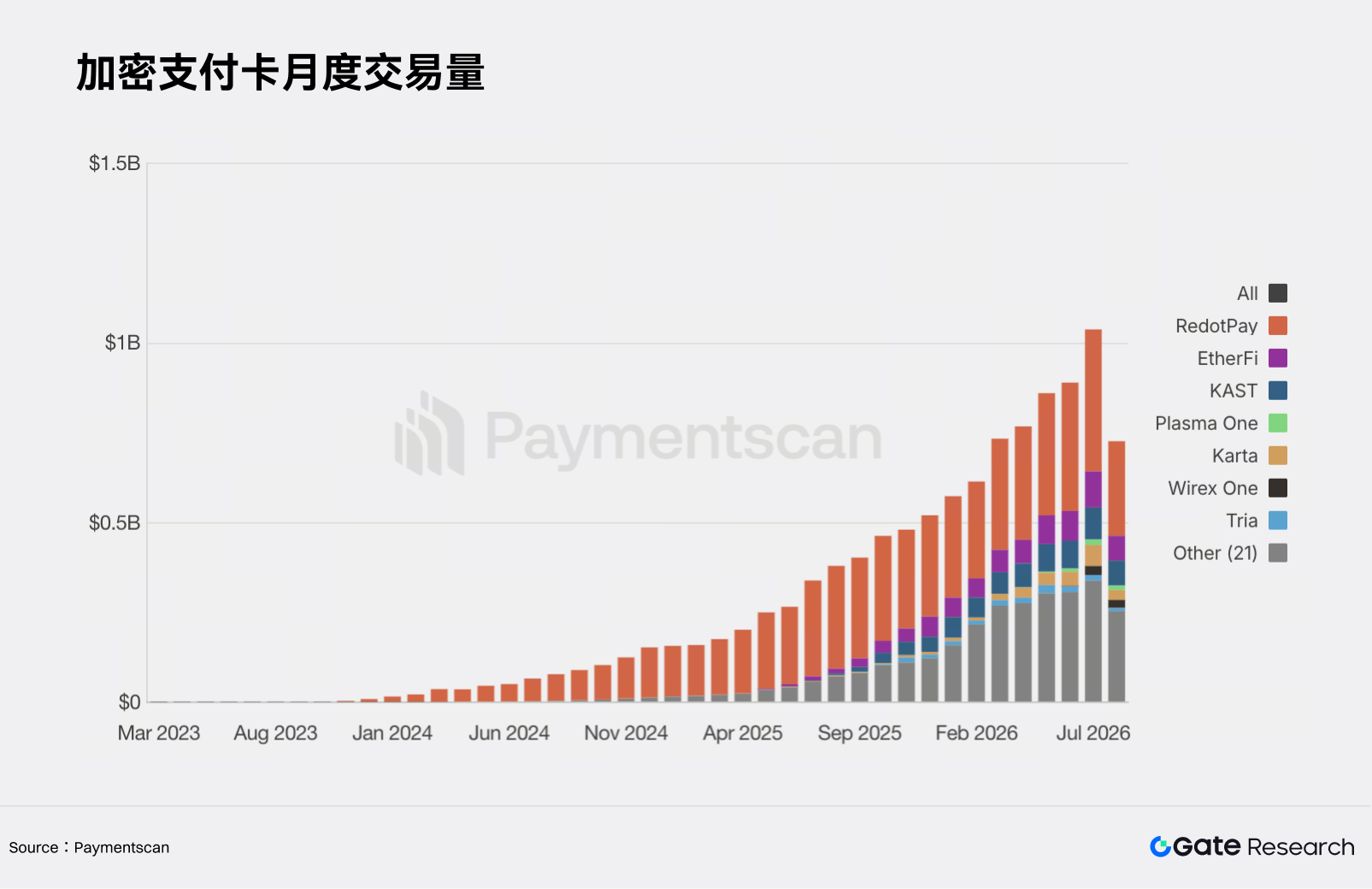
The increase in transaction counts is equally pronounced. January 2024 saw approximately 540,000 transactions, rising to 2.78 million in January 2025, 7.41 million in January 2026, and exceeding 10.51 million in July 2026. Based on July 2026 transaction volume and count, the average transaction size approaches $100.
Average transaction size indicates that Crypto Cards have expanded beyond everyday retail to cover spending categories including hotels, airfare, electronics, software subscriptions, advertising expenses, and cross-border bills. Virtual cards and mobile wallets have lowered barriers to online and contactless payments, while physical cards cover ATM withdrawals, hotel pre-authorizations, car rentals, and traditional offline terminals.
Market expansion is driven by five categories of demand:
• Stablecoin holders seeking direct spending channels;
• Cross-border workers needing to connect on-chain income with local living expenses;
• Crypto platforms aiming to increase account usage frequency;
• Wallet projects seeking to bring self-custodied assets into real-world spending;
• Enterprises and Web3 teams requiring stablecoin treasury and business expense management tools.
Crypto Cards have transformed crypto assets from trading and store-of-value instruments into high-frequency consumption vehicles. Payment behavior increases platform daily active users, asset retention, and user stickiness, while generating interchange fee sharing, conversion revenue, membership income, and cross-selling opportunities for issuers.
1.2 Market Participants
Based on incomplete statistics, at least 250 projects or companies are currently involved in the Crypto Cards space.
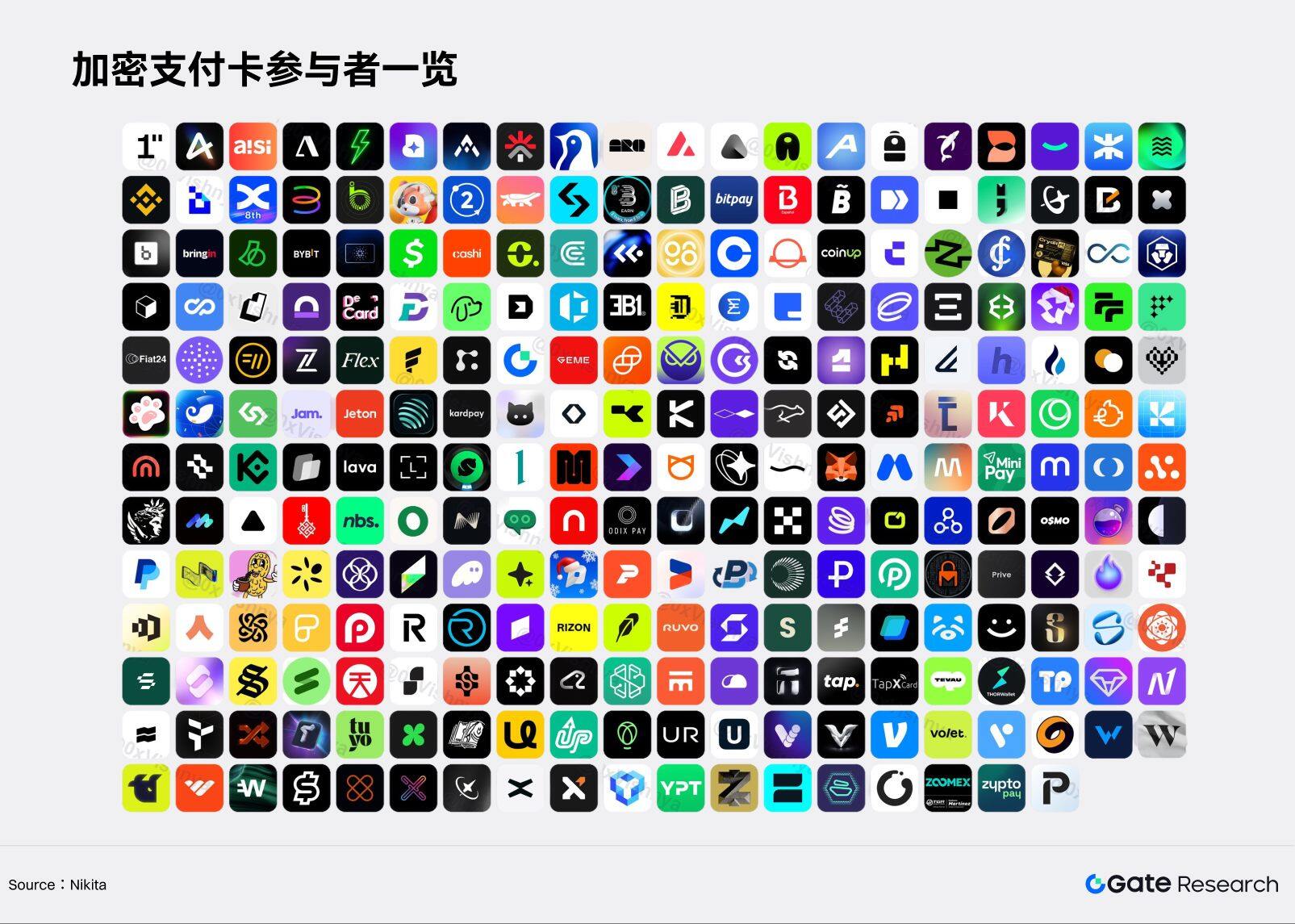
Based on the nature of the underlying company or sector, Crypto Cards can be broadly categorized into three types of participants.
The first category comprises exchanges and centralized platforms. Representative products include Gate Card and certain exchange co-branded cards. Advantages include user base, trading liquidity, multi-asset support, and unified account experience. Limitations primarily stem from custody risk, regional regulation, and platform account restrictions.
The second category includes wallet and on-chain financial projects. Representative products include MetaMask Card, Gnosis Pay, and Ether.fi Cash. Advantages include self-custody, on-chain transparency, smart contract permissions, and DeFi composability. Users must understand wallet security, contract authorization, gas fees, and collateralization risks.
The third category encompasses stablecoin account and payment fintech companies. RedotPay and KAST are representative. These products emphasize stablecoin balances, cross-border funds, and bank card spending. They are typically more payment-focused than exchange cards while being closer to conventional financial applications than on-chain cards.
Additionally, the industry has a layer of issuance infrastructure. Institutions such as Rain, Bridge, Wirex, UR, Kulipa, and Immersve provide card issuance, settlement, or payment processing capabilities for multiple card brands. Paymentscan data shows that KAST, Karta, Tria, and certain other projects utilize Rain-related issuance infrastructure, while MetaMask Card partners with Baanx, Monavate, and Mastercard.
The concentration of issuance capabilities has lowered entry costs for new brands while creating partner dependencies. Brand owners must differentiate through product experience, compliance, liquidity, and user operations, while issuance infrastructure providers hold banking relationships, card network access, and regional expansion capabilities.
1.3 RedotPay Establishes Scale Leadership
RedotPay entered a rapid growth phase in late 2023, with cumulative spending exceeding $6 billion and cumulative transactions surpassing 100 million. Monthly spending was approximately $139.8 million in December 2024, rising to $282.2 million in December 2025, and reaching $395.1 million in July 2026, with monthly transactions of approximately 6.205 million in the same period.
RedotPay's product positioning targets a broad base of stablecoin users. Users can apply for virtual or physical cards, use crypto assets for card spending, and connect to mobile wallets including Apple Pay and Google Pay. Broad coverage, relatively standardized products, and a stablecoin account experience have helped attract a large base of high-frequency users.
Scale advantages come with certain fees. RedotPay's official help center shows a virtual card issuance fee of $10 and a physical card issuance fee of $100. Crypto asset conversion fees are approximately 1%, with a potential 1.2% fee when transacting in non-card-denominated currencies. Physical card ATM withdrawal fees are typically 2%, with a 3% fee applicable to certain high-value withdrawals. Merchant refunds typically do not return conversion or transaction fees incurred at the time of payment.
RedotPay suits users who prioritize regional availability, stablecoin balances, and spending convenience. For price-sensitive users or those frequently transacting across currencies, conversion fees, foreign exchange fees, and ATM fees can significantly impact total costs.
1.4 Ether.fi and KAST Accelerate Growth
Ether.fi Cash began scaling in 2025, with cumulative transaction volume of approximately $754 million and roughly 9.51 million transactions. Monthly volume was approximately $10.82 million in July 2025, growing to $100.3 million by July 2026, an increase of over eight-fold in twelve months. Active addresses exceeded 40,000 in the same month.
Ether.fi Cash integrates payment cards, on-chain assets, and collateralized borrowing into a single product. Users can utilize USDC, USDT, EURC, ETH, WETH, weETH, eBTC, eUSD, and certain yield-bearing assets to fund payment balances or support borrowing. The product's growth demonstrates that a segment of crypto users is willing to adopt more complex structures in exchange for asset control, yield, and credit access.
KAST's cumulative volume is approximately $684 million, with monthly volume of roughly $2.18 million in July 2025, reaching $89.6 million by July 2026. KAST offers 2% base cashback, up to 3% maximum cashback, supports Apple Pay and Google Pay, with foreign exchange fees of approximately 0.5% to 1.75% and ATM fees of $3 plus 2%.
KAST positions a stablecoin financial account as its product entry point, emphasizing the integration of receiving, holding, converting, and spending. Its growth indicates that Crypto Cards user needs are expanding to include account functionalities such as salary receipt, cross-border transfers, stablecoin savings, and multi-currency treasury management.
1.5 Regional Markets Exhibit Distinct Demand Structures
Europe formed an early cluster of Crypto Cards products. SEPA transfers, multi-country cross-border spending, euro settlement, and the electronic money institution framework provided conditions for product issuance. MetaMask Card covers multiple European Economic Area countries as well as Switzerland and Monaco. Gate Card's early European version expanded to 29 EEA countries.
Latin America places greater emphasis on USD stablecoin value storage, cross-border income utilization, and international online payments. MetaMask Card has expanded to markets including Argentina, Brazil, Chile, Colombia, Mexico, and Uruguay. For local users, Crypto Cards can reduce stablecoin conversion costs and banking transfer steps.
The US market possesses mature bank card, mobile wallet, and credit infrastructure, with correspondingly higher entry requirements. Gate US launched the US version of Gate Card in July 2026. This product is a prepaid Visa debit card issued by Lead Bank, with Bridge serving as program manager and stablecoin infrastructure partner, while Gate US handles platform onboarding, customer compliance, risk management, and transaction monitoring. Users can fund payments with supported assets such as USDC, with the system completing USD conversion at the time of transaction.
Asia-Pacific, the Middle East, and Africa exhibit strong cross-border payment and stablecoin demand, but regulations governing crypto assets, card issuance, and foreign exchange management vary significantly across countries. A product being usable at local merchants does not necessarily mean local residents can apply. Application regions, spending regions, and issuing regions must be verified separately.
II. Card Types, Funding Models, and Use Cases
Crypto Cards products can be analyzed across two dimensions: card type and funding model. Card type is determined by the issuing institution, account structure, and credit relationship. The funding model describes how user assets are converted into available payment balances. There is no fixed correspondence between the two, and a single product may support multiple funding models simultaneously.
2.1 Card Types
2.1.1 Debit Card
Debit Cards deduct from the user's available funds and do not provide revolving credit. Payment amounts typically come directly from fiat balances, stablecoin balances, platform accounts, or wallet assets. Transactions are declined when account balances are insufficient.
The primary difference between Crypto Debit Cards and traditional debit cards lies on the funding side. Traditional debit cards typically connect directly to bank deposit accounts. Crypto Debit Cards can connect to stablecoin accounts, exchange accounts, or self-custodial wallets, completing crypto asset conversion at the time of payment.
For example, MetaMask Card is a self-custodial Debit Card. User assets remain in the MetaMask wallet prior to payment, and selected assets are converted to the merchant's settlement currency at the time of transaction. Certain instant spending cards in the Gate Card product line exhibit similar debit characteristics.
Debit Cards suit daily spending, online shopping, stablecoin income utilization, and budget management. Users incur no borrowing interest, with primary costs deriving from asset conversion fees, foreign exchange fees, and transaction fees.
2.1.2 Credit Card
Credit Cards allow users to spend within a credit limit and repay according to billing statements or agreements. Credit limits can originate from traditional credit assessment or be collateralized by crypto assets.
The credit attribute in crypto credit cards is determined by the issuing and credit relationship. Some products may allow users to pay via collateralized borrowing while remaining legally or structurally classified as Debit Cards or Prepaid Cards.
For instance, Ether.fi Cash positions its product as a crypto-native Credit Card. Users can collateralize crypto assets to support credit limits, borrow USDC or EURC through Borrow Mode for card spending, with outstanding balances accruing interest at applicable rates. Users can defer repayment of spending balances but must bear borrowing interest, collateral ratio fluctuations, and potential liquidation risk.
Credit Cards are better suited to users with stable cash flow, substantial asset holdings, and familiarity with collateral management. Hotel pre-authorizations, car rentals, and travel bookings are also typically more readily accepted with credit cards.
2.1.3 Prepaid Card
Prepaid Cards require users to deposit funds into the card account before spending from the preloaded balance. User spending is limited by the available card balance, typically creating no credit liability and not directly connecting to traditional bank checking accounts.
Funding for Crypto Prepaid Cards can come from stablecoins, fiat obtained through crypto asset conversion, or platform account balances. Users complete top-up first, after which the issuing system records balances in the card's denominated currency.
The Gate US version is a prepaid Visa debit card issued by Lead Bank. Users fund the card with supported crypto assets, with related asset conversion and card balance management executed according to its US-specific card rules.
Prepaid Cards suit spending budget management, virtual card subscriptions, travel reserves, and corporate expense control. Limitations include the need for advance top-up, potential idle balances, and additional costs in top-up, conversion, and refund processes.
2.2 Funding Models
2.2.1 Instant Pay / Direct Pay
Instant Pay or Direct Pay models allow users to spend directly from platform accounts or wallets at the time of transaction. Upon receiving a card authorization request, the system checks balances, calculates the required amount, and completes digital asset deduction, conversion, and fiat settlement.
The operational flow can be summarized as:
Initiate payment → Check account assets → Determine conversion price → Deduct or freeze assets → Complete card authorization → Backend clearing
This model does not require users to maintain a separate card balance, reducing capital occupation from advance top-ups. Platforms must possess rapid quoting, account debiting, asset conversion, and settlement liquidity to meet bank card network authorization speed requirements.
Gate Card's multi-account payment functionality falls under this model. Users can select payment accounts, spot accounts, or Simple Earn flexible-term balances as funding sources, with deductions and conversions completed at the time of payment according to specific card rules. Gate lists supported assets including USDT, USDC, BTC, and ETH, with the actual range depending