






US Q3 Earnings Preview: Beats May Not Be Rewarded, Misses Will Be Punished More Harshly—Beware of Three "Hidden Profit Killers"


- Core View: US Q3 earnings appear strong on the surface, but profits are highly concentrated in a handful of tech giants. "Beats" no longer drive stock prices higher, and the market is stingy with rewards for good news while punishing bad news more severely. Cost erosion, doubts about AI monetization, and overly optimistic 2027 expectations constitute a triple hidden risk.
- Key Elements:
- Consensus expects S&P 500 Q3 EPS to grow 27% year-over-year. In early reports, 85% beat expectations, but beaters' next-day excess performance was only 0.7 percentage points—about half the historical average—while missers underperformed by an average of 3.3 percentage points.
- The top 10 earnings contributors are expected to account for 68% of the index's total earnings growth, with Micron and Nvidia alone making up 34%. The median stock's EPS growth is just 9%, a marked deceleration from 14% in Q2, with market breadth falling to its lowest since the dot-com bubble.
- Mentions of raw material costs have risen to their highest frequency since mid-2022, and retail gasoline prices are up about 30% year-over-year, creating direct cost pressure on retail, transportation, and industrial goods sectors.
- Hyperscale cloud providers' 2026 capex is expected to grow over 90% year-over-year, with capex already exceeding 100% of operating cash flow. Whether AI investments can be successfully monetized has become the core variable for earnings sustainability.
- Q2 EPS grew 50%, but excluding investment revaluation gains from Amazon and Google, actual growth drops to 32%. Earnings quality issues require a deeper look beyond headline figures.
- Consensus expects 16% EPS growth in 2027, while BofA forecasts only 12%. Historical data shows that when EPS growth is above trend but begins to decelerate, stock returns tend to be weakest.
Original author: Xu Chao
Original source: Wallstreetcn
The third-quarter earnings season for US stocks has officially begun. The overall data appears impressive, but beneath the surface of prosperity, undercurrents are stirring—earnings are highly concentrated, cost pressures are rising, and the market's tolerance for "beats" has dropped sharply.
According to the latest report from Bank of America Securities, consensus expectations for this season project S&P 500 third-quarter earnings per share to grow 27% year-over-year, while BofA's own forecast is even higher at 32% (corresponding to $93.50 per share). Among early reporters, 85% exceeded EPS expectations, above the historical average of 71%, and the macroeconomic backdrop remains broadly favorable.
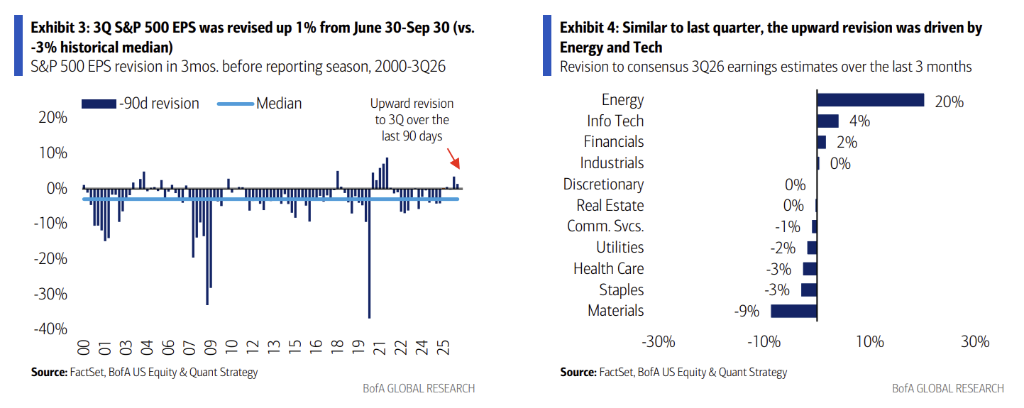
However, as major banks JPMorgan, Goldman Sachs, Wells Fargo, and Citigroup take the stage in succession this week, the core tension of this earnings season will gradually surface: after two consecutive quarters of substantial beats, "beating expectations" itself has become the new normal for the market—can it still drive stock prices higher?
BofA data shows that in the second quarter of 2026, 77% of S&P 500 constituents exceeded EPS expectations—the highest hit rate since 2021. But the market reaction has clearly dulled: among companies that beat both earnings and revenue expectations, their next-day excess performance relative to the S&P 500 was only 0.7 percentage points, roughly half the historical average of 1.4 percentage points; while companies that missed on both saw their shares underperform the index by an average of 3.3 percentage points the next day, slightly above the historical average penalty. This asymmetry clearly signals one thing: the market's reward for good news has become stingy, while the punishment for bad news remains undiminished.
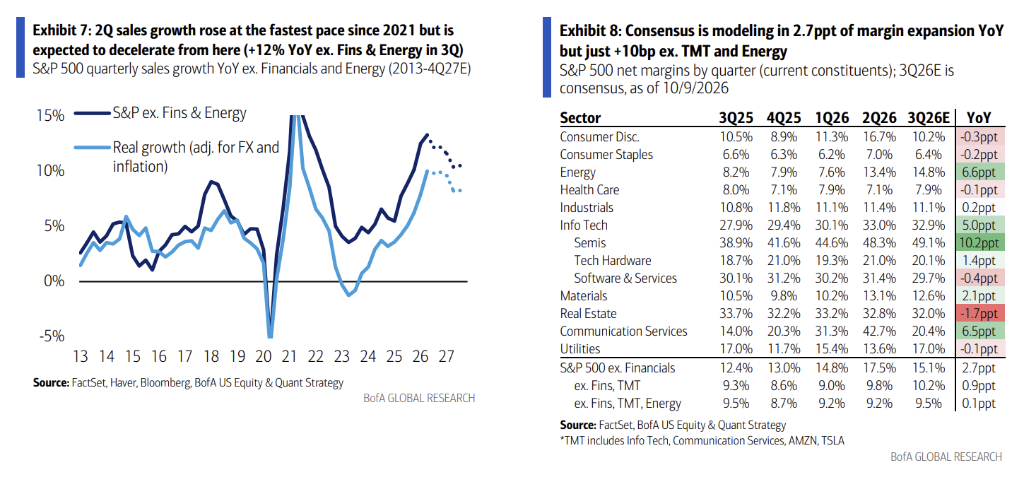
BofA warns that for investors, the real risk this earnings season may not lie in the results themselves, but in three hidden killers: commodity costs eroding profits, doubts about AI narrative realization, and overly optimistic 2027 expectations.
Earnings Concentration Hits Historic Extreme, Median Stock Growth Nearly Stagnant
On the surface, this earnings season looks quite solid: consensus expects all 11 sectors to post positive growth, only the second time in history this has occurred. But when the index is broken down, the picture is entirely different.
According to Goldman Sachs data, the top 10 earnings contributors in the S&P 500 are expected to account for 68% of the index's total earnings growth this quarter, a sharp jump from 47% in the first quarter and 48% in the second quarter.
Among them, Micron alone contributes 19% of index growth, Nvidia contributes 15%, and these two together account for 34% of third-quarter index earnings growth. The remaining contributors are Meta (7%), Google parent Alphabet (6%), and Broadcom (5%), along with Exxon Mobil, Chevron, and Marathon Petroleum, which benefited from the oil price shock of the Middle East conflict.
For most other companies, the boom is fading. Consensus expects the median S&P 500 stock to see third-quarter EPS growth of only 9%, down from 14% in the second quarter, and analysts expect "sequential deceleration in all sectors except information technology and communication services." At the margin level, analysts have cut third-quarter margin expectations for the median stock by 11 basis points since the start of the quarter, with "reductions in every sector except information technology."
Goldman Sachs' market breadth data also confirms this divergence: although the S&P 500 index is only 2% from its all-time high, the median stock remains 17% below its record high, and market breadth has fallen to its lowest level since the dot-com bubble.
Three "Hidden Profit Killers": Costs, Exchange Rates, and Earnings Quality
Killer No. 1: Commodity and energy costs eroding profit margins.
The frequency of S&P 500 companies mentioning "raw material costs" on earnings calls has risen to its highest level since mid-2022. BofA analysts point out that commodity inflation will limit room for margin beats in specific industries. Third-quarter US retail gasoline prices rose about 30% year-over-year, putting direct pressure on the cost side for retail, transportation, and industrial goods sectors. Consumer discretionary analyst Chris Nardone notes that if oil prices remain elevated for an extended period, margins will face sustained risk, and retailers may be forced into a difficult trade-off between passing on prices and preserving customer value perception.
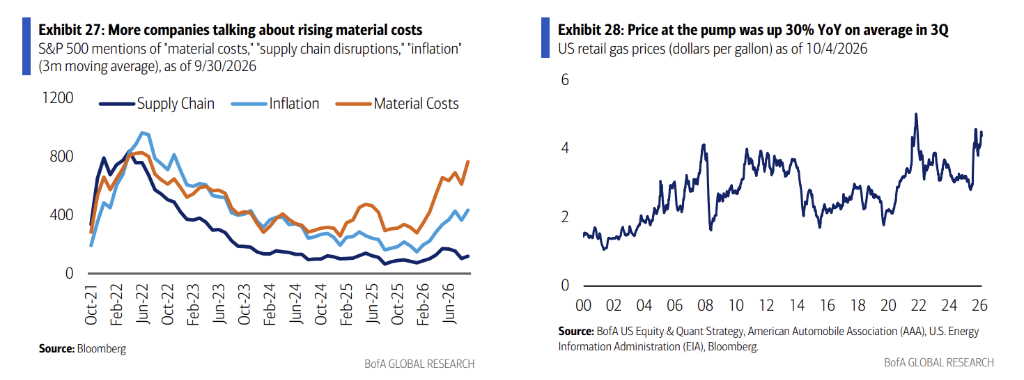
Notably, labor costs are the variable with the greatest impact on overall index margins—labor spending accounts for about 40% of US corporate operating costs, while energy costs account for less than 5%. BofA believes wage inflation is currently on a cooling trajectory, which is an important buffer for overall margins, but if energy prices continue to rise and eventually pass through to the consumer side, the downside risks for the fourth quarter and 2027 cannot be ignored.
Killer No. 2: The AI capex narrative remains unresolved, and the path to realization is still unclear.
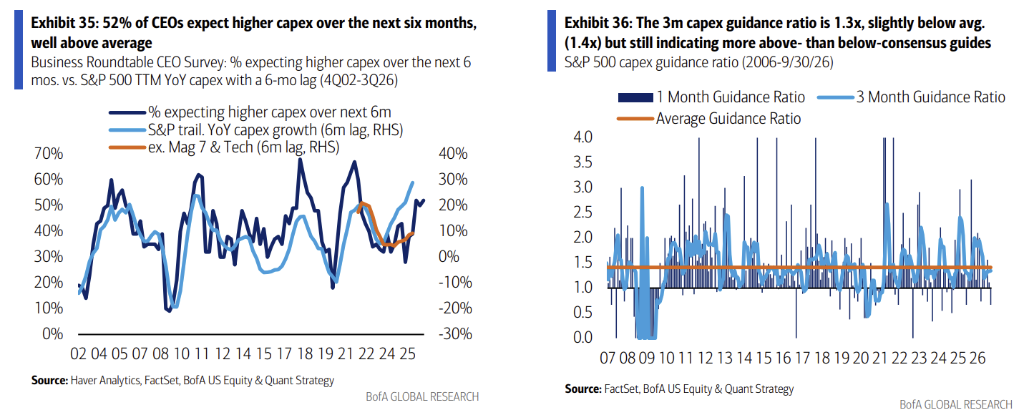
Hyperscale cloud providers (Microsoft, Amazon, Google, Meta, Oracle) are expected to see capital expenditure growth exceed 90% year-over-year in 2026, far surpassing any historical period, and related 2026 capex forecasts have been revised up by 70% over the past year.
However, these companies' capex as a share of operating cash flow has already exceeded 100% in 2026, and the divergence between free cash flow and net income is widening. BofA warns that whether AI investment can be successfully monetized is the core variable for index earnings sustainability, and "the interaction between geopolitics, interest rates, and the tech sector may be underestimated by the market."
Large-cap software analyst Tal Liani notes that entering the third-quarter earnings season, the market focus is on whether software vendors can convert customer AI adoption into substantive revenue growth. "Demand continues to exceed supply, and pricing trends remain favorable," but Koji Ikeda also cautions that the market will increasingly differentiate between companies that can genuinely generate revenue growth from AI and those that merely rely on the AI narrative—"the two will diverge significantly."
Killer No. 3: Earnings quality is questionable, with one-time gains masking true performance.
S&P 500 EPS grew 50% year-over-year in the second quarter, but excluding Amazon and Google's private investment revaluation gains, actual growth dropped to 32%. BofA points out that such investment revaluation gains "can also cause damage when valuations reverse," making them a key variable investors need to look through the numbers to assess. At the index level, the ratio of free cash flow to net income has fallen to a historically low range, mainly because hyperscalers' massive capital expenditures are pressuring free cash flow.
2027 Expectations: Consensus Optimistic, BofA More Cautious
The real stress test for the market is in the pricing of the future. Consensus expects S&P 500 EPS to grow 16% year-over-year in 2027, significantly below 33% in 2026, while BofA's forecast is more conservative at just 12%.
BofA strategists note that "historical data shows that when EPS growth is above trend but begins to decelerate, stock returns are historically weakest"—which is exactly where the market finds itself now. At the same time, 2027 consensus forecasts assume "no EBIT margin contraction in any sector except energy," and against a backdrop of highly uncertain commodity prices, the fragility of this assumption is obvious.
At the sector level, information technology (especially semiconductors) is expected to remain the primary driver of index earnings growth in 2027, contributing about 80% of the growth share, while the communication services sector will face year-over-year negative growth pressure due to high base effects. On bank stocks, BofA analyst Ebrahim Poonawala notes that the bank stock index BKX has fallen 12% from its mid-August high, with rising interest rates, doubts about the sustainability of the AI capex cycle, and concerns about AI disruption being the main suppressing factors. "If visibility on these issues improves, there is room for valuation recovery before year-end."
In summary, the fundamental backdrop for this earnings season remains solid, but the market premium for "beats" has been significantly compressed. For investors, the focus should shift from "can they beat" to "can they sustain after beating"—and cost erosion, the path to AI monetization, and 2027 earnings assumptions are precisely the three key threads that will determine the answer.





