






Amid the U.S. Treasury selloff, institutions are starting to buy the dip: a record $59.3 billion flood of capital


- Core View: After months of selling pressure, U.S. Treasury yields have risen to multi-decade highs, and large institutional investors are once again increasing their Treasury allocations, believing current yields are sufficient to attract fixed-income investment—though they remain divided on duration selection.
- Key Points:
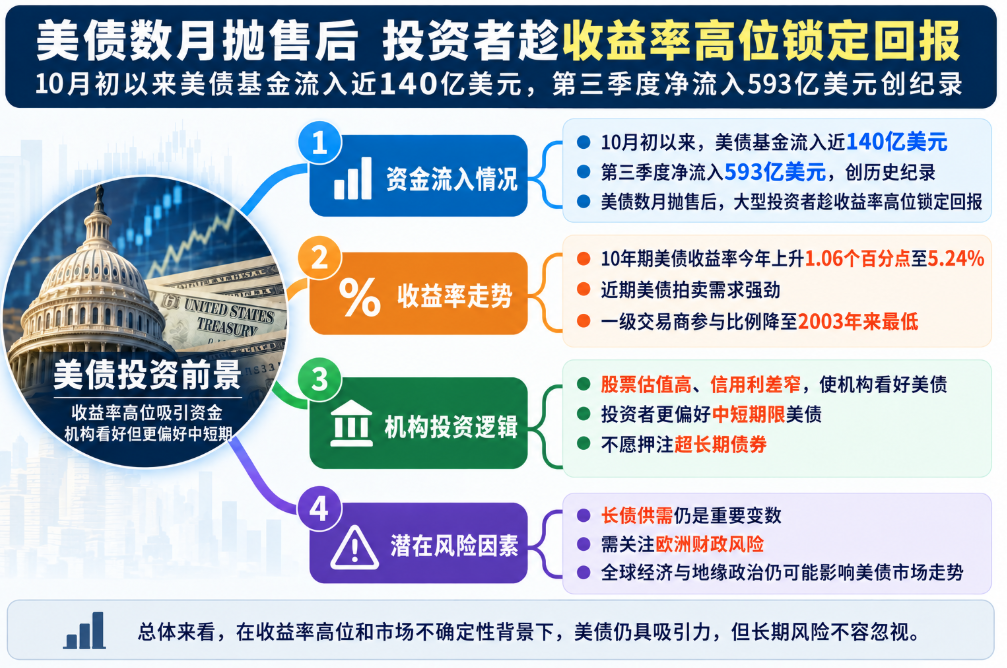
- Since early October, investors have poured nearly $14 billion into U.S. government bond funds; third-quarter net inflows reached $59.3 billion, a record high.
- The 10-year Treasury yield has risen 1.06 percentage points this year to 5.24%, having previously touched a 24-year high of 5.36% before an auction.
- Institutions including Amundi and Pimco are bullish on medium- to long-term Treasury allocations, arguing that elevated equity valuations and narrow credit spreads make Treasuries more attractive.
- Institutions lack confidence in ultra-long bonds, with Morgan Stanley and PGIM both cautious on 20-year and 30-year Treasuries.
- U.S. Treasury Secretary Bessent's expansion of debt buybacks and European fiscal risks could affect the supply-demand dynamics and capital flows in the Treasury market.
Source: Jinshi Data
After months of selling pressure in the U.S. Treasury market, large investors are trying to lock in returns while yields sit at multi-decade highs. Although they cannot yet be certain the selloff is over, a growing number of fund managers believe current yields are sufficient to make fixed-income investments attractive again.
According to calculations by the Financial Times based on EPFR data, investors have poured nearly $14 billion into U.S. government bond funds since the start of October. Previously, net inflows into such funds reached $59.3 billion in the third quarter, setting a historical record. Relative to the $32 trillion U.S. Treasury market, these inflows remain limited.
The 10-year U.S. Treasury yield has risen 1.06 percentage points this year to 5.24%. Vincent Mortier, chief investment officer of Amundi, which manages €2.6 trillion in assets, said: "This is a high level, and it naturally attracts new interest." The company is currently gradually increasing its U.S. Treasury allocation in dollar-denominated portfolios.
Last Wednesday, the U.S. Treasury issued $39 billion in 10-year notes, and market demand was strong. Hours before the auction, the related yield had touched 5.36%, the highest level in 24 years.
In this auction, the participation rate of primary dealers responsible for absorbing bonds not purchased by investors fell to the lowest level since 2003. The 3-year and 30-year Treasury auctions held last week also performed steadily, reflecting that higher yields are attracting buyers.
Mortier believes the appeal of 10-year U.S. Treasuries also comes from inflation expectations. The market expects inflation to average about 2.35% annually over the next decade, meaning investors could potentially earn a real yield close to 3%.
Equity valuations are elevated; institutions are bullish on medium-term returns but reluctant to bet on ultra-long bonds
The recovery in Treasury buying followed a violent round of selling. Factors driving the decline included higher energy costs from the Iran war launched by Trump, large-scale debt issuance by AI companies, and market expectations that U.S. economic growth will remain strong in the coming years.
Dan Ivascyn, chief investment officer of Pimco, which manages $2.3 trillion in assets, said that even if U.S. Treasury prices may still fall and yields continue to rise, Treasuries remain attractive compared with stocks whose valuations are near historical highs.
He pointed out that corporate bonds also offer limited additional risk compensation relative to low-risk U.S. government debt. Ivascyn said: "When you see how high equity valuations are and how narrow credit spreads are, we simply feel these rates are much more attractive."
Greg Peters, co-chief investment officer of PGIM Credit, is also bullish on current medium- to long-term allocation opportunities. He said: "A U.S. 10-year Treasury (yield) above 5% is a good medium- to long-term hold... This is a pretty good investment."
Mortier, meanwhile, expects U.S. yields to be more likely to fall from current levels than to rise further. Amundi judges that the recent inflation spike will gradually ease over the medium term, providing a basis for future declines in yields.
However, institutions have not formed a consensus view on Treasuries of different maturities. After the Federal Reserve raised rates in September, the market worried that if inflation remained persistently high, the central bank could begin a further rate-hiking cycle, making long-term bonds more vulnerable to shocks.
Peters made clear: "I'm not sure I would buy 30-year U.S. Treasuries." Vishal Khanduja, broad market fixed income director and portfolio manager at Morgan Stanley Investment Management, believes bonds with maturities of no more than 10 years are attractive, but "we have lower confidence in 20-year and 30-year maturities."
Khanduja said his team has already positioned its portfolio according to this judgment, believing that current yield levels are enough to prompt investors to reduce cash or some floating-rate securities allocations and instead hold fixed-rate bonds to lock in existing yields.
Long-bond supply and demand, along with European risks, remain variables
Khanduja cautioned that the longer the bond maturity, the more complex the impact of supply and demand factors on prices becomes. He specifically mentioned that U.S. Treasury Secretary Bessent's decision to expand the scale of U.S. government debt buybacks could change the supply-demand dynamics for bonds of certain maturities.
He said: "When non-economic participants enter and distort the supply-demand technicals in that part of the market, it becomes very difficult to make a very clear valuation argument."
Fiscal risks outside the United States could also affect demand for Treasuries. Peters believes that if the situation in the eurozone becomes more tense, it could push funds toward U.S. Treasuries. French sovereign bonds have already fallen sharply ahead of next spring's closely watched election.
Peters said: "I can absolutely imagine a scenario where France has problems, yield correlation across the eurozone becomes stronger than it is now, and you see money flowing into the U.S. Treasury market."
Despite being bullish on current yields, investors still acknowledge that buying now may amount to trying to catch a falling knife. If U.S. Treasury yields continue to surge, the returns locked in now may not be optimal.
Khanduja believes the yield buffer investors have already obtained is becoming more attractive. He said: "Mathematically, the yield buffer is becoming (so) much more attractive that holding these levels is easier than waiting for yields to finally peak or bottom before entering fixed-income securities."





