Gate Research: The "Wall Street-ization" Wave in Crypto Financial Products — Competition or Convergence?


- Key Takeaways: The crypto market is undergoing a profound "Wall Street-ization" transformation, where traditional financial institutions are systematically acquiring the issuance, pricing, and distribution rights of crypto assets through products such as ETFs, futures, custody, and RWA. At the same time, CEXs and traditional brokers like Gate and Robinhood are moving toward each other, jointly driving the integration of stocks, crypto, RWA, and other assets into unified accounts, forming a two-way converging hybrid capital market.
- Key Elements:
- As of May 2026, spot ETFs hold approximately 1.5 million BTC, accounting for 7.14% of the maximum total supply, marking large-scale institutional holdings of crypto assets through compliant channels.
- The RWA market is growing against the trend: while the broader market fell 28% in the first half of 2026, the RWA sector grew over 40% against the trend, surpassing $32 billion in scale; tokenized U.S. Treasuries expanded from $380 million in 2023 to over $11 billion by 2026.
- Tokenized stocks have become the growth engine for RWA: the number of holding wallets grew 188% in six months to approximately 350,000, making it the largest RWA category by wallet count, surpassing tokenized gold.
- Gate exchange is penetrating from crypto into traditional finance through a four-phase strategy (stock tokens, CFDs, real U.S. stocks, and Hong Kong/Korea stocks), supporting trading of over 10,000 U.S. stocks and 1,000 Hong Kong stocks.
- Robinhood is converging in the opposite direction: in 2025, it completed the acquisition of Bitstamp and launched Stock Tokens in Europe, with plans to build its own Layer 2 to support RWA tokenization. Its Q4 2024 crypto revenue grew over 700% year-over-year.
- Shift in power structure: U.S. executive orders allowing alternative assets in 401(k) retirement plans have opened the door to approximately $12.5 trillion in retirement funds for crypto, with traditional brokers and asset managers (such as BlackRock and Franklin Templeton) deeply involved in issuance and distribution.
In January 2009, Satoshi Nakamoto embedded a line of text in the Bitcoin genesis block: "The Times 03/Jan/2009 Chancellor on brink of second bailout for banks." This line served as both a timestamp and is often seen as a commentary on the bank bailout system following the 2008 financial crisis: Bitcoin sought to establish a peer-to-peer value transfer system that doesn't rely on banks or trusted third parties.
Yet today, seventeen years later, one of the mainstream ways to hold Bitcoin is by buying shares of an ETF issued by BlackRock, the world's largest asset manager, or holding stock in Bitcoin treasury companies. Does this mean the crypto market has strayed from its founding principles? Is Wall Street systematically seizing the issuance, pricing, custody, and distribution rights of crypto financial assets?
1. Is Wall Street Taking Over the Issuance, Pricing, Custody, and Distribution of Crypto Assets?
1.1 The Ideal: Bitcoin's Founding Intent in 2009
This brings us back to the original purpose of Bitcoin's creation. The Bitcoin whitepaper described a financial order built around three "de-" principles:
• Decentralization: No central issuer, no headquarters, no servers that can be shut down. The ledger is maintained collectively by global nodes, with rules encoded in software.
• Disintermediation: Peer-to-peer value transfer without banks, brokers, or clearinghouses acting as intermediaries and guarantors. "Private keys equal ownership," and self-custody is the default paradigm.
• Debanking: Anyone can hold and transfer assets without opening an account, undergoing KYC, or being an accredited investor, and can also participate in the issuance of new coins (through mining).
The spiritual core of this ideal was to reclaim the four powers of finance—issuance, pricing, custody, and distribution—from a handful of institutions and distribute them to every participant in the network. It was both a direct response to the 2008 financial crisis and a declaration to the market: if the centralized financial system can fail, then build a system that doesn't need it.
1.2 Reality: Are These Four Powers Being Seized?
However, this decentralized order has seemingly become less pure following the approval of spot Bitcoin ETFs in 2024. In other words, traditional finance is integrating crypto technology into its own asset issuance, settlement, and distribution systems.
Asset management giants like BlackRock, Fidelity, and Franklin Templeton have packaged BTC and ETH into products purchasable through traditional financial accounts. When BTC and ETH are packaged as ETFs, they transform from "on-chain assets requiring an understanding of wallets and private keys" into "financial products that can be bought in traditional securities accounts." As of May 2026, ETFs hold approximately 1.5 million Bitcoin, representing about 7.14% of Bitcoin's 21 million total supply cap within just two years.
The same shift is occurring in the derivatives market. CME's Bitcoin and Ethereum futures and options provide institutions with a regulated trading venue for hedging and risk management integration. Increasingly, institutions can gain crypto exposure through futures, options, ETFs, structured products, and fund shares without directly touching on-chain assets.
RWA and tokenized Treasuries have further expanded the boundaries of "Wall Street-ization." The RWA Treasury market has grown from approximately $380 million in early 2023 to over $11 billion in 2026, making it the fastest-growing segment in the entire RWA space, with the issuer list reading like a who's who of Wall Street. BlackRock's BUIDL, Franklin Templeton's Benji, JPMorgan's Kinexys, and Ondo's tokenized Treasury products are all bringing traditional financial assets onto the chain.
Institutions like Coinbase, Fidelity Digital Assets, and BNY Mellon handle custody, trading, and compliance infrastructure. Furthermore, in August 2025, a U.S. executive order allowed alternative assets such as cryptocurrencies and private equity to enter 401(k) retirement plans, opening the door to approximately $12.5 trillion in retirement account funds for crypto assets. As more institutions participate, numerous brokers and wealth management firms are gradually incorporating distribution rights into their purview.
Behind this lies not just a change in product formats, but a shift in power structures: asset managers handle issuance, brokers and advisors handle distribution, qualified custodians handle safekeeping, market makers and authorized participants handle primary market creation and redemption, exchanges handle listings, and regulatory frameworks define boundaries. Crypto assets have thus entered the language system of traditional finance.
2. A Two-Way Convergence: 1+1>2
But Wall Street's "centralization" is only one side of the coin. Stepping back, the other side reveals both parties complementing each other's shortcomings. This is not a zero-sum game of one absorbing the other, but a bidirectional convergence of two systems.
The crypto-native system offers permissionless openness, a 24/7 global market, and programmable on-chain settlement, but it has always lacked four things: compliant issuance channels, institutional-grade custody trust, deep fiat liquidity, and distribution networks that reach mainstream audiences. These four things happen to be exactly what Wall Street has in abundance.
Conversely, Wall Street has licenses, custody, trillion-dollar capital pools, and global distribution channels, but its assets are trapped in an outdated infrastructure: markets only open on business days, cross-border barriers are high, settlement takes T+2, and products cannot be freely composed with one another. These limitations are precisely what the crypto rails were born to solve. This 1+1>2 dynamic is not merely a theoretical exercise.
Over the past year, crypto exchanges have been launching real U.S. stock trading, and this wave presents two seemingly opposite directions that converge at the same endpoint. One starts from crypto exchanges and moves toward traditional finance; the other starts from traditional finance and moves toward crypto. Gate and Robinhood are the clearest representatives of these two paths.
2.1 Path A: From CEX to Traditional Finance
Gate's TradFi path can be divided into several phases. The first phase was tokenization of traditional assets. On July 3, 2025, Gate officially launched the xStocks Trading Section, becoming one of the first crypto exchanges to offer tokenized asset trading. Partnering with xStocks and Ondo, it allowed users to trade spot and perpetual contracts on U.S. stocks like Apple, Tesla, and Meta directly with USDT, 24/7, without needing a traditional securities account. The core of this path is the "third-party compliant issuance + CEX distribution" model represented by xStocks. The underlying structure involves Swiss regulated entity Backed Finance holding 1:1 real stocks via an SPV structure under the DLT law framework (purchased through brokers like Interactive Brokers and custodied at regulated custodians like InCore Bank). Tokens are issued on the Solana SPL standard, incorporating Chainlink price feeds for high-frequency synchronization with off-chain markets.

The second phase was converting traditional assets into CFDs, providing users with price exposure to gold, forex, indices, commodities, and select stocks through contracts for difference. In January 2026, Gate expanded its TradFi CFD products to cover gold, forex, indices, commodities, and popular stocks, integrating USDx as an internal settlement unit pegged to USDT into the trading experience. In this phase, the exchange provides price exposure; users trade derivatives without directly holding the underlying stock assets.

The third phase was launching real stock trading in June 2026. On June 1, Gate officially launched real stock trading, currently supporting over 10,000 U.S. stocks and ETFs across major markets like NYSE and Nasdaq, allowing users to trade directly with USDT. This signifies that a native crypto trading platform is no longer satisfied with offering spot, derivatives, Launchpad, copy trading, wallets, and on-chain tools to native users; it is now bringing traditional securities traders—stocks, ETFs, bonds, forex, and funds—into its trading ecosystem.
The key difference from the earlier CFD phase is that Gate emphasizes connecting to real securities markets through compliant broker infrastructure, rather than stock tokens or synthetic assets. On June 3, Gate also announced a strategic partnership with Alpaca to expand real stock trading access for eligible users. Alpaca is an SEC-registered clearing broker, with the partnership focusing on trade execution, clearing, and custody infrastructure. In other words, Gate is not issuing stocks itself but positioning itself as the front-end gateway connecting crypto accounts, stablecoin funds, and traditional broker clearing systems.
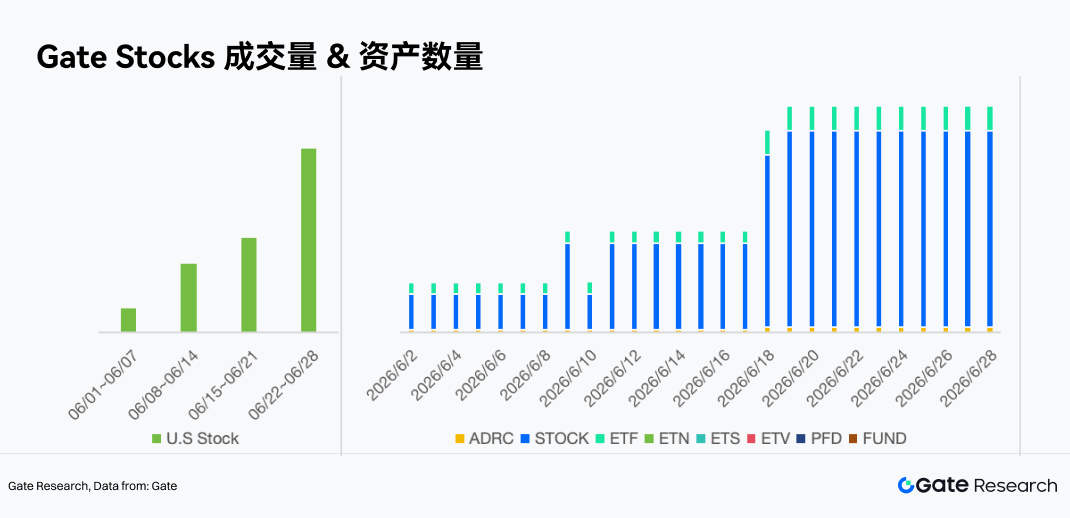
The fourth phase is geographic expansion of stock markets. After U.S. stocks launched, Gate introduced Hong Kong stock trading on June 15, initially covering over 1,000 HKEX-listed stocks. Users can trade Tencent, HSBC, Xiaomi, Meituan, BYD, China Mobile, and other HK stocks using USDT, sharing the same stock account system as U.S. stocks. On June 22, Gate further launched Korean stock trading, supporting KRX-listed stocks, initially covering the top 1,000 companies by market cap, including Samsung Electronics, SK Hynix, NAVER, Hyundai Motor, and Celltrion, spanning both KOSPI and KOSDAQ markets. Looking at the timeline, Gate completed the rapid rollout of "U.S. stocks → HK stocks → Korean stocks" within June, forming a multi-market product matrix with USDT as the unified capital gateway and global stocks as allocation targets.
These phases reflect the evolution of CEX growth logic. In the past, CEXs primarily relied on spot, derivatives, Launchpad, wealth management, and Web3 wallets to build user ecosystems. However, as crypto trading penetration increases, fee competition intensifies, and regulatory requirements rise, growth space relying solely on crypto-to-crypto trading is narrowing. Traditional assets like stocks, ETFs, and commodities can expand the tradable asset pool and improve user asset retention. For Gate, real stock trading not only serves crypto users' cross-asset allocation needs but also helps attract traditional finance users into its account system.
2.2 Path B: From Traditional Finance to Crypto
In the opposite direction from Gate, traditional brokers represented by Robinhood are gradually penetrating the crypto market. These brokers' advantage lies in their mature securities brokerage user base, compliance frameworks, and retail trading product experience, allowing them to integrate traditional financial products like stocks, ETFs, and options with crypto assets on the same trading platform at lower customer acquisition costs. Traditional financial institutions are not only adding crypto assets as a supplement to their traditional wealth management systems but also leveraging crypto's 24/7 trading and high volatility to develop new revenue streams and enhance platform competitiveness.
The most representative traditional broker is Robinhood, originally a typical retail broker and fintech platform starting with stocks, options, cash management, margin, and subscription services. But over the past few years, crypto assets have become one of its growth engines. In Q4 2024, Robinhood's crypto trading revenue reached $358 million, up over 700% year-over-year, driving overall transaction revenue up more than 200% year-over-year. By full-year 2025, Robinhood's total revenue reached $4.5 billion, with annual net deposits of $68 billion and 4.2 million Gold subscribers, showing its transformation from a single stock trading app into a comprehensive financial account.
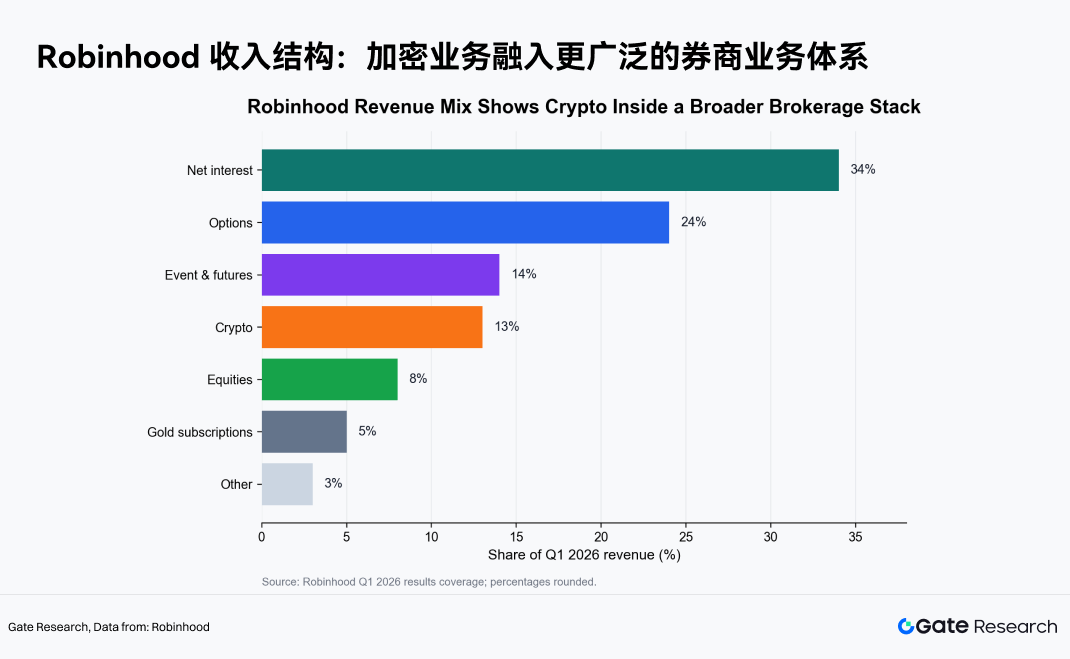
Robinhood's crypto strategy is not limited to listing coin trading. In June 2025, Robinhood completed its acquisition of Bitstamp, integrating Bitstamp's retail and institutional crypto trading operations across the EU, UK, US, and Asia, while strengthening its global crypto licenses and institutional business capabilities. This shows Robinhood is not simply treating crypto as another trading category in its stock app—it is using M&A to build out crypto exchange capabilities, licenses, institutional clients, and global operations.
More importantly, it is bringing traditional stock assets on-chain. On June 30, 2025, Robinhood announced the launch of Stock Tokens in Europe and revealed plans to build Robinhood Layer 2 to support RWA tokenization, 24/7 trading, cross-chain functionality, and self-custody. Its stock tokens were initially issued on Arbitrum, with future plans to migrate to Robinhood's own Layer 2 built on Arbitrum's tech stack. These Classic Stock Tokens are derivative contracts with Robinhood, reflecting the price performance of the underlying stocks and ETPs.
This contrasts with Gate's emphasis on real stock trading: Robinhood leans toward packaging traditional equity exposure as on-chain or quasi-on-chain tokenized exposure, while Gate connects from CEX accounts into real securities brokerage infrastructure.
2.3 The Common Goal of Both Paths: Competing for the Next-Generation Integrated Financial Account
For everyday users, the financial classification of assets may not matter much. Most people don't care whether they're trading stocks, cryptocurrencies, ETFs, event contracts, or tokenized securities. What users truly care about is whether they can trade within a single account, enter and exit at low cost, see price changes in real-time, and swiftly switch positions amid market volatility.
This is precisely the core motivation for traditional brokers embracing crypto assets. They aren't simply trying to become another Gate or CEX—they want to avoid having the next-generation financial gateway taken by crypto platforms.
Therefore, the key isn't whether any single product succeeds in the short term, but that the direction of industry convergence is already clear: traditional brokers want crypto's trading speed, global liquidity, younger user base, and high-frequency trading behavior; crypto platforms want traditional finance's real assets, compliant identity, institutional trust, and broader asset supply.
Both sides are moving toward each other's most valuable attributes. The boundary between Crypto and TradFi is being broken down at the product level, and the next phase of competition will center on compliance capabilities, asset coverage, capital efficiency, user experience, and global account infrastructure.
3. RWA and On-Chain Treasuries: The Middle Layer of a Unified Capital Market
Gate and Robinhood above represent convergence at the user entry point, while RWA and on-chain Treasuries represent convergence at the asset layer.
In the past, one of the biggest problems in the crypto market was the relatively closed on-chain asset supply. Besides native tokens, stablecoins, NFTs, and a few derivative assets, the chain struggled to carry real-yield assets that were diverse enough, low-volatility enough, and institutional-grade enough.
On-chain Treasuries changed this. When U.S. Treasuries, money market funds, and short-term bond funds are tokenized, they become approximations of "risk-free yield" in the on-chain world. They can serve as collateral, participate in DeFi portfolios, support institutional treasury management, and act as yield sources behind stablecoins and on-chain financial products.
However, this market is still in its early stages. As of May 2026, the tokenized U.S. Treasury market stands at approximately $15 billion, compared to the roughly $30 trillion U.S. Treasury market overall—a gap of more than three orders of magnitude.
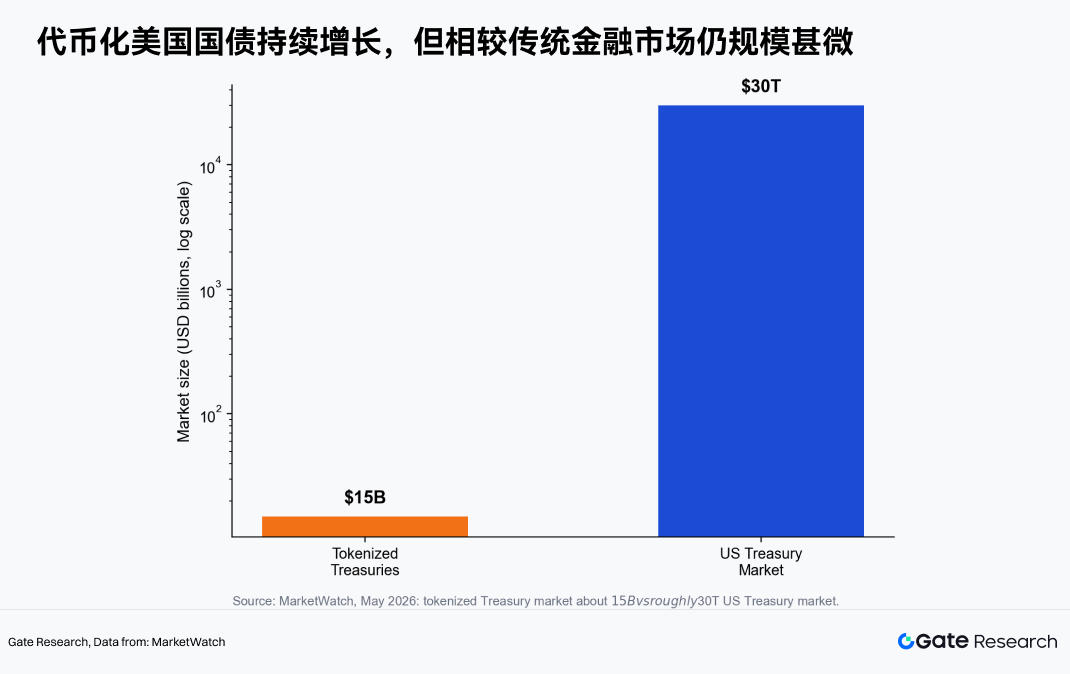
This gap reveals two things. First, RWA is not a completed market but one that is just beginning its institutionalization. Second, its ceiling is not determined by crypto-native users, but by whether traditional financial assets can enter the on-chain environment in a compliant, auditable, settleable, and distributable manner. This is why traditional institutions like JPMorgan, BlackRock, Franklin Templeton, BNY, DTCC, and Nasdaq all appear in the tokenization narrative simultaneously. In the long run, they are not building a standalone crypto product—they are testing the future underlying settlement and asset registration infrastructure of capital markets.
Data proves this convergence is not narrative hype but a genuine structural trend. In the first half of 2026, the overall crypto market fell 28% and DeFi TVL shrank over 25%, yet the RWA sector grew over 40% against the trend, exceeding $32 billion. Tokenized stocks were the growth engine: wallet counts grew 188% in six months to approximately 350,000, making it the largest RWA category by wallet count, surpassing tokenized gold. This indicates that a significant number of users who were originally in the crypto world but wanted U.S. equity exposure found an entry point without returning to traditional brokers. Meanwhile, DTCC and banks in the U.S. and Japan are planning to enter the market in 2026–2027 to "infrastructuralize" tokenized stocks.
4. The Logical Endpoint: Stocks, Crypto, RWA, and On-Chain Treasuries Trading Side by Side
4.1 Unified Capital Market and the "Super Account"
In the old financial system, different assets were siloed into different accounts: stocks in brokerage accounts, funds in asset management accounts, bonds in institutional systems, deposits in bank accounts, crypto on exchanges or in wallets, and on-chain assets in self-custody addresses. Each asset class had its own trading hours, settlement cycles, custody rules, compliance requirements, and user interfaces. But a new generation of platforms is attempting to compress these divisions into a single account.
Crypto exchanges start from coins and expand toward stocks, ETFs, RWAs, payments, and on-chain yield; traditional brokers start from stocks and expand toward crypto, tokenized securities, prediction markets, stablecoins, and 24