SBF Sold Too Early, Missing $37 Billion; Amazon Rakes In $150 Billion: The Complete Wealth-Creation Record of Anthropic's IPO


- Core Viewpoint: Anthropic completed the largest IPO in history at $83 per share, raising $81.3 billion at a market capitalization of approximately $1.5 trillion. Its five-and-a-half-year, eight-round financing history reveals the complete cycle of capital shifting from "fear" to "conviction," as well as the profound divergence in investment logic across the AI industry.
- Key Elements:
- Revenue growth is nearly vertical: surging from $41 million in 2023 to $33.24 billion in the first three quarters of 2025, with annualized revenue of approximately $81 billion by the end of October.
- Early Series A investors saw staggering returns: lead investor Jaan Tallinn and other non-professional VCs entered at approximately $0.257 per share, yielding a 323x return at the IPO price.
- FTX's bankruptcy estate was forced to sell its shares at a low price, missing out on approximately 28x appreciation; SBF was sentenced to 25 years in prison for fraud.
- Amazon and Google collectively invested approximately $51.6 billion, holding a combined ~28% stake after the IPO but with no voting rights, while securing over $230 billion in compute procurement commitments.
- Anthropic's insistence on AI safety bottom lines led to a contract conflict with the Pentagon and brief placement on a "supply chain risk" list, though revenue was not materially affected.
- The founding team locked in 50.1% voting power through a Founder LLC, with a "Long-Term Benefit Trust" holding a majority of board seats, while VCs are conspicuously absent from the list of major shareholders.
Author: Sleepy
On the morning of November 19 Beijing time, Anthropic priced its IPO at $83 per share, above the previous range of $70 to $78. That evening, ANT will officially begin trading.
The offering size was also increased at the last minute, from 825 million shares to about 980 million shares, raising $81.3 billion. By initial offering size, it surpassed SpaceX's $75 billion in June of this year, making it the largest IPO in history.
According to Bloomberg, the order book was nearly 7 times oversubscribed before it closed. On a fully diluted basis, the offering price corresponds to a market value of about $1.5 trillion, roughly 50% higher than the $965 billion valuation of the May H round.
Its revenue curve is almost vertical. In 2023, Anthropic's revenue was $41 million; in 2024, $386 million; in 2025, $4.585 billion. In the first three quarters of this year, it was $33.24 billion, with the third quarter alone approaching $17 billion. By the end of October, its annualized revenue was about $81 billion. The prospectus claims Claude is the fastest-adopted technology in enterprise history.
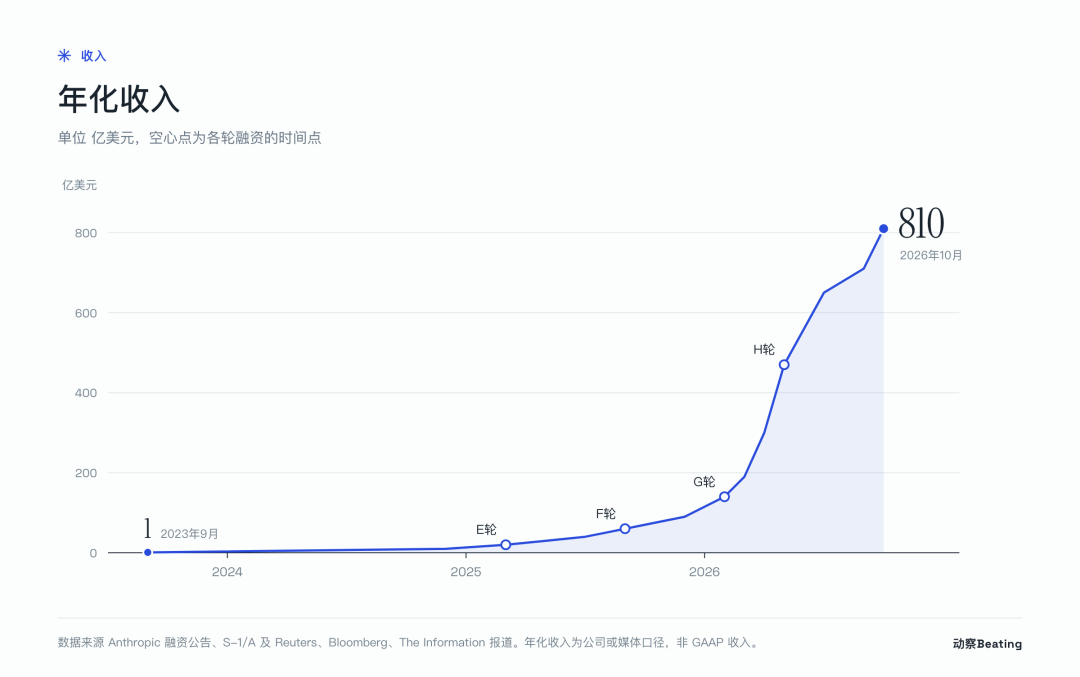
Five years ago, its first external funding round was only $124 million. The lead investor publicly said he was extremely afraid of AI.
This S-1 shows, for the first time, the per-share price of every round. On a post-split basis, the 2021 A round was $0.257 per share, and the May 2026 H round was $58.9. At the $83 offering price, $1 from the A round is worth $323 today, and $1 from the H round is worth $1.41.
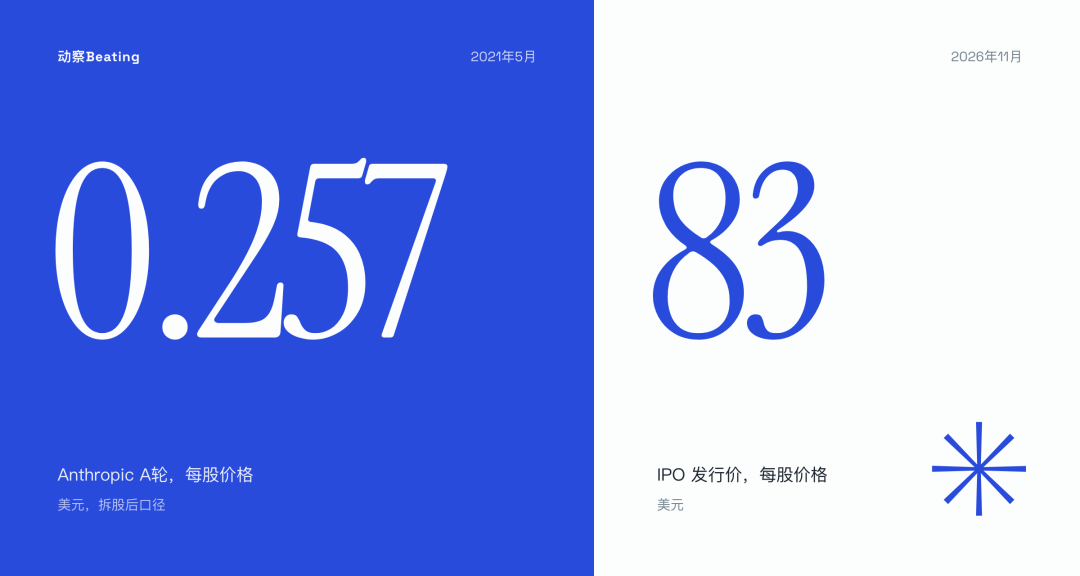
The earlier the money, the more afraid it was; the later the money, the more certain it was.
The fearful money made 323 times; the certain money made 41%.
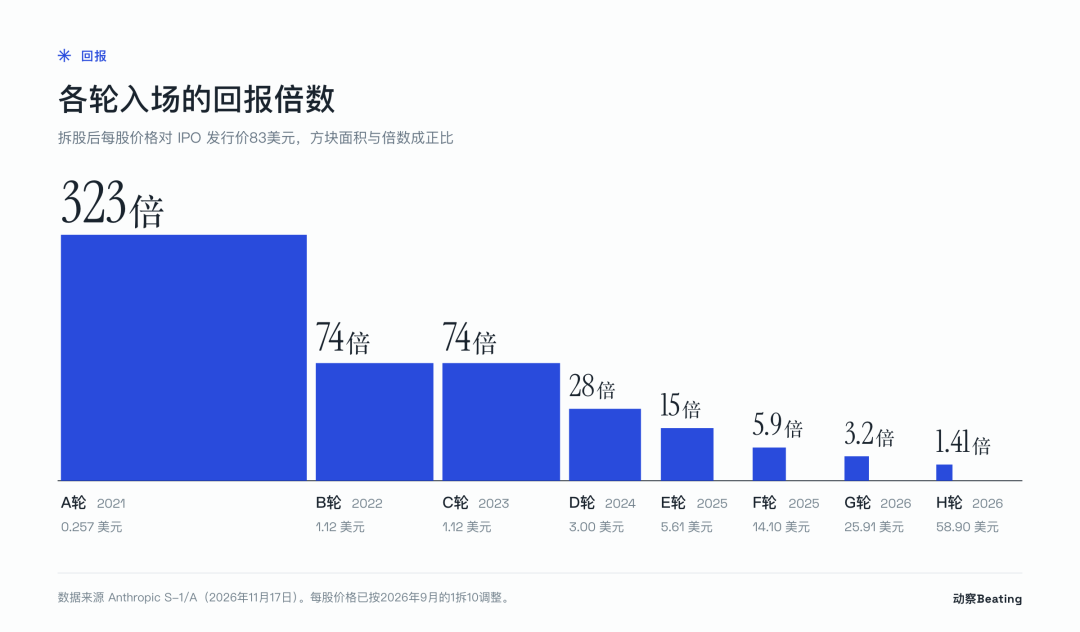
In between lie five and a half years, eight rounds of equity financing, more than $40 billion in cash from two cloud vendors, a lawsuit with the Pentagon, and a man sentenced to 25 years in prison. Before the IPO, all shareholders had invested about $137.3 billion in Anthropic, at a weighted average cost of $11.5 per share.
Money has memory, and it also has personality.
Beating reviewed this S-1 and its three amendments, and cross-checked public reports from the past five years, trying to answer a simple question.
What happened to the people who invested in Anthropic?
Non-capitalist money
In the spring of 2021, according to SF Standard, Dario set up a tent in his sister Daniela's backyard and pitched Eric Schmidt and others from inside it.
At the time, no one thought this was a good business. Daniela later recalled that AI was not an exciting investment direction back then.
The person who helped make the connection, Anjney Midha, was a friend of co-founder Tom Brown. On the 20VC podcast this year, he said he introduced Anthropic to 22 VCs, and 21 turned it down. According to the show summary, they originally wanted to raise $500 million in the first round, but ultimately shrank it to just over $100 million.
On May 28, 2021, Anthropic announced the completion of a $124 million Series A. The lead investor was Skype co-founder Jaan Tallinn, with Dustin Moskovitz, Eric Schmidt, James McClave, and a Swiss organization called the Center for Emerging Risk Research (CERR) participating.
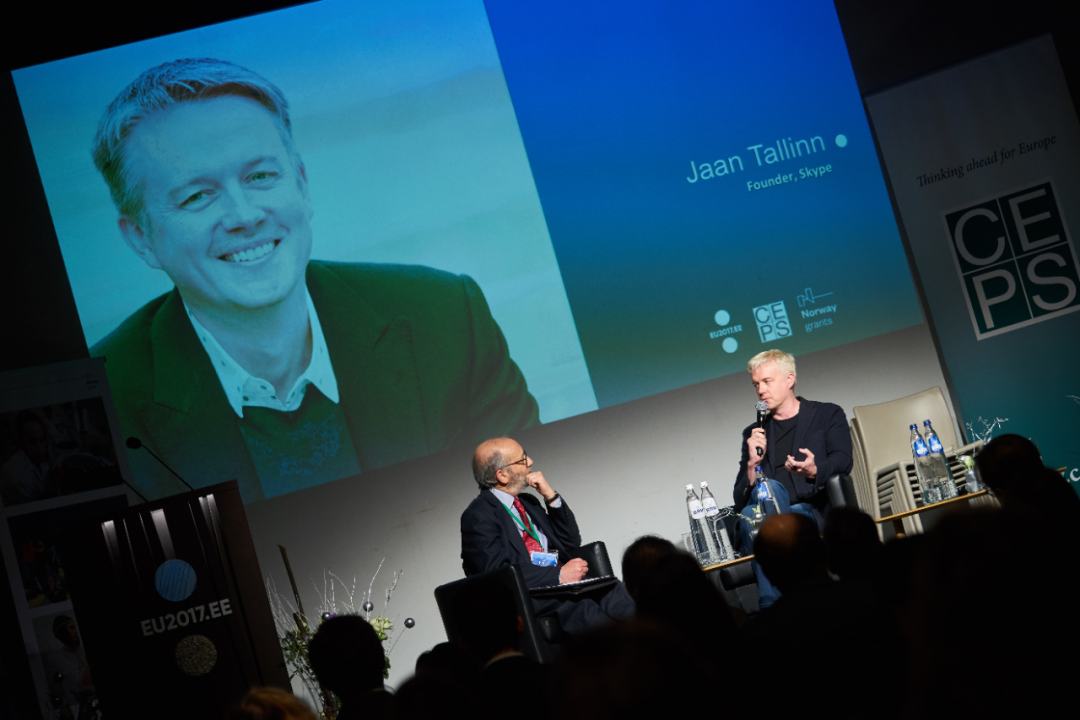
Jaan Tallinn at the Digital Europe seminar | Source: Valdek Laur
There was hardly a professional VC on that list.
Tallinn is one of the oldest backers in the AI safety circle; according to WSJ, he has donated about $170 million to AI safety over the past decade. Moskovitz is a Facebook co-founder and the largest funder of the effective altruism movement. CERR was a nonprofit with an EA background; according to EA Forum materials, it later evolved into today's Macroscopic Ventures.
Tallinn and Dario knew each other very early. He told The Generalist in October this year that he and Dario had been hanging out since 2012. According to Semafor, the two met in the MIRI (Machine Intelligence Research Institute) circle. Interestingly, Dario at the time strongly opposed the views of the MIRI camp and belonged to the "empiricist" faction that believed in experiments and data.
In 2018, Dario wrote a long essay titled "Big Blob of Compute," whose core was to push Richard Sutton's "The Bitter Lesson" to its extreme: compute and data would crush all clever design. Tallinn's reaction after reading it was, oh no, this is an engineering problem, not a scientific one.
So when he heard Dario was leaving OpenAI, he went to find him immediately.
Tallinn said that before investing, he asked Dario to first get several quotes from VCs, to confirm that he was merely replacing money that VCs would have invested anyway, rather than causing a company to exist that otherwise would not have. So he said the first round basically became "non-capitalist money."
His way of investing was also unlike an investor. According to a 2023 Semafor report, he gave up his board seat to Open Philanthropy's AI safety researcher Luke Muehlhauser, on the grounds that he wanted someone who could represent the things he worried about. He told The Generalist that he did not need to be accountable to other investors, so he did not need to maximize his own returns.
Non-capitalist money ultimately earned the highest return capitalism can offer.
At the offering price, the shareholders from this round collectively hold about 488 million shares, worth about $40.5 billion; $1 million invested is worth about $323 million today.
How much Tallinn invested was never disclosed; he does not appear in the prospectus's table of major shareholders, indicating a stake of less than 5%. WSJ wrote a profile of him in September this year, estimating his net worth at about $12 billion, with a rather interesting headline: a man terrified by AI is about to make billions more from it.
He has never hidden this tension. In 2023 he told Semafor that Anthropic was the lab most focused on safety he had ever seen, but they were handling dangerous things, and he was not sure they should be doing it.
That year, he also said one thing: "Plan A failed."
According to Semafor, he was referring to the plan to steer AI labs toward safety through investment. In March of that year, he signed the Future of Life Institute (FLI) open letter calling for a six-month pause on training, but Anthropic did not sign. Co-founder Jack Clark later explained to him that the company's policy was not to sign petitions.
Fear is also a kind of conviction.
Moskovitz went further. In early 2025, he and his wife Cari Tuna transferred their Anthropic shares into a nonprofit vehicle, citing the appearance of avoiding conflicts of interest. He said on social media that all these shares were in the foundation and that he personally did not benefit. In November of the same year, the couple renamed their philanthropic organization Open Philanthropy to Coefficient Giving. Also in 2025, Moskovitz stepped down as CEO of Asana. He remains a board observer at Anthropic.
Donating the shares did not let him escape scrutiny. In September this year, a blogger posted a long thread on X alleging that Anthropic's doomsday narrative was inflating the equity value of Moskovitz's circle, and that this money was in turn funding organizations that evaluate Anthropic; the post received nearly 5 million views. The named evaluation organization, METR, denied receiving money from Anthropic.
The ex
Eric Schmidt is the least EA-like person on the A round list.
The former Google CEO invested "tens of millions of dollars" in 2021. Bloomberg estimated in October this year that he holds about 1% of Anthropic, which at the fully diluted valuation implied by the offering price is worth about $15 billion.
This investment is also interesting. The person who introduced him to Dario was Cami Clark. She dated Schmidt for three years starting in 2011, began dating Dario in 2014, and later became Dario's wife. In 2018, three years before Anthropic was founded, Schmidt visited the couple's apartment. Fortune, recounting this episode, joked that in Silicon Valley, staying on good terms with an ex pays off.
In October this year, on the podcast In Good Company hosted by the CEO of Norway's sovereign wealth fund, Schmidt denied that there was an AI bubble, one of his arguments being that Anthropic's revenue growth exceeded twice the fastest pace during his tenure at Google.
At that point, there was still one month until Anthropic's IPO.
Beyond the A round list, there is another name that only surfaced this year. According to FT in May this year, Google DeepMind CEO Demis Hassabis was also an early angel investor in Anthropic, which had never been disclosed before. FT also mentioned that Dario has always regarded Hassabis as a role model.
As for James McClave, he appeared in both the A and B round announcements. Five years later, it is still hard to find much more information about him in public reports.
This is probably the most classic form of an early investor.
Legacy
On April 29, 2022, Anthropic announced a $580 million Series B, led by Sam Bankman-Fried.
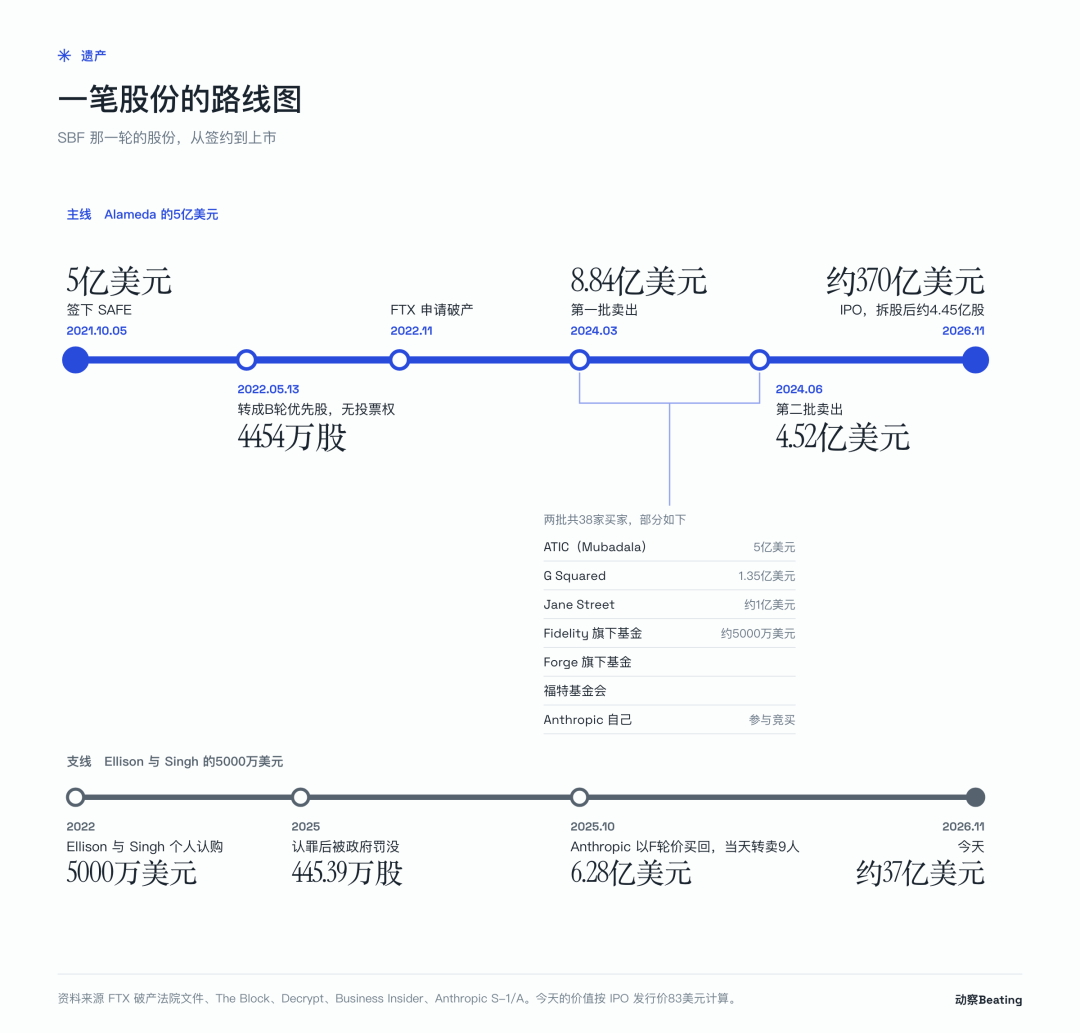
According to a report cited by Fortune, SBF and Anthropic were connected through a mutual acquaintance shortly after Dario left OpenAI. The entity providing the money was one controlled by SBF under Alameda Research, with an investment amount of $500 million. The agreement for this money was signed as early as October 5, 2021; it was a modified SAFE, and in May 2022 it converted at $11.2261 per share into about 44.54 million Series B preferred shares, representing about 13.56% of Anthropic at the time.
In the same round, Alameda co-CEO Caroline Ellison personally invested $10 million, and FTX engineering director Nishad Singh invested $40 million.
The prospectus hides a detail that almost no one noticed at the time. The Series B preferred stock was non-voting stock and could not participate in any board elections.
Half a year later, FTX collapsed.
One of Anthropic's largest external shareholders went bankrupt overnight. According to Fortune, in its 2023 fundraising deck Anthropic called Alameda a "silent investor" and expected the shares to be disposed of in the bankruptcy proceedings.
In February 2024, the Delaware bankruptcy court approved the sale of these shares. In March, the first batch of about 29.47 million shares sold for $884 million to 24 buyers. The largest was ATIC, under Abu Dhabi's sovereign fund Mubadala, which put in $500 million. SBF and Ellison's former employer Jane Street bought about $100 million, a Fidelity fund bought about $50 million, and the Ford Foundation was also on the list.
According to Decrypt, the bidder list even included Anthropic itself, as well as several SPVs named after Anthropic. In June, the remaining about 15.07 million shares sold for another $452 million, with the largest buyer being G Squared, and a fund under Forge also bought some.
The two batches totaled $1.336 billion, or about $30 per share, exactly equal to Anthropic's Series D price in early 2024.
A bankrupt estate in a hurry to repay debts exchanged $500 million for $1.336 billion, which counts as a respectable exit.
But what if it had not sold?
After the stock split, these shares became about 445 million. At the offering price, they are worth about $37 billion today, about 28 times the sale price back then. ATIC's $500 million is now worth about $13.8 billion. Jane Street's $100 million is worth about $2.7 billion. According to Bloomberg Línea, in the third quarter of 2025, Jane Street's private investments contributed about $830 million in trading revenue, most of it from Anthropic.
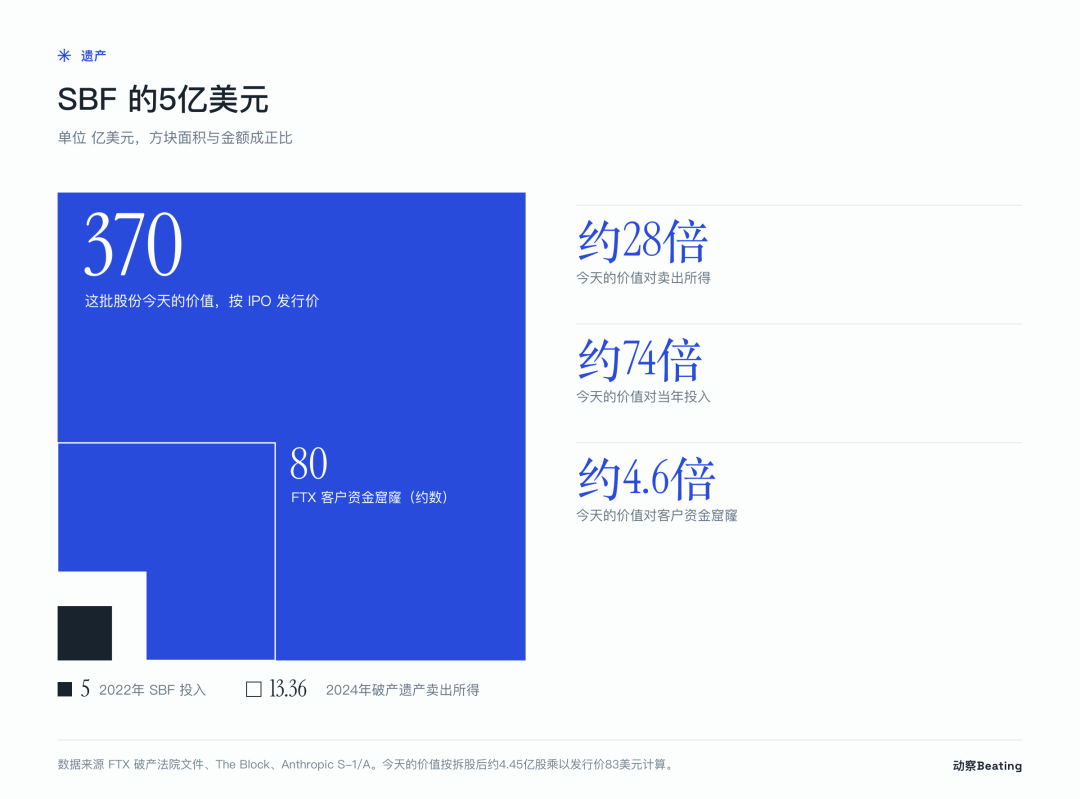
FTX creditors later recovered about 119% of their claims, with some categories higher. The money from selling Anthropic accounted for about 10% of distributed funds. And the value of these shares today is roughly more than four times that roughly $8 billion customer fund hole from back then.
SBF himself has kept using this to defend himself. On October 31, 2025, he posted a roughly 30-page document on X titled to the effect of "FTX was never insolvent," claiming that if bankruptcy lawyers had not taken over, FTX would be worth more than $100 billion today, with Anthropic one of the core assets he listed. He said handing FTX to bankruptcy administrator John Ray was the biggest mistake he ever made. Just this week, NYT interviewed him in prison, and he once again complained about the decision to sell the shares.
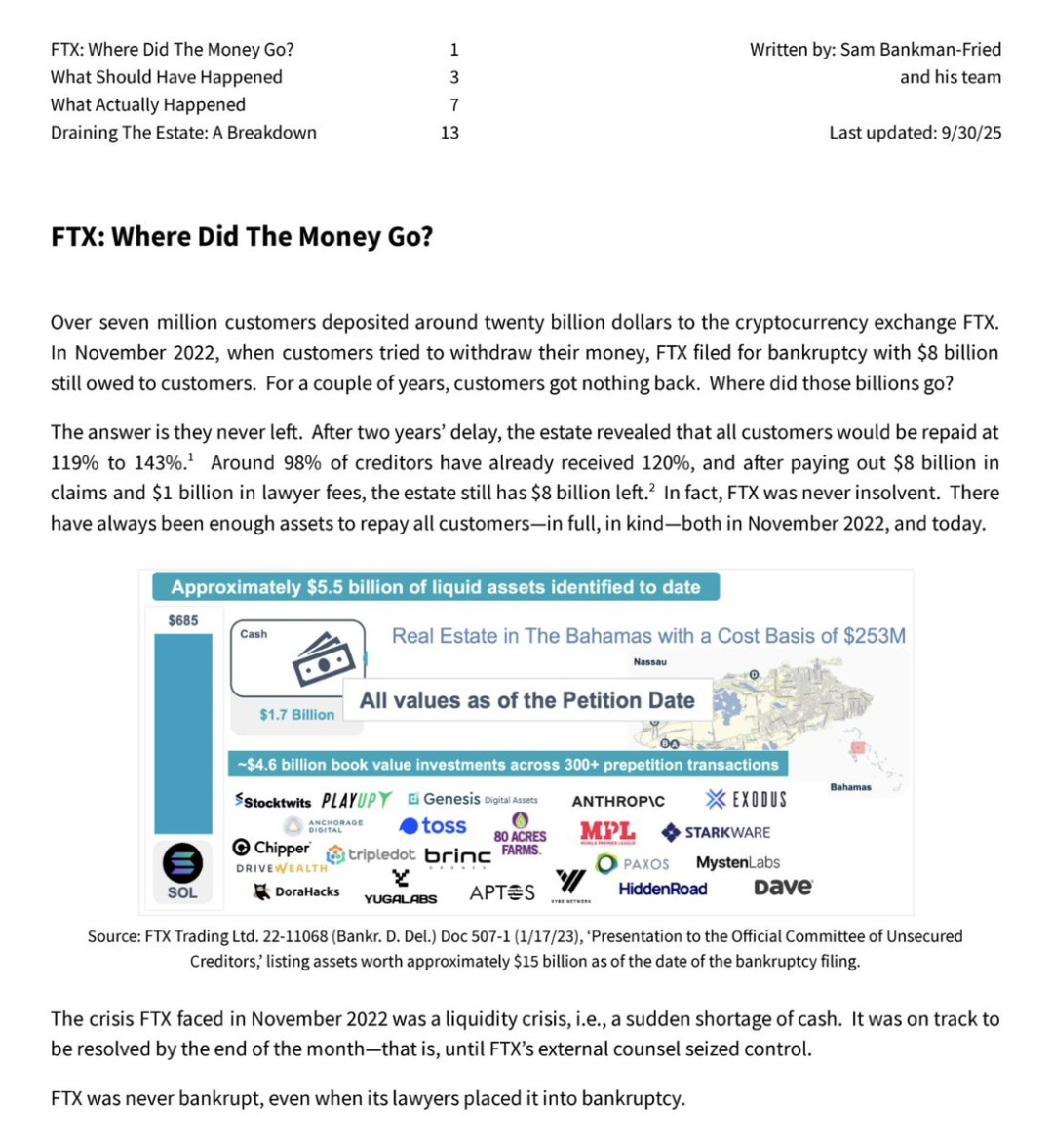
SBF publishes "FTX: Where Did The Money Go?" | Source: X
The court did not accept this logic. On June 12 this year, the U.S. Court of Appeals for the Second Circuit unanimously upheld his conviction, 25-year sentence, and roughly $11 billion forfeiture order. The ruling said whether the assets the defendant bought appreciated had nothing to do with whether he committed fraud.
He submitted a pardon application to the Department of Justice. Trump said in an interview in January this year that there was no plan to pardon him. In July, the U.S. Senate unanimously passed a nonbinding resolution saying he should not be pardoned under any circumstances. On September 10, his lawyers filed a petition for certiorari with the Supreme Court, case number 26-349; the federal government's response deadline has been extended twice and is now December 16.
When ANT opened, his case was still in line.
The $50 million from Ellison and Singh had an even more convoluted ending. After the two pleaded guilty, these shares were forfeited by the government. The prospectus disclosed a transaction: in October 2025, Anthropic bought back 4.4539 million Series B preferred shares from the U.S. government at the Series F price and resold them the same day to 9 investors for a total of about $628 million. The prospectus said only that these shares were forfeited by former holders in a legal proceeding to which Anthropic was not a party. It did not name the original holders, but the share count precisely matches the $50 million subscription by the two back then.
At the offering price, these shares are worth about $3.7 billion, nearly six times the government's sale price. According to Business Insider, the money did not go into FTX's bankruptcy estate.
Ellison was sentenced to two years in prison and released in January this year. In August, she joined Manifund, a nonprofit that connects philanthropic founders with donors; the organization had also received funding from FTX and Alameda back then. Singh did not serve time.
Flat round
After FTX collapsed, Anthropic needed new money.
In April 2023, TechCrunch obtained its fundraising deck at the time. Anthropic planned to spend up to $5 billion over the next two years training a model called Claude-Next that would be 10 times more powerful than the strongest AI at the time, with $1 billion to be spent in the next 18 months. The deck said that the company that trained the best models of 2025 and 2026 would lead so far ahead that no one could catch up in later cycles. At that time Claude was still in closed testing, with only a dozen or so partners.
According to The Information at the time, the round targeted $300 million