24H Trending Coins & News | Largest Bet in Bitcoin Options Market Shifts to $60K Puts; Over 160,000 Sign Petition Demanding Jensen Huang's Return to Nvidia (November 17)


- Key Takeaways: This Bitcoin downturn was driven by a combination of institutional spot selling, sustained ETF outflows, and high contract leverage, falling from $80K to $62K within 10 days. Insufficient market liquidity has exacerbated fragility, and the largest options bet has shifted to $60K puts.
- Key Elements:
- MARA has sold a cumulative 40,581 BTC (approximately $3.02 billion) this year, with BTC spot ETFs seeing net outflows of about $3 billion over the past two weeks, generating roughly $300 million in selling pressure per business day.
- On November 12, a whale's long position exceeding $500 million on Hyperliquid was liquidated, accelerating the decline; on Deribit, the notional open interest of $60K put options reached $900 million, surpassing that of $100K call options.
- Backpack received CFTC approval for DCM and DCO licenses and will establish the first blockchain-based derivatives exchange in the U.S., supporting perpetual contracts and 7×24 trading.
- Solana bids farewell to Mainnet Beta and launches protocol version 1.0, with Alpenglow activated, reducing transaction finality time to approximately 150 milliseconds.
- SemiAnalysis significantly revised down its AI compute forecasts, cutting its 2028 global AI accelerator capital expenditure projection by 28%, dropping to $923 billion by 2030.
- Kava's HARD Lend was exploited for approximately 53.9 million KAVA due to an accounting vulnerability; Lighter was attacked due to API key signature nonce reuse, has returned approximately 5 million USDC, and resumed withdrawals.
- Hong Kong plans to submit a bill before the end of the year to bring digital asset trading, asset management, and custody under licensing regulation; California voters passed Proposition 42 prohibiting new taxes on personal property including digital assets.

Popular Tokens on CEXs
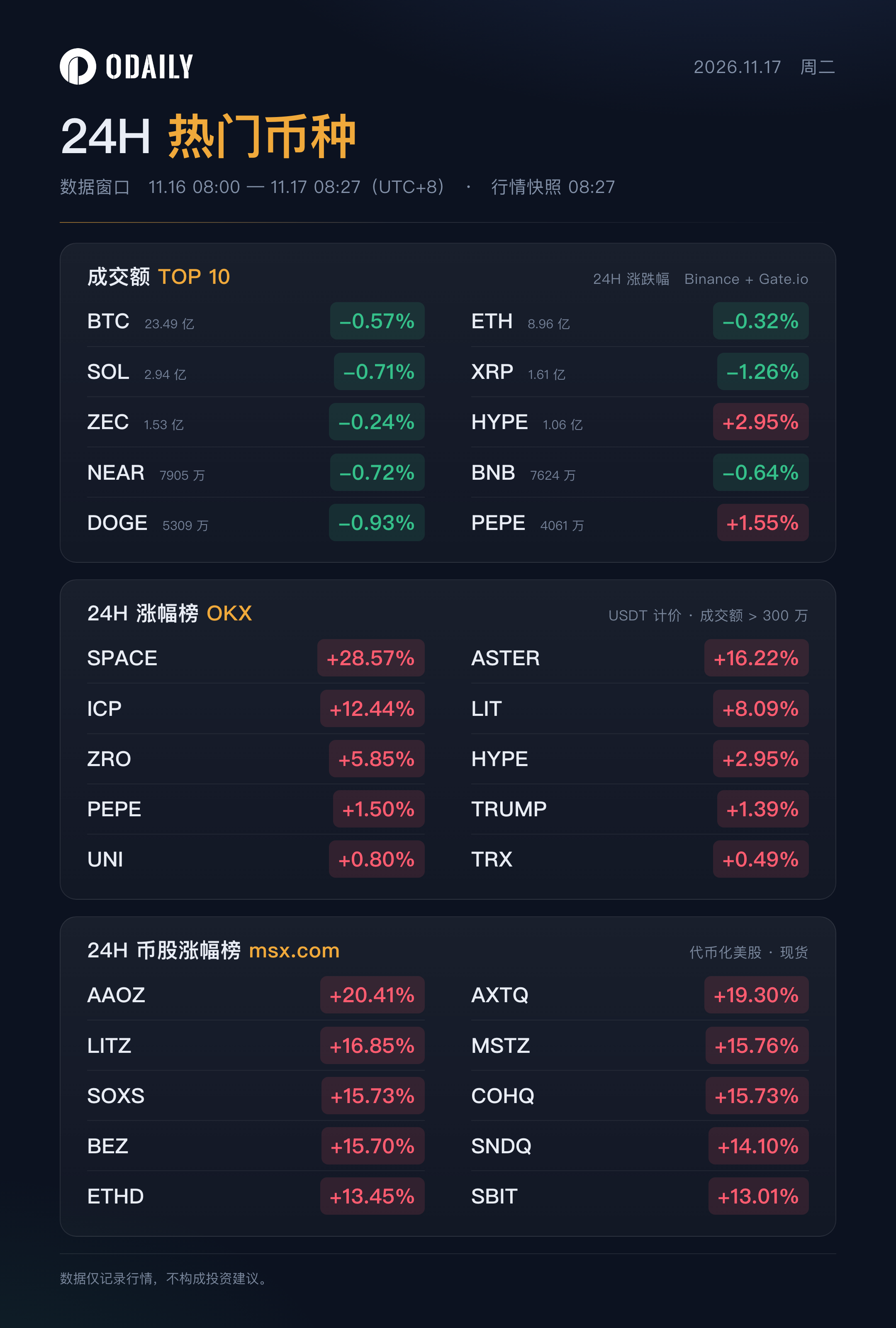
Top 10 CEX tokens by trading volume and their 24-hour price changes:
- BTC: -0.57%
- ETH: -0.32%
- SOL: -0.71%
- XRP: -1.26%
- ZEC: -0.24%
- HYPE: +2.95%
- NEAR: -0.72%
- BNB: -0.64%
- DOGE: -0.93%
- PEPE: +1.55%
Top 24-hour gainers (data source: OKX):
- SPACE: +28.57%
- ASTER: +16.22%
- ICP: +12.44%
- LIT: +8.09%
- ZRO: +5.85%
- HYPE: +2.95%
- PEPE: +1.50%
- TRUMP: +1.39%
- UNI: +0.80%
- TRX: +0.49%
Top 24-hour gainers among tokenized stocks (data source: msx.com):
- AAOZ: +20.41%
- AXTQ: +19.30%
- LITZ: +16.85%
- MSTZ: +15.76%
- SOXS: +15.73%
- COHQ: +15.73%
- BEZ: +15.70%
- SNDQ: +14.10%
- ETHD: +13.45%
- SBIT: +13.01%
Headlines
Over 160,000 Sign Petition Demanding Jensen Huang's Return to Nvidia
The petition calls on Nvidia's board to reinstate Jensen Huang as CEO and has gathered more than 160,000 signatures, with Elon Musk saying he would sign it as well. Y Combinator CEO Garry Tan has also signed the petition; more than 7,500 signatories claim to be Nvidia employees, though their identities have not been verified, and this figure represents roughly 18% of the company's total workforce. Two major Nvidia shareholders, Brad Gerstner and Gavin Baker, wrote to the board recommending that all options be kept on the table, including Jensen Huang's return. U.S. Treasury Secretary Scott Bessent, however, argued that Nvidia should look outside the company for a new CEO and said he hopes the board and outside legal counsel will respond within the next 10 days. Nvidia's board has approached Arm CEO Rene Haas as a potential successor. An Nvidia spokesperson said the company is in the process of selecting a CEO search firm and has not formally contacted any potential candidates. (Decrypt)
About 5 Million USDC Returned as Lighter Resumes Withdrawals and Explains Security Incident
According to Lighter's monitoring, Lighter released a statement on the November 16 security incident, saying that on the morning of November 16 UTC, a trader's API key was taken over by an attacker, resulting in the withdrawal of funds. The Lighter protocol, smart contracts, and infrastructure were not affected. The affected account did not use the official Lighter SDK but instead used insecure signing code; that code reused the signing nonce, allowing the attacker to derive the private key from public data. After the incident, the Guardian mechanism of Lighter's smart contracts was unexpectedly triggered, and withdrawals were temporarily paused. Lighter's security committee used this to return approximately 5 million USDC to the affected trader, and withdrawals have now resumed.
Industry News
On-chain analyst Yu Jin published a post analyzing the reasons for the recent crypto market decline, saying that this drop was not triggered by a single bearish event but by a combination of factors, including increased spot selling by treasury companies and institutions, continued outflows from spot BTC ETFs, and elevated open interest (OI) in the futures market alongside low trading activity. Yu Jin noted that MARA has sold a cumulative 40,581 BTC this year, worth about $3.02 billion; over the past two weeks, spot BTC ETFs saw net outflows of about $3 billion, bringing roughly $300 million of selling pressure on average per business day. With insufficient market trading volume and liquidity and persistently high OI, spot selling further triggered futures liquidations, deepening the price decline. The downturn accelerated further after a whale's long position worth more than $500 million on Hyperliquid was liquidated on November 12, with BTC falling from $80,000 to $62,000 in 10 days. Yu Jin believes that this decline was mainly the result of the interaction between insufficient market liquidity and institutional selling pressure, and that no single market participant could independently dictate BTC's price trend.
The AI infrastructure investment boom is showing new signs of cooling. Semiconductor research firm SemiAnalysis, in its latest model update, sharply lowered its forecasts for AI accelerator shipments, capital expenditure, HBM demand, and power demand over the coming years. The adjustments for 2028 to 2030 were particularly notable: the 2028 global AI accelerator capex forecast was cut by 28%, while 2029 and 2030 were lowered by 41% and 40%, respectively. Under the latest model, global AI accelerator capex in 2030 will fall to $923 billion from the previously forecast $1.531 trillion, a reduction of $608 billion. At the same time, the cumulative forecast for accelerator logic silicon wafer shipment area from 2026 to 2030 was cut by 17%.
Largest Bitcoin Options Bet Shifts to $60,000 Puts, With Open Interest Valued at $900 Million
Amid Bitcoin's recent decline, the option with the highest open interest value in the Deribit options market has shifted from the $100,000 call to the $60,000 put, with the latter carrying a notional open interest of about $900 million, slightly above the $867 million of the $100,000 call. Bitcoin's 30-day implied volatility index BVIV rose as high as 57.13 points on Sunday, the highest level since June, before falling back to 44 points, indicating that market tension has eased somewhat. (CoinDesk)
Project News
Backpack Approved by U.S. CFTC to Establish First Blockchain-Based Derivatives Exchange in the U.S.
Backpack announced that it has received approval from the U.S. Commodity Futures Trading Commission (CFTC) and obtained the relevant qualifications for a Designated Contract Market (DCM) and Derivatives Clearing Organization (DCO), and plans to establish the first blockchain-based derivatives exchange in the United States. According to the announcement, the approved business includes crypto perpetual contracts, supporting leveraged trading, crypto asset and fiat collateral, cross-margin, and 24/7 trading, and allowing U.S. users to access Backpack's global liquidity through a unified order book. Mark Wetjen, President of Backpack US, said the approval will help bring blockchain financial infrastructure into the U.S. regulatory framework and help shift price discovery from offshore, unregulated platforms to the United States. Backpack CEO Armani Ferrante said that as the company entered the Asian, EU, UAE, and U.S. markets, it has consistently adhered to local regulatory requirements from the outset.
Solana Network Bids Farewell to Mainnet Beta, Uniformly Adopts Solana 1.0 Protocol Version
The Solana Foundation announced that the Solana network will move from Mainnet Beta to Mainnet and adopt a unified Solana 1.0 protocol version. The change is being advanced by the Solana Foundation together with the Anza and Firedancer teams and does not involve a change of the underlying network; ordinary users need not take any action, and SOL, accounts, assets, applications, and transaction history are all unaffected. The foundation said that Alpenglow has been activated on mainnet, shortening transaction finality to about 150 milliseconds; the gradual deployment of Firedancer helps improve client diversity. The release of a protocol version does not mean that all related features are immediately activated, and developers, validators, and RPC operators still need to follow the compatible versions and upgrade guidance for each client.
Kava Chain officially disclosed that HARD Lend suffered a security incident on November 14, in which about 53.9 million KAVA was stolen. The attacker exploited a lending account accounting vulnerability to artificially inflate the value of BUSD collateral and withdrew KAVA from the lending pool through repeated borrowing and liquidations. About 49.2 million of the stolen KAVA has been bridged to BNB Chain via LayerZero. Kava said the incident only affected the decentralized lending application HARD Lend on Kava Chain, did not affect the underlying security of Kava Chain, and did not create new KAVA tokens, with user deposits generally remaining largely unaffected.
Kamino Unveils Trading Execution Algorithm ONE and Institutional Platform Omni, New App Now Live
At Solana Breakpoint 2026, Kamino announced three products: a fully rebuilt Kamino app, the trading execution algorithm Kamino ONE, and the institutional-focused automated portfolio platform Kamino Omni. The new app is now live, with more than 200 performance improvements; a new Assets Hub allows users to discover and purchase more than 100 real-world assets.
Funding and Investment
AI CRM Company Dreamteam Raises $53 Million in Funding Led by Accel
AI startup Dreamteam AI Inc. has completed a $53 million funding round led by Accel, with participation from Azim Premji's Premji Invest and Together Fund, among other institutions. The company plans to use the funds to expand its AI customer relationship management (CRM) platform business and challenge traditional CRM vendors such as Salesforce, SAP, and HubSpot. Founded in 2025 and headquartered in San Francisco, Dreamteam's core product uses AI agents to analyze customer conversations, emails, and meeting content, identify customer purchase intent, competitor developments, and potential deal risks, and automatically advance the sales process. The platform is equipped with four types of AI agents with different functions, responsible for meeting preparation, following up on commitments, identifying risks, and driving deals. The company currently has hundreds of enterprise customers three months after launching its product beta, spanning industries such as healthcare, manufacturing, and consulting. (Bloomberg)
AMD announced that it has completed its acquisition of World Labs. World Labs was co-founded by AI researcher Fei-Fei Li and focuses on developing AI models capable of creating and simulating interactive 3D environments, as well as robot learning and simulation technologies. Fei-Fei Li will join AMD as Executive Vice President and Chief Scientist, reporting directly to AMD Chair and CEO Lisa Su. AMD said the World Labs team will continue to advance foundational model research and work with AMD engineers to apply research on model capabilities to the development of future AI infrastructure, in order to support customers and developers in the open AI ecosystem.
Tether Capital Invests $15 Million in Nomad to Expand U.S. Dollar Financial Services in Brazil
Tether Capital announced on November 16 a strategic investment of $15 million in Brazilian fintech company Nomad. Nomad provides U.S. dollar accounts, international payments, and global investment services. (Tether News)
Regulatory Developments
Four U.S. Democratic Senators Question SEC's Tokenized Securities Exemptive Regulatory Arrangement
U.S. Democratic Senators Angela Alsobrooks, Ruben Gallego, Mark Warner, and Catherine Cortez Masto sent a letter to SEC Chair Paul Atkins, pointing out that the SEC's five-year innovation exemption for tokenized securities introduced in September of this year has anti-money laundering regulatory loopholes. The exemption allows eligible tokenized securities trading venues to operate without registering as securities exchanges, but does not clarify how customer identification and anti-money laundering requirements apply to the relevant transactions, nor does it specify whether platforms need to restrict token recipients. The four senators warned that investors who have completed identity verification and purchased tokenized stocks could transfer them to unverified wallets, including wallets held by overseas persons or participants in illegal activities.
U.S. Strategic Bitcoin Reserve Cannot Buy Bitcoin on the Open Market Without Congressional Approval
Bitcoin News posted on X that former White House crypto adviser Patrick Witt said the U.S. Strategic Bitcoin Reserve cannot purchase Bitcoin on the open market without congressional approval. An附加provision in the National Defense Authorization Act requires such purchases to receive explicit congressional approval. The reserve was established in March 2025 under Executive Order 14233, holds seized Bitcoin estimated at 200,000 to 328,000 BTC, and has not yet purchased any Bitcoin. H.R. 8957 passed the House Financial Services Committee in September, but it concerns custody and a 20-year holding period, not purchases; without relevant legislation, the next president could revoke the reserve by signing an executive order.
Hong Kong plans to submit a bill before the end of this year to bring digital asset trading, investment advice, asset management, and custody services under a licensing regime. On stablecoins, two of the first 36 applicants were granted licenses in April and launched a Hong Kong dollar stablecoin. The scale of tokenized funds offered to the public in Hong Kong has grown about sevenfold in a year; two tokenized money market funds have been offering round-the-clock trading on licensed platforms since last month. Paul Chan said that decentralization does not mean exemption from responsibility.
California voters have passed Proposition 42, which prohibits new taxes on personal property such as 401(k) retirement accounts, business interests, digital assets, intellectual property, and personal belongings, though real estate is excluded. The Associated Press declared the proposition passed on Friday, when about 96% of ballots had been counted, with yes votes slightly above 51% and no votes close to 49%. The proposition also prohibits retroactive taxation, except in cases where the state declares a state of emergency. Proposition 42 was originally placed on the ballot alongside Proposition 40 as a "poison pill" aimed at blocking the latter's proposed one-time billionaire wealth tax. Ultimately, Proposition 40 was rejected by voters, while Proposition 42 passed. This means that any future effort to tax personal assets would first need to seek voter approval to overturn Proposition 42. (Los Angeles