When the Crypto Engine Enters Traditional Finance: A Conversation with Bitget CFD's Head — How Did It Build a Hundred-Billion-Dollar Cross-Border Case in Ten Months?


- Key Takeaways: Crypto exchanges are accelerating the blurring of boundaries with traditional finance. Through its CFD business, Bitget has expanded into traditional assets such as gold, forex, and stock indices. Ten months after launch, its single-day trading volume peaked at $10 billion, already equivalent in scale to a mid-sized traditional CFD brokerage, with the goal of ranking among top-tier brokerages by trading volume.
- Key Elements:
- Bitget CFD launched in January this year, with trading volume growing about fourfold from the initial period. Gold accounts for 80-90% of overall trading volume, followed by U.S. stock indices and crude oil.
- It adopts a tiered leverage design: gold offers up to 2000x leverage only for small positions, and as position size increases, leverage steps down to 500x, 200x, and 100x to control risk.
- It offers four account types — zero-fee, ECN, Pro, and Standard+ — corresponding to high-frequency traders, quantitative users, institutional clients, and channel customers, enabling tiered order flow management.
- It connects to more than a dozen tier-one liquidity providers, with an order fill rate of 99.999%. In the ten-plus seconds around the release of non-farm payroll data, about 100,000 orders flooded in, with execution times of 40-150 milliseconds, and no congestion or downtime occurred.
- It carries over the crypto world's copy-trading mechanism and launches public and private lead trading, while also leveraging the MT5-based EA ecosystem and Open API, making migration costs for traditional trading teams extremely low.
- JZ admits that the biggest gap with traditional top-tier brokerages lies in trust rather than technology. Traditional users still see Bitget as a new player, and it will take time to build brand recognition.
Original | Odaily (@OdailyChina)
Author | jk

The boundary between crypto and traditional finance is becoming increasingly blurred. Leading exchanges are successively bringing gold, forex, stock indices, and US equities onto their platforms, and "all-category assets" has become the keyword of a new round of competition. From tokenized treasuries and tokenized stocks to perpetual contracts on traditional assets and CFD, exchanges have more and more pathways into traditional finance. Crypto market users are also beginning to pay attention to opportunities beyond the crypto market, with precious metals, forex, and stock indices becoming destinations for hot money.
Bitget's CFD (Contract for Difference) business, launched in January this year, is one product that has already achieved scale amid this trend. This business line's single-day trading volume peaked at approximately $10 billion, with overall trading volume growing about fourfold compared to its initial launch, a scale equivalent to a traditional mid-sized CFD broker.
CFD stands for "Contract for Difference." Through it, traders can participate in the price movements of assets such as gold, forex, and stock indices without actually purchasing or holding these assets. Traders can choose to go long or short based on their judgment of market trends, and ultimately calculate profit or loss based on the price difference between opening and closing positions.
For example, suppose gold is currently selling at $4,000 per ounce. You believe it will rise, so you buy 1 ounce of gold CFD. Later it rises to $4,100, you close the position, and you earn the $100 difference. If it falls to $3,900, you lose $100. Throughout the entire process, you never actually bought gold—no custody, no physical delivery required.
Odaily spoke with JZ, the head of CFD at Bitget, about this new product direction. JZ comes from the traditional finance industry, having worked in front office, middle office, and back office, and most of the team he now leads also comes from this circle. He claims he is not good at grand narratives, but when it comes to business, he is very down-to-earth. In his view, the significance of CFD for Bitget lies in bringing together two types of traders who previously had no connection, forming a market with greater liquidity and tighter spreads. From the original intent to the current state, JZ shared many details from the front lines of the business.
The following is the original interview:
Why Did Bitget Decide to Do CFD?
As crypto exchanges increasingly venture into traditional assets such as gold and forex, JZ believes there are two reasons behind this.
One is the changing needs of users: In earlier years, users only needed a few mainstream coins. When Bitcoin was quiet, many people felt there was nothing to do in the crypto market, but found that gold, silver, forex, and major stock indices were constantly moving. They wanted to apply their familiar trading style and macro judgments directly to these markets.
The other is the expanding scope of competition among exchanges. Many peers are expanding into more categories, and Bitget is also seeking innovation. For exchanges, this is new growth space and also a way to capture the increasingly diverse trading needs of existing users.
When we asked why they chose CFD, JZ explained that in traditional financial markets there are a large number of stock brokers and CFD brokers with a massive client base, many of whom have never touched a crypto exchange. CFD itself is a mature product with a broad audience and clear demand, making it suitable for bringing this group in. Its rules are also very simple, similar to crypto market contracts, but with clearer quotes and broader markets.
What users hold is a contract—no need to actually buy a pound of gold. Just judge the direction and settle by the price difference.
JZ told us that CFD primarily targets traditional CFD traders already accustomed to MT5. CFD and tokenized stocks are not the same thing but are complementary to each other: CFD trades a contract and settles the price difference, without needing to hold the asset; tokenized stocks trade an asset certificate backed by real asset custody. The former has a lower barrier to entry, while the latter requires more consideration around holding, custody, and compliance. Bitget has a dedicated product line for stocks.
He also gave a vivid example. Traditional CFD brokers basically only do gold and forex with limited varieties—once gold has no market movement, funds can only sit idle. Putting crypto assets and traditional assets on the same platform creates a "when one side is down, the other side is up" effect: when gold is quiet, you can trade coins; when coins are quiet, you can trade gold, forex, and indices; and when both are cold, you can still do wealth management. This is exactly what Bitget's UEX (Universal Exchange) strategy aims to achieve.
How Does It Compare to Traditional Brokers?
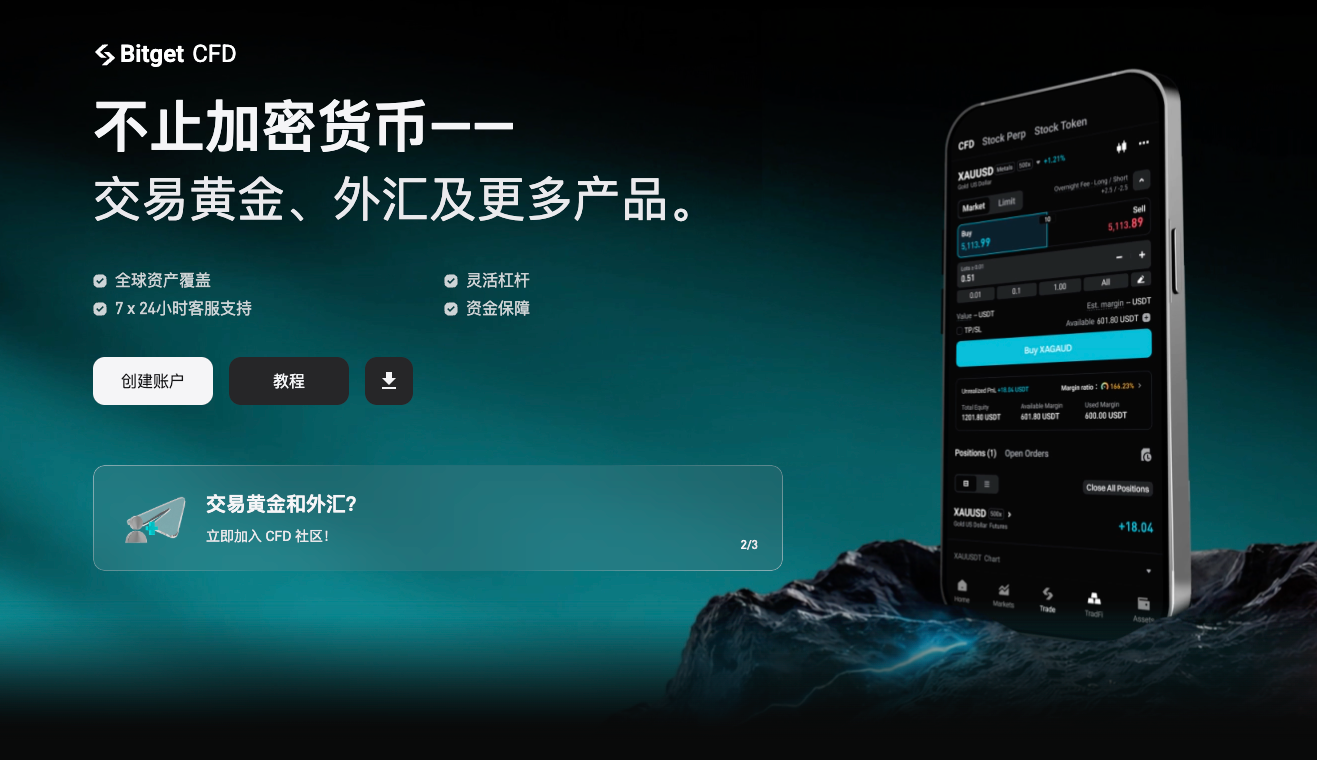
Bitget already has a certain foundation in products, technology, and global operations, but traditional CFD brokers, after years of development, have deep accumulation in professional client relationships, channel networks, and market trust. JZ very candidly said that these are not things that can be fully compensated for in the short term through product launches alone. In the traditional CFD circle, Bitget is still a new name and needs time for users to know and accept it, gradually earning market recognition through real trading experience and long-term service.
But from the perspective of the crypto industry, doing new products is something of great value. According to JZ's observation, traditional CFD clients value the trading environment, fund safety, and platform strength the most. Bitget has already done well in these areas, and combined with its technical capabilities, ecosystem of 125 million users, and global influence, these are things traditional MT4/MT5 brokers find hard to match. In his view, traditional traders are always looking for a trading platform with stronger overall capabilities, better trading experience, and more professional and reliable service—and Bitget is that answer.
Ten Months After Launch, How Far Has It Come?
JZ told us that Bitget CFD's single-day trading volume peaked at approximately $10 billion. In the CFD industry, that is already at the level of a mid-sized broker, and this business line only started in January this year. Second, compared to the initial launch period, trading volume has grown about fourfold. His next goal is to reach the trading volume of top traditional brokers.
Among the various instruments Bitget has launched so far, gold has grown the fastest, accounting for about 80-90% of overall trading volume, which is basically consistent with the overall CFD market. Next is global stock indices, mainly US stock indices, followed by commodities, primarily crude oil. JZ explained that these asset classes are all global markets heavily influenced by politics, geopolitical conflicts, interest rates, and risk appetite across countries. One tweet from Trump, and market moves are amplified exponentially under the influence of hot topics and leverage.
"But we won't be satisfied with where we are now. We will continue to reach the trading volume of top traditional brokers."
JZ told us that the bulk of trading volume growth comes from crypto users, including Bitget's existing users and those coming from other exchanges. They need more instruments to capture opportunities, and the gold, forex, silver, crude oil, and global stock indices listed on Bitget precisely meet this demand. Another portion comes from traditional CFD users. As Bitget breaks into this circle through business and sales channels, more and more traditional users are coming, and this is also an important source of incremental growth. After trying it out, these users generally find that a crypto exchange can also do CFD very professionally.
JZ believes that this is an important difference between Bitget and other crypto exchanges. Many crypto exchanges lack professional teams that understand CFD, while Bitget's team basically comes from the traditional CFD industry and is also familiar with Web3. When designing products, the needs of both types of users can be accommodated, and channels can be expanded on both sides simultaneously.
Gold with Up to 2000x Leverage?
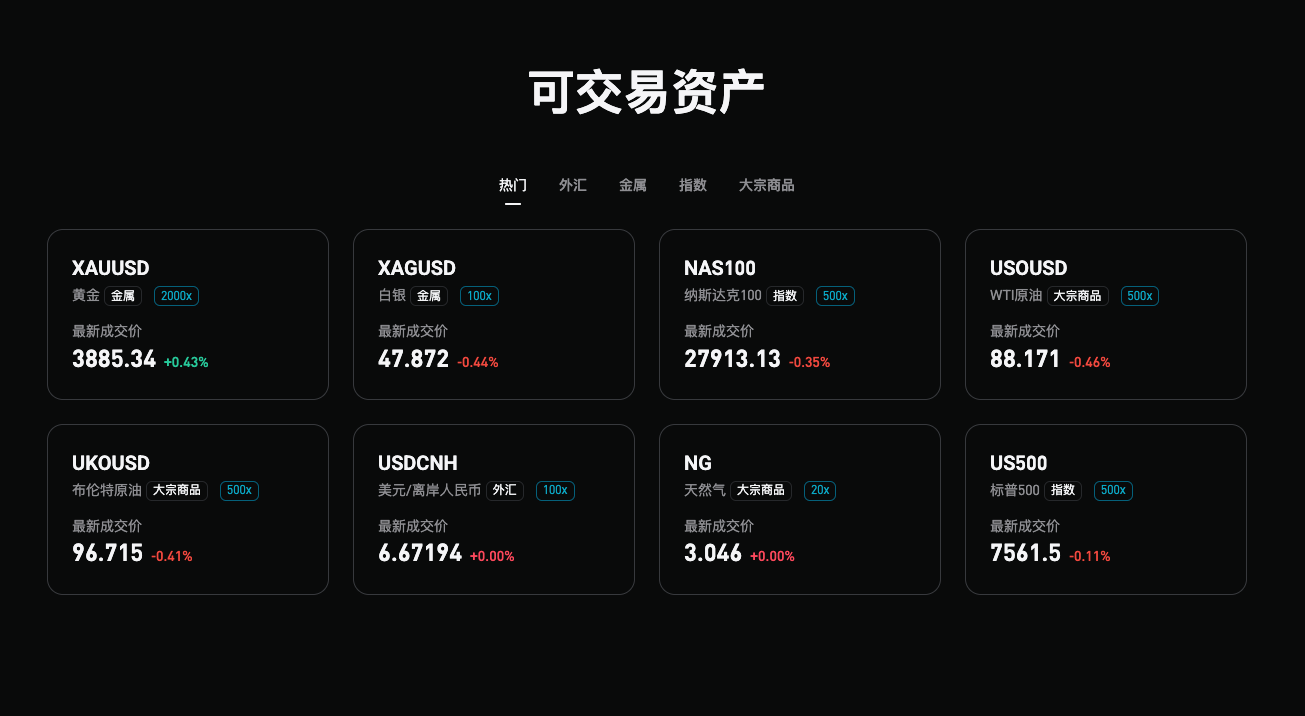
Gold with up to 2000x leverage is one of Bitget CFD's most closely watched selling points.
JZ provided a detailed explanation of the platform's 2000x leverage design: First, there is the tiered leverage design—2000x only applies to small positions, and leverage automatically decreases as position size increases: up to 2000x for small positions, then stepping down to 500x, 200x, 100x, and so on as positions grow. JZ said the platform designed it this way primarily to protect users, hoping to meet different traders' capital usage needs while implementing more prudent risk management for larger positions and leaving traders enough room to operate.
For experienced CFD users, high leverage is nothing new. They understand how high leverage works, under what circumstances they will be liquidated, and how to set take-profit and stop-loss orders, so using 2000x is no obstacle.
JZ revealed that some users even say, "Bitget, when can you offer 3000x or 5000x leverage?" However, for now, Bitget will maintain the cap at 2000x.
Four Account Types for Four Types of Traders
Bitget CFD currently offers four account types: Zero Fee, ECN, Pro, and Standard+. JZ sees this account system as a major distinguishing feature of Bitget's CFD offering among crypto exchanges, with user personas as the primary design consideration.
He roughly divides market traders into three categories. The first is high-frequency, cost-sensitive self-directed traders who prefer quick in-and-out day trading. The second is clients developed through channels, who often have KOLs or trading teams behind them. The third is the most professional, including physical gold enterprises and jewelry companies, who engage in term arbitrage, cross-market hedging, and basis trading.
ECN accounts have very low spreads with a small additional commission. This model is borrowed from the traditional forex market, which Bitget has adapted. It suits users running automated, quantitative, and programmatic strategies, who require precise entry prices and are mostly professional individual traders.
Zero Fee accounts incorporate commissions into the spread, with all costs reflected in the spread. "Some users don't want a separate commission line in their statement because it feels unclear to them—this account is designed for them."
Pro accounts are aimed at enterprises and professional institutions, with trading conditions and liquidity allocation more focused on meeting the needs of large-volume trading, institutional trading, and professional strategies. Bitget matches appropriate institutional liquidity resources based on client type and trading characteristics.
Standard+ accounts mainly serve clients acquired through IBs, KOLs, and other partner channels. Compared to other account models, it has a different trading cost structure and provides partners with corresponding service and commission space. Bitget hopes that through this mechanism, channels will be motivated to continuously invest in client education, market analysis, and customer service, thereby forming a more sustainable cooperative relationship among the platform, partners, and traders.
Account Tiering Is Also Order Flow Segmentation—Matching the Most Suitable Orders to the Most Suitable Clients
Behind account tiering is refined management of order flow. Bitget CFD's liquidity is divided into two categories: one dedicated to retail order flow and one for institutional and professional order flow. Retail orders go to retail liquidity, while enterprise clients with gold hedging needs have their orders routed to institutional liquidity.
JZ said this design draws on lessons from the industry. Different liquidity providers differ in asset coverage, quote depth, order size, and risk-bearing capacity. If all types of orders used the same liquidity allocation method, optimal execution results might not be achieved. Therefore, Bitget matches appropriate liquidity resources based on different client types and order characteristics, allowing both retail and institutional clients to obtain a trading environment better suited to their needs.
To this end, Bitget divides retail and institutional into two lines, with Pro accounts on the institutional line. According to JZ, professional and corporate clients highly rate this arrangement, and trading volume is also considerable.
Liquidity and Execution: Withstanding the Test of Highly Volatile Markets
For professional traders, spreads, liquidity, and execution quality matter far more than interface and marketing campaigns. JZ said this system has been operating in the industry for over twenty years, and Bitget has mature experience to draw on, with its overall architecture benchmarked against top traditional brokers.
Aggregated Quotes and Liquidity Design with Rewards and Penalties for LPs
Bitget CFD connects to more than a dozen tier-one liquidity providers, including banks, non-bank institutions, and high-frequency quantitative market makers. By aggregating their quotes and depth, overall liquidity is better than connecting to any single one. JZ said this has brought Bitget's spreads and trading costs to industry-leading levels, with an order fill rate of 99.999%. The team conducts long-term real-time monitoring of each LP, tracking fill rate, execution time, slippage, market depth, and spreads. Those that perform well get more orders; those that perform poorly are first urged to improve, and if they cannot, the partnership is terminated.
Whether orders go to the retail line or institutional line depends on client tiering results, based on KYC information at account opening and trading behavior analysis, with the entire process transparent to clients. He believes that directly telling clients "your trading style is better suited to which account" makes clients feel the platform is candid and more willing to commit funds and increase trading volume. He believes that only when the platform, LPs, and clients are all in a healthy state can this ecosystem operate sustainably.
A Hundred Thousand Orders Flooding In Within Seconds Around Non-Farm Payrolls
The few seconds when important data is released best test a platform's strength. Under our questioning, JZ divided Bitget's response capabilities into two parts.
One part is liquidity—the LP screening and real-time monitoring mentioned earlier. The other part is technology and hardware: trading servers, bridge systems, and LP order execution systems are all deployed in dedicated financial data centers in Tokyo, London, and other locations, with multi-location disaster recovery.
He gave an example: around each Non-Farm Payrolls release, within about ten seconds the platform sees roughly 100,000 orders flood in, and each order can basically be filled in about 40-150 milliseconds, with no congestion. Spreads widen during such times, which is the real state of the market; but so far, during NFP, CPI, and other data releases, the platform has not experienced quote anomalies or downtime, nor received slippage-related complaints. During such periods, Bitget safeguards system operations through liquidity resources, trading servers, bridge systems, and multi-location deployment, while continuously monitoring order processing, execution time, and slippage performance. To date, it has maintained high availability, low latency, and high-quality execution.
When asked whether execution data can be better than traditional brokers, JZ answered frankly: this is the level the industry can achieve—it's hard to go higher. In other words, what Bitget is telling us is that a crypto exchange can already match top traditional brokers in execution quality.
Copy Trading and Automation: Serving Different Types of Traders
Accounts, leverage, and liquidity determine whether a platform can trade; copy trading and automation tools determine who trades and how. These two features correspond to Bitget's two major user groups.
Copy Trading: Letting Skilled Traders Lead Those with Capital
Copy trading is very common in the crypto world, and Bitget is one of the first platforms among crypto exchanges to launch copy trading. The CFD business directly adopts this mechanism. Its role is to bridge the gap—on one side, people with limited capital but strong trading skills; on the other, people with capital but limited trading skills. Lead traders share strategies and earn profit sharing; followers earn returns; the platform gains trading volume—all three parties benefit. "It serves as a bridge between those who understand trading and those who don't," JZ told us.
In JZ's view, this is also a major advantage of Bitget over traditional CFD brokers. Bitget itself has a massive user base, so when an excellent trader joins, they can easily attract copy-trading users.
Bitget first launched public copy trading, where all lead traders are publicly displayed and users choose for themselves, which received very good response. Later, some lead traders raised new needs—they wanted their strategies available only to specific people, inviting their high-net-worth clients in, while also offering differentiated, customized strategies for their clients. So Bitget subsequently launched private copy trading.
EA and Open API: One Set of Code to Trade Multiple Asset Classes
Bitget chose MT5 as the trading infrastructure for CFD, largely because of its EA (Expert Advisor, automated trading program) ecosystem. According to JZ, there are currently over one million EAs on MT5, which users can select based on their own strategies and risk preferences, or write themselves. Many professional traditional CFD traders value the platform's brand and