24H Trending Coins & News | Bitcoin briefly fell to $62,000, hitting a new low since July; CZ says he bought the dip and Binance has not sold crypto assets (November 16)


- Key Takeaways: Bitcoin fell to its lowest level since July, with this round of selling pressure mainly coming from the US market. Shrinking stablecoin supply and under-pressure institutional demand indicate a loss of market purchasing power, but the protocol and consensus rules remain intact, and industry participants remain optimistic about the medium to long term.
- Key Elements:
- About 64,000 Bitcoin mining machines with roughly 13 EH/s of hash rate were redirected to the OCEAN mining pool. The attackers did not mine any blocks, the Bitcoin protocol and consensus rules were not compromised, and what failed was the operational management software.
- Coinbase's cumulative BTC spot volume difference has been declining continuously since November 9. Analysts believe the US is the main source of selling pressure; Bitcoin briefly fell toward $62,000 over the weekend.
- Total stablecoin supply shrank by $17 billion over the past month, the largest single-month decline since 2022, with market purchasing power draining accordingly.
- Binance's ETH reserves fell to about 2.9 million coins, a new low since 2021 and down nearly 42% from July 2025, possibly reflecting investors accumulating during the dip.
- At the macro level, the US 10-year Treasury yield rose above 5%, the dollar strengthened, and inflation concerns intensified expectations of Fed tightening, putting the entire market in a risk-off environment.
- MARA sold 13,597 Bitcoin over six weeks, cashing out $1.1 billion to repay debt and develop AI data centers.

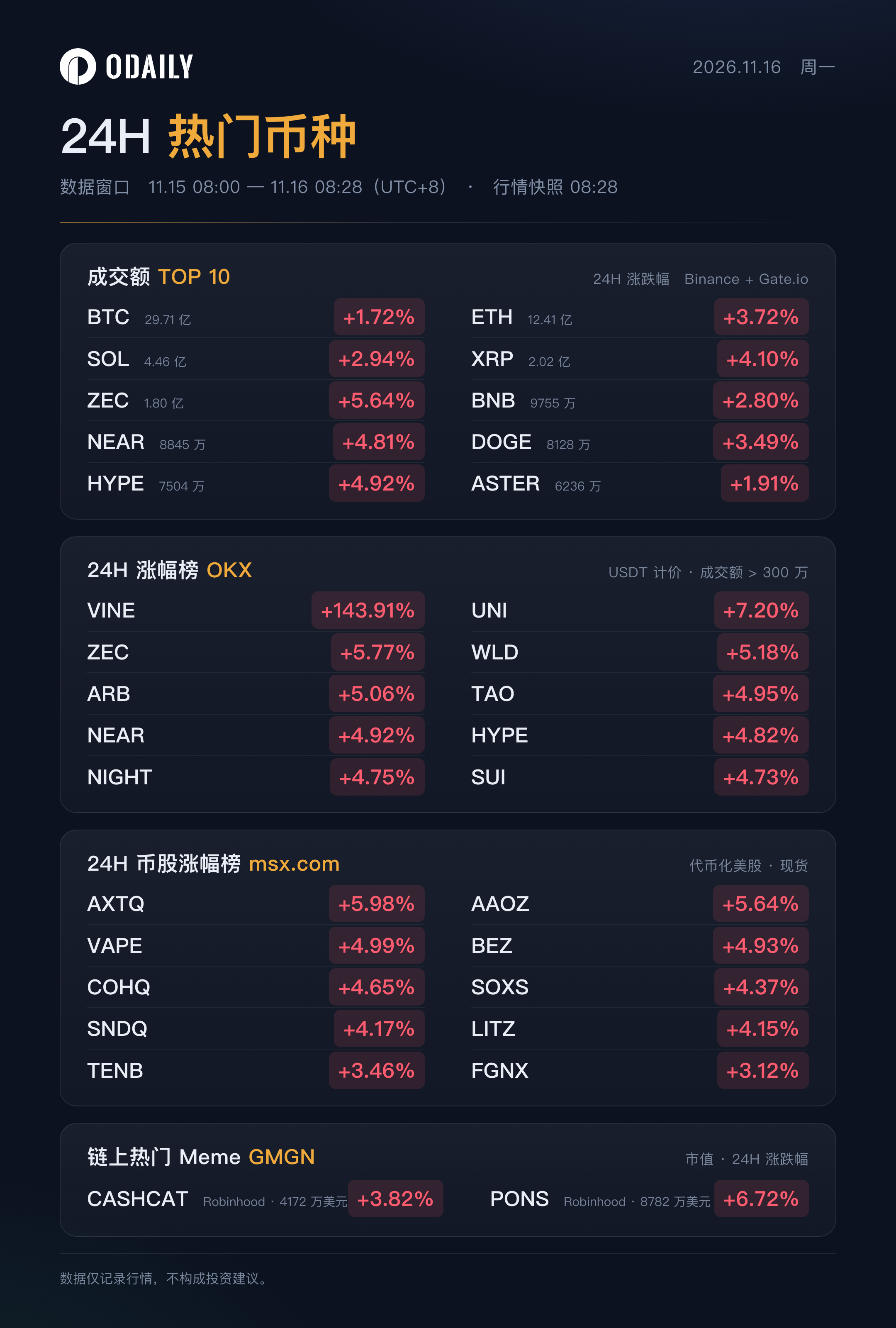
Trending Coins on CEXs
Top 10 CEXs by trading volume and their 24-hour price changes:
- BTC: +1.72%
- ETH: +3.72%
- SOL: +2.94%
- XRP: +4.10%
- ZEC: +5.64%
- BNB: +2.80%
- NEAR: +4.81%
- DOGE: +3.49%
- HYPE: +4.92%
- ASTER: +1.91%
Top 24-hour gainers (data source: OKX):
- VINE: +143.91%
- UNI: +7.20%
- ZEC: +5.77%
- WLD: +5.18%
- ARB: +5.06%
- TAO: +4.95%
- NEAR: +4.92%
- HYPE: +4.82%
- NIGHT: +4.75%
- SUI: +4.73%
Top 24-hour gainers among tokenized stocks (data source: msx.com):
- AXTQ: +5.98%
- AAOZ: +5.64%
- VAPE: +4.99%
- BEZ: +4.93%
- COHQ: +4.65%
- SOXS: +4.37%
- SNDQ: +4.17%
- LITZ: +4.15%
- TENB: +3.46%
- FGNX: +3.12%
2. Top 2 Trending On-Chain Meme Coins (data source: GMGN):
- CASHCAT (Robinhood) — A meme coin on Robinhood Chain. A BitGo developer submitted code to add the token to the public BitGoJS repository on July 27, and Robinhood listed it on August 6; the @3i team said it bought in early during this window by tracking repository changes and Wintermute's on-chain activity. Market cap $41.72 million, 24-hour gain +3.82%.
- PONS (Robinhood) — A meme coin on Robinhood Chain, listed by Robinhood in the same batch as Cash Cat. The @3i team said it sold both tokens after listing, earning a cumulative profit of over $6 million; this profit figure has not been independently verified. Market cap $87.82 million, 24-hour gain +6.72%.
Headlines
David Lawant, Head of Research at Anchorage Digital, posted on X the cumulative volume delta (CVD) for bitcoin spot trading pairs on four exchanges: Binance, Bybit, Coinbase, and OKX. The comparison showed that starting November 9, Coinbase's CVD trended downward with almost no sustained rebounds, while the other three CEXs showed no notable fluctuations during the same period, suggesting Coinbase may be an important source of selling pressure in this round of BTC decline. David Lawant said: "The selling pressure in this round of bitcoin is mainly coming from the US."
CZ: Has Bought the Dip Over the Past Few Days, Binance Has Not Sold Cryptocurrencies
CZ posted an analysis of potential reasons for the recent cryptocurrency market decline, emphasizing that no one can determine the real cause at present and that correlation does not imply causation. Regarding the medium- to long-term outlook, CZ remains bullish on the crypto industry's development and believes the crypto market will continue to grow. He added that bitcoin fell to a low of $62,006 yesterday, a price that can serve as a reference for future market trends. CZ also denied rumors that Binance sold crypto assets, and revealed that after receiving some stablecoins recently, he had bought cryptocurrencies over the past few days, joking that this might also be one of the reasons for the market decline.
Industry News
Bitcoin fell toward $62,000 over the weekend, hitting a new low since July. Unlike previous sudden crashes, this decline accumulated gradually during relatively calm trading before accelerating recently as large-scale liquidations emerged, weighing on investor confidence and leaving traders exhausted and despairing. At the macro level, the US 10-year Treasury yield rose above 5%, the dollar strengthened, and persistent inflation intensified expectations that the Fed will tighten policy. Market analysts believe the short-term direction depends largely on whether institutional demand can stabilize and whether the macro environment allows risk appetite to recover; until then, any rebound may remain fragile and market volatility will stay elevated. All financial markets are currently in a risk-off environment with rising interest rates. This bitcoin decline has erased most of the gains from the earlier rebound from below $65,000 to above $87,000, and the market is beginning to worry about whether it could fall further below this year's low of around $58,000. (Bloomberg)
Crypto analyst Darkfost posted that Binance's ETH reserves have fallen to about 2.9 million, the lowest since 2021. In July 2025, Binance's ETH reserves still exceeded 5 million when ETH was near $5,000; since then ETH has corrected over 63%, while Binance's ETH reserves fell nearly 42% over the same period. Darkfost noted that continued declines in exchange reserves may mean some investors are accumulating ETH during the price pullback and moving assets to personal wallets or using them for DeFi yield strategies. Binance's 30-day moving average net flow has also been mostly negative recently, indicating ETH outflows continue to exceed inflows. However, exchange withdrawals do not directly prove investors are accumulating. Over the long term, if exchange reserves continue to decline, it could reduce the supply of ETH readily available for sale, creating a more favorable supply-demand environment when demand recovers.
Glassnode: Stablecoin Supply Is Shrinking Rapidly, Single-Month Outflow Hits Highest Since 2022
Glassnode posted on X: "Stablecoin supply is shrinking rapidly. Over the past month, total stablecoin supply has decreased by $17 billion, the largest single-month drop since 2022. As holders convert stablecoins into fiat, purchasing power for BTC and the broader crypto market is also draining away. For a real bull market to arrive, capital must flow into the crypto ecosystem rather than continuously out of it."
Bitcoin Protocol and Consensus Rules Intact; Hashrate of About 64,000 Miners Redirected
According to OCEAN monitoring, about 64,000 bitcoin miners were compromised and roughly 13 EH/s of hashrate was redirected to the OCEAN mining pool, with the incident beginning at about 8 PM Central Time that evening. OCEAN reported that its hashrate briefly rose to about 50 EH/s before stabilizing at around 40 EH/s; the redirected hashrate later dropped to about 100 PH/s, with most affected miners pulled back or going offline within a short period. All redirected output flowed to a single payout address controlled by an attacker, but the attacker did not mine any blocks and the address received no payments; the lost revenue of the affected miners cannot be recovered. Hosting provider CoreX Hosting was the first to notify operators, saying it discovered unauthorized changes to the mining pool settings of affected machines. One operator said the entire mining operation was affected and suspected the entry point was the miner fleet management software Luxor Commander, though this link is unconfirmed. There had been reports of unauthorized mining pool setting changes in the days before November 14, suggesting the incident may not be isolated. The bitcoin protocol and consensus rules were not compromised; what failed was the operational software connecting mining companies to hardware.
Project News
South Korean exchange Coinone announced that the server of its outsourced customer service provider MetaM was accessed by an external attacker without authorization in the early hours of November 12. Coinone received a report from the provider at about 9:20 that day; MetaM said its customer service was interrupted at 6:03 and discovered anomalies afterward, confirming unauthorized access to phone numbers and consultation conversations, and reported the matter to the Korea Internet & Security Agency on November 13.
Kava Lend Attacker Borrowed About 55.2 Million KAVA, Worth About $3.76 Million at Pre-Attack Prices
According to on-chain analysis monitoring, an attacker borrowed about 55.2 million KAVA from Kava Lend, the native lending protocol on the Kava chain, on Friday evening, worth about $3.76 million at pre-attack prices. The attacker squeezed the net supply of the nearly idle BUSD market to a minimal value, inflating the deposit value by about 243,000x within roughly 3 minutes, then used the inflated collateral to borrow KAVA in 127 separate transactions and used a second account to liquidate each loan to bypass the borrowing cap. About 49.2 million KAVA was bridged via LayerZero to BNB Chain, most of which was sold for about $2.09 million in BNB and USDT. On-chain data shows the attacker had been repeatedly testing the market since November 8. Kava previously stated that the incident was not unlimited minting and that the impact was confined to Kava Lend.
Forward Industries Denies That Transfer of About $123 Million in SOL Was a Company Action
According to Forward Industries monitoring, at 8:58 PM ET on November 14, the company denied that the transfer activity of about 1.78 million SOL was its own and said it did not execute the transaction. On-chain records show two transactions withdrew about 1.78 million SOL from two staking accounts to the same wallet; 50 seconds later, that wallet transferred out about 1.88 million SOL, including another 102,000 SOL in staking withdrawals. On-chain records can only prove that the wallet was authorized to withdraw; they cannot independently prove that Forward Industries controlled the signing wallet. The disputed amount represents about 20% of the company's disclosed SOL treasury, but does not mean its holdings have been confirmed to have decreased. The two transfers did not show any execution, and a Coinbase Prime label does not prove a sale occurred.
Solana Co-Founder Responds to Node Resource Debate: Full Nodes Can Run with Very Low Compute
Solana co-founder Toly posted today in response to Bankless co-founder David Hoffman's earlier discussion on blockchain resource requirements, saying Solana has already achieved the relevant goals and demonstrating a running test: a Solana mainnet full node, using less than a single CPU core of a tablet and connected via a 5G network, took only 10 seconds to go from zero to catching up with the latest block on the chain and participating in voting, a process that also included parallel compilation (make -j) and initial snapshot sync. Previously, Toly said in 2023 that running Solana would cost less than all EVM chains combined and process more transactions than all EVM chains combined. At the time, David Hoffman responded that Solana had not yet made sufficient efforts to lower the barrier to running nodes, emphasizing that reducing resource requirements is an important cultural requirement for the long-term operation of blockchain systems, and arguing that blockchains with lower resource requirements are more sustainable.
Cashing Out $1.1 Billion in Six Weeks: MARA Sells 13,600 Bitcoin and Plans Further Sales
GSR Head of Content Frank Chaparro posted that MARA sold 13,597 bitcoin over six weeks, cashing out $1.1 billion, and plans to sell more. MARA had said it would hold its bitcoin reserves; this sale is intended to repay debt and fund the development of AI data centers.
Funding and Investment
21 Banks Pledge About $270 Million for Project Faro
A banking consortium of 21 institutions has pledged about $270 million for the US dollar stablecoin project Project Faro. Goldman Sachs, Citigroup, Santander, and Deutsche Bank are reportedly participating. The project is scheduled to launch in 2027 and will be operated by a US-registered issuer. (Decrypt)
Regulatory Developments
Hopes Fade for Substantive US Crypto Legislation This Year; Industry Looks to New Congress
Multiple US crypto industry figures expect little substantive progress on crypto legislation during the final weeks of the current congressional session (the "lame-duck" period between the election and the start of the next Congress on January 3). Cody Carbone, CEO of the Digital Chamber, said there is little hope of further progress on the CLARITY Act, and lawmakers appear to be shifting attention to other matters. With Democrats set to gain more control in the next Congress after the midterms, Republicans have limited time left and Democrats lack incentive to make major compromises now. A few issues may still attract attention, including crypto tax rules, granting the US Commodity Futures Trading Commission (CFTC) more authority to oversee crypto spot markets, and expediting permits for data center construction. Among these, a bipartisan bill on data center permitting has passed an initial procedural step in the Senate, but some bitcoin mining companies are divided over provisions that may require them to bear grid expansion costs and higher energy fees.
Gate: Indian Police Judicial Freeze Case Still Under Review, No Assets Handed Over to Police Yet
Gate released a statement on the handling of the case involving its users whose assets were judicially frozen by Indian police, saying that since receiving the asset freeze request from Indian police in September 2025, its AML team and legal department have repeatedly asked the police to supplement relevant evidence and have reviewed the case on a case-by-case basis. After receiving a request related to asset handover in April 2026, Gate still did not commit to executing it, instead continuing to request supplementary materials, explicitly adhering to case-by-case review and declining to directly commit to asset handover. As of now, the case remains in the judicial review stage, and Gate will continue to hold the relevant funds and will not transfer them lightly while users contest the matter, while continuing to assist users in resolving the issue.
Lummis: Democrats Oppose Consumer Protection Provisions of the CLARITY Act
Cynthia Lummis posted that Democrats had previously demanded a mandatory SEC review mechanism requiring crypto projects to submit relevant information to the SEC and complete certification before offering products to the public. The CLARITY Act incorporated this requirement, but Democrats ultimately voted against the bill. Lummis believes this means