


From $2 Trillion Expectations to a Sprint Toward $1.5 Trillion: Anthropic's IPO Hits an Upside-Surprise CPI and Near-5% Treasury Yields, as AI Pricing Matures


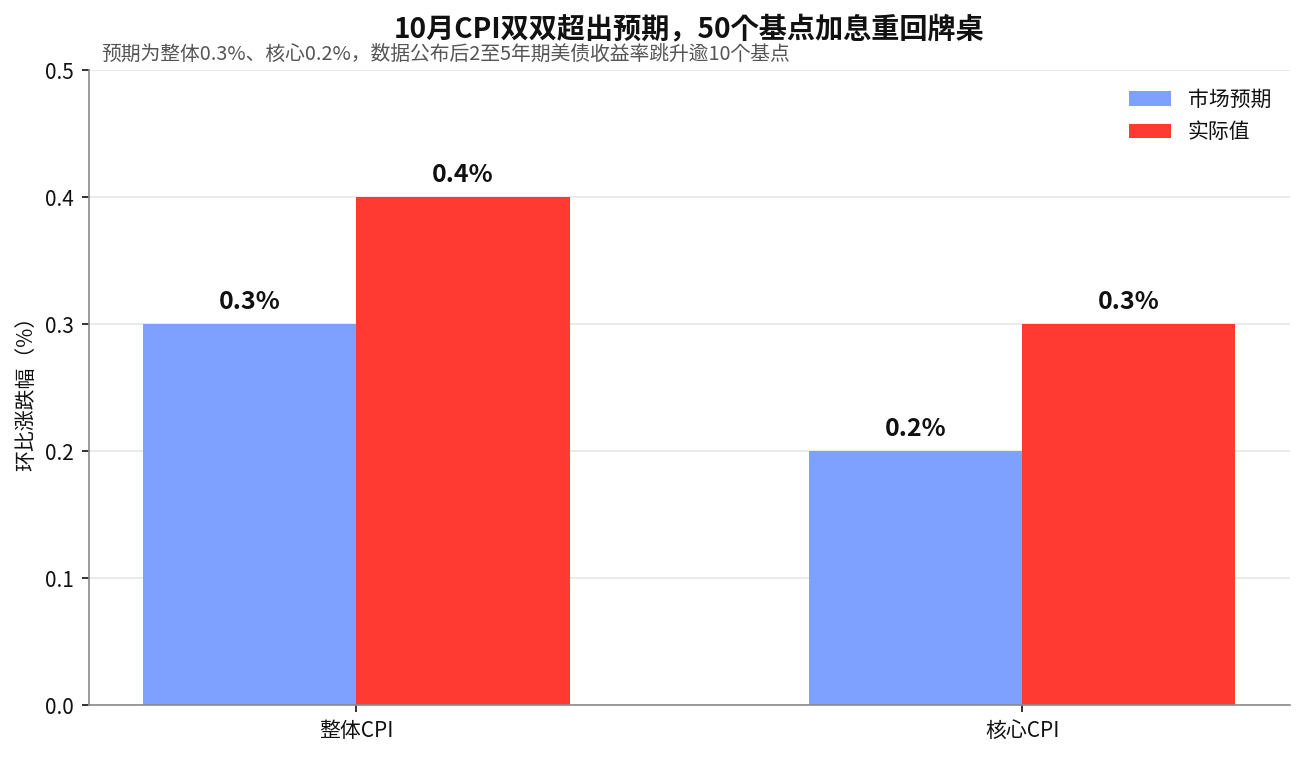
On the evening of November 10 Beijing time, US October CPI rose 0.4% month-over-month overall and 0.3% on a core basis, both above market expectations. The 10-year Treasury yield closed at 4.998%, approaching the 5% threshold. On the same day, Anthropic officially launched its IPO roadshow, setting its offering price range at $70 to $78 per share, which at the upper end corresponds to a market value of approximately $1.02 trillion based on post-offering share count. Yet as recently as late October, the market was still discussing a record valuation of $2 trillion.
On the evening of November 10 Beijing time, CPI came out first. On the same day, Anthropic began its roadshow with a valuation table that had been repeatedly refined. The two events landing on the same day reflect a change in the price of money—and the question of whether AI's long-term story can still be sold at yesterday's price.
1. CPI Lands, Money Gets More Expensive Again
What's truly worth watching about October CPI is not how striking the 0.4% figure is, but that it once again interrupted the market's smooth expectation of continued disinflation and a shift toward looser policy. Headline CPI rose 0.4% month-over-month, lower than September's 0.6% but above the 0.3% market expectation. Core CPI rose 0.3% month-over-month, also above the 0.2% expectation. No price data was collected during the October government shutdown, and this report still lacks a comparable official year-over-year reading, so the month-over-month figure carries more concentrated weight for pricing.
The bond market's reaction was blunt. The 10-year Treasury yield rose from 4.879% the previous trading day to 4.998%, once again approaching the 5% threshold, while 2-year to 5-year yields also climbed noticeably. The market subsequently revived discussion of a possible large rate hike in December. Regardless of where the policy rate ultimately heads, the most important change in this round of trading is that the market has begun to take the "higher rates for longer" scenario seriously.
For traditional value stocks, rising rates may not shake the foundations of valuation. For a company like Anthropic, it's different. Its revenue is growing rapidly today, but a considerable portion of its value is built on revenue and cash flow many years into the future. When rates rise, future money discounted to today takes a bigger haircut, and the market will naturally demand more certain growth—or a friendlier price.
That's why CPI and the Anthropic IPO appearing on the same day deserve to be viewed together. One re-prices money; the other re-tests how much AI assets should sell for.
2. How the $2 Trillion Quote Was Walked Back
What's most worth watching about Anthropic's IPO is not the final offering price itself, but the rapid shift in the market's psychological price point over less than a month. In late October, after the company filed its S-1, the market briefly discussed a listing valuation of about $2 trillion. By November 3, the buyer discussion range reported by media had fallen to $1.5 trillion to $1.6 trillion. After a sharp selloff in tech stocks, potential investors continued to reassess, and by around November 8 the discussion range had dropped to $1.1 trillion to $1.3 trillion. On November 10, the company officially announced 825 million Class A shares with an offering range of $70 to $78; based on approximately 13.087 billion post-offering shares, the $78 upper limit corresponds to a market value of about $1.02 trillion, and the $74 midpoint to about $968.4 billion.
The real negotiating space in this roadshow lies between buyers' psychological price of $1.2 trillion to $1.3 trillion and the underwriting syndicate's $1.5 trillion target. Both figures above are calculated on the post-offering share count stated in the prospectus, excluding options and restricted stock. According to Reuters, when employee options, restricted stock, and shares reserved for the charitable donation matching program are included, the $78 upper limit corresponds to a fully diluted valuation of about $1.4 trillion—still slightly below some investors' expectations. Market participants say the underwriting team is pushing to move the overall valuation toward $1.5 trillion (all figures are from reports and accounts dated November 10).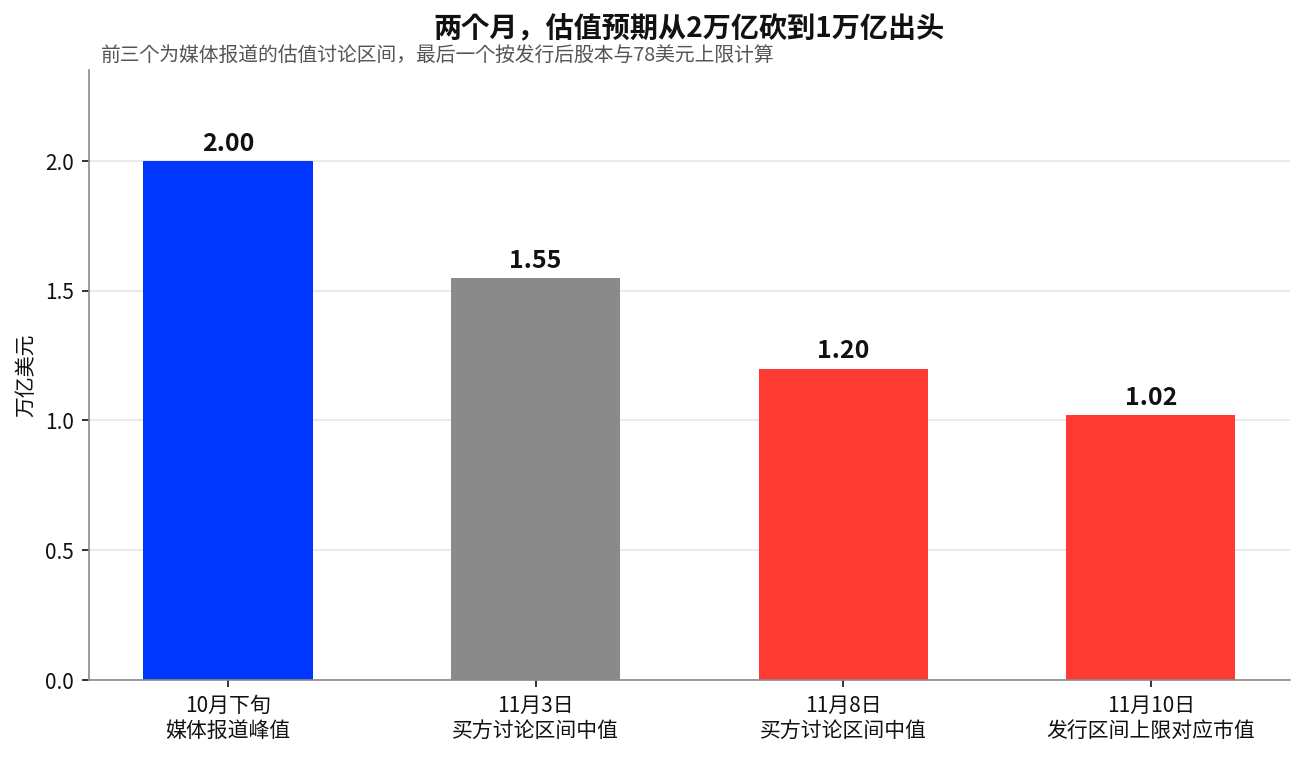
Rather than saying Anthropic "fell from $2 trillion to $1 trillion" in a short period, it's more accurate to say the market's valuation tolerance for it underwent several rounds of downward revision. The $2 trillion figure was a high-end expectation discussed by the market before the listing; $1.02 trillion is the upper end of the range the company formally provided during its roadshow. The two aren't calculated exactly the same way, but placed on the same timeline, the change is clear enough.
Looking at it through a revenue multiple makes it more intuitive. Against roughly $81 billion in annualized revenue in October, $1.02 trillion implies about 12.6 times. Calculated on the earlier $2 trillion market discussion valuation, the multiple approaches 25 times. What the market compressed is precisely that premium. In other words, buyers aren't refusing to pay an AI premium—they're just paying it with more discretion.
This is also the most valuable signal from this IPO. The market didn't bid prices up indefinitely just because revenue growth was spectacular; instead, it began putting revenue growth, profit margins, capital investment, and financing needs on the same spreadsheet and recalculating. Only a market that does the math can sustain a healthy bull market.
3. Revenue Racing Ahead, Bills Locked In First
Looking at revenue alone, Anthropic remains a growth company with tremendous momentum. Third-quarter revenue was $16.96 billion, versus about $1.38 billion a year earlier—roughly 11 times year-over-year growth. That's 47% quarter-over-quarter growth, with October annualized revenue further reaching about $81 billion. Market demand for Claude hasn't disappeared because of the valuation discussion cooling; enterprise customers and developers are still rapidly increasing usage.
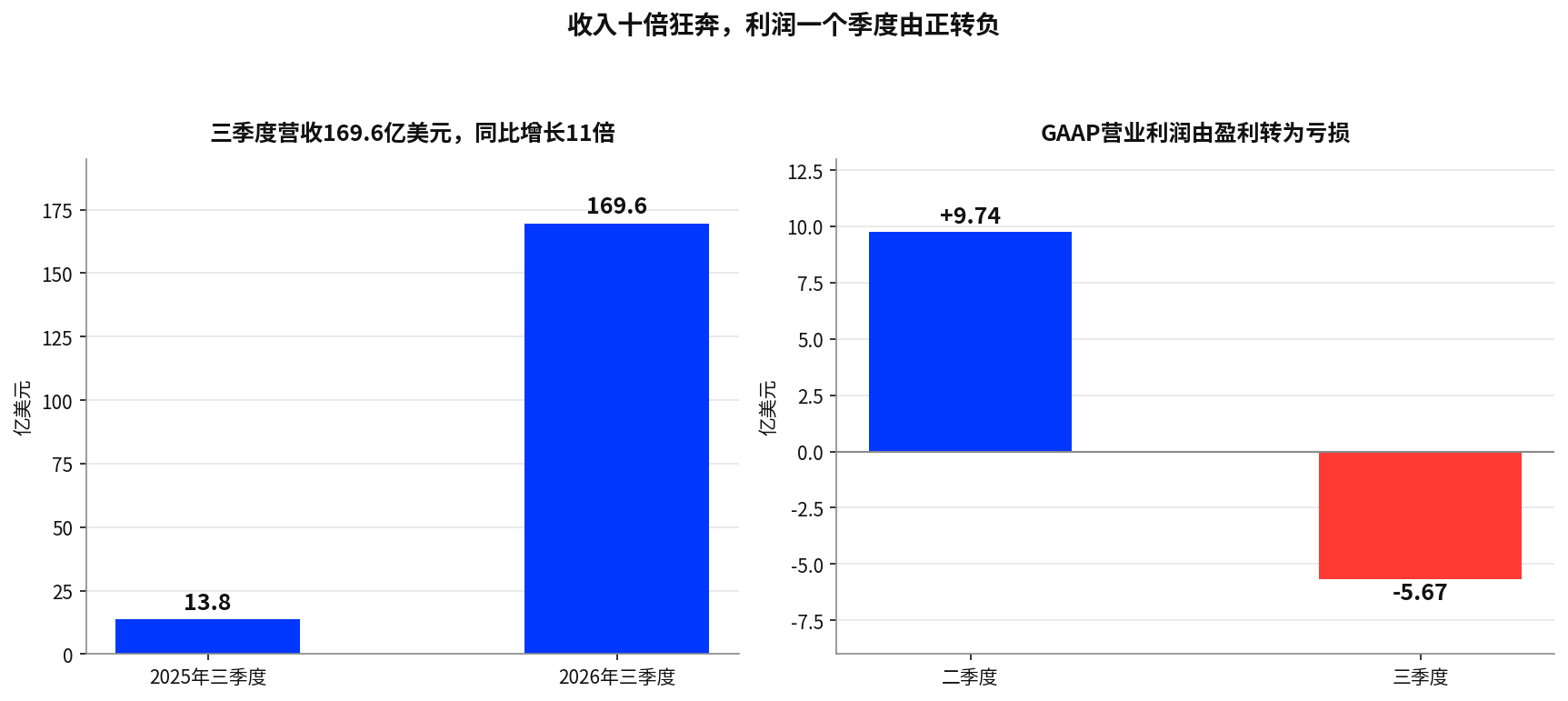
What's making buyers cautious is the income statement and cost structure. In the second quarter the company still recorded $974 million in GAAP operating profit; in the third quarter it swung to a $567 million operating loss. Revenue is growing at high speed, but profit isn't expanding in sync. The most direct explanation is that the compute investment required for model training and inference is simply too large.
The key isn't the short-term loss, but that a considerable portion of costs must be locked in ahead of time, while revenue realization requires continuous validation. The prospectus discloses that the company has signed a large volume of purchase and lease commitments totaling about $900 billion, of which roughly $447.5 billion will come due before 2030. Third-quarter short-term compute spending was about $5 billion, with cumulative short-term compute contracts of about $24 billion.
In other words, what Anthropic faces isn't the ordinary software company problem of "revenue rising fast, profit arriving late," but the economics unique to AI infrastructure. The stronger the model, the greater the demand, and the greater the compute consumption. Revenue growth must consistently run ahead of compute costs for scale to compound smoothly. What the market needs to verify has never been "does anyone use Claude," but whether Claude's commercialization can consistently outrun the growth of its compute bills.
4. How to Read the $900 Billion in Commitments
How much can Anthropic raise at most in this IPO? 825 million shares at the $78 upper limit comes to about $64.35 billion, plus about $26 billion in private placement, for a total of roughly $90.4 billion.
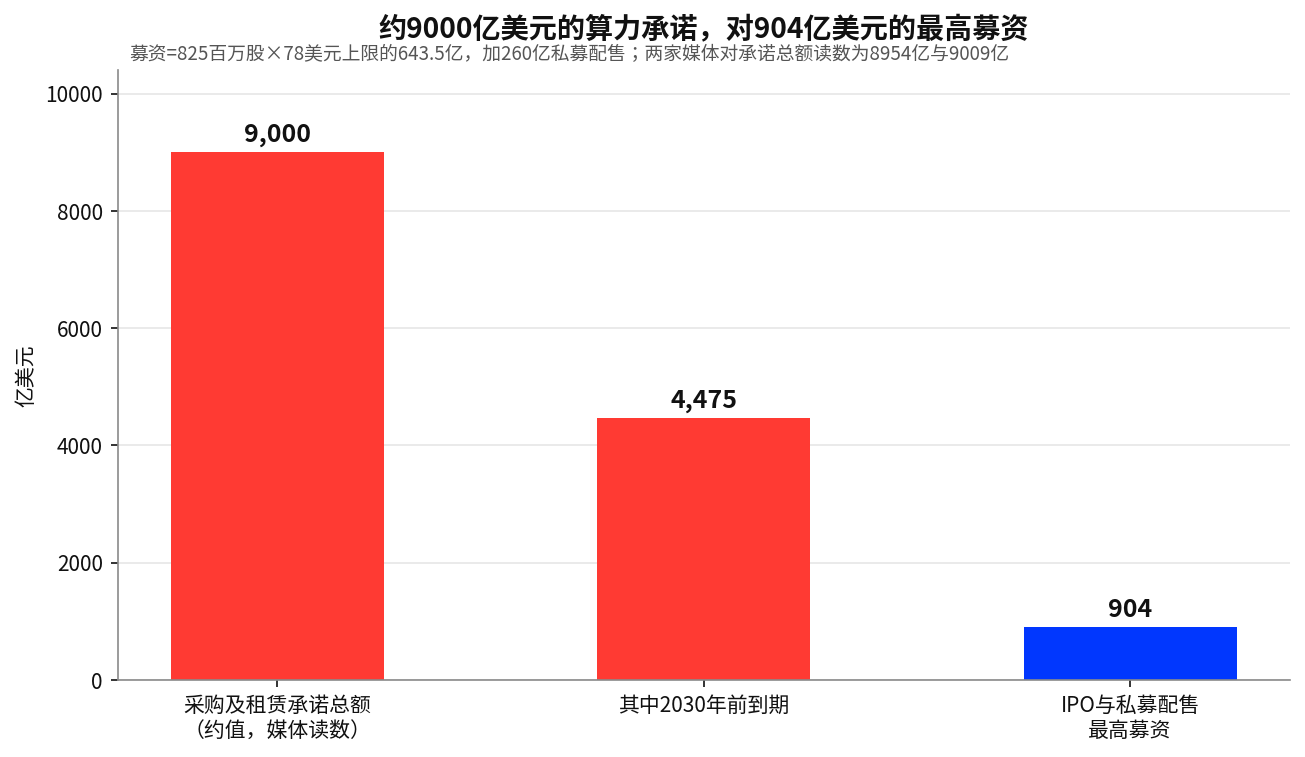
Putting $90.4 billion next to the roughly $900 billion in commitments isn't meant to simply conclude that "the fundraising can't cover the contracts." These commitments differ in term, payment structure, and funding source, and can't be read as a single cash expenditure table. What it truly tells the market is the magnitude of Anthropic's future capital needs. IPO proceeds matter, but to support years of compute investment ahead, the company will also need revenue to keep materializing and, if necessary, to return to capital markets.
This is also the biggest difference between Anthropic and an ordinary internet IPO. The exam question for traditional software companies is whether user growth can turn into revenue. For frontier model companies there's an extra layer: while revenue grows at high speed, they must simultaneously invest in compute to maintain product performance, train next-generation models, and meet customer demand. If revenue keeps growing rapidly, these investments will be absorbed by an ever-expanding commercial scale. If revenue growth slows while the signed commitments remain, pressure will surface.
The "safety cushion" buyers want is also clear. It's not whether Anthropic makes money today, but whether in the coming years it can prove that revenue growth will ultimately pass through compute costs and become sustainable free cash flow. A company forced to grow up this way by the market is, over the long run, more robust.
5. Founders Give Up Only a Small Slice
There's another detail of this IPO that's easily amplified by emotion: the proportion of secondary shares sold is very low. Of the 825 million shares offered, about 801 million are newly issued company shares, and about 23.65 million are secondary sales, all from the seven co-founders. At the $74 midpoint, each founder is selling about $250 million in shares, for a total of about $1.75 billion. Based on the holdings disclosed in the prospectus, each is selling about 1.4%, with the vast majority of shares retained.
This structure has real benefits. This isn't an IPO primarily meant to let early shareholders cash out and exit; the vast majority of proceeds go to the company, not to old shareholders' pockets. For an AI company that will need to invest heavily in the future, this matters a great deal. But it also shouldn't be read as "founders proving with real money that they're extremely bullish at $78." They're selling only a small proportion, which can be understood either as continuing to tie themselves to the company's long-term value or as exchanging some cash in a private market with limited liquidity while retaining most of the upside.
What's truly worth watching is when and at what price the remaining over 98% of holdings will enter the market. The short-term offering structure addresses immediate supply; medium- and long-term valuation will ultimately depend on whether revenue, profit, and cash flow can keep up with expectations.
6. AI Pricing Is Shifting, and Anthropic Will Affect Pricing Across the Entire Industry Chain
Over the past two years, AI assets have most easily commanded a premium, on the grounds of large demand, fast iteration, and broad space. As long as revenue growth kept beating expectations, the market was willing to discount more distant profits into today.
Now the environment has changed. Rates are again approaching 5%, AI infrastructure investment has reached the hundreds-of-billions-of-dollars scale, model companies' compute commitments run into the hundreds of billions, and the market naturally wants to ask more concrete questions: Can revenue growth cover capital investment? When will investment turn into free cash flow? Anthropic happens to concentrate these questions in a single company. It has extremely strong revenue growth and enormous capital needs. It has proven that AI applications have real commercial demand, and it has also shown the market that the commercialization of frontier model companies doesn't mean the capex cycle is over.
So the real change in this IPO isn't "AI falling from $2 trillion to $1 trillion," but AI valuation shifting from "how big can it become in the future" to "how much must be invested first to get that big, and how much of that investment can ultimately be recovered." This is also the significance of viewing CPI and the Anthropic IPO together: CPI sets the price of money; the IPO sets how high a premium the market is willing to pay for growth. One governs cost; the other demands proof. Both are pushing AI trading in a more solid direction.
If Anthropic can ultimately complete its offering smoothly around $1 trillion and hold steady, the signal isn't that "the AI bubble is over." On the contrary, it would show that capital is still willing to give frontier AI companies very high pricing, just with clearer conditions attached: revenue growth must be fast enough, commercialization must keep progressing, and capital investment must ultimately turn into cash flow. If valuation continues to be revised down during the roadshow, or if the stock clearly breaks issue price after listing, the impact won't stay confined to Anthropic. The market will re-examine the entire chain related to AI capex, including GPUs, cloud computing, data centers, Neoclouds, and the long-term procurement contracts around these companies.
In the past, the market could keep raising prices upstream along "AI demand growth"; once model companies' commercialization begins to be constrained by the cost of capital, upstream order growth will also face new scrutiny. This doesn't mean Nvidia, cloud providers, or data center assets will fall, but their valuations will henceforth have to answer a more concrete question: Can the cash flow ultimately created by the AI industry outrun the capital invested across the entire chain? Companies that can answer this will secure a firmer position in the new round of pricing.
7. Final Thoughts: AI Hasn't Changed, but the Way It's Bid Has
What's most worth watching about this IPO is its timing: on one side, October CPI came in above expectations and the 10-year Treasury yield is approaching 5%. On the other, one of the world's most closely watched AI companies has formally entered the pricing stage. Far-forward expectations that could once be masked by low rates and high risk appetite must now withstand the test of a higher cost of capital.
So what Anthropic faces isn't "does AI still have a story," but how expensive AI's story can be sold for. If the company can secure stable institutional demand around $1 trillion and continue to prove through revenue growth that compute investment ultimately turns into profit and cash flow, this valuation contraction looks more like a healthy re-pricing. AI isn't over; the market is simply demanding a thicker margin of safety—and a thicker margin of safety is precisely what gives a long-term rally the confidence to run far.
If the offering price still can't attract enough buyers, or if the stock keeps breaking issue price after listing, what the market will need to re-examine isn't just Anthropic, but the pricing habits the entire AI industry chain has built over the past two years. AI's long-term logic hasn't changed because of one CPI print or one IPO, but the way capital markets bid for AI stories is changing. In the past everyone cared more about "how big can it grow in the future"; now they must answer another question: to achieve this growth, how much must be invested today, and when will that money come back. Companies that can answer this question well will be the true protagonists of the next round of the market.
Disclaimer:
This content is intended for general informational and market commentary purposes only, based on public information compiled as of the time stated herein, and relevant market data, expectations, and probabilities may change as market conditions evolve. The views and investment strategies of third-party institutions, analysts, or other persons cited herein represent only the views of the relevant third parties at specific times and do not represent the views or recommendations of BIT. This article does not constitute investment advice, investment research, an offer, solicitation, or recommendation of any securities, investment products, or trading strategies, nor should it serve as the basis for any investment decision. Financial markets involve risk; securities prices and market performance may fluctuate, and historical performance and past market trends do not represent or guarantee future results. Investors should independently assess relevant risks based on their own circumstances and seek professional advice when needed.





