


As protocols "move back to mainnet" one after another, how does Ethereum's value logic change?


- Core Viewpoint: As Ethereum mainnet scaling accelerates and Gas costs drop significantly, projects are returning to mainnet from self-built L2s. The role of L2 is shifting from "the only scaling solution" to differentiated execution environments, and ETH's value logic is also shifting from fee burning to a decentralized settlement asset and staking-based economic security.
- Key Elements:
- ENS abandons Namechain and returns to mainnet; domain registration Gas costs fell about 99% over a year, from nearly $5 to less than $0.05.
- Projects such as Synthetix, Trueo, ShapeShift, Superseed, and Nillion have successively migrated back from L2s or scaled back to the Ethereum mainnet.
- Blast ceases operations because maintenance costs exceed revenue, Abstract announces it will shut down its network in December, and the standalone L2 business model is under pressure.
- Most L2s remain at Stage 1, and progress toward Stage 2 is far slower than expected; some L2s may proactively remain at Stage 1 for the long term.
- Synthetix adopts a hybrid architecture: assets are custodied in L1 contracts, order matching is handled by an off-chain CLOB engine, and batch settlement is written back to mainnet.
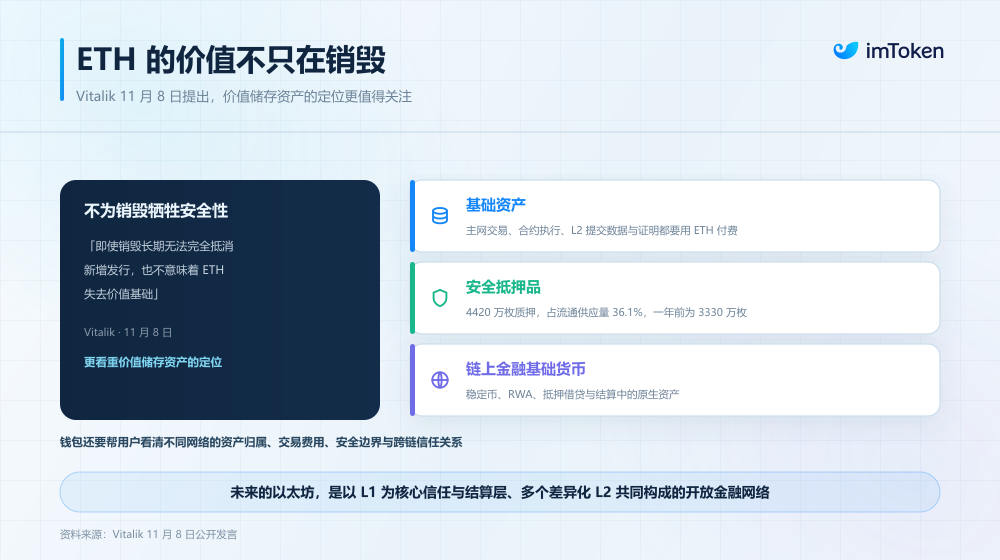
- Vitalik believes ETH's value should be based on decentralization and CROPS properties, and that fee burning may offset only less than 10% of break-even issuance in the long run.
Is L2 cannibalizing L1's value? Is Ethereum losing its global composability?
During the two years when the Rollup narrative was at its peak, this kind of anxiety pervaded almost the entire Ethereum community. The market logic at the time was that since mainnet transaction costs were getting higher and higher, more applications, assets, and users should be migrated to independent L2s.
However, entering 2026, things began to show some interesting changes.
From Synthetix deploying its new perpetual futures exchange back to Ethereum mainnet, to ENS abandoning its long-planned Namechain, to projects like Trueo and Superseed重新 choosing L1, project teams seem to feel that maintaining an independent L2 is no longer an optimal solution.
Even some L2s have begun to experience operational contraction or even shutdowns. In early October, Blast, which once had over $2 billion in TVL, announced it would gradually cease operations, and subsequently Abstract also announced it would shut down its network in December.
On the other side, the Ethereum Foundation, through integrating three strategic pillars—"Scale," "Improve UX," and "Harden the L1"—has also pushed mainnet performance into a new phase of engineering delivery. So from "everything can be a Rollup" to "returning to Ethereum mainnet," what exactly has happened to Ethereum?
1. From "Exodus Wave" to "Mainnet Return Wave"
Over the past few years, constrained by Ethereum mainnet's high Gas fees, building an L2 or deploying core operations to other Rollups had become almost standard practice for many leading protocols.
But recently, the on-chain ecosystem has been undergoing an interesting reverse adjustment, especially as different types of projects have begun to re-evaluate the choice between L1 and L2 from the perspectives of infrastructure costs, asset security, and ecosystem liquidity.
The most representative case is ENS.
In 2024, ENS Labs planned a dedicated ZK Rollup called Namechain for ENSv2, hoping to reduce domain registration and management costs through an independent execution environment.
But by February 2026, ENS co-founder Nick Johnson announced that the project would stop developing Namechain and deploy ENSv2 directly on Ethereum mainnet. His reasoning was very direct: Ethereum L1's scaling speed has far exceeded expectations from two years ago.
According to data disclosed by ENS Labs, with the increase in Ethereum's Gas Limit, the average Gas cost for ENS domain registration dropped by approximately 99% over the past year, from nearly $5 to less than $0.05. Meanwhile, maintaining an independent L2 not only requires bearing node and infrastructure costs but also requires additional work on cross-chain resolution, bridging, security audits, and ongoing operations and maintenance.
If a business can already be completed on mainnet at extremely low cost, then continuing to maintain an independent Rollup may instead make the product architecture more complex.
Similar changes have also appeared in the DeFi space.
In June 2025, Synthetix, which had once actively promoted Ethereum's L2 ecosystem, published "L2s are Dead, Long Live Ethereum," stating bluntly that the past L2 scaling路线 had brought applications problems such as liquidity fragmentation and infrastructure instability. In December of the same year, Synthetix's new-generation perpetual futures exchange officially launched on Ethereum mainnet.
In the second half of 2026, there were also some more specific migration actions:
- Trueo: In September, announced it would migrate its primary deployment from Base back to Ethereum L1, hoping to leverage mainnet's stronger integration capabilities, network effects, and neutrality to build a more credible prediction market and outcome oracle;
- ShapeShift: On October 1, migrated its rFOX staking program from Arbitrum to Ethereum mainnet. The reason was practical: the vast majority of FOX tokens are already held on mainnet, so having users bridge across chains just to participate in staking was unnecessary;
- Superseed: In August, stopped its original L2 network and planned to shift the core products of its entire ecosystem to Ethereum mainnet, no longer relying on independent chain Gas revenue to support loan repayment, but instead achieving the original product goals through application-layer yield strategies;
- Nillion: In October, launched Blacklight L1, migrating node operations originally running on Nillion L2 to Ethereum mainnet, and planned to gradually phase out the original L2 network;
Of course, these cases cannot simply be understood as all protocols withdrawing from L2, but they at least show that more and more project teams are beginning to re-select infrastructure based on the security, liquidity, and execution efficiency that their business truly needs.
More notably, the operational pressure on some independent L2s has also begun to surface.
On October 2, Blast announced it would cease operations, citing that the cost of maintaining the network had exceeded the revenue generated by the L2, with no reliable path to economic sustainability in sight. Subsequently, Abstract also announced plans to shut down its network on December 15. Although it had integrated over 144 applications and attracted more than 400,000 users, insufficient liquidity, a limited DeFi ecosystem, and lack of institutional participation ultimately made independently operating a consumer-grade public chain unsustainable.
This also shows that for many L2s, owning a chain does not equal owning a sustainable business model.
Especially against the backdrop of Ethereum continuously lowering L2 data publication costs and mainnet performance持续 improving, simply relying on low Gas and token incentives to attract users has become increasingly difficult to form long-term competitiveness.
2. Restructuring the L1-L2 Relationship: "State Stays on Mainnet, Computation Outsourced"
Why are project teams no longer fixated on maintaining a "big and comprehensive" L2?
Beyond the economics, there is a more fundamental question: as more and more applications and liquidity are dispersed across different networks, what impact is being had on Ethereum's most important global composability?
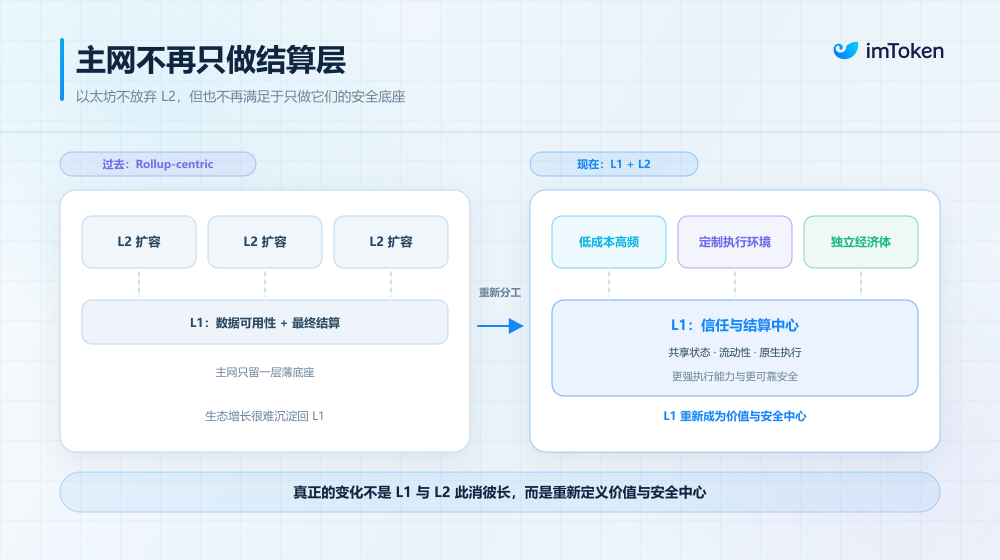
In the original Rollup-centric roadmap, the division of labor was actually very clear—L1 handles security, data availability, and final settlement; L2 handles extreme scaling and low Gas.
In that era when mainnet Gas often cost tens of dollars, this was almost the only viable answer.
But reality developed in a much more complex way than expected. As of November 2026, ETHBEAT (formerly L2BEAT) data has recorded dozens of different types of L2s, but only a handful have reached Stage 2, with asset volumes that are almost negligible. Meanwhile, major Rollups such as Base, Arbitrum One, and OP Mainnet remain at Stage 1.
Ultimately, the speed at which L2s are advancing toward Stage 2 is far slower than expected, while at the same time, L1's own scaling progress is accelerating. As Vitalik Buterin summarized, with mainnet's own scaling speeding up, "the original vision of L2s and their role in Ethereum no longer holds."
More importantly, some L2s may, for reasons of regulation, business models, or customer control, actively choose to remain at Stage 1 for the long term.
This does not necessarily mean they are wrong. For institutional applications that need to meet specific regulatory requirements, retaining certain management and upgrade permissions may actually be part of the product design. But if they长期 rely on a small number of entities holding key upgrade rights and state adjudication rights, they should not be simply equated with a fully decentralized shard of Ethereum mainnet.
Therefore, in specific application architectures, there is a consistent pragmatic compromise approach: keep assets and critical state on L1, and delegate high-frequency, complex computations to off-chain or other execution environments.
Synthetix's new-generation perpetual futures exchange is a very typical case. It adopts a hybrid architecture in which user assets are still custodied by Ethereum L1 contracts, order matching is handled by an off-chain high-performance CLOB (Central Limit Order Book) engine, and trade results are written back to mainnet through batch settlement.
In this way, users do not need to bridge large amounts of assets to another chain just to gain trading speed, while also enjoying an order-matching experience close to that of centralized exchanges.
Of course, this does not completely eliminate trust issues. Synthetix currently still has some margin management that relies on the off-chain order book, and the off-chain matching system itself also needs to be scrutinized. But asset custody and final withdrawal are still guaranteed by mainnet contracts, so users do not have to entrust the security of all their funds to an independent L2's sequencer and bridging system.
This actually provides another way of thinking: it is not necessarily required to move all computations on-chain to achieve true on-chain finance; the key lies in which steps must be provided with irreplaceable trust guarantees by on-chain rules.
From a longer-term perspective, the Native Rollup research direction promoted by Vitalik may be a more ideal solution (further reading: "Understanding Vitalik's L2 Reflection: Farewell to Fragmentation, Course Correction Toward Native Rollups in the New Phase").
Simply put, through Ethereum's native ZK-EVM verification mechanism, mainnet can directly verify Rollup EVM execution results, reducing dependence on external security councils and creating conditions for more trustworthy interoperability and synchronous composability between different Rollups.
At the same time, solutions such as the Ethereum Economic Zone (EEZ) are also attempting to enable tighter synchronous interaction between different Rollups and mainnet.
These technologies are still at different stages of research and validation, but they all point in one direction: ensuring that users are not forced to accept fragmented assets, liquidity, and trust systems simply because they use different execution environments.
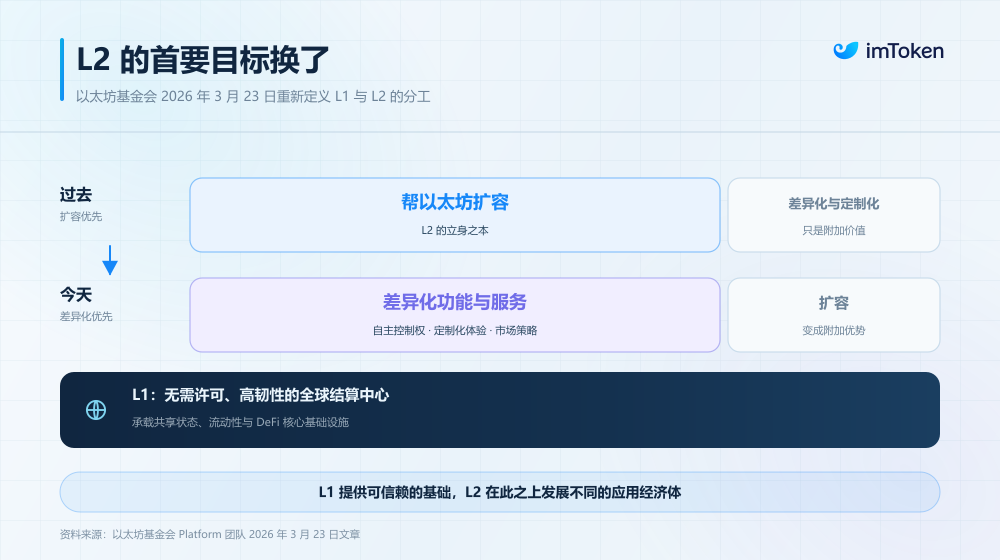
Of course, L2s will not disappear as a result. For high-frequency trading, gaming, privacy computing, and applications that require autonomous control over their execution environment, L2s still hold significant value.
What truly needs to change is the past mindset of treating "scaling" as the sole core mission of L2s.
3. When Both L1 and L2 Become Cheap, What Does ETH Capture Value With?
What has been discussed above is the evolution of infrastructure and application architecture, but ultimately we must return to a more practical question: if Ethereum mainnet becomes increasingly powerful and more applications return to L1, will ETH's value logic change accordingly?
Over the past few years, the crypto market's valuation of ETH has largely depended on the fee-burning mechanism introduced by EIP-1559.
Under this mechanism, among the transaction fees paid by users, the base fee is burned, and the priority fee is paid to validators. When network transaction demand is strong and block space is tight, the base fee tends to rise, and ETH's burn volume increases accordingly.
This was also an important foundation of the past "Ultrasound Money" narrative: if the network continues to grow, fee burning has the potential to offset or even exceed ETH's new issuance, putting ETH into net deflation.
But the problem lies precisely here.
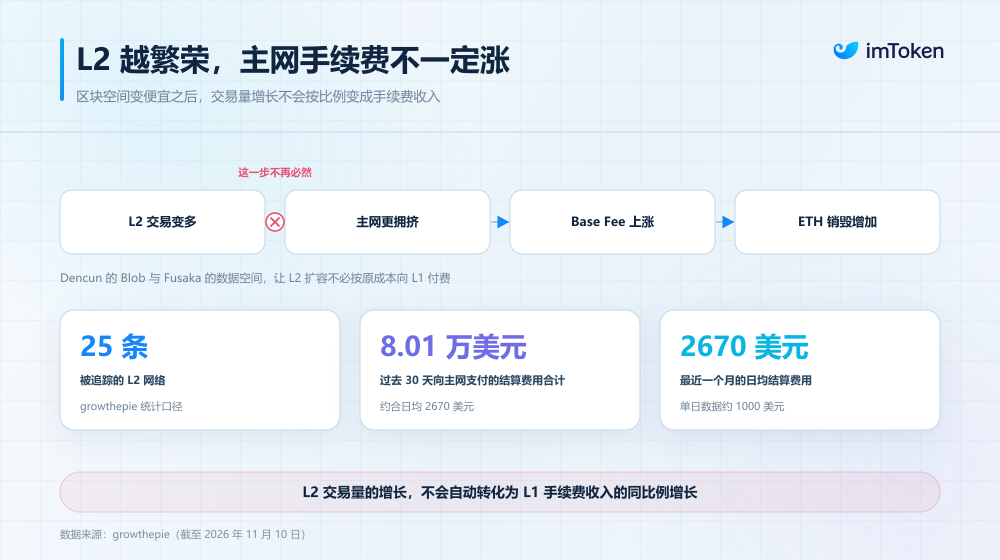
As upgrades such as Dencun and Fusaka continuously lower the cost for L2s to submit data to mainnet, and mainnet itself continues to raise the Gas Limit, the cost per transaction and fee revenue may decline accordingly.
Even if the entire ecosystem's transaction scale continues to expand, it does not mean ETH's burn volume will necessarily grow in sync. If ETH's valuation is supported simply by raising Gas fees, ordinary users and real applications may instead bear higher costs, ultimately harming the network's long-term competitiveness.
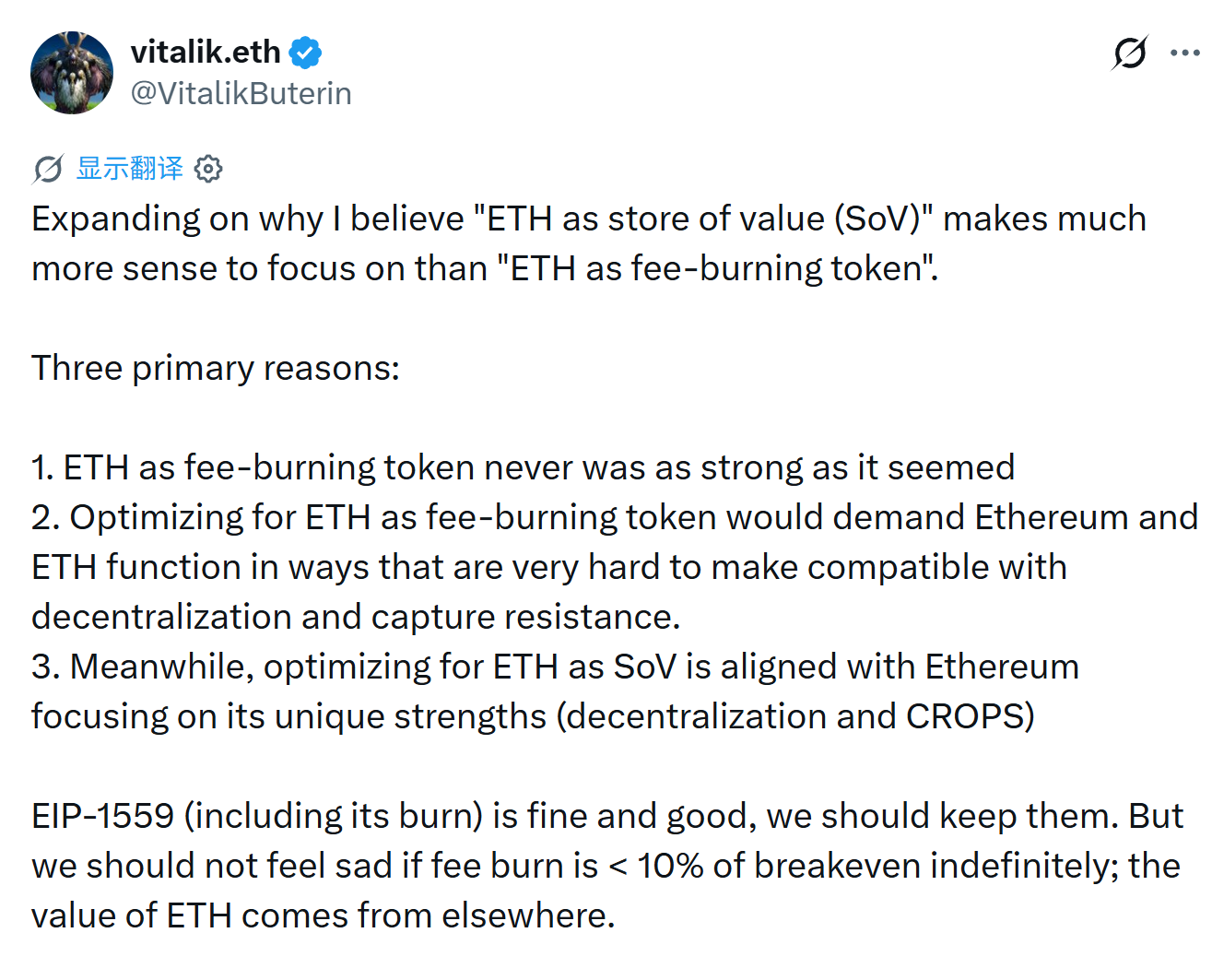
Vitalik Buterin specifically discussed ETH's value positioning, and his view is quite clear: rather than primarily understanding ETH as an asset that derives value from fee burning, he believes ETH's positioning as a store of value is more worthy of Ethereum's long-term investment.
Vitalik did not deny EIP-1559, nor did he advocate abolishing the fee-burning mechanism.
On the contrary, he believes this mechanism remains reasonable and should be retained. But even if fee burning can only offset less than 10% of break-even issuance in the long term, holders should not be disappointed, because ETH's sources of value are not limited to burning.
Why?
First, during the period when ETH's burn volume was highest, it largely came from speculative activity within the crypto industry.
For example, Yuga Labs' Otherdeed NFT mint in 2022 once generated approximately $180 million in fee burning in a single day, but this revenue was not truly external demand. If the crypto market as a whole shrinks and users' speculative capacity declines, such transactions and fee revenue may also disappear simultaneously.
Therefore, deriving ETH's long-term valuation solely from historical burn data cannot form a reliable value floor.
Second, if supporting a market cap of hundreds of billions of dollars for ETH required the network to continuously generate sufficiently high fee revenue, Ethereum might have to behave like a large commercial company—constantly increasing R&D investment, adjusting product direction, and engaging in more active governance intervention.
This is not entirely consistent with Ethereum's long-held goals of decentralization and resistance to control.
More importantly, deliberately maintaining high Gas fees to increase burn volume may itself exclude the ordinary users who most need privacy, security, and open financial services.
So, setting aside fee burning, what should ETH's long-term value ultimately be built on?
In Vitalik's view, the answer lies in Ethereum's truly unique competitiveness: decentralization, and what he summarizes as the CROPS properties—Censorship and Capture Resistance, Open Source, Privacy, and Security.
These attributes ultimately point to a more pragmatic value—stability, and the ability of the network to continue operating as the external environment constantly changes.
Especially in an era of accelerating AI development and constant changes in traditional finance and digital infrastructure, a financial infrastructure that can remain neutral, reliable, and difficult for external forces to control over the long term may be far more important than high fee revenue at any particular stage.
From this perspective, the strengthening of L1 is actually consolidating the long-term value foundation of ETH from three dimensions.
- Core state and settlement capabilities build Ethereum's most important network effect: computation itself can be continuously commoditized, and execution environments can be replicated, but a shared settlement layer with大量 assets, mature financial protocols, and deep liquidity is very difficult to rebuild in a short period. This means ETH's status as the underlying Gas asset, native collateral, and settlement asset has the opportunity to be strengthened as core financial activity reconverges;
- Mainnet scaling frees ETH's value from reliance on high per-transaction fees: over the past two years, Ethereum has been trying to resolve a long-standing contradiction—how to increase throughput without letting node hardware requirements spiral out of control. If a series of technologies gradually mature, Ethereum has the opportunity to evolve from a past "low-frequency, high-price" settlement network into a global financial infrastructure with higher throughput and lower usage costs;
- Staking mechanism and economic security establish a more solid underlying demand for ETH: across the entire network, ETH's value is forming more diversified support. It is both the native resource required for network operation and the economic collateral for PoS consensus, while also being an important collateral and liquidity asset in DeFi and the on-chain financial system. This is much more complete than explaining ETH's long-term value solely through fee burning;
Final Thoughts
If Ethereum's development path over the past few years is seen as a scaling experiment, then the changes in 2026 look more like Ethereum beginning to search again for the balance point of the entire ecosystem.
L2s will not disappear, nor should they. They remain an important component of Ethereum's expansion of application scenarios, hosting differentiated execution environments, and serving more users.
But at the same time, L1 cannot remain for the long term in a底层 role responsible only for providing data availability and final settlement.
It needs to re-strengthen its execution capabilities, liquidity hub position, censorship resistance, and economic security, so that the most important assets and financial state can settle in a sufficiently trustworthy environment.
Just as the philosophy conveyed by Lean Ethereum—subtract redundancy and friction, and put the most core security, censorship resistance, and state consensus back at the center of the protocol (further reading: "A Year Later, "Lean Ethereum" Sets Out Again: What Answer Does Ethereum Want to Deliver?").
So as the most valuable state and liquidity reconverge on mainnet, a more powerful, more unified in experience, and more solidly grounded Ethereum is opening a new chapter for its next decade.





