


AI Compute Stocks Rally Together: What Is the Market Repricing Around Anthropic's Estimated $807 Billion Long-Term Contract and Broadcom's $63 Billion Financing?


- Core View: Anthropic's approximately $807 billion long-term compute commitment and Broadcom's $63 billion financing arrangement have increased the visibility of AI compute demand, but contract and financing scale do not equal revenue or profit; investment returns still need to be validated by delivery, utilization, and cash flow.
- Key Elements:
- On October 27, the Philadelphia Semiconductor Index rose 3.6%, with all 30 constituent stocks gaining; compute cloud and hardware supply chain names led the gains, while Nvidia rose only 0.90%, as capital concentrated on infrastructure expansion segments.
- Anthropic's compute spending arrangement totals up to approximately $807 billion, of which about $417 billion is signed payment obligation, with an additional $125 billion to $150 billion arrangement; this figure is a media estimate, the S-1 did not disclose the total amount, and it is not confirmed revenue.
- Broadcom, together with Bank of America, Blackstone, Citi, and Morgan Stanley, established a $63 billion SPV financing to purchase XPU and networking equipment and lease it to Anthropic, with delivery starting in 2027; Broadcom provides equipment residual value support, but the risk has not disappeared.
- Oracle expanded its Nvidia Vera Rubin deployment to the multi-gigawatt level and for the first time introduced Google TPU and Cerebras inference solutions, reflecting that cloud platforms are purchasing in a differentiated manner based on training, inference, and workloads.
- Financial differentiation is clear: Broadcom's quarterly free cash flow was $13.665 billion; Oracle's quarterly free cash flow was negative $5.396 billion; CoreWeave's quarterly capital expenditure was about 2.5 times its revenue, with free cash flow of negative $5.743 billion.
- Cerebras reported quarterly revenue of $180 million and a net loss of $451 million; the 10.10% stock price gain reflects partnership expectations, but commercialization and the profit model still await customer payment validation.
- Going forward, it is necessary to track cloud providers' capital expenditure and cloud revenue, financing costs and credit spreads, equipment residual value, and the unit economics and sustained cash flow of the inference business.
1. Why Did AI Compute Stocks Suddenly Rally Across the Board?
On October 27, the U.S. stock market's AI compute chain saw a strong rebound. The Philadelphia Semiconductor Index rose 3.6%, with all 30 constituent stocks closing higher. Broadcom gained 4.00%, Oracle rose 3.55%, Cerebras climbed 10.10%, and CoreWeave advanced 7.94%. The Nasdaq rose 1.18%, and the S&P 500 gained 0.60%.
The rebound was not limited to chip stocks. Compute cloud company Nebius rose 11.22%, IREN gained 7.90%, and hardware supply chain company Celestica climbed 11.93%. By comparison, Nvidia rose only 0.90% on the day, while NXP closed up 3.12% but fell about 7% in after-hours trading following its earnings release.
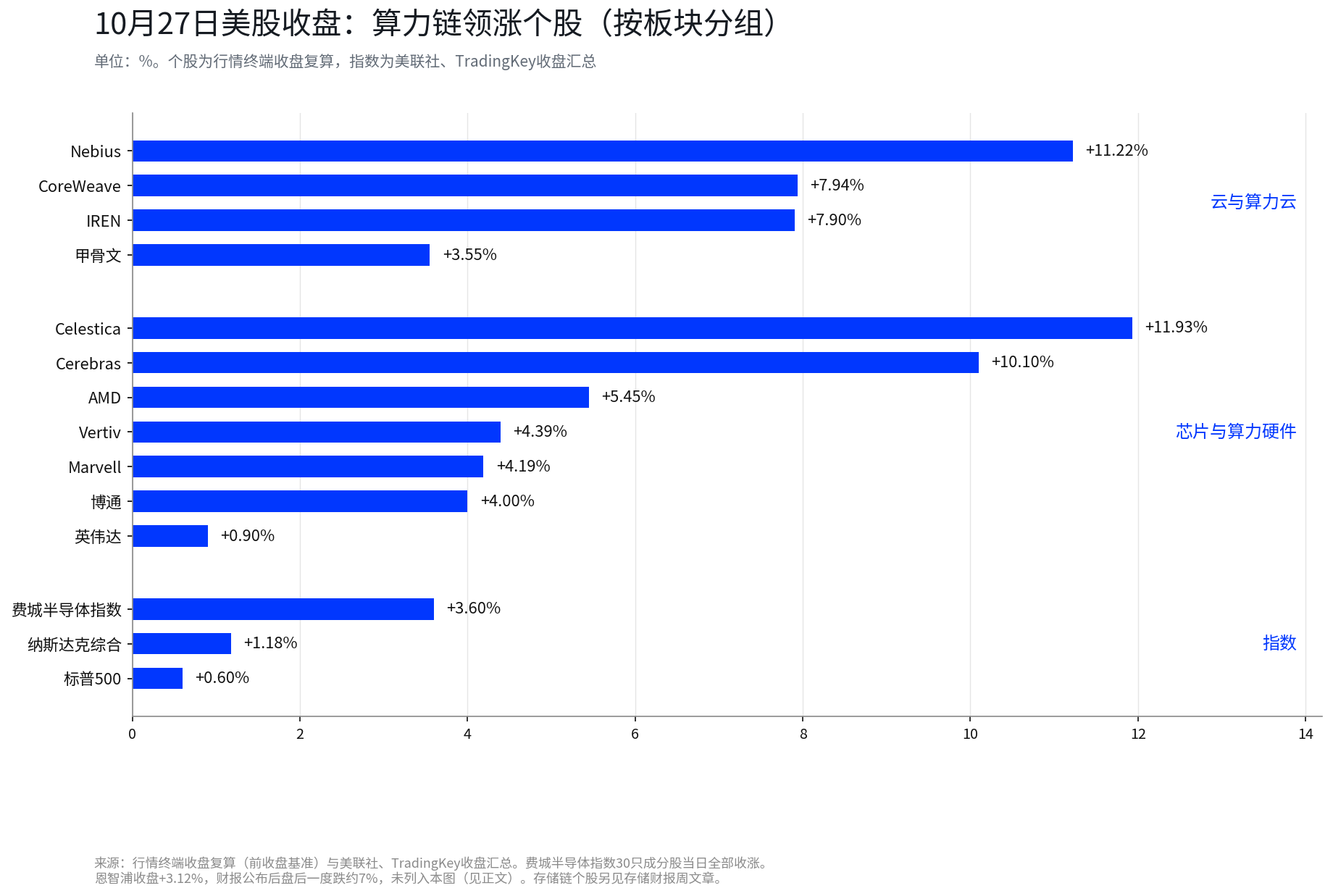
This shows that capital was not simply buying every AI-related stock. The companies with the largest gains were more closely tied to compute infrastructure expansion, equipment procurement, and compute leasing. The market's focus has also shifted from whether the AI boom can continue to who can secure orders and funding from this investment cycle—and ultimately convert that into profits.
There were two direct catalysts. The first was Anthropic filing for an IPO, with related disclosures and media summaries presenting a massive long-term compute spending arrangement that gave investors a view of model companies' demand for cloud services, accelerators, and data center resources over the coming years. The second was Broadcom announcing a $63 billion financing arrangement, with Bank of America, Blackstone, Citigroup, and Morgan Stanley participating in financing Anthropic's procurement of Broadcom AI accelerators and networking equipment, with deliveries expected to begin in 2027.
Taken together, the two pieces of news mean more than just "AI demand remains strong." Long-term contracts increase demand visibility, while financing arrangements provide funding support for part of that demand. The market had previously worried about whether tech companies' ever-increasing capital expenditures could ultimately be recouped. Now, the market is beginning to see how compute demand is being converted into actual deployment through contracts and financing structures. But this is not yet the answer to investment returns. Between contract values, financing scale, and ultimate profits, there remain delivery, equipment utilization, customer payment capacity, and ongoing operating cash flow.
2. The $807 Billion Compute Commitment: Seeing Demand Is Not the Same as Seeing Revenue
According to media summaries of Anthropic's IPO filing and related agreements, the company's compute and infrastructure spending arrangements total up to approximately $807 billion. The related amounts cover long-term cloud services, equipment leasing, procurement agreements, and some future compute arrangements, with suppliers including Broadcom, Google, Amazon, Microsoft, and Nvidia-related procurement channels.
Media reports also mentioned that signed agreements correspond to payment obligations of approximately $417 billion. There are also additional compute arrangements for delivery between 2028 and 2031 with undetermined pricing, expected to potentially add $125 billion to $150 billion in payment obligations.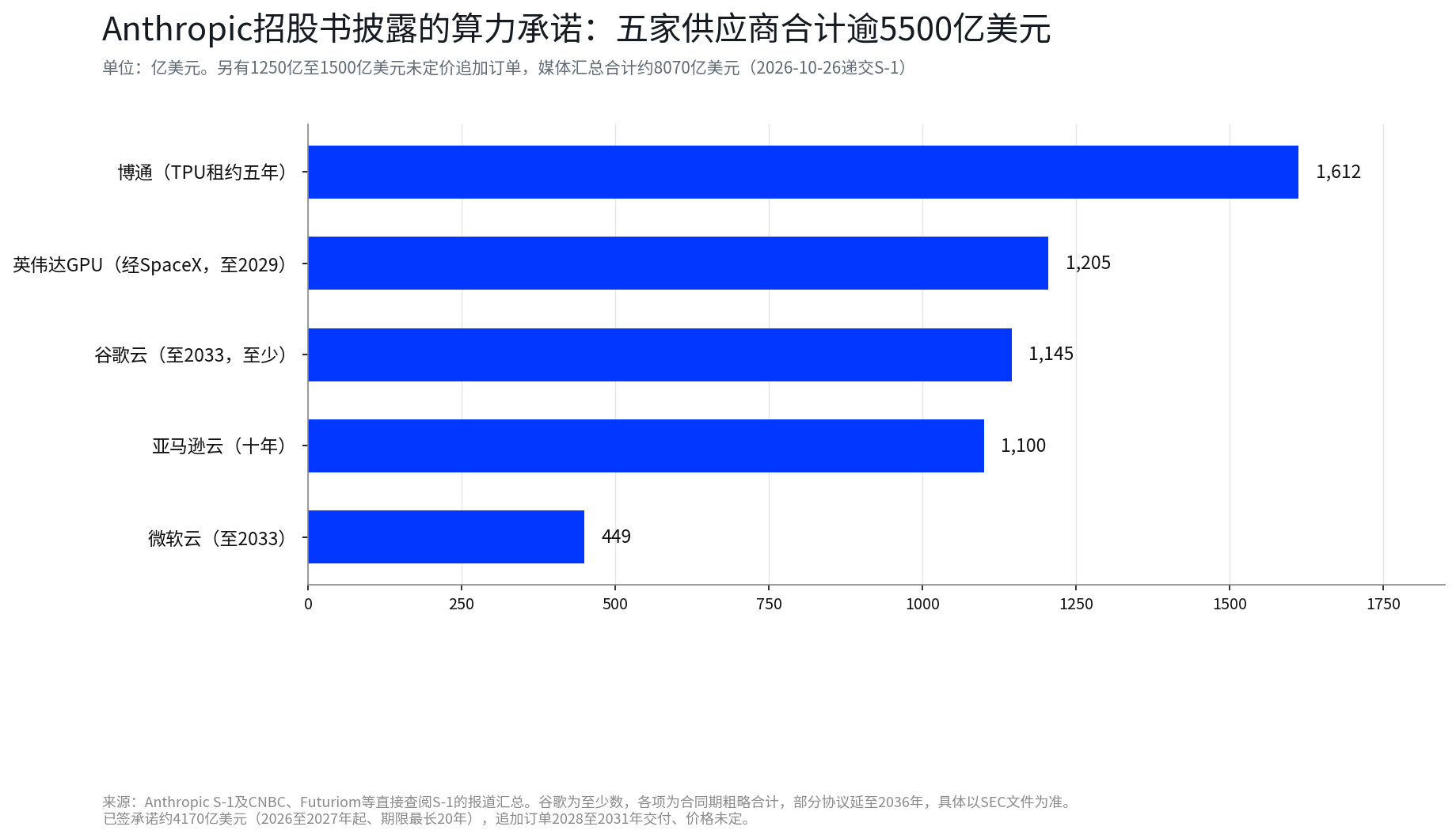
These numbers are large enough, but one issue must first be clarified: the $807 billion figure is a media-aggregated estimate of long-term spending arrangements, not confirmed revenue for Anthropic, nor can it be directly viewed as a rigid order that has fully taken effect with a determined amount. Since the S-1 did not disclose the total compute commitment, different media outlets' aggregated results are inconsistent. The $417 billion and $125 billion to $150 billion figures are two of the relatively clear data points, while other reports give combined totals ranging from $542 billion to $657 billion. Different agreements also have different durations, payment terms, and execution certainty, and some arrangements involve future deliveries or compute that has yet to be secured.
What is truly noteworthy is that these long-term agreements have changed the angle from which the market observes compute demand. In the past, investors mainly estimated chip shipments, data center construction, and supplier revenue based on capital expenditure guidance from cloud providers such as Microsoft, Google, and Amazon. Model companies' long-term spending arrangements fill in another piece of the puzzle from the demand side: training frontier models requires massive compute, and providing services to enterprises and consumers likewise requires sustained investment in inference resources. To ensure access to sufficient computing power in the future, model companies will book resources in advance and even assume certain minimum payment obligations. For suppliers, this helps improve visibility into future revenue. At least within the scope covered by contracts, demand no longer depends entirely on how much equipment customers decide to purchase each quarter on an ad hoc basis.
However, contract scale still cannot be directly equated with commercial value. Signing does not equal revenue recognition; multi-year agreements may require phased equipment delivery or cloud service provision, and related revenue will be recognized gradually as performance progresses. Long-term contracts cannot eliminate customer credit risk. If a model company's commercialization progress lags expectations and its revenue is insufficient to cover compute payment obligations, even if the contract remains binding, performance and financing pressure may rise. Growth in compute demand does not equal an improvement in compute investment returns. Model call volume can grow, but if the revenue per call is insufficient to cover computing, energy, and infrastructure costs, scaling up may not bring better profits. Therefore, what the $807 billion truly provides is a reference point for the scale of future demand, not a profit forecast. The market is willing to pay a premium for greater demand visibility, but whether that premium can ultimately be realized still depends on whether model companies can convert compute into sustained revenue.
3. The $63 Billion Financing: The Compute Business Begins to Test the Credit Market
If long-term contracts answered "who needs compute," Broadcom's financing arrangement further answered "who pays for it." On October 26, Broadcom announced that Bank of America, Blackstone, Citigroup, and Morgan Stanley would participate in a $63 billion financing arrangement. The related special purpose vehicles (SPVs) will purchase Broadcom's XPU AI accelerators and networking equipment, then lease the equipment to Anthropic, with deliveries expected to begin in 2027. Broadcom will also provide equipment residual value support corresponding to the first-lien financing portion.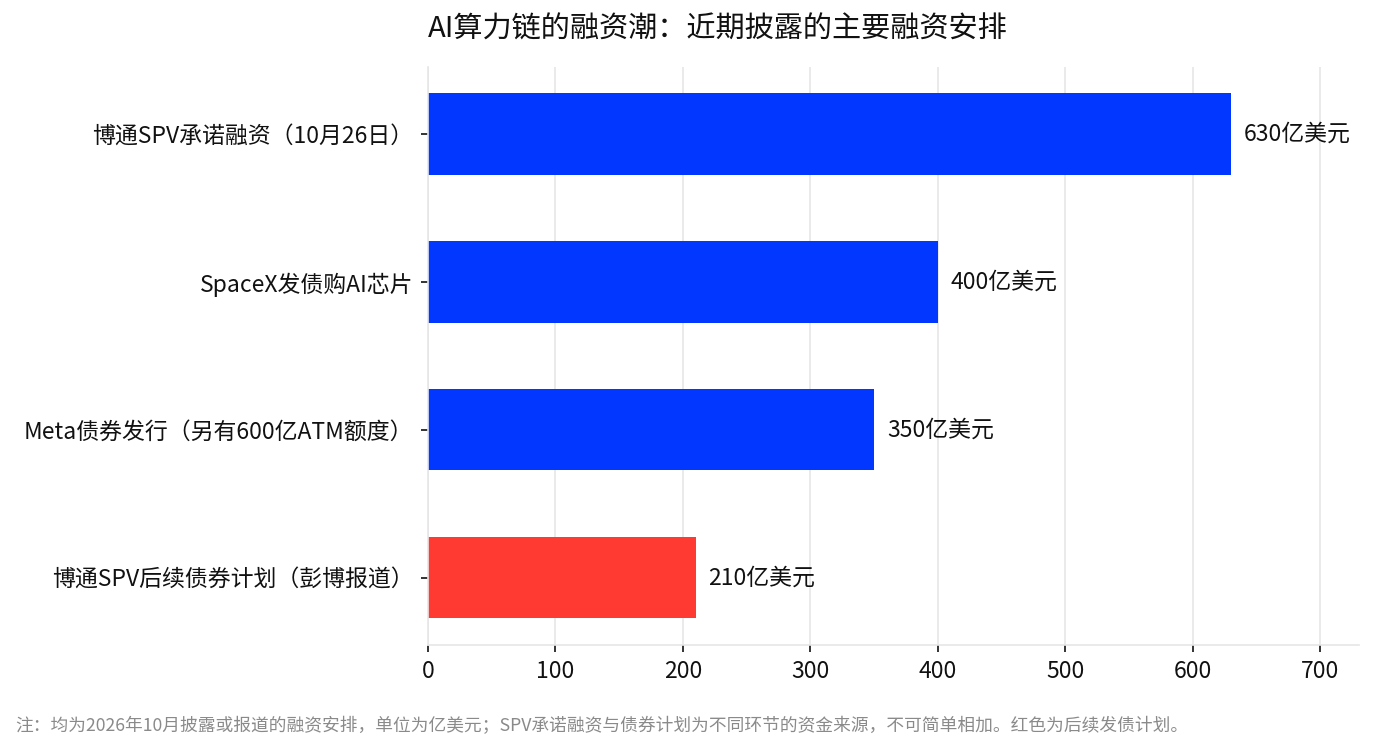
This structure connects chip procurement, external financing, equipment leasing, and residual value arrangements. For end customers, compute deployment can obtain funding support through leasing and financing arrangements. For equipment suppliers, the project's funding sources and execution path are also clearer. It reflects a change in AI infrastructure expansion: compute investment is no longer just a matter of how much capital expenditure a tech company decides to increase—it is also becoming an asset financing business with financial institution participation. Other recent financing arrangements also indicate that AI infrastructure's demand for capital is spreading to the bond market and other credit channels. However, different transactions differ in financing scale, use of proceeds, and completion progress, and announced financing commitments cannot all be regarded as cash already in place.
More importantly, SPVs do not make risk disappear into thin air. Under the traditional procurement model, enterprises directly purchase equipment and bear the corresponding capital investment. Through SPVs, equipment can be held by independent vehicles and then provided to end users via leasing. Such arrangements help bring in more funding sources, but they do not change the fact that compute projects still ultimately need to generate sufficient cash flow. If Anthropic cannot pay as agreed, or if the second-hand value of AI accelerators is lower than expected, the financing structure may still come under pressure. Broadcom's residual value support is particularly noteworthy: it helps financial institutions assess equipment value, but it also means Broadcom has not completely shed the value risk of the related equipment.
Whether such transactions can operate over the long term depends on at least three real-world conditions:
- Whether financing costs are reasonable. The higher the debt interest rates and credit spreads, the more cash returns the project needs to generate.
- Whether equipment residual values hold up. AI chips update quickly, and the residual value of long-term leased equipment is not fixed.
- Whether customers can keep paying. If model companies' commercial revenue cannot keep pace with compute spending, the more complex the financing structure, the more noteworthy the risk transmission may become.
Therefore, the significance of the $63 billion financing is not that the AI industry will no longer lack money, but that compute expansion has gained a new way of organizing capital. It may accelerate equipment deployment, and it may also amplify volatility when demand or financing conditions weaken.
4. Oracle Adds Multiple Chips: Inference Demand Opens Space for Competitors
On October 27, Oracle announced it would expand deployment of Nvidia's Vera Rubin systems, with related cloud infrastructure plans scaling to multi-gigawatt levels. At the same time, Oracle plans to offer Google TPU compute on its cloud platform for the first time and introduce Cerebras's inference solutions, while some Nvidia systems will also use Oracle's Acceleron networking chips.
The specific transaction amounts for the related partnerships were not all disclosed, so multi-gigawatt-level deployment cannot be directly converted into confirmed orders or profits. But this set of news at least reveals a change in cloud platforms' procurement strategies: the same large cloud service provider is offering more hardware choices for different tasks.
This is related to the stage of AI application development. Large-scale model training has very high requirements for high-performance accelerators, high-bandwidth interconnect, and software ecosystems, and Nvidia has established a clear advantage in this area. But as models enter enterprise applications, the inference stage is becoming increasingly important—that is, the process in which models are repeatedly called upon to actually execute tasks.
Especially as AI agents begin handling multi-step tasks, a single job may involve multiple model calls. Customers care not only about whether a model can complete a task, but also about response speed, cost per call, throughput, and energy efficiency. For high-frequency, repetitive, or tasks with specific computational characteristics, specialized chips may offer more competitive solutions. This creates opportunities for different architectures such as Google TPU and Cerebras. They do not need to surpass Nvidia on all tasks; as long as they can reduce costs and improve speed in specific scenarios, they may win customers. But Oracle simultaneously expanding Nvidia system deployment also shows that this is not a story of Nvidia about to be replaced. More accurately, the AI compute market is moving from relatively concentrated hardware procurement toward more granular selection based on workload, cost, and performance, and different companies' investment logic will diverge accordingly.
- Nvidia needs to continue proving the overall advantages of its accelerators, systems, and software ecosystem.
- Broadcom needs to convert demand for custom accelerators and networking equipment into sustained profit and cash flow growth.
- Specialized chip companies such as Cerebras need to prove that their technological advantages can bring real customer payments, large-scale deployment, and sustainable profitability.
Entering a large cloud platform is an important step toward commercialization, but a partnership list itself is not a moat. Customers will ultimately decide procurement scale based on actual usage costs and business results.
5. Orders and Stock Prices Are Rising, but Cash Flow Is Not Improving in Tandem
The October 27 rebound brought the AI compute chain back into the market spotlight, but the financial performance of different companies reminds investors: demand growth does not translate evenly into shareholder returns. Based on available data, Broadcom and Oracle have relatively mature revenue scale and cash flow foundations, compute cloud companies such as CoreWeave are growing faster but need to invest heavily in equipment purchases, and Cerebras is still in the stage of expanding commercial deployment and validating its profit model.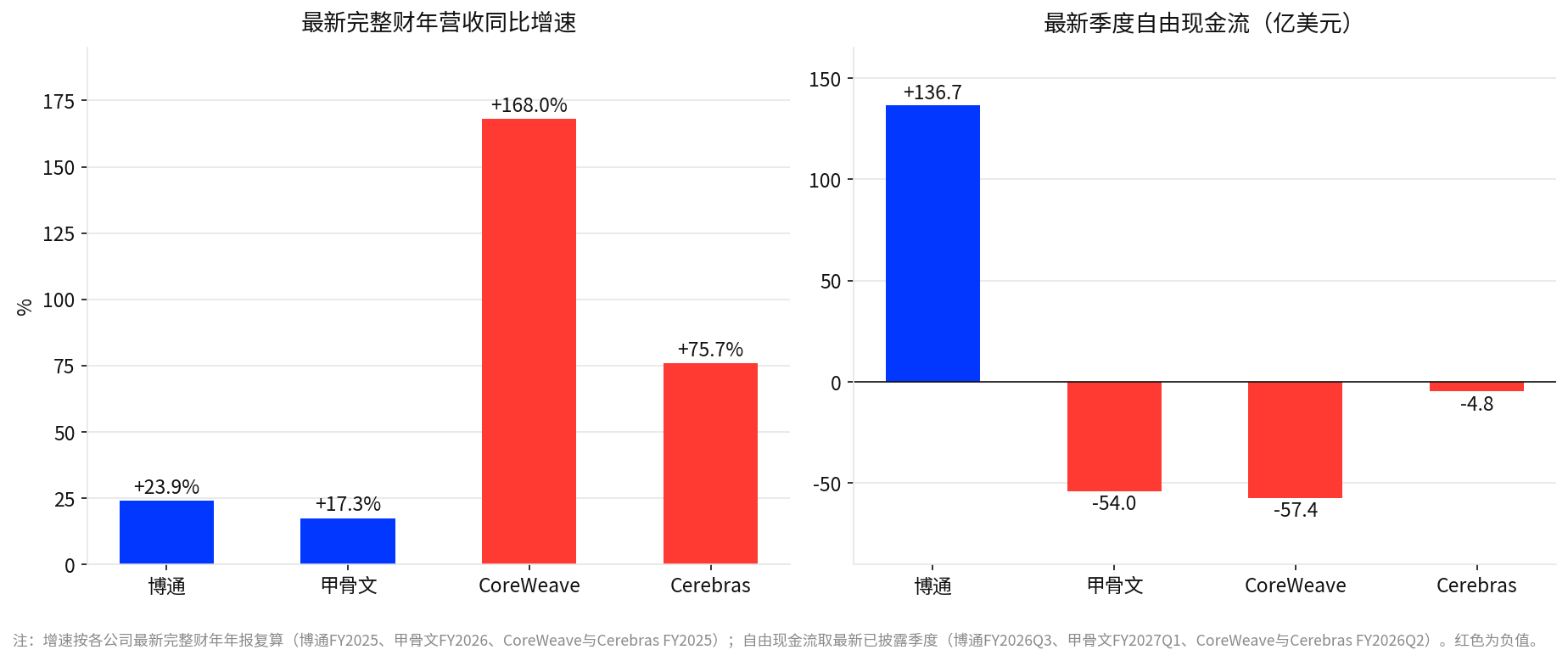
Broadcom: Cash Flow Advantage, but Also Additional Equipment Risk
Broadcom's latest quarterly revenue was $29.591 billion, net income was $13.088 billion, operating cash flow was $14.197 billion, capital expenditure was $532 million, and free cash flow was $13.665 billion. Its latest full fiscal year revenue was $63.887 billion, up 23.9% year-over-year. These figures show that Broadcom not only has growth opportunities in AI accelerators and networking equipment but also has a strong cash flow foundation. Compared with compute cloud companies that need to purchase large amounts of equipment, its business model does not require bearing infrastructure capital expenditures of the same scale.
But the $63 billion financing arrangement also places new tests on Broadcom. Residual value support means that if equipment value declines, some risk may flow back to the supplier side. Going forward, attention should be paid to the delivery pace, profit margins, customer concentration, and potential financial exposure from residual value support in the related business. For Broadcom, the question is not only how fast AI revenue can grow, but also whether that revenue can continue to convert into cash and whether new financing arrangements will alter its originally favorable risk-reward structure.
Oracle: Fast Expansion, but Payback Pressure Is Also Rising
Oracle's latest quarterly revenue was $19.345 billion, operating cash flow was $23.103 billion, capital expenditure was $28.499 billion, and free cash flow was negative $5.396 billion. Its latest full fiscal year revenue was $67.358 billion, up 17.3% year-over-year. Quarterly capital expenditure exceeding operating cash flow shows that Oracle is using current funds to exchange for future compute capacity. Multi-gigawatt-level cluster expansion and the introduction of more chip architectures help enrich cloud service offerings, but they also mean the company needs to continue investing in equipment, data centers, and related infrastructure.
If new capacity can secure customer orders and maintain high utilization, today's capital expenditure may form the revenue base for the future. If customer demand falls short of expectations, equipment investment will lengthen the payback period and further increase financing pressure. Next, cloud infrastructure revenue, capital expenditure, free cash flow, and customer contract fulfillment are more worth tracking than procurement scale alone.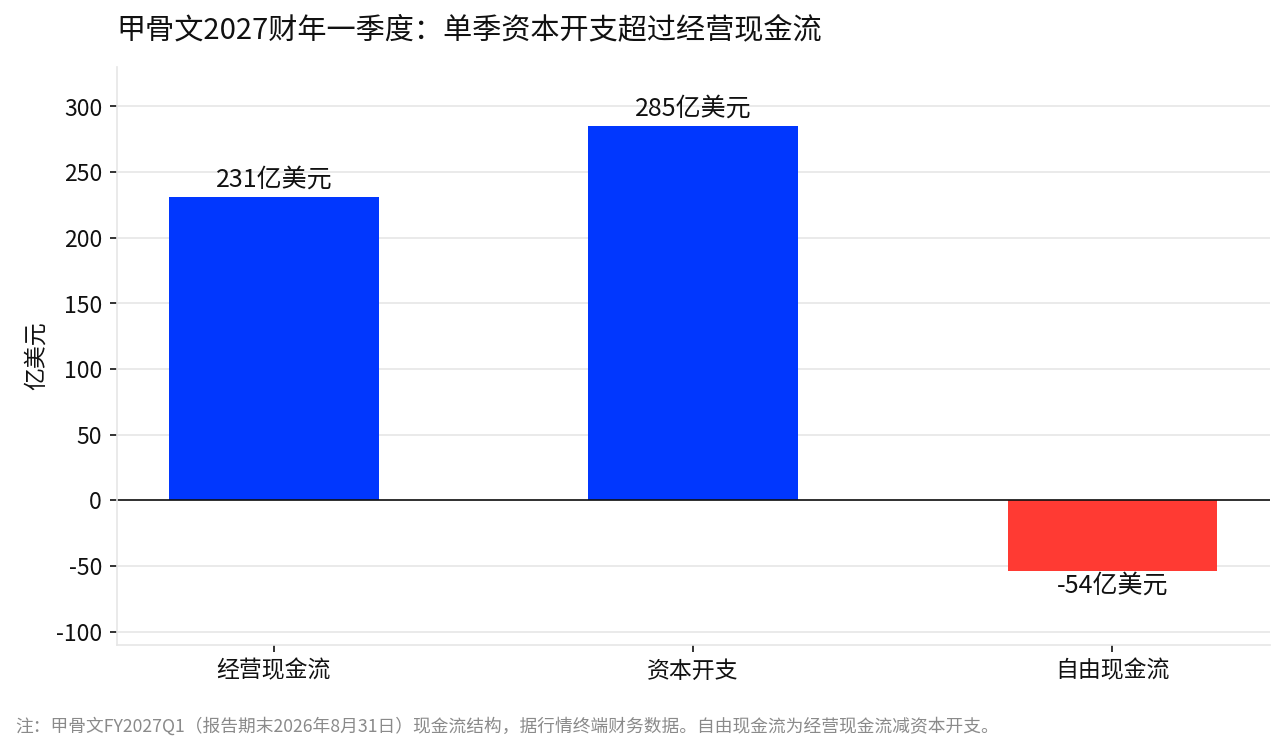
CoreWeave: Rapid Revenue Growth, Equally Staggering Capital Needs
CoreWeave's latest quarterly revenue was $2.575 billion, capital expenditure was $6.422 billion, and free cash flow was negative $5.743 billion. Its fiscal 2025 revenue increased from $1.915 billion in the prior fiscal year to $5.131 billion, up 168% year-over-year. The high growth is not hard to understand: as compute demand expands, customers need to rent GPUs and related infrastructure, and compute cloud companies therefore gain more revenue. But this type of business requires continuous equipment procurement, data center construction, and funding for expansion.
Quarterly capital expenditure was about 2.5 times revenue, meaning revenue growth has not translated into free cash flow in tandem. As long as demand persists, financing remains smooth, and equipment utilization is sufficiently high, this model may continue to expand. But if financing costs rise, or if equipment更新速度 faster than cash recovery, growth may also put pressure on the balance sheet. For CoreWeave, orders and revenue growth are certainly important, but it is also necessary to watch whether liabilities, capital expenditure, equipment utilization, and free cash flow can gradually improve.
Cerebras: Entering Oracle's Cloud Platform, but Customers Still Need to Vote with Revenue
Cerebras's partnership with Oracle provides a new distribution channel for its inference chips. A large cloud platform can expand potential customer coverage and lower the barrier for customers to try new architectures. But opening a commercialization channel does not mean the profit model has been validated. Cerebras's latest quarterly revenue was $180 million, down from $193 million in the previous quarter, with a net loss of $451 million. Its fiscal 2025 revenue was $510 million, up 75.7% year-over-year.
The stock price rose 10.10%, reflecting the market's positive reaction to new partnership opportunities. But compared with mature chip suppliers, Cerebras's revenue scale remains small, and its loss scale cannot be ignored. What to watch next is whether customers continue to use its products, whether it has advantages in per-unit inference economics, and whether new deployments can bring sufficient revenue and profit.
These four companies are at different positions in the industry chain, and one cannot look only at revenue growth rates, nor simply judge all companies' long-term value by single-quarter free cash flow. But together they illustrate one issue: compute orders can bring growth expectations, but only with controllable costs and sustained customer payments can growth potentially translate into shareholder returns.
6. What Evidence Does the Market Need Next?
This rebound has restored some of the market's confidence in AI compute demand, but for valuations to remain firmly supported, operating data still needs to keep up. First, look at large tech companies' capital expenditure and cloud business revenue. If AI investment continues to grow while enterprise customer demand, cloud service revenue, and profit margins improve, the growth logic for hardware suppliers will be better supported. Conversely, if capital expenditure keeps rising while revenue and cash flow do not improve accordingly, the market may still re-examine investment returns.
Second, look at financing conditions. The $63 billion financing arrangement demonstrates a new way of organizing capital, but subsequent debt costs, credit spreads, equipment residual values, and end customers' payment capacity will all affect whether such transactions can be replicated. The larger the financing scale, the more the project itself needs to generate sufficient cash flow.
Finally, look at whether the inference business can truly make money. Rising model call volume is only one signal of demand growth. The per-unit computing cost, response speed, energy consumption, and software adaptability of different architectures will determine whether customers are willing to pay over the long term. For specialized chip companies and compute cloud companies, market attention ultimately needs to translate into customer usage, revenue growth, and better unit economics.
Conclusion: Compute Demand Is Clearer, but Investment Returns Still Need Verification
Anthropic's long-term compute spending arrangements, Broadcom's





