






SpaceX Reportedly Seeks $40 Billion in Financing, BiyaPay Market Watch: Who Foots the Bill Behind Nvidia's Mega Order?


- Core Viewpoint: AI expansion is shifting from tech companies' own capital to external debt financing. The market needs to assess both the sustainability of chip demand and whether customers can use future operating returns to cover today's fixed funding costs.
- Key Elements:
- SpaceX is in talks for approximately $40 billion in financing to purchase Nvidia AI chips, including about $10 billion in bank loans and $30 billion in investment-grade debt. Apollo is expected to lead, with PIMCO also in negotiations, but the deal remains in the negotiation stage.
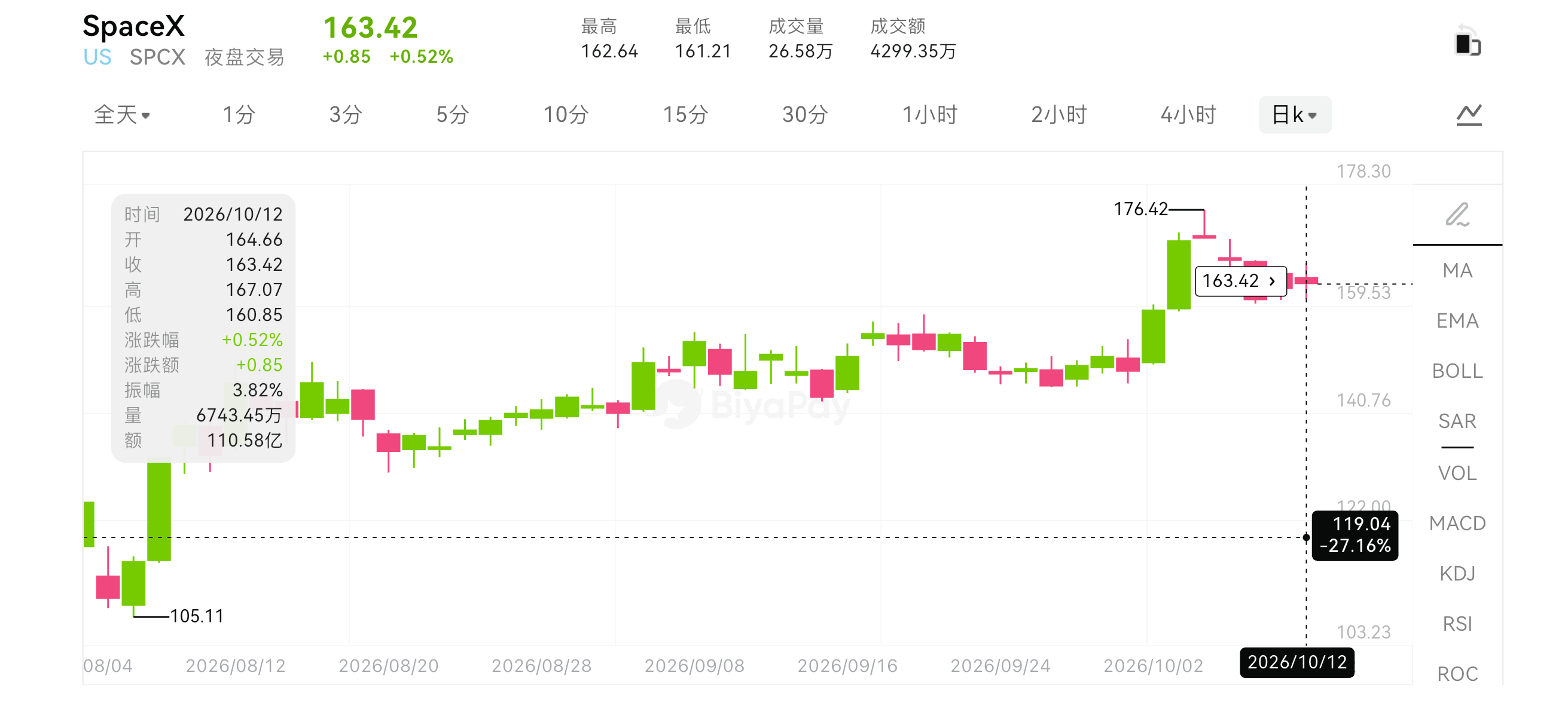
- At the October 12 U.S. stock market close, SpaceX stood at $163.42, up 0.52%, while Nvidia was at $226.32, down 1.29%. The divergence in stock prices indicates that the market is not simply pricing in the "mega order."
- If the full $40 billion is interest-bearing debt at an average annual rate of 6%, annual interest alone would be approximately $2.4 billion; a 1 percentage point fluctuation in interest rates would result in a difference of about $400 million in annual interest.
- Chip procurement is only part of compute investment—data centers, power, cooling, networking, and operations teams all require costs, and there is a time lag between chip delivery and data center readiness.
- For Nvidia, financing intent, procurement contracts, delivery arrangements, and revenue recognition are separate stages. "Potential major customer demand" is more accurate than "$40 billion already in hand."
- There are time lags in how different parts of the AI supply chain benefit: upstream focuses on delivery, data centers on utilization rates, application companies on paid retention, and financing institutions on debt-servicing capacity—they cannot be analyzed synchronously under a single concept.
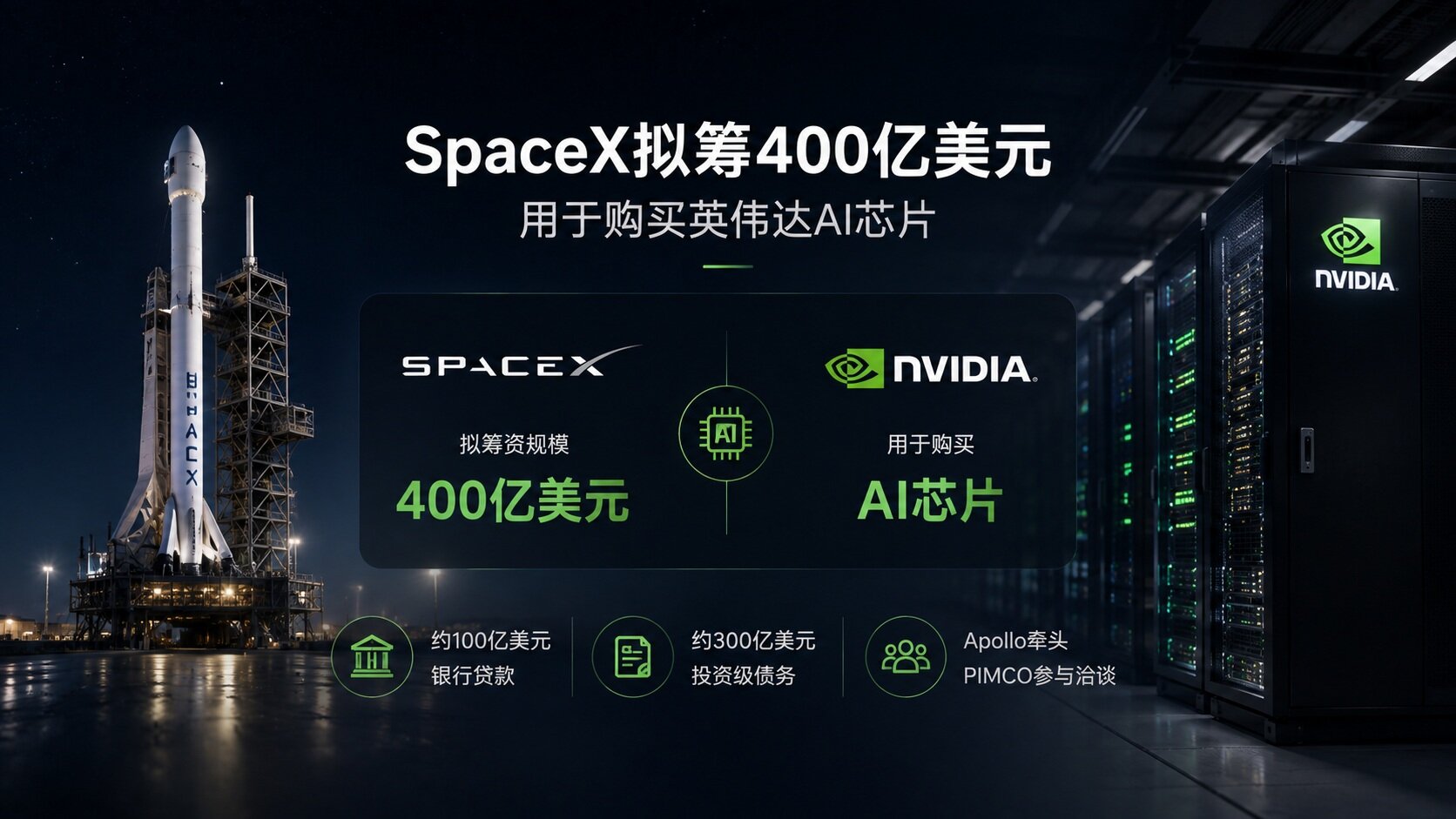
The bill for AI expansion is shifting from tech companies' balance sheets to banks and bond markets.
According to reports, SpaceX is in talks with banks and asset management institutions for approximately $40 billion in financing to purchase Nvidia AI chips. The proposed structure includes about $10 billion in bank loans and $30 billion in investment-grade debt, with Apollo expected to lead the arrangement and PIMCO also in the mix. The news first surfaced on October 6, and public reports still point to financing negotiations—it cannot be understood as funds already received, let alone counted directly as $40 billion in Nvidia revenue.
Stock price movements did not simply follow the "big order."
BiyaPay market data shows that at the October 12 U.S. stock market close, SpaceX (SPCX) traded at $163.42, up 0.52%; Nvidia (NVDA) traded at $226.32, down 1.29%. This divergence is worth noting, but the financing news had already entered the market a week earlier, so the day's gains and losses cannot be entirely attributed to this plan. Procurement scale, financing costs, and the broader trading environment across the tech sector may all influence how capital makes its judgment.
What truly merits discussion is not just how many chips Musk is preparing to buy. When a large-scale AI investment begins to rely on external debt to advance, it means the market needs to assess two things simultaneously: whether chip demand is sustainable, and whether the customer can use future operating returns to cover the financing costs that are certain to occur today.
From Scrambling for Chips to Scrambling for Financing
In the past, discussions about AI infrastructure tended to focus on GPU supply, advanced packaging, and data center scheduling. As long as chips were unavailable, companies could easily miss their expansion window. Now, the computing power competition has added another threshold: even if equipment can be purchased, one must find capital that can withstand the construction cycle.
Debt financing has its business logic. Companies need not consume large amounts of cash at once, and it can reduce the impact of new equity financing on ownership percentages. But it also locks in a portion of future expenditures. Whether GPUs run at full capacity and whether services can be sold can change with the market; interest payments and maturity repayment schedules, however, will not automatically pause because customer growth falls short of expectations.
When observing this type of news, I prefer to look at chip suppliers, computing power users, and the financing environment together. As a global one-stop asset allocation platform, BiyaPay covers U.S. stocks, Hong Kong stocks, digital assets, and fiat currency exchange scenarios, providing an entry point for viewing different markets in one place. The platform supports digital currency exchange for USD and HKD, allowing users to participate in real stocks such as U.S. and Hong Kong equities in real time with zero commission without applying for an offshore account. The significance of cross-market observation is to compare price reactions—whether capital is looking at new orders or reassessing expansion costs—rather than drawing the same conclusion for the entire AI sector just because of a financing figure.
$40 Billion in Equipment Still Needs an Operating Bill
Chip procurement is only part of computing power investment. Equipment also requires data centers, electricity, cooling, networking, and operations teams, and there may be a time gap between data center construction and equipment delivery. Chips arriving before the data center is ready, or insufficient customer load after the data center is operational, will both lengthen the payback period.
A simple calculation that does not involve actual financing terms can be made: assuming all $40 billion forms interest-bearing debt with an average annual interest rate of 6%, the annual interest alone would be approximately $2.4 billion. If the average interest rate fluctuates by 1 percentage point, the annual interest would differ by about $400 million. This only illustrates the sensitivity of financing costs; it is not the financing price SpaceX has announced, nor does it include principal repayment, equipment depreciation, and other operating expenses.
For the AI business, the key therefore is not just "computing power scale," but also the utilization rate of sellable computing power, unit revenue, and customer renewals. Expanding equipment investment can enhance service capacity, but it may also bring greater fixed costs when demand is insufficient. In particular, as hardware continues to iterate, the financial debt repayment timeline and the technological competition cycle may not align, and whether old equipment can continue to generate sufficient revenue requires separate judgment.
A Demand Signal for Nvidia, but Revenue Realization Still Has Conditions
From Nvidia's perspective, a major customer raising funds to purchase chips can reinforce the market's judgment on computing power demand. But financing intent, procurement contracts, delivery arrangements, and revenue recognition are different stages. Financing scale may be adjusted, orders may be executed in batches, and the specific product mix and contract terms will also affect the pace of revenue.
Therefore, when discussing this news, "potential major customer demand" is more accurate than "$40 billion already in the bag." Suppliers can typically recognize product sales revenue earlier than computing power operators, but this does not mean they are completely immune to the customer's financing environment. If the customer's fundraising slows, construction is delayed, or procurement pace adjusts, the supplier's delivery expectations will also be affected.
Nvidia's decline that day also reminds the market to separate industry demand from stock pricing. New procurement intentions can improve demand expectations, but stock prices are also affected by existing valuations, delivery pace, financing costs, and sector sentiment. Order news and stock prices not moving in sync does not automatically mean demand is disproven; likewise, a large financing plan is not sufficient to prove the stock price will necessarily benefit.
Time Gaps Are Emerging in AI Chain Returns
The same round of capital expenditure means different cash flows for different companies. Chip and networking equipment suppliers look at delivery, data center operators look at utilization, application companies look at payment and retention, and financing institutions look at debt-servicing capacity. They all belong to the AI industry chain, but they do not necessarily benefit at the same time.
This is also why related U.S. stocks cannot be analyzed simply together under the "AI concept." Upstream order growth can coexist with downstream cash flow pressure; large downstream upfront investment does not necessarily mean there will be no returns in the long run. What truly needs comparison is each company's position in the industry chain and whether the speed of revenue recovery matches the speed of expenditure occurrence.
For the overall market, expanded external financing will also increase the connection between the tech industry and credit markets. When financing conditions are loose, expansion can accelerate; when the cost of capital rises, the return requirements for projects that originally seemed viable will also increase. This transmission does not mean a debt crisis has already emerged, but it will make the market pay more attention to financing terms and operating cash flow, rather than just total computing power scale.
What to Watch Next for the Big Order
What will be more informative next is whether the financing is formally signed, whether funds are disbursed in stages, whether procurement and construction plans are made public, and whether business revenue can keep up with investment. Only as these stages are gradually implemented can the market judge how much operational, chargeable computing power $40 billion can actually form.
This SpaceX news provides a very clear observation window: AI demand is still sufficient to drive discussions of massive financing, but the capital market already needs to answer questions more complex than "are there enough chips." For Nvidia, the test is whether demand can be continuously delivered; for computing power operators, the test is whether revenue can cover equipment and financing costs. Only when both bills can be squared can expansion have a more solid foundation.





