2030 South Korea Crypto Market: Timing and Strategies for Institutional Entry


- Core Viewpoint: South Korea's crypto market leads globally in trading volume but severely lags in real-world asset tokenization. As global financial institutions enter the market and regulatory frameworks mature, stablecoins, payment settlement, and tokenized assets will become core components of South Korea's financial system by 2030.
- Key Elements:
- South Korea has 11.13 million accounts eligible for trading (over 20% of the population), with a daily average trading volume of 5.4 trillion Korean won in the second half of 2025, yet tokenized assets amount to only about 640 billion Korean won—less than one-eighth of the daily average trading volume.
- Global tokenized assets total approximately $37.3 billion with over 1.5 million users. Institutions such as the NYSE, DTCC, and Nasdaq are driving tokenization from experimentation to financial infrastructure.
- The Bank of Korea's Project Hangang has completed Phase 1 wholesale CBDC testing, with participating banks expanded to nine and now entering Phase 2 with real transactions.
- KRW stablecoin legislation is still under discussion, with a National Assembly subcommittee planning to review it in November 2026. However, both the market and regulators widely acknowledge its necessity, and implementation is only a matter of time.
- South Korea's trade volume accounts for approximately 85% of GDP (compared to about 25% for the United States), making cross-border corporate payments the application scenario with the greatest potential for KRW stablecoins.
- The offshore pathway can immediately reach international capital. South Korea's inclusion in the FTSE World Government Bond Index is expected to bring in 70 trillion to 90 trillion Korean won in foreign capital inflows.
- The hub chain architecture can address liquidity fragmentation and the isolation of private chains, becoming the underlying infrastructure that the three major sectors of stablecoins, payments, and RWA all depend on.
1. Current State of Korea's Crypto Market
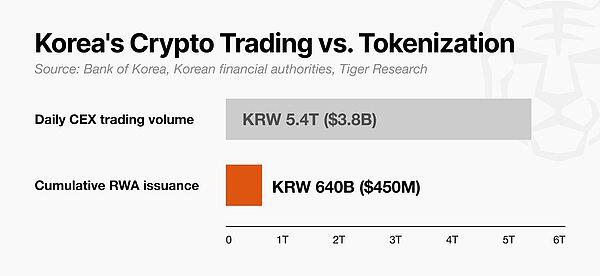
According to the Bank of Korea, approximately KRW 640 billion (about USD 450 million) of real-world assets have been tokenized in Korea. This scale is less than one-eighth of the daily trading volume on Korean centralized exchanges. However, strong investor interest remains concentrated in trading, and the industry ecosystem built around real-world use cases is still immature.
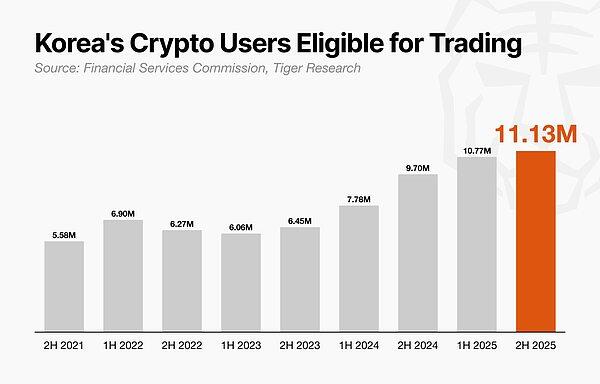
By trading volume, Korea's crypto market already ranks among the top globally. According to a survey published by financial regulators in March 2026, as of the end of 2025, Korea had 11.13 million trading-eligible accounts, equivalent to over 20% of the national population. Despite the market downturn, average daily trading volume in the second half of 2025 still reached KRW 5.4 trillion (about USD 3.8 billion).
As the primary industry use case beyond trading, real-world asset tokenization has developed slowly. Korea's cumulative token issuance scale is only about KRW 640 billion (about USD 450 million), and most of it is concentrated in non-standardized assets such as music copyright royalties (65%) and artwork (17%). The tokenization of standardized traditional financial assets such as bonds and funds remains relatively rare. (Source: Bank of Korea, March 2026)
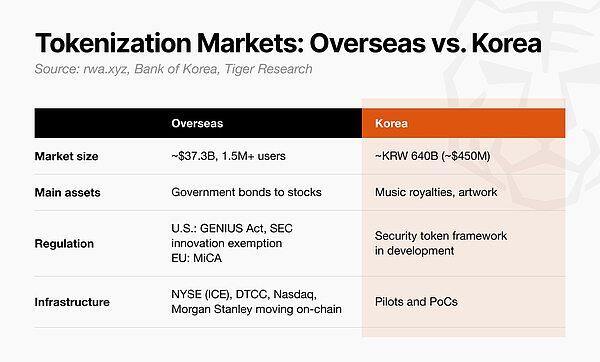
In overseas markets, regulatory progress and institutional participation are driving tokenization from a crypto experiment toward financial infrastructure.
The overseas tokenization market is far larger than Korea's. According to data published by rwa.xyz in August 2026, the total value of tokenized assets globally is approximately USD 37.3 billion, with over 1.5 million users. From cash equivalents such as government bonds to equities, an increasing variety of asset types are moving on-chain.
The regulatory systems supporting this sector are also being rapidly refined. The United States passed the GENIUS Act to regulate stablecoins, and subsequently continued to advance the CLARITY Act. Although the CLARITY Act failed to pass a Senate vote, the U.S. Securities and Exchange Commission promptly introduced an innovation exemption allowing tokenized securities trading platforms to be exempt from exchange registration requirements for five years. Europe has also established a unified regulatory framework through its core crypto asset regulation, MiCA.
Existing financial infrastructure has already begun moving on-chain. The New York Stock Exchange, owned by Intercontinental Exchange, is building a platform to support round-the-clock tokenized securities trading; the Depository Trust & Clearing Corporation, which handles clearing and settlement for most U.S. securities transactions, has also received approval from the U.S. Securities and Exchange Commission to operate its own tokenization services. Major exchanges and banks such as Nasdaq and Morgan Stanley are advancing in the same direction.
This market, which previously grew primarily through bottom-up forces, is now being reshaped by large financial institutions entering directly.
Faced with these global changes, the Korean market has also begun to break through its previous limitations.
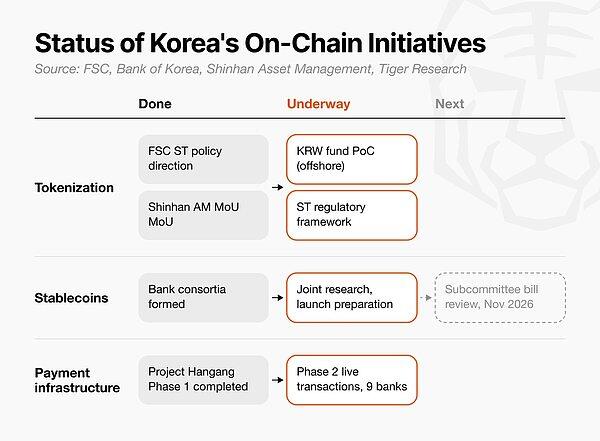
In the tokenization space, Shinhan Asset Management has conducted a proof of concept with overseas partners to test the on-chain issuance and distribution of KRW-denominated funds. Many financial institutions are also expanding cooperation through overseas offices. At the policy level, Korea's Financial Services Commission has clarified the policy direction for security tokens and begun building a regulatory framework.
In the stablecoin space, large financial institutions have formed alliances to jointly research KRW stablecoins and accelerate preparations ahead of launch. Related legislation is still under discussion: the relevant subcommittee of the National Assembly plans to review the bill in November 2026, but the specific timing of passage remains uncertain. Nevertheless, both the market and regulators generally agree on the necessity of stablecoins, so stablecoin regulation and market implementation are no longer a question of "whether" but "when."
In the payment infrastructure space, the Bank of Korea has completed Phase 1 of Project Hangang. In this phase, the Bank of Korea issued wholesale central bank digital currency to participating banks, which then converted customer deposits into deposit tokens and put them into circulation. Since then, the number of participating banks has expanded to nine, and the project has entered Phase 2, conducting tests with real transactions.
Korea's crypto market started later than overseas markets but is developing steadily. For a market still in its early stages, speed alone will hardly narrow the gap with mature markets. However, questions such as who can issue, how ownership is divided among participants, and what structure asset tokenization should adopt cannot be decided hastily.
Therefore, the current approach of advancing pilots gradually is the right one, and the next task is to find new opportunities in this process.
2. Korea's Crypto Market in 2030
Imagine a day in 2030: a customer buys coffee at a convenience store using a KRW stablecoin; a banking app shows that wages are not received via traditional account transfer but arrive as token transfers; an employee at a New York asset management firm can purchase KRW-denominated government bonds using only a wallet.
These changes may appear to be subtle adjustments in daily life, but they signal a larger-scale transformation underway in the financial system. Based on the pace of infrastructure development in major economies and the proof-of-concept projects and regulatory discussions underway in Korea, it can be judged that stablecoins will become part of Korea's financial system within the next few years.
2.1. Stablecoins: Coexisting with the Existing Payment System
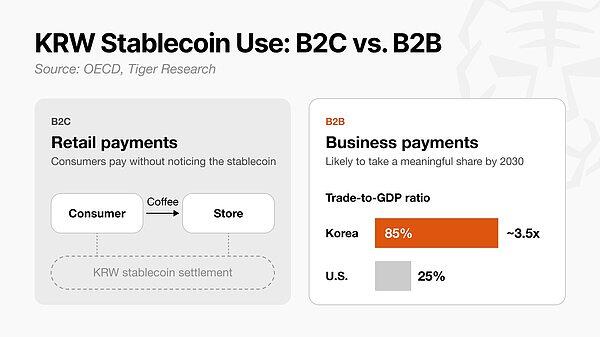
By 2030, consumers are expected to buy coffee at a nearby convenience store using KRW stablecoins without even realizing that stablecoins are being used behind the transaction. KRW stablecoins may also capture a significant share of business-to-business payments.
The case for using KRW stablecoins in B2B scenarios is particularly strong. According to data from the Organization for Economic Cooperation and Development, Korea's trade-to-GDP ratio is approximately 85%, about 3.5 times the roughly 25% ratio of the United States.
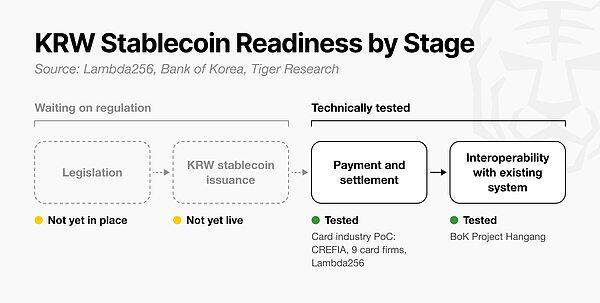
Even before KRW stablecoins were formally regulated, their underlying blockchain technology had already been tested for commercial applications from multiple angles. In a card industry proof of concept jointly conducted by the Korea Credit Finance Association, major card companies, and Lambda256, KRW stablecoins were used as a payment method while retaining the existing authorization and settlement systems.
The Bank of Korea's Project Hangang, based on central bank digital currency, also validated the interoperability between distributed ledger payment networks and the existing financial system. Given that the relevant technology has already been thoroughly tested, KRW stablecoins could spread rapidly once the regulatory framework is in place. Their implementation depends primarily on when regulations are finalized.
The application of KRW stablecoins in Korea is mainly divided into two areas: retail and business-to-business transactions.
- Retail: Following the way payment infrastructure has evolved to date, consumers will continue to have the same payment experience as now, without realizing that KRW stablecoins are being used. However, because KRW stablecoins will coexist with fiat currency and other payment methods, the scalability and profitability of the retail model may be limited in the short term.
- Business-to-business transactions: Currently, intermediaries make cross-border corporate payments slower and more costly. Stablecoins can reduce the cost of large trade transactions and accelerate settlement, thus delivering the greatest benefits in this area.
By 2030, KRW stablecoins will operate in parallel with existing card and settlement infrastructure and will develop into a core component of the payment system rather than replacing the existing system.
2.2. Payments: The Opportunity Is Not in the Payment Button but in Settlement Operations
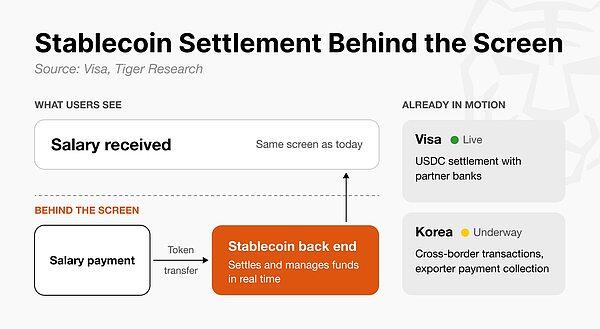
By 2030, wages will appear in banking apps as token transfers rather than account transfers. If stablecoins are the new form of money, the more difficult question is how to operate that money. The interface users see will be the same as today, but the back end will settle and manage funds in real time through stablecoin-based processes.
Technical testing of payment infrastructure has already made significant progress. Visa's USDC settlement pilot has entered real settlement with partner financial institutions. Korea is also advancing similar projects, with a focus on cross-border transactions and exporter collections.
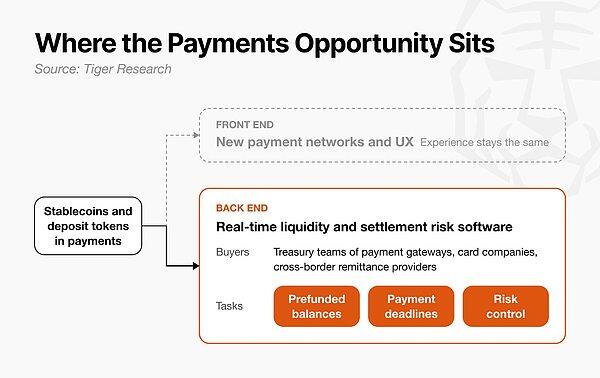
The opportunities in payments can be divided into front-end and back-end segments.
- Front end, i.e., the payment user experience: The cards and payment experiences consumers see will remain unchanged, with deposit tokens and stablecoins completing settlement in the background. Therefore, new tools will be used alongside existing payment methods.
- Back end, i.e., settlement fund operations: Key opportunities are expected to come from specialized enterprise software for the treasury teams of payment gateways, card companies, and cross-border remittance service providers, used to manage prefunded balances, meet payment deadline requirements, and control risk.
By 2030, the focus of payment market development is expected to be not on building new payment networks but on providing software and infrastructure to the treasury teams of existing payment companies to manage liquidity and settlement risk in real time.
2.3. Real-World Assets: From Issuance to Global Distribution
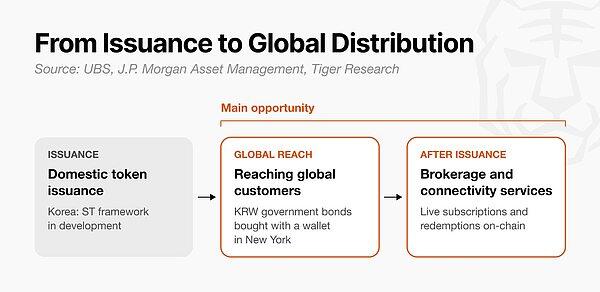
By 2030, an employee at a New York asset management firm will be able to purchase KRW-denominated government bonds using only a wallet. This shows that the main opportunity in the real-world asset market is not just domestic token issuance, but reaching global customers and providing the brokerage and connectivity services needed for continuous operation after issuance.
Global financial institutions have already demonstrated that tokenized assets can be commercially operated. Cases such as UBS's tokenized fund uMINT and J.P. Morgan's JLTXX are increasing, and these products are already processing subscriptions and redemptions in real on-chain environments. In Korea, as financial regulators build a security token regulatory framework, discussions about bringing various financial assets on-chain are also becoming more active.
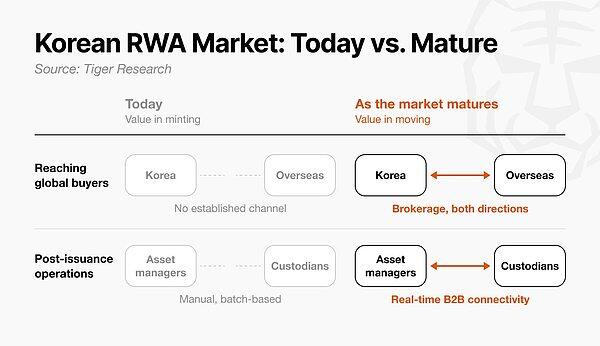
The opportunities in the real-world asset market can be divided into domestic issuance and global expansion and brokerage services.
- Domestic issuance: Issuance is the first step and remains important. Securities firms and other financial institutions will steadily build infrastructure to reliably complete the tokenization and issuance of underlying assets.
- Global expansion and brokerage services: Two areas are expected to become key opportunities. The first is brokerage services, which connect Korean tokenized assets with overseas investors or bring overseas real-world asset products into Korea, because Korean-issued assets currently lack mature channels to reach global buyers. The second is enterprise-facing connectivity infrastructure to support real-time processing of subscriptions, redemptions, and balance updates between asset managers and custodians after issuance. Without such infrastructure, these operations would still rely on manual and batch processes, and tokenization would lose its efficiency advantage.
As Korea's real-world asset market gradually matures, more value is expected to come from the circulation of tokenized assets rather than the minting itself. Specialized brokerage and operational infrastructure will help assets reach global buyers and connect post-issuance business-to-business operational processes in real time.
3. Opportunities in the Korean Market Before 2030
As Korea's crypto market continues to expand and mature before 2030, a series of business opportunities related to the on-chain transition are expected to emerge. Currently, these opportunities are still closer to pilots than mature businesses: they have been validated under test conditions but have not yet achieved commercial-scale operations.
In this process, timing is critical. Institutions that act immediately while the rules are still being formulated are most likely to gain a leading position once the rules are finalized.
3.1. KRW Stablecoins: Modular Issuance Based on Shared Infrastructure
As of September 2026, Korea's Digital Asset Basic Act still has one core question unresolved: which entities are eligible to issue KRW stablecoins. Until this question is clarified, distribution, custody, and payment services built on stablecoins cannot truly take shape.
For KRW stablecoins to truly gain adoption, the first priority is to ensure that issuers at the core of the business can earn sustainable profits. Stablecoin issuers' primary revenue typically comes from interest on reserve assets, so the business depends on economies of scale. If reserve assets can only be held in the form of bank deposits, yields will decline and growth potential will be significantly constrained.
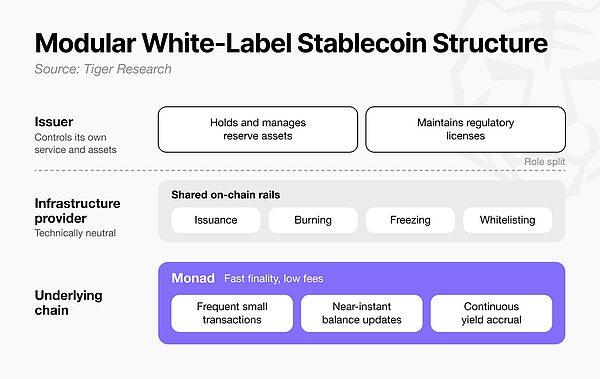
To break through this limitation, a modular white-label model that shares technical infrastructure and separates the responsibilities of each party is gaining attention. Issuers are responsible for holding and managing reserve assets and maintaining the necessary regulatory licenses; infrastructure providers supply shared on-chain infrastructure for issuance, burning, freezing, and whitelist management. Infrastructure providers remain strictly neutral at the technical level, while issuers continue to control their own services and assets.
For this division of responsibilities to work effectively, the underlying blockchain must complete settlement at the speed and cost required by consumer accounts, including support for frequent small transactions, near-instant balance updates, and yield that accrues continuously rather than in batches.
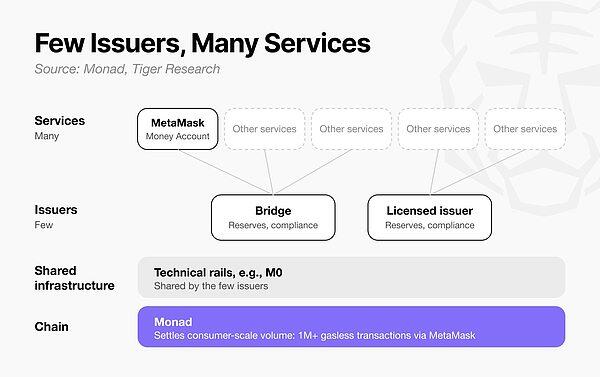
The mUSD model demonstrates how this division of responsibilities works in practice. Bridge, a Stripe subsidiary, serves as the issuer, responsible for reserve management and legal compliance; stablecoin infrastructure provider M0 provides the technical infrastructure. MetaMask built its Money Account directly on top of this division of responsibilities: users' mUSD balances automatically generate yield and can be spent through a linked bank card, while MetaMask itself does not need to handle reserve assets or licensing issues.
As of August 2026, such integrations in wallets like MetaMask have processed over 1 million gas-free transactions, demonstrating that the infrastructure can handle real consumer transaction volumes, not just a technical demonstration.
Whether this specific division of responsibilities—with non-bank issuers partnering with independent infrastructure providers—can operate in Korea remains an open question. The Digital Asset Basic Act currently under discussion has proposed that banks should hold a majority stake in KRW stablecoin issuers, namely 50% plus one share of the issuing entity. Under such a structure, an institution equivalent to Bridge would be placed in a subordinate technical service role and would not be able to serve as an issuer.
But regardless of which model is ultimately adopted, the number of entities that can become issuers is likely to be small. This is precisely the significance of the modular model: a small number of issuers can share technical infrastructure, while other companies can develop services that actually use stablecoins.
3.2. Payments: The Back-End Opportunity
For payment companies to seize this opportunity, they must design their business around a clear division of responsibilities. The front end remains the domain of existing payment gateways, card companies, and remittance service providers, each retaining their own user experience.
The real opportunity lies in the back end—providing specialized tools for these companies' treasury teams to track prefunded balances, meet settlement deadlines, and manage risk in real time rather than through daily or weekly batch processing.
Operating in real time on the back end imposes specific requirements on the underlying blockchain. Card networks need to complete settlement within strict time windows, so if the blockchain cannot keep up with authorization and settlement volumes, it will simply reproduce the batch processing problem in another form.
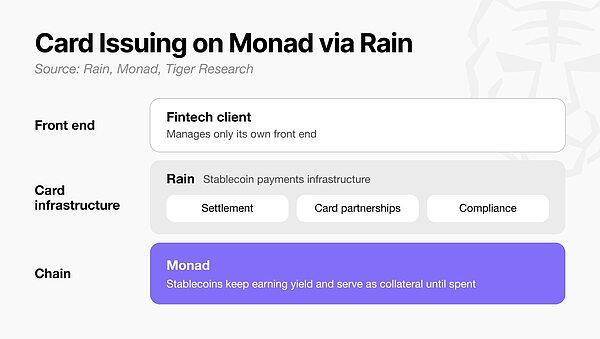
Stablecoin payment infrastructure company Rain has already built a card issuance product. Rain handles settlement, card partnerships, and compliance, so fintech clients only need to manage their own front end. Stablecoins spent through these cards can continue to generate yield before actual spending and can continue to be used as collateral, rather than sitting idle in prefunded settlement accounts.
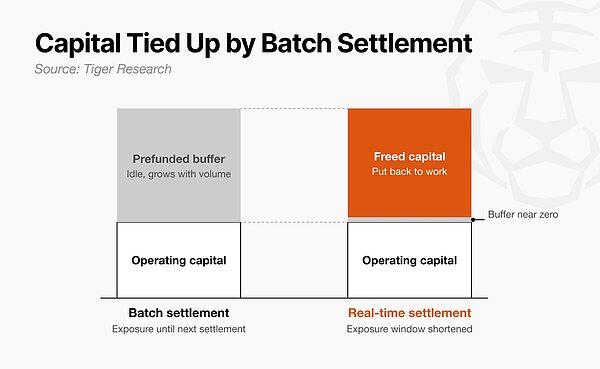
The significance of the Rain model is not limited to cards; its importance also comes from the costs generated by batch settlement. Payment companies that settle only once or twice a day must hold prefunded funds to cover the time gap between accepting payment and completing settlement. These funds generate no yield while idle and grow as