US Treasury yields hit a 24-year high at 5.34%, yet Accenture surged 16%: the same night, two directions, two historic records


- Key Takeaway: On the night U.S. Treasury yields hit a 24-year high, the AI supply chain charted an independent course backed by concrete orders and earnings data, with the market showing clear divergence in its response to rising interest rates.
- Key Elements:
- The 10-year U.S. Treasury yield spiked to 5.342% intraday, the highest since April 2002; the 30-year yield broke above 5.6%.
- Accenture surged 24% intraday, marking the largest single-day gain in its history. New bookings for fiscal year 2026 reached a record $84.5 billion, with resilient AI-related demand easing market concerns about IT consulting being disrupted.
- The optical communication sector saw a broad rally, with Coherent up 10.90% and Ciena up 7.77%, as the market focused on the optical interconnect bottleneck arising from the upgrade of AI data centers from 800G to 1.6T.
- Micron's long-term supply agreements with customers increased to $32 billion in committed amounts, with over 75% of planned capacity for fiscal year 2027 already locked in, validating that AI infrastructure demand is extending to supporting segments.
- Fed Vice Chair Jefferson said patience can be maintained, with the probability of holding steady in October rising from 49% to 63%, and yields retreating from their highs.
- AI-related companies with order and earnings anchors held firm, buffering valuation pressure from rising rates; high-valuation, unprofitable growth stocks faced more pronounced pressure.
On October 1, two opposing historic records emerged in the U.S. stock market.
On one side was the bond market. The 10-year U.S. Treasury yield surged intraday to 5.342%, the highest level since April 2002; the 30-year yield broke above 5.6%, also a level unseen in nearly 24 years. The S&P 500 briefly pulled back nearly 1% from its high intraday, while the Dow at one point fell more than 1% from its intraday high.
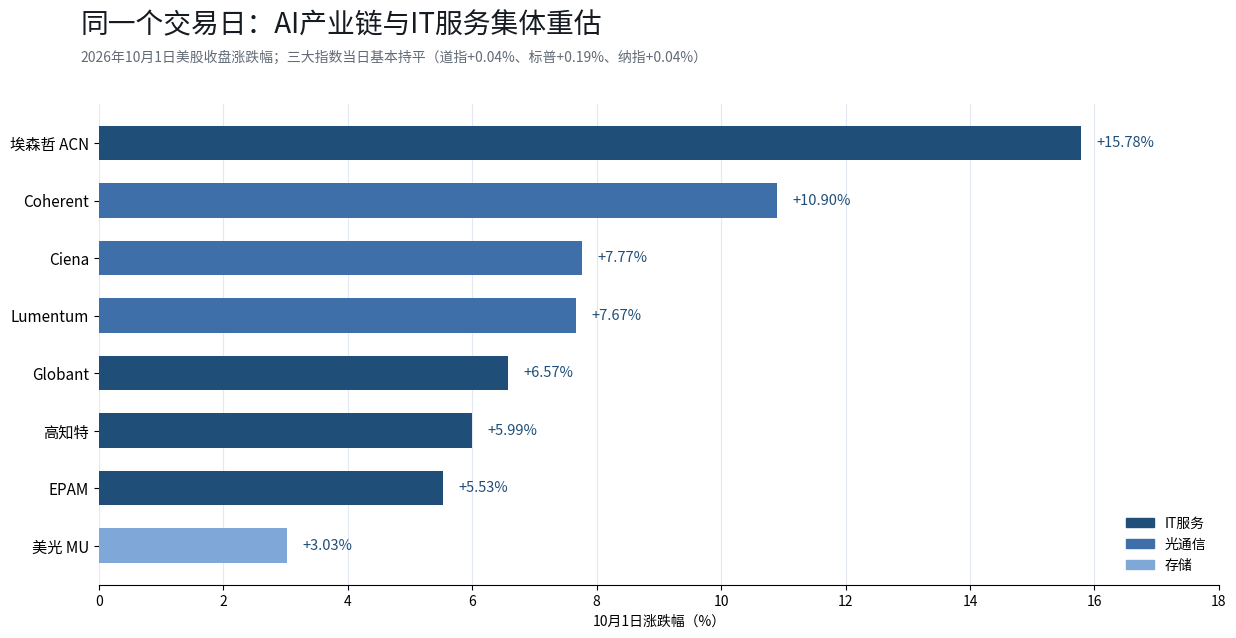
On the other side was a sector within the stock market. IT services giant Accenture (ACN) surged as much as 24% intraday, marking the stock's largest single-day gain in history, and still closed up nearly 16%. Optical communications stocks rallied collectively, with Coherent up 10.90%, Ciena up 7.77%, and Lumentum up 7.67%.
U.S. Treasury yields retreated after peaking intraday, with the 10-year ultimately closing near 5.24%, and the three major indices turned from losses to gains: the Dow rose 0.04%, the S&P 500 rose 0.19%, and the Nasdaq rose 0.04%.
But the calm at the close masked the violent swings during the session. What was truly noteworthy that night was that while the bond market set records, the AI supply chain ran an independent rally.

1. Accenture's $84.5 Billion in Orders Answered the Market's Biggest Concern
One of the important reasons for Accenture's sharp rally was that its AI business data eased market concerns about whether AI would disrupt the IT consulting industry.
First, the quarterly numbers. Fourth-quarter revenue was $18.7 billion, above the upper end of the company's previous guidance range (about $18.4 billion), up 6% year-over-year in dollar terms; adjusted earnings per share were $3.29, compared with $2.25 in the same period a year earlier. More critically, orders: fourth-quarter new bookings reached $22.2 billion, up 4% year-over-year, exceeding consensus expectations and corresponding to a book-to-bill ratio of 1.2x; the quarter recorded 141 client orders worth at least $100 million each, a record high for a single quarter.
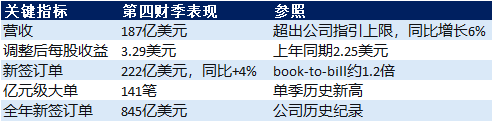
Looking at the full year, fiscal 2026 new bookings reached a record $84.5 billion, with full-year adjusted earnings per share of $13.97, up 8% year-over-year, and the company announced its largest-ever shareholder return plan of $11.5 billion. CEO Julie Sweet said: "AI is now embedded in all of our work, and demand is surging." The company disclosed that nearly 100 new clients launched their first advanced AI projects during the quarter, bringing the full-year total of such clients to more than 400; revenue from eight emerging AI/data partners more than doubled in fiscal 2026, with related orders growing more than threefold.
The significance of this data does not lie in Accenture itself. To some extent, these figures reflect that enterprise-side AI-related demand remains resilient. The market had previously worried: if AI can automatically complete consulting and analysis work, will consultancies like Accenture, which charge by headcount, be replaced? Accenture's order data has to some extent alleviated this concern—some enterprise clients still need external professional support when advancing AI implementation.
Accenture's sharp stock rally drove global IT services stocks higher collectively: Globant rose 6.57%, Capgemini rose 7.38%, Cognizant rose 5.99%, and Infosys and EPAM Systems rose more than 5%. The entire IT services sector was repriced.

2. The Surge in Optical Communications Is the Next Bottleneck for AI Infrastructure
The surge in optical communications stocks was not an isolated event. Coherent launched its PhotonLink integrated optical platform for AI infrastructure that day, directly igniting market expectations for next-generation data center networks.
Some market views suggest that as AI data centers upgrade from 800G to 1.6T optical modules, the importance of optical communications in data transmission within AI computing clusters is rising. Computing chips solve the problem of "how fast computation is," while optical communications solve the problem of "how fast data travels." As GPU cluster scale expands from thousands of cards to hundreds of thousands of cards, the bandwidth and latency of optical communications directly determine the utilization rate of the entire cluster.
Data also validates this point. Memory chips strengthened the same day: SK Hynix rose more than 5%, Micron Technology rose more than 3%, and SanDisk rose 2.75%. Micron disclosed after the close on September 30 that customer long-term supply agreement commitments had increased to $32 billion, up sharply from the $22 billion disclosed in June, with strategic cooperation customer agreements rising from 16 to 26, and more than 75% of planned fiscal 2027 capacity already locked in by customers. The simultaneous strength in optical communications and memory chips was interpreted by some market participants as AI infrastructure demand extending toward supporting segments such as optical interconnect and storage.
3. Why the Violent Bond Market Swings Did Not Suppress These Two Sectors
The key to understanding that night lies in recognizing that the surge in U.S. Treasury yields had differing impacts on different sectors.
When U.S. Treasury yields hit new highs intraday, the biggest impact was on high-valuation, unprofitable growth stocks, because their valuations depend heavily on discounted future cash flows, and small changes in the denominator are amplified. But Accenture and the optical communications sector shared a common characteristic: their gains were anchored by earnings data and industrial orders, not pure valuation expansion.
Accenture's order data represents actual contracts. Micron's $32 billion supply agreement represents actual commitments. Demand for optical communications comes from data center capital expenditure, and data center capital expenditure comes from budgets already announced by cloud providers. These disclosed orders and agreements provided some support for the fundamentals of the relevant companies. In that day's market performance, this to some extent buffered the valuation pressure brought by rising rates.
Fundstrat economic strategist Hardika Singh raised a question worth considering in a report: U.S. stocks are near historic highs, but government bond yields are simultaneously at their highest levels in decades, which inevitably raises questions about how long this rally can last. Some investors even expect that a persistently elevated interest rate environment may break the decades-old market rule of "there is no alternative to stocks."
But that night's market action showed some divergence: high rates affected different assets differently. Some AI-related companies with order or earnings support performed relatively firmly, while some high-valuation assets came under greater pressure.
4. Why the Fed's "Patience" Matters More Than the New Treasury High
The retreat of U.S. Treasury yields from the 24-year high of 5.34% was directly triggered by remarks from Fed Vice Chair Jefferson. He said that after the 25 basis point rate hike in September, the Fed can afford to be patient before deciding whether to raise rates further.
Market expectations for an October rate hike cooled markedly as a result. According to CME FedWatch, the market's probability of the Fed holding steady in October rose from about 49% the previous day to about 63%, with the probability of a hike falling below 40% accordingly.
But Minneapolis Fed President Kashkari's remarks provided an offset. He believes that further rate increases may still be needed in the future to curb demand as the economy moves into 2027, though whether the next move will come in October remains uncertain.
The difference in attitude between the two Fed officials precisely reflects the core contradiction in the current market: economic data remains resilient, but the impact of high rates on the market and the economy is accumulating. U.S. initial jobless claims released on October 1 fell to 197,000, below the expected 200,000; the September ISM manufacturing PMI edged down from 54.6 to 54.5, but the input price index climbed noticeably. The economy is not weak, but inflationary pressure has not disappeared either.
5. What to Watch Next
First observation: whether U.S. Treasury yields can hold below 5.2%. 5.34% is a 24-year high; if this level is repeatedly tested without breaking, selling pressure in the bond market may be released in stages. But if subsequent economic data remains strong, yields could still rise further.
Second observation: the pace of earnings realization across the AI supply chain. Accenture and Micron's order data show that enterprise-side AI demand is still expanding, but the surge in the optical communications sector is more expectation-driven. The next validation point is whether actual data center capital expenditure deployment can keep up with the stock price gains.
Third observation: two data releases before the October FOMC meeting. Before the Fed's late-October policy meeting, there are still two key data points: September nonfarm payrolls and CPI. If employment data weakens, the probability of a rate hike may fall further, potentially providing some support for high-valuation assets; if inflation data exceeds expectations, U.S. Treasury yields could still rise further.
In simple summary: Accenture's $84.5 billion in order data to some extent reflects that enterprise AI-related demand remains resilient. The rise in optical communications stocks reflects growing market attention to optical interconnect demand within AI infrastructure. The bond market set a 24-year record, but these two directions both set their own records on the same night.
Data notes:

Disclaimer: The content of this article is for general information and market commentary purposes only, based on public materials available as of the time stated in the article, and relevant market data, expectations, and probabilities may change with market conditions. The views and investment strategies of third-party institutions, analysts, or other persons cited in this article represent only the views of the relevant third parties at a specific time and do not represent the views or recommendations of BIT. This article does not constitute investment advice, investment research, an offer, solicitation, or recommendation of any securities, investment products, or trading strategies, nor should it serve as the basis for any investment decision. Financial markets involve risk, securities prices and market performance may fluctuate, and historical performance and past market trends do not represent or guarantee future results. Investors should independently assess relevant risks based on their own circumstances and seek professional advice when necessary.