AMD to Acquire Li Fei-Fei's World Labs for $8.2B — Will Nvidia's Physical AI Moat Be Torn Open?


- Core Takeaway: AMD is acquiring Li Fei-Fei's World Labs in an all-stock deal valued at approximately $8.2 billion, aiming to shore up its physical AI and world model capabilities. However, Wall Street reacted cautiously, with AMD shares closing down 3.61% on the day.
- Key Elements:
- World Labs was founded two years ago with roughly 70 employees. In September 2026, it released Atlas, a multimodal world model capable of reconstructing 3D scenes from a small number of 2D images.
- The deal carries a premium of approximately 64%: World Labs was valued at about $5 billion after its February 2026 funding round, and AMD is paying $8.2 billion.
- Li Fei-Fei will serve as AMD's Executive Vice President and Chief Scientist, reporting directly to Su Zifeng.
- The physical AI market was valued at approximately $890 million in 2025 and is projected to reach $15.26 billion by 2032, with a compound growth rate of about 47.2%.
- Nvidia has already built a five-layer technology stack including Omniverse, Cosmos, and Isaac, while AMD's footprint in this space was previously nearly nonexistent.
- Nvidia participated in World Labs' funding round in February of this year, making it both a competitor and a shareholder in the target company. How those equity interests will be handled has not been disclosed.
- Key risks include regulatory approval, integration and talent retention challenges, and the test of ecosystem openness post-acquisition.
On September 28, AMD announced it had reached an agreement to acquire World Labs, founded by Fei-Fei Li, in an all-stock deal worth approximately $8.2 billion. On the day the news broke, AMD closed down 3.61% at $607.87; the following day (September 29), the stock was essentially flat, closing at $607.57 with a slight gain in after-hours trading. $8.2 billion to buy a two-year-old, 70-person lab with undisclosed revenue — Wall Street did not applaud. But Lisa Su isn't running the numbers for this quarter.
1. What Exactly Is AMD Getting for $8.2 Billion
World Labs, founded in 2024 and headquartered in San Francisco, was co-founded by "Godmother of AI" Fei-Fei Li and focuses on spatial intelligence and world models. On September 1, 2026, it launched its next-generation world model, Atlas, billed as "the world's first multimodal world model" — natively supporting joint modeling of text, images, video, and 3D, capable of reconstructing three-dimensional scenes from a small number of 2D images and generating interactive physical environments.
To put what Atlas does in one sentence: just as a large language model predicts the next word, it predicts what a scene looks like from a different viewpoint. Pixel-level camera control, spatial reconstruction, spatiotemporal simulation, image generation, outputting up to 1-minute 1440p video, and surpassing specialized models on 3D reconstruction tasks.
The valuation curve is even more telling:
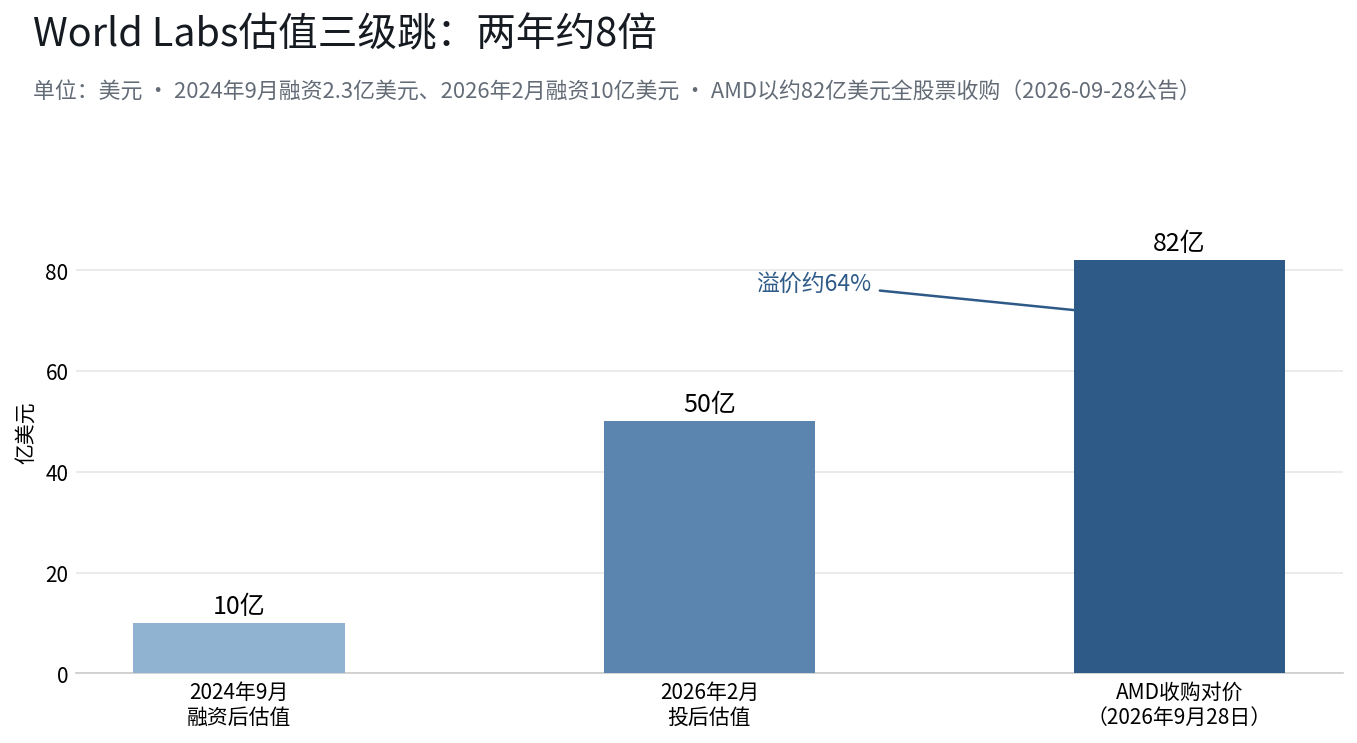
When it raised $230 million in September 2024, its valuation was about $1 billion; after completing a $1 billion funding round in February 2026, its post-money valuation was about $5 billion. AMD's offer of $8.2 billion represents a premium of roughly 64%.
The personnel arrangement is the core of this deal: Fei-Fei Li will serve as AMD's executive vice president and chief scientist, reporting directly to Lisa Su.
2. Why Physical AI, and Why Now
First, look at Nvidia. Omniverse reconstructs the world, Newton builds the physics engine, Cosmos generates world models, Isaac and GR00T train robots, and Jetson Thor handles edge deployment — a five-layer technology stack interlocked layer by layer, from chips to physics engines to robot brains, forming a complete pipeline. When customers buy Nvidia's solution, they get a one-stop closed loop covering training compute, simulation environments, and robot deployment, with extremely high switching costs.
Now look at AMD. Its previous footprint in physical AI was almost nonexistent, with its developer-facing AI capabilities mainly concentrated in the ROCm software ecosystem and hardware adaptation of Ryzen AI's on-device NPU. It had no self-controlled native world model technology reserves. In an interview with Bloomberg Television, Lisa Su almost laid bare the logic of the acquisition: "The deeper you understand the entire end-to-end process, the better systems you can build."
The physical AI market is not large, but it is growing astonishingly fast:
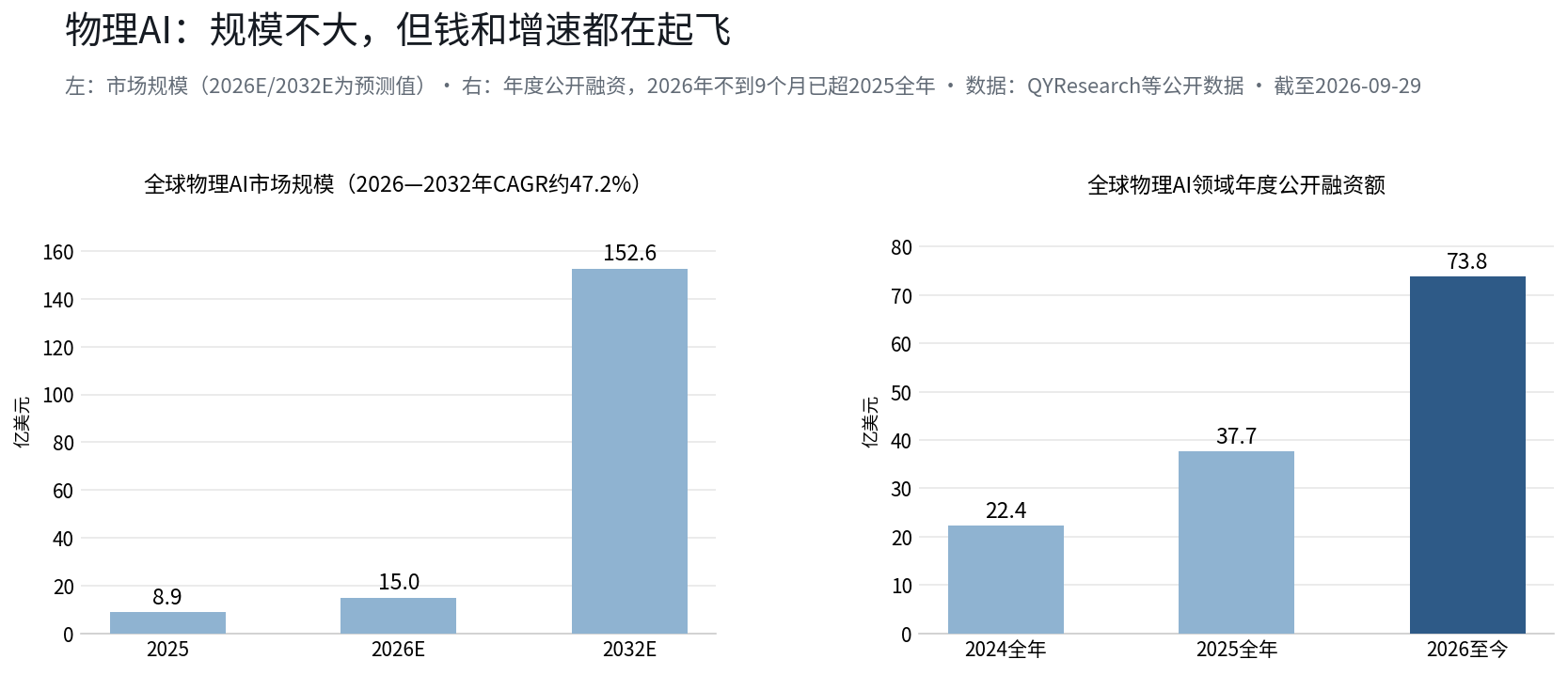
According to QYResearch data, the global physical AI market was about $890 million in 2025, is expected to reach $1.5 billion in 2026, and is projected to reach $15.26 billion by 2032, with a compound annual growth rate of about 47.2% from 2026 to 2032. Capital is moving faster than the market: so far in 2026, publicly disclosed financing in the global physical AI sector has reached about $7.38 billion, exceeding the full-year total of $3.77 billion in 2025 and more than triple the full-year total of $2.24 billion in 2024.
What AMD is buying may not just be current revenue, but also the technical capability of "how models compute." An all-stock deal looks more like a ticket to the main battlefield of physical AI.
3. Why World Labs Is Willing to Sell
Why would a 70-person team founded just two years ago, with cumulative funding of only $1.2 billion, sell at this point? With compute, talent, and capital all at war simultaneously, the pressure on a small team is easy to imagine.
- On the compute front, World Labs' two funding rounds totaled about $1.23 billion; by contrast, Nvidia feeds Cosmos with its own chips, and Google feeds Genie with TPUs — they are simply not on the same scale.
- On the talent front, big tech is spending lavishly to compete for AI talent, and a 70-person team looks more like a "Whampoa Military Academy."
- On the capital front, model training expenses continue to climb, while World Labs is still in the early stages of commercialization, with revenue unable to cover even a fraction of its training bills. More critically, Nvidia's Cosmos open weights further compress the monetization space at the model layer.
The timing of the acquisition is worth noting: Atlas was just released on September 1, 2026, and the physical AI narrative is in a relatively hot window, which may also be a more favorable valuation moment.
4. Nvidia's Role: Competitor, or Shareholder
There is an easily overlooked detail in this deal: Nvidia had just participated in World Labs' $1 billion funding round in February this year. In other words, Nvidia is both AMD's main competitor in the AI chip field and an existing shareholder of World Labs. How the equity rights of a competitor as a shareholder of the acquisition target will be handled has not been disclosed by either side — and this unresolved question could become one of the variables in the closing process.
5. Why the Market Did Not Applaud
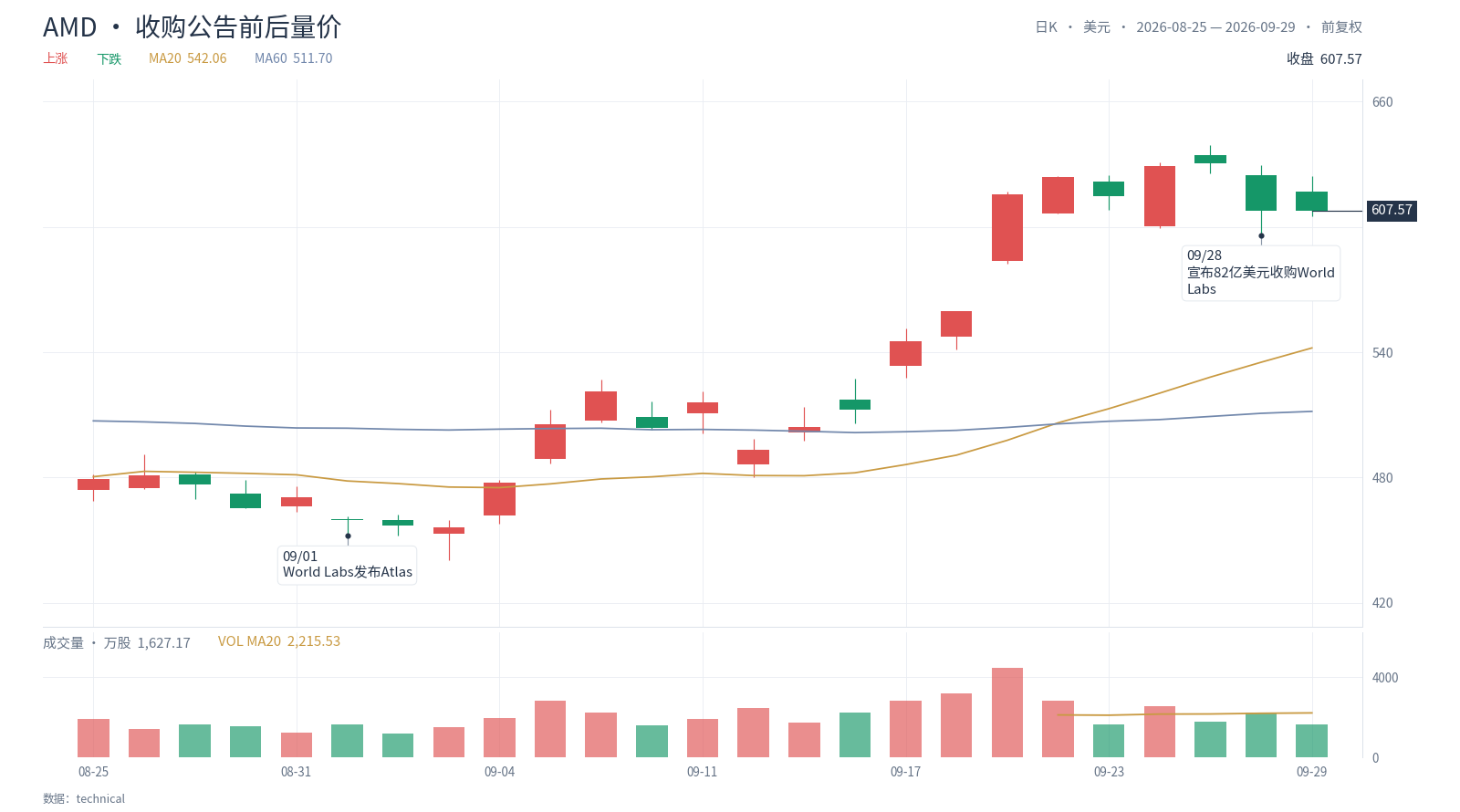
Wall Street's views on the deal are somewhat divided: some analysts continued to maintain positive ratings and price targets on AMD after the announcement. But AMD's stock closed down 3.61% on September 28, and only stabilized on the second trading day, with the market overall remaining cautious.
Three risks need to be watched:
- Regulatory approval. In an environment of tightening AI merger reviews, completing the deal by year-end is no formality.
- Integration risk. A two-year-old lab whose product has just launched and whose revenue scale is undisclosed is valued at $8.2 billion in stock, and its most core asset is a team centered on one individual's reputation. When a hardware company swallows a research-oriented organization, cultural conflict and talent attrition are real problems.
- The test of ecosystem openness. Whether World Labs' models and tools continue to be compatible with other vendors' platforms after the acquisition will become a touchstone for the open ecosystem AMD has promised.
Final Thoughts
AMD spent $8.2 billion on a ticket to physical AI, filling in part of its positioning in this field. Atlas's technical direction is worth watching, Fei-Fei Li has considerable industry influence, and the physical AI market continues to grow rapidly. But from a ticket to a complete competitive system, what lies in between is the maturity of the software ecosystem, the breadth of hardware adaptation, and the stability of the talent organization.
Lisa Su said AMD's ambition is to "define the future of AI computing." This $8.2 billion is only the first step.
Disclaimer: This article is for general informational and educational purposes only and does not constitute any investment advice, investment recommendation, securities research, or an offer or solicitation to buy or sell any securities or other financial products. The market views, analyses, and third-party materials mentioned herein are for reference only and should not be used as the basis for any investment decision. Investing involves risk, and you should make investment decisions independently based on your own circumstances and seek professional advice when needed.