USDD Transfers: Making Stablecoin Circulation More Free


- Core Viewpoint: The value of stablecoins lies not only in preserving value, but also in the convenience of circulation. Through GasFree and TokenPocket integration, USDD allows users to pay fees with USDD without holding TRX, significantly lowering the threshold and cost of on-chain transfers.
- Key Elements:
- GasFree integrated with USDD on August 17, 2026, supporting wallets such as TronLink and Guarda, with all fees settled in USDD.
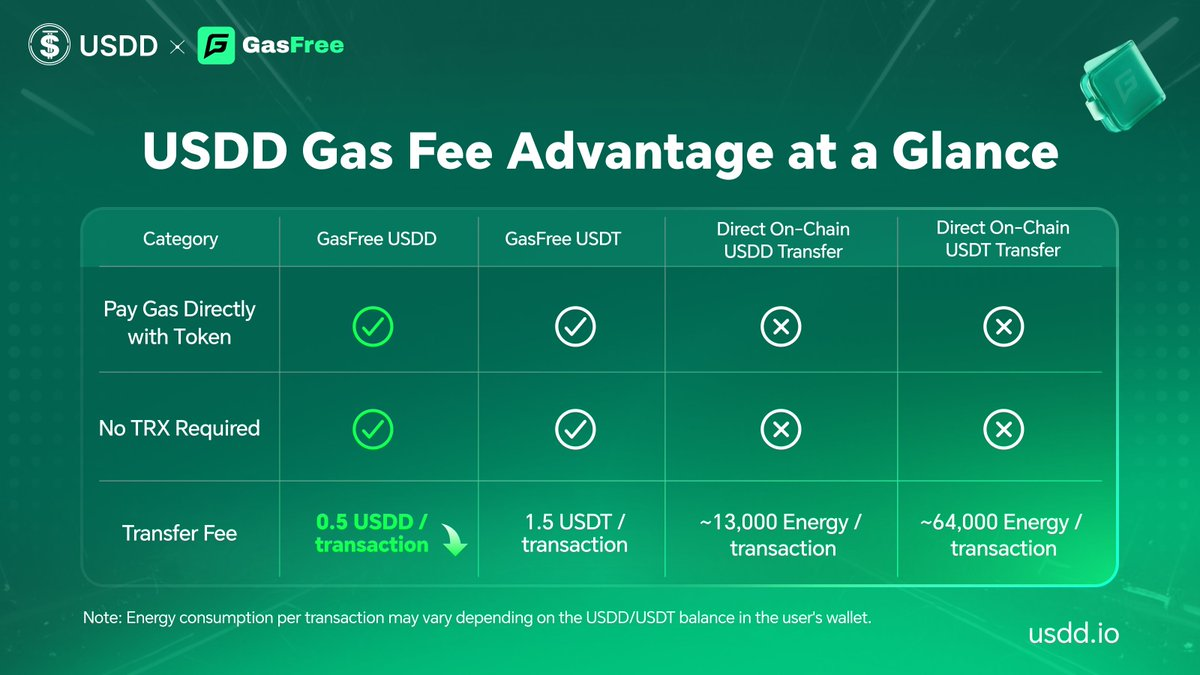
- Significant cost advantage: GasFree USDD transfers cost only 0.5 USDD per transaction, while USDT requires 1.5 USDT; direct on-chain USDD transfers consume approximately 13,000 energy, compared to about 64,000 energy for USDT.
- TokenPocket supports paying network fees directly with USDD, eliminating the need for users to separately reserve TRX, making the process extremely simple.
- TokenPocket partnered with USDD to launch a Gas Subsidy Season (September 15 to 28, 2026), offering 50% gas subsidies and 5,000 USDD in rewards.
- USDD transfers cover diverse on-chain scenarios including asset transfers, payments, settlements, fund scheduling, and DeFi interactions.
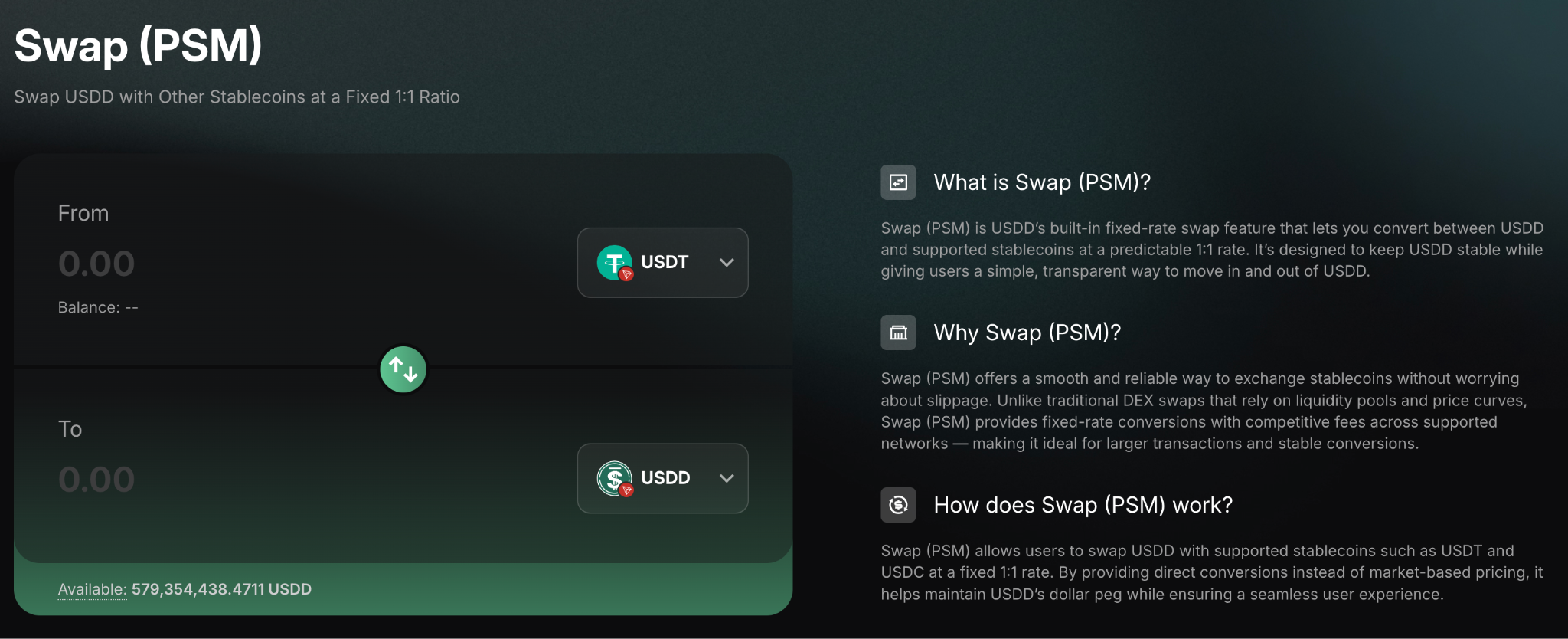
- The PSM tool supports 1:1 zero-slippage swaps between USDT, USDC, and USDD, completing the end-to-end experience before, during, and after transfers.
The value of a stablecoin lies not only in whether it can preserve value, but also in whether it is easy to use and convenient to transfer.
Whether it is wallet transfers, payments for goods and services, transaction settlement, treasury liquidity management, or the use of decentralized applications, the efficiency of transfers directly determines the practical value of a stablecoin.
However, on-chain transfers often come with barriers that traditional payments do not have: users not only have to pay network fees, but also need to hold the native token of the public chain separately, and may even have to understand technical concepts such as energy and bandwidth.
In response to these pain points, USDD has launched a series of transfer solutions. Two of them are most noteworthy:
- Use GasFree transfers: pay fees without holding TRX
- TokenPocket integration: pay network fees directly with USDD
This is an important step in USDD's expansion of its transfer infrastructure. As the ecosystem develops, more integration solutions will be launched in the future.
The purpose of these solutions is simple—to make the circulation of stable assets on-chain more convenient, more efficient, and lower in cost.
Why transfer efficiency matters
From the user's perspective, on-chain transfers seem simple—select an asset, enter an address, and confirm. But behind every transfer, network resources are consumed, which generates fees.
This gives rise to a pain point all too familiar to stablecoin users: suppose a user holds 100 USDD and wants to send it to someone else, but first has to prepare TRX to pay the transaction fee.
For veteran crypto users, keeping a small amount of TRX in their wallet has long been standard practice. But for a user who mainly uses stablecoins, having to specifically obtain another token just to send out the stablecoins they hold undoubtedly adds a cumbersome barrier.
To address this issue, USDD's transfer infrastructure provides multiple solution paths:
- Lower transfer fees—transferring USDD on TRON already has extremely low network fees.
- No more reliance on gas tokens—through platform integration, users can pay fees directly with USDD.
- Simpler transfer experience—through wallet integration, underlying details such as energy and bandwidth are completely hidden behind the scenes.
The significance of these improvements is this: stablecoins no longer stop at "holding," but can truly circulate and enter higher-frequency financial scenarios.
GasFree: lower cost and lower barriers for transferring USDD
On-chain stablecoin transfers have long faced two unavoidable problems: first, users need to separately hold another token to pay fees; second, under high-frequency transfers, fees continue to accumulate and rise.
On August 17, 2026, GasFree and USDD officially completed integration. Since then, users' everyday USDD transfers have had lower barriers and lower costs.
Currently, USDD already supports GasFree transfers on the TRON network, and wallets supporting GasFree include TronLink, Guarda, Klever Wallet, and eDir.
Transfer USDD without holding TRX
Through wallets and transfer channels that support GasFree, users can transfer TRON-based USDD without separately holding TRX to pay fees; all generated fees are settled in USDD.
For USDD, this integration is highly significant: it lowers the cost of holding and using the asset. Users no longer need to prepare extra TRX just to pay fees and can simply focus on the USDD transfer itself. The overall experience is therefore significantly improved and better aligned with everyday usage habits.
This mechanism makes on-chain stablecoin transfers smoother.
Hold USDD → Send USDD → Pay transfer fees with USDD
After the process is simplified, USDD becomes more practical in daily on-chain activity. As USDD continues to expand its role as a medium for on-chain value transfer, this integration also marks an important step for stablecoins—no longer merely something to "hold," but something easier to use.
Using GasFree to significantly reduce transfer costs
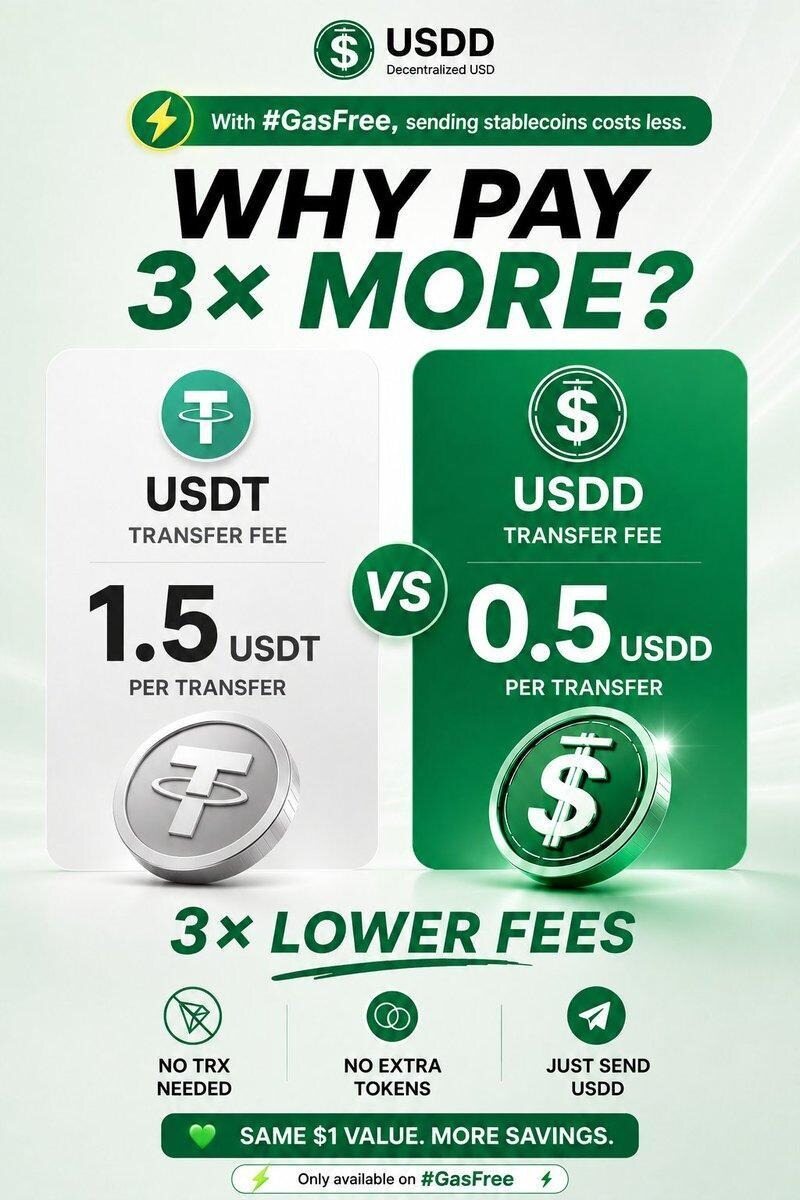
In addition to improving convenience, GasFree can also significantly reduce the cost of circulating stablecoins on-chain. For USDD transfers through GasFree, the fee is only about one-third of a comparable USDT transfer, making USDD the most cost-effective transfer option on the TRON network (actual fees may vary slightly depending on transaction type and different fee mechanisms).
This advantage is equally obvious in direct on-chain transfer scenarios: a single USDD transfer consumes far less energy than a USDT transfer, effectively reducing the resources and costs required to transfer USDD on TRON.
For users who transfer frequently, the accumulated cost savings are considerable.
- GasFree USDD transfer: only 0.5 USDD per transaction
- GasFree USDT transfer: 1.5 USDT per transaction
- Direct on-chain USDD transfer: consumes about 13,000 energy per transaction
- Direct on-chain USDT transfer: consumes about 64,000 energy per transaction
This set of comparative data intuitively reflects the direction USDD has consistently focused on—making on-chain stablecoin transfers more efficient and more cost-effective.
GasFree getting started guide
Getting started with GasFree is very simple: first, create a GasFree wallet in TronLink and deposit TRON-based USDD into the GasFree address.
Once the USDD arrives, users can directly initiate on-chain transfers without preparing TRX in advance to pay gas fees. The entire process flows smoothly, and even beginners can get started easily.
After setup is complete, users can unlock many conveniences of the USDD GasFree service: no need to separately reserve TRX to pay gas fees, easier transfer management, and significantly lower fees for each transaction.
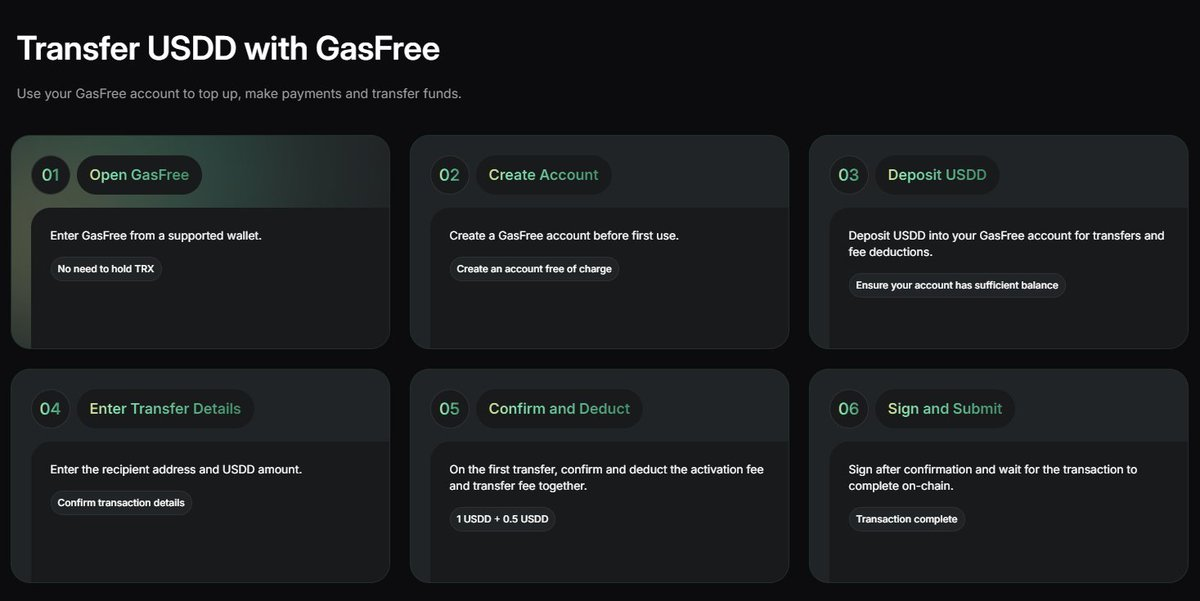
USDD not only makes the transfer of on-chain stable assets more efficient and convenient, but also effectively lowers transfer costs and provides a smoother, more unobstructed interaction experience. For USDD, GasFree is not just a transfer feature, but also strengthens USDD's positioning as a "medium for on-chain value circulation," reducing the technical friction and usage costs between holding USDD and actually using it.
To learn more about USDD GasFree features, please visit https://www.usdd.io/gasfree.
TokenPocket: settle network fees directly with USDD
TokenPocket supports paying network fees directly with USDD, making USDD transfers even simpler. In transactions supported by TRON, users no longer need to separately reserve TRX to pay network fees and can simply choose to settle with USDD.
Pay network fees with USDD, no need for another token
TokenPocket now supports paying network fees with USDD, allowing the entire transfer process to be completed using USDD.
The process is clear and easy to understand: users only need to initiate a USDD transfer, choose to pay the network fee in USDD, review the fee details, and confirm the transaction—all without separately preparing TRX.
TokenPocket step-by-step guide
Open TokenPocket to initiate a transfer, select USDD as the transfer token, and also choose USDD in the fee deduction option. The wallet will automatically list the fee details (including required bandwidth and energy) for clear visibility. After confirming everything is correct, submit the transaction and the on-chain transfer is complete.
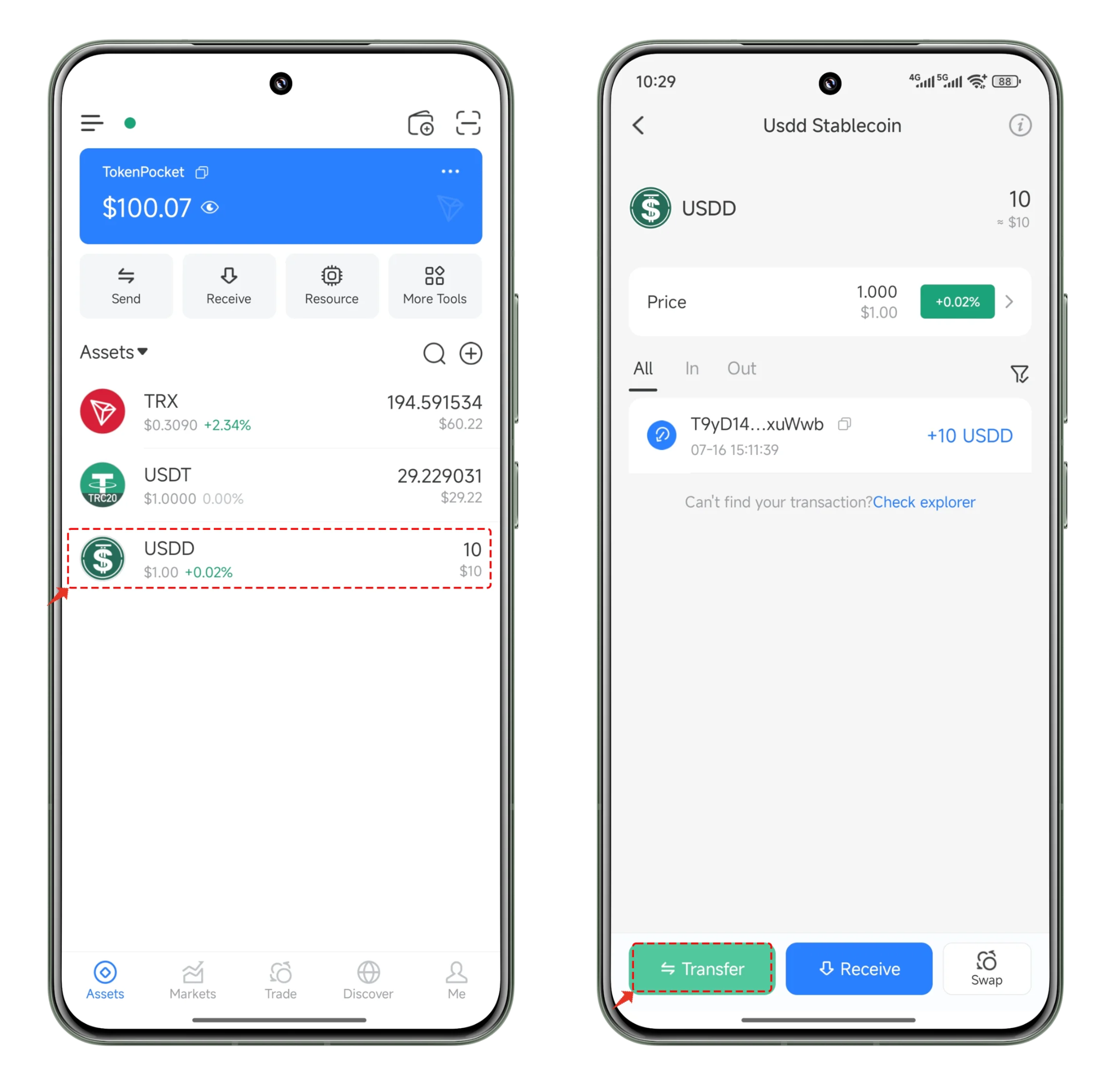
With this minimalist process, users can enjoy a smoother transfer experience, no longer need to hold TRX separately, and also gain a new path for paying fees on TRON.
For detailed instructions, see TokenPocket's FAQ page: https://help.tokenpocket.pro/en/wallet-faq-en/tron-wallet/usdd-gas
TokenPocket × USDD Gas Subsidy Season
To encourage more users to experience paying gas fees with USDD, TokenPocket, together with USDD, launched the "Gas Subsidy Season" event from September 15 to September 28, 2026. During the event, users only need to use USDD to pay gas fees and complete on-chain tasks to immediately enjoy a 50% gas fee subsidy.
The event also features 5,000 USDD in rewards and a KeyPal hardware wallet. Users can participate in the leaderboard competition to win corresponding rewards.
While participating in on-chain interactions, users can also personally experience the efficiency and convenience of paying fees with USDD. The 50% gas subsidy is available for a limited time, helping users further reduce transfer costs.
Join the TokenPocket × USDD Gas Subsidy Season now: https://zealy.io/cw/tokenpocket/leaderboard/1911b954-6677-48a3-8fe1-bd39bfd64a32
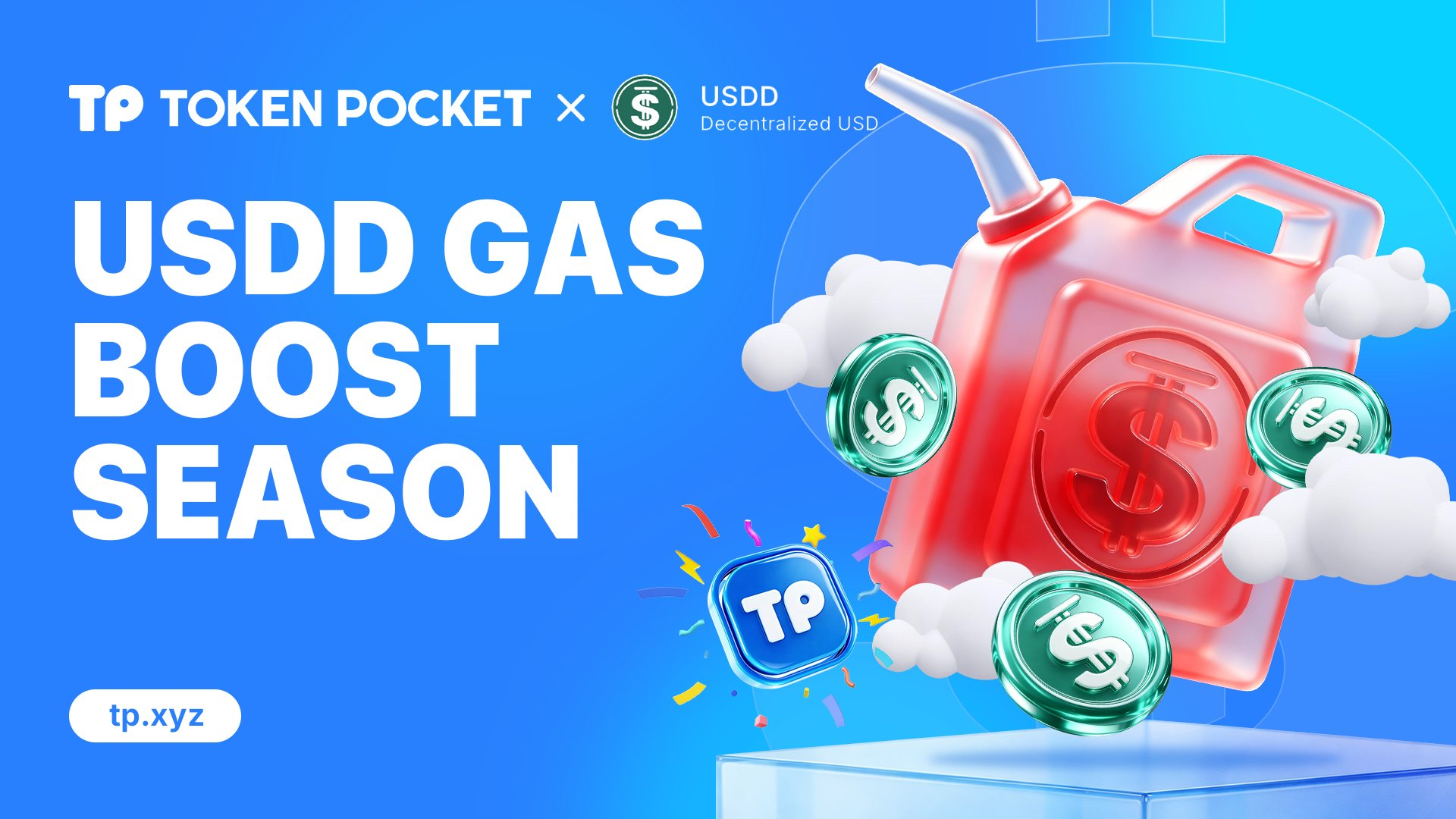
TokenPocket now supports paying network fees with USDD, making USDD more practical in everyday on-chain transfers. Users no longer need to separately hold and manage additional tokens, with holding and transferring completed in one step for a more convenient and unified experience.
USDD has taken another step forward in driving stablecoins into real on-chain scenarios. As users increasingly move value between wallets, applications, and markets, eliminating unnecessary friction in every transaction becomes ever more critical. The core goal is very clear: make USDD not only easy to hold, but also easy to circulate, becoming the best medium for transferring stable assets on-chain.
From wallet transfers to payments and settlement
On-chain transfers are essentially just the movement of assets from one address to another. But the economic intent behind them often goes far beyond that.
A single USDD transfer can carry many different kinds of on-chain activity:
- Asset transfers: moving stable assets between individuals, or between wallets.
- Payments: sending USDD to merchants or service providers.
- Settlement: transferring funds between counterparties or settling financial obligations.
- Fund allocation: reallocating stablecoin liquidity among multiple wallets.
- DeFi interactions: transferring USDD into the relevant contract before depositing, swapping, borrowing, or calling a DApp.
For this reason, transfer efficiency is not an added advantage for USDD, but the key to its transformation—allowing USDD to become not just a static store of value, but a truly usable asset in everyday on-chain activity.
By improving transfer convenience and reducing transfer costs, USDD aims to make it easier for users to move stable assets across ecosystems while removing the burden of managing multiple gas tokens. The practical value of USDD in real on-chain transactions is built on this.
For stablecoins to truly integrate into everyday on-chain scenarios, these seemingly minor experience details often determine success or failure.
Building a more convenient transfer experience
USDD's transfer network integrates multiple mechanisms to optimize the core pain points in the user transfer process one by one and build a convenient, efficient transfer experience across the board.
Before transfer:
- USDD's stablecoin swap tool PSM is simple and efficient, allowing users to swap mainstream stablecoins such as USDT and USDC into USDD at 1:1 with zero slippage.
During transfer:
- In some scenarios, users can use the GasFree feature to complete transfers without holding additional TRX.
- In specific transaction scenarios, users can pay relevant fees directly with USDD through TokenPocket.
After transfer:
- In addition to basic wallet-to-wallet transfers, USDD is already deeply embedded in diverse on-chain scenarios, covering merchant and service provider payments, counterparty settlement, and DeFi activities such as yield generation, swaps, and lending.
These mechanisms are interlinked and run through the entire transfer process, significantly improving USDD's usability: users can swap specific stablecoins into USDD, transfer stablecoin assets at lower cost, and apply them to various on-chain activities.
This not only meets users' diverse needs, but also enables stablecoins to complete the leap from passive holding to practical usability.
Therefore, for USDD, efficient transfers are by no means only about convenience. They are a key part of building a truly usable on-chain currency—allowing value to flow smoothly among different users, applications, and financial activities.
Making stablecoin circulation smoother
Whether a stablecoin is good to use cannot be judged by price stability alone; it also depends on whether it is easy to obtain, has sufficient liquidity, and transfers smoothly. USDD's transfer infrastructure is built around this idea, helping users move from passively holding stablecoins to actively using them on-chain.
Today, stablecoins are evolving from a simple trading tool into broader financial infrastructure, making the efficient flow of value increasingly critical. USDD is targeting exactly this shift: combining sound value with practical transfer capabilities that can support scenarios such as payments, settlement, fund allocation, and DeFi.
USDD's goal is extremely clear: to make stablecoin circulation smoother with lower cost and less friction.
As the scope of stablecoin applications continues to broaden, USDD is also continuously evolving: both stable and reliable, while also allowing digital value to flow as needed.