






2026 First Half: TRON Ecosystem Advances on Dual Tracks of "DeFi + AI" — DeFi Asset Value Undergoes Comprehensive Upgrade to Solidify the Foundation, While AI Innovative Products Land Densely to Explore New Blue Oceans


- Core Viewpoint: The global crypto market experienced a downturn in the first half of 2026, yet the TRON ecosystem grew against the trend. Through the dual-track strategy of "building a solid foundation with DeFi + opening new frontiers with AI," it achieved a breakthrough in stablecoin scale, enhanced DeFi value, and delivered a dense rollout of AI products, building core competitiveness capable of weathering market cycles.
- Key Elements:
- The circulation of USDT on the TRON blockchain surpassed $90 billion, further consolidating its leading position as a global mainstream stablecoin settlement network and providing low-cost liquidity for the upper-layer ecosystem.
- The DeFi ecosystem has formed a comprehensive deflationary matrix covering SUN.io, JustLend DAO, WINkLink, and BitTorrent. Multiple projects have implemented routine buyback-and-burn mechanisms, with TVL exceeding $5.18 billion and 24-hour active addresses surpassing 3.88 million, firmly ranking first among global public chains.
- SUN.io launched SunSwap V4 (introducing six major innovations including singleton pattern and native TRX pass-through), with liquidity peaking at $108 million and cumulative SUN token burns exceeding 678 million.
- JustLend DAO's cumulative net revenue surpassed $94.2 million. JST completed four rounds of large-scale buyback and burns (cumulative burns accounting for 17.29% of total supply), with the token price surging over 275% year-to-date. GasFree's cumulative transfer volume exceeded $132.6 billion.
- BitTorrent launched BTTInferGrid, a decentralized AI computing network, to enter the AI sector, and initiated a long-term BTT buyback and burn program. Meanwhile, the SEC dropped all charges against it, clearing regulatory risks.
- The AI ecosystem has formed a complete product matrix centered on B.AI, Bank of AI, AINFT, and BTTInferGrid. B.AI's cumulative registered users surpassed 2.2 million, with single-day token throughput exceeding 1.1 trillion.
In the first half of 2026, the global crypto market entered a downward adjustment cycle, impacted by multiple factors such as fluctuations in traditional financial cycles and the diversion of funds toward the AI sector's hot topics. Market liquidity tightened, and most sectors faced stagnant growth. However, the TRON ECO ecosystem bucked the trend and delivered an independent market performance, achieving breakthrough development across multiple core businesses: from the scale leap of its stablecoin settlement network, to the collective value upgrade of assets in the DeFi sector, to the rapid launch and strategic positioning of new AI track products. The entire chain delivered outstanding results far exceeding the industry average.
As the liquidity foundation supporting the efficient operation of the entire ecosystem, the stablecoin business has always been TRON's core competitive advantage. In the first half of 2026, despite the overall global USDT supply remaining stable, the circulation of USDT on the TRON chain expanded against the trend, successfully surpassing the $90 billion mark and repeatedly setting new historical peaks. It is now steadily advancing toward the $100 billion scale, continuously consolidating its position as the industry leader among global mainstream stablecoin settlement networks, providing ample, low-cost liquidity support for various DeFi and AI applications in the upper-layer ecosystem.
While solidifying its dominant position in the stablecoin sector, TRON established a clear dual-track development pattern of "DeFi as the foundation + AI as the new frontier" in ecosystem development during the first half of 2026: The DeFi ecosystem strengthened the overall value-capture capability of the ecosystem through the implementation of regular buyback-and-burn mechanisms across multiple core projects, coupled with continuous product feature iterations. Meanwhile, the AI sector saw the密集 launch of multiple core products, rapidly building a complete AI intelligent ecosystem—from an upper-layer unified multi-model AI service gateway, to AI Agent infrastructure, and further down to distributed computing power at the base layer—successfully seizing the first-mover advantage in the Web3 AI industry.
DeFi Ecosystem's "Buyback & Burn + Product Iteration" Dual-Track Synergy Drives Comprehensive Value Surge Across the TRON Ecosystem
Facing industry headwinds, the DeFi sector of the TRON ecosystem in the first half of 2026 consistently advanced along the dual main lines of "buyback-and-burn value empowerment + product feature iteration and upgrade." On one hand, through the continuous implementation of buyback-and-burn mechanisms across core projects in multiple tracks, a normalized deflationary system covering the entire ecosystem was established. On the other hand, the functionality and user experience of core protocols were continuously refined, achieving a two-way improvement in token value and protocol fundamentals.
In terms of deflationary value building, multiple core projects within the TRON ecosystem have implemented buyback-and-burn programs, forming an ecosystem-wide deflationary matrix covering liquidity infrastructure, lending, oracles, and distributed transmission, comprehensively enhancing the value-capture capability of ecosystem assets:
· Liquidity infrastructure SUN.io continues to expand the funding sources for SUN token buybacks and burns. In the 50th buyback and burn round this April, income from the SUNX business was added to the burn funding pool, based on the original SunSwap V2 and SunPump business revenues. The 50th and 51st rounds of SUN token buybacks and burns were completed in April and July, respectively;
· DeFi infrastructure JUST ecosystem delivered on its multi-round JST large-scale buyback and burn deflation plan as scheduled. The JST token completed its second and third rounds of large-scale burns in January and April, respectively, with the fourth round of buyback and burn implemented in July, setting a new historical high for burn funding scale in this round;
· Oracle sector WINkLink initiated its WIN token buyback and burn plan in July, allocating all service revenue to WIN buybacks and burns.
· Distributed data transmission leader BitTorrent also launched BTT token buybacks and burns in July, allocating all revenue from its decentralized business to BTT buybacks and burns.
On the product iteration front, the TRON ecosystem continued to optimize products around multiple core scenarios including trading, lending, oracles, and decentralized files, continuously strengthening the ecosystem's core competitiveness:
· SUN.io completed a brand upgrade in January, adding a Chinese brand to achieve global development with both Chinese and English branding, and launched the SunSwap V4 version in March, improving trading depth and user experience;
· JustLend DAO launched the SBM V2 version in June, introducing isolated independent liquidity pools to cover more long-tail asset categories, further improving the product matrix and security mechanisms of the lending ecosystem; The ecosystem's gasless transfer solution GasFree achieved leapfrog growth in both stablecoin transfer volume and user base in the first half of the year;
· Oracle WINkLink upgraded its price service page in March, adding a "Market Statistics" data section to continuously enhance on-chain data service capabilities;
· BitTorrent launched a new decentralized AI computing product, BTTInferGrid, in June, officially entering the AI track and opening up new long-term growth space for itself.
The continuous execution of buyback-and-burn mechanisms, coupled with the constant strengthening of product fundamentals, not only drove a steady increase in DeFi activity on the TRON chain but also provided solid support for the long-term value of ecosystem tokens.
As of September 1, DeFiLlama data shows that the total value locked (TVL) in DeFi on the TRON chain has exceeded $5.18 billion, ranking among the top five global public chains, on par with Solana and BSC, with the gap continuously narrowing and even surpassing both during peak periods. User activity advantages are even more pronounced: during the same period, TRON's 24-hour active addresses exceeded 3.88 million, nearly twice that of second-place BSC, firmly ranking first among global public chains—a full testament to the ecosystem's real user scale and on-chain vitality.

Liquidity Infrastructure SUN.io: SunSwap V4 Reshapes DEX Trading Efficiency, SUN Buyback Funding Sources Continuously Expanded
In the first half of 2026, SUN.io executed multiple key initiatives across core dimensions including brand globalization, product experience upgrades, and token value empowerment, completing a full-chain, multi-dimensional upgrade from brand awareness to product capabilities to value mechanisms, achieving a significant leap in overall ecosystem competitiveness.
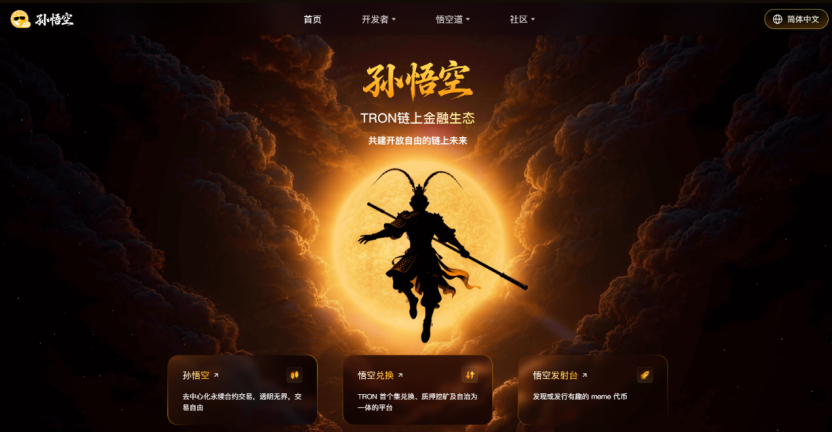
In brand building, SUN.io has achieved a global development strategy with dual-brand synergy in both Chinese and English. In January of this year, SUN.io completed a comprehensive brand refresh, adding the Chinese brand "孙悟空" (Sun Wukong), with all its core products simultaneously completing unified naming under both Chinese and English brands: DEX platform SunSwap was named "悟空兑换" in Chinese, Meme issuance platform SunPump was named "悟空发射," and derivatives trading platform SunX was named "孙悟空," with the Chinese version of the official website also launched simultaneously. At this point, SUN.io's main product matrix has fully covered core DeFi tracks including "DEX spot trading + Meme asset issuance + Perp derivatives trading," and through the dual-line operational advantages of Chinese and English dual branding, it precisely reaches user groups across different global regions, driving the synergistic development of the global ecosystem.
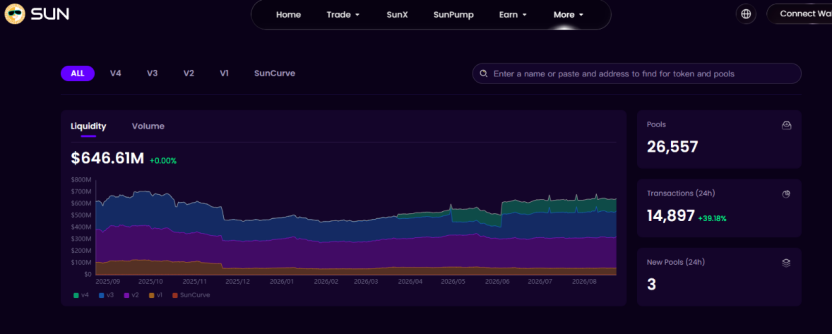
In terms of product experience, SUN.io continuously iterates its core protocols, leveraging technological innovation to significantly lower user trading barriers and costs. On March 2 of this year, SUN.io's DEX platform SunSwap officially launched the V4 version, innovatively introducing six major features: Singleton Mode (unified liquidity pool management), Native TRX Direct Swap (TRX can be swapped directly without wrapping), Flash Accounting (unified net settlement), Hooks (customizable trading rule plugins), Custom Accounting (customized settlement strategies), and Subscribers (real-time position change notifications). These features pushed the protocol's customizability and extensibility to new heights, unlocking possibilities for more innovative scenarios in the DeFi ecosystem. More importantly, within less than five months of its launch, SunSwap V4 achieved high-speed growth in both liquidity and trading volume, with liquidity peaks stabilizing at $108 million and 24-hour trading volume exceeding $70 million during peak periods, demonstrating strong growth momentum.
Additionally, in May of this year, SUN.io completed a comprehensive upgrade of its Universal Router smart routing contract, supporting automatic optimal-path swaps across multiple liquidity pools, further improving trading efficiency.
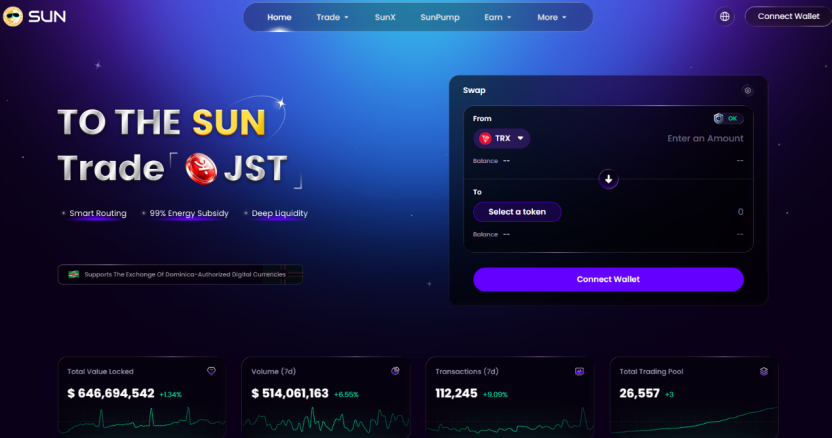
According to the latest official data released on September 1, the current SUN.io platform has a total value locked (TVL) of approximately $650 million, with over 26,500 liquidity pools launched. In the past 7 days, the platform's total trading volume exceeded $514 million, with over 112,000 transactions during the same period. All core operational metrics continue to trend steadily upward.
In terms of token value empowerment, SUN.io accelerates the deflationary process of the ecosystem token SUN by continuously expanding funding sources for buybacks and burns. Starting from the 50th round of buyback and burn (executed on April 25), SUN.io formally incorporated revenue from the SunX derivatives business into SUN's buyback funding pool, based on the original SunSwap V2 trading fees and SunPump business revenue, significantly expanding the boundaries of burn funding sources. Additionally, the burn execution cycle was adjusted to be announced uniformly in mid-month of each quarter, making the deflationary rhythm more transparent and predictable.
As of September 1, since the buyback and burn mechanism was officially launched in December 2021, SUN.io has executed 51 consecutive rounds of burn operations without interruption, with a cumulative total of 678,547,188.32 SUN tokens burned—just one step away from the 700 million milestone—continuously strengthening the ecosystem token's deflationary pressure.
JustLend DAO's Real Yields Fuel JST Buybacks and Burns, Diversified Product Matrix Advances on All Fronts
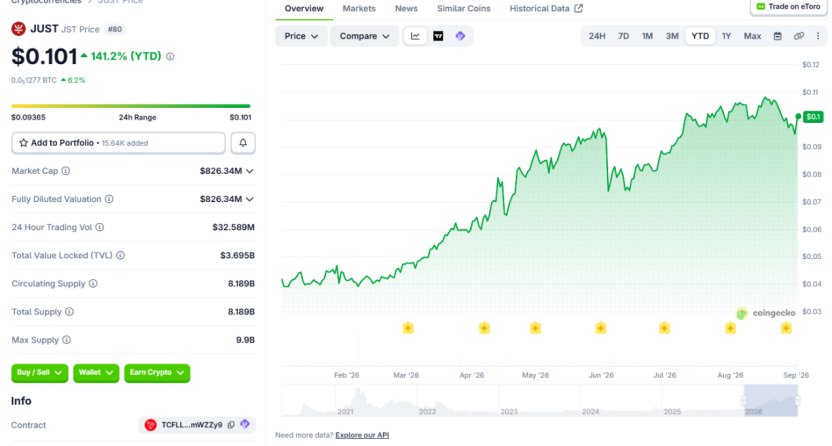
As the core value pillar of the TRON DeFi ecosystem, the JUST ecosystem in the first half of 2026 relied on the continued stable profitability of its core protocol JustLend DAO to drive multiple rounds of large-scale JST token buybacks and burns, successfully constructing a complete value loop of "real business revenue → normalized deflation implementation → positive token value appreciation." Driven by this loop, the JST token's value achieved leapfrog growth: the price rose from $0.04 at the beginning of the year to a peak of $0.11, representing a cumulative increase of over 275%; market capitalization climbed from approximately $400 million at the start of the year to a peak above $868 million, setting a new high since 2022, with a quoted price of $0.101 on September 1.
Meanwhile, JustLend DAO's diversified product matrix is flourishing across multiple fronts, covering high-potential tracks including lending, liquid staking, energy rental services, and smart wallets, opening up new space for long-term ecosystem growth.
Since the beginning of 2026, JST has completed three consecutive rounds of large-scale routine burns, with each round's burn funding exceeding $20 million, and cumulative buyback and burn investment of over $70 million in the first half of the year, of which nearly 90% came from JustLend DAO's real operating net income:
Second round (January 14): Approximately 525 million JST burned, representing 5.30% of total supply, corresponding to $21 million in funds;
Third round (April 15): Approximately 271 million JST burned, representing 2.74% of total supply, corresponding to $21.3 million in funds;
Fourth round (July 17): Combined routine burn and special USDJ historical stability fee burn, totaling approximately 355 million JST burned, representing 3.59% of total supply, corresponding to $34.59 million in funds—setting a new all-time high for single-round burn funding.

To date, JST has completed four rounds of large-scale buyback and burn plans, with cumulative JST burns reaching 1.711 billion tokens, accounting for approximately 17.29% of the total token supply, with cumulative funding exceeding $94.62 million. Except for the USDJ historical stablecoin special burn (valued at approximately $10.39 million) in the fourth round, all routine JST buyback and burn funding comes 100% from JustLend DAO's real business revenue.
According to data disclosed on the official financial page, JustLend DAO's platform cumulative net income has exceeded $94.2 million, with the total funds allocated to the JST buyback and burn pool approaching $105 million. After deducting the $10.39 million USDJ special historical stability fee, nearly $94 million in buyback and burn funds all came from real revenue generated by the platform's daily operations. The platform currently retains approximately $10.34 million in existing reserve income, which will be allocated to the next routine burn process according to plan.
As the core protocol of the JUST ecosystem, JustLend DAO has formed multiple core business segments including the lending market (SBM), liquid staking (sTRX), energy rental, gasless transfer solution (GasFree), and direct energy purchase (Buy Energy). Each segment firmly holds a leading position in its respective industry track, constituting a stable and diversified revenue matrix.
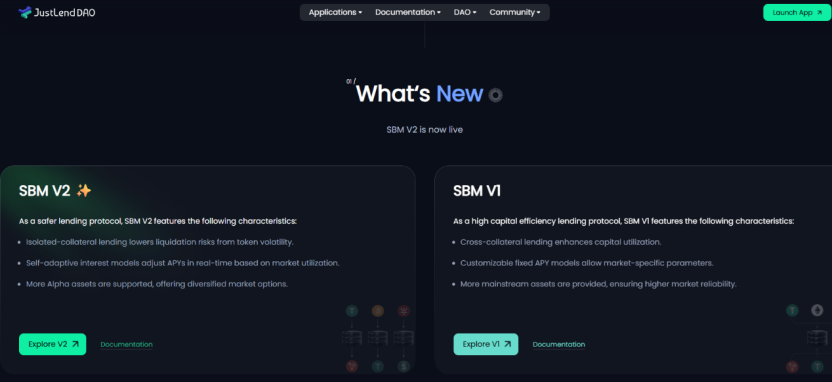
In the core lending track, JustLend DAO's lending market SBM has long maintained a top-five position globally in the lending sector by TVL. According to DeFiLlama public data as of September 1, JustLend DAO's lending market SBM currently has a TVL of $3.38 billion, ranking fourth globally in the decentralized lending sector. In June of this year, the platform officially launched the SBM V2 version, innovatively introducing an isolated liquidity pool mechanism that broadens the coverage of new asset types while significantly enhancing overall platform security. On the asset side, the platform also added an exclusive lending market for U assets in the first half of 2026, continuously improving its asset layout.
In the liquid staking track, JustLend DAO's sTRX product has accumulated over 9.73 billion TRX staked, with participating addresses exceeding 17,000. Both total staking scale and participating user numbers continue to climb steadily. The energy rental market derived from the liquid staking ecosystem, with its flexible model of "rent as you use, pay as you need," addresses the pain point of needing long-term large-scale TRX staking to reduce on-chain gas costs, and has now surpassed 80,000 cumulative participating users.
In August of this year, JustLend DAO further launched a new TRON energy instant-purchase service—Buy Energy—which supports users in purchasing the energy they need in one transaction based on actual requirements. Compared to directly burning TRX to obtain on-chain resources, this product can save users up to approximately 64% in fees.
At this point, JustLend DAO has built a gas cost optimization tool matrix centered on the core goal of "lowering on-chain usage barriers," encompassing "Energy Rental + Buy Energy + GasFree gasless transfer solution."
Among these, the GasFree gasless transfer solution has grown into a new growth engine for the platform: this feature allows users to pay on-chain fees directly through the target asset being transferred without needing to hold the native token TRX, fundamentally removing the native token holding barrier for ordinary users participating in on-chain transactions. Currently, GasFree supports fee deduction for transfers of two stablecoins, USDT and USDD (with USDD officially integrated in August of this year), and both user numbers and transfer volumes are in a phase of rapid growth.
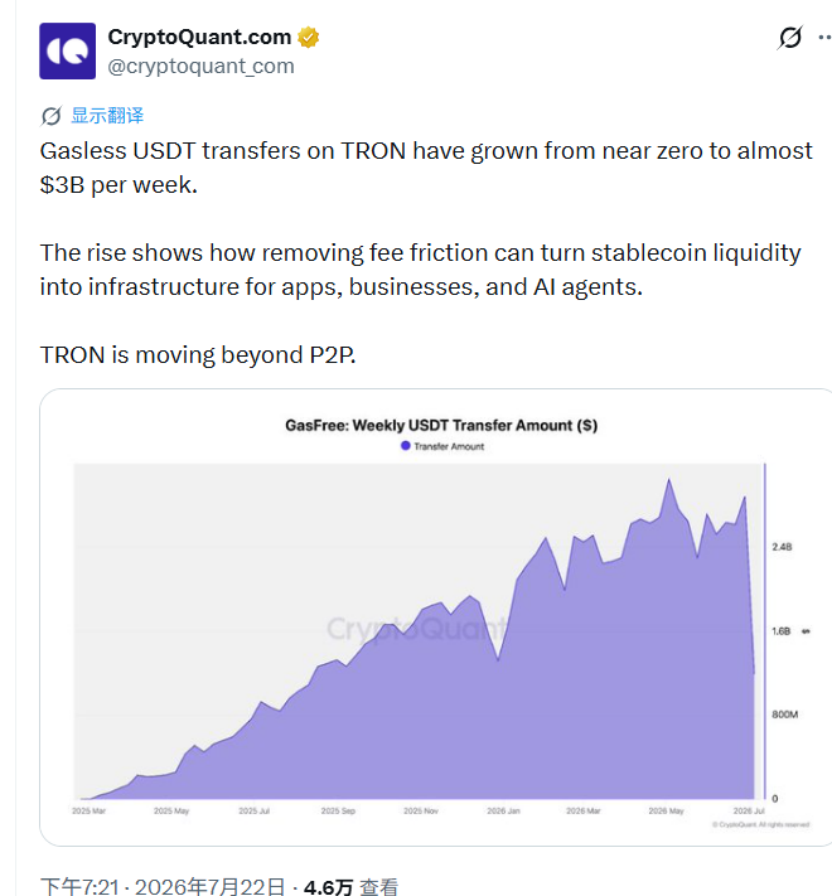
According to data from CryptoQuant's "TRON Q2 Report," GasFree's weekly transfer volume reached $2.9 billion in the last week of June, with a historical record of $3 billion in a single week set in early May. As of September 1, GasFree's cumulative stablecoin transfer volume has exceeded $132.6 billion, processing over 7.7 million transactions and saving global users over $8.48 million in fees cumulatively, rapidly becoming an irreplaceable new growth curve for the JustLend DAO ecosystem.
In addition to continuous product iteration and accelerated growth of core business, JustLend DAO is also constantly expanding external ecosystem partnerships, opening up channels for acquiring incremental users. On July 6, JustLend DAO was officially integrated into the Binance Wallet DeFi interface, with its liquidity pools going live simultaneously, directly reaching the massive user base of a top-tier CEX. Subsequently, the platform, together with core TRON ecosystem projects such as USDD and SUN.io, launched the "TRON DeFi Summer" carnival event in partnership with Binance Wallet, with a total prize pool of up to $4.5 million


