Executive reshuffle with high-profile hires—Is Polymarket going public?


- Core takeaway: Polymarket has recently brought in a wave of former executives from Amazon, Uber, Coinbase, and other major companies while rewriting its trading engine, which the market interprets as building a financial company governance framework for an IPO. However, a true IPO has not yet been launched at its $21 billion valuation, and on-chain tokenized trading around IPO expectations has already emerged.
- Key elements:
- Polymarket completed approximately $1 billion in financing in early September at a post-money valuation of $21 billion, led by 1789 Capital.
- The company has been aggressively recruiting former Amazon CFO, DoorDash VP of Operations, Uber Head of Growth, Coinbase Head of US Business, Robinhood Compliance Officer, and the NYSE executive in charge of matching systems, filling key roles in finance, compliance, and trading infrastructure.
- The engineering team has publicly stated it will rewrite the matching engine, on the grounds that the platform already handles user funds and the code rapidly built in its early days cannot support exchange-grade operations long term.
- ICE holds approximately 22% of issued shares, corresponding to about $4.6 billion; Blockchain Capital and CEO Coplan each hold about 11%.
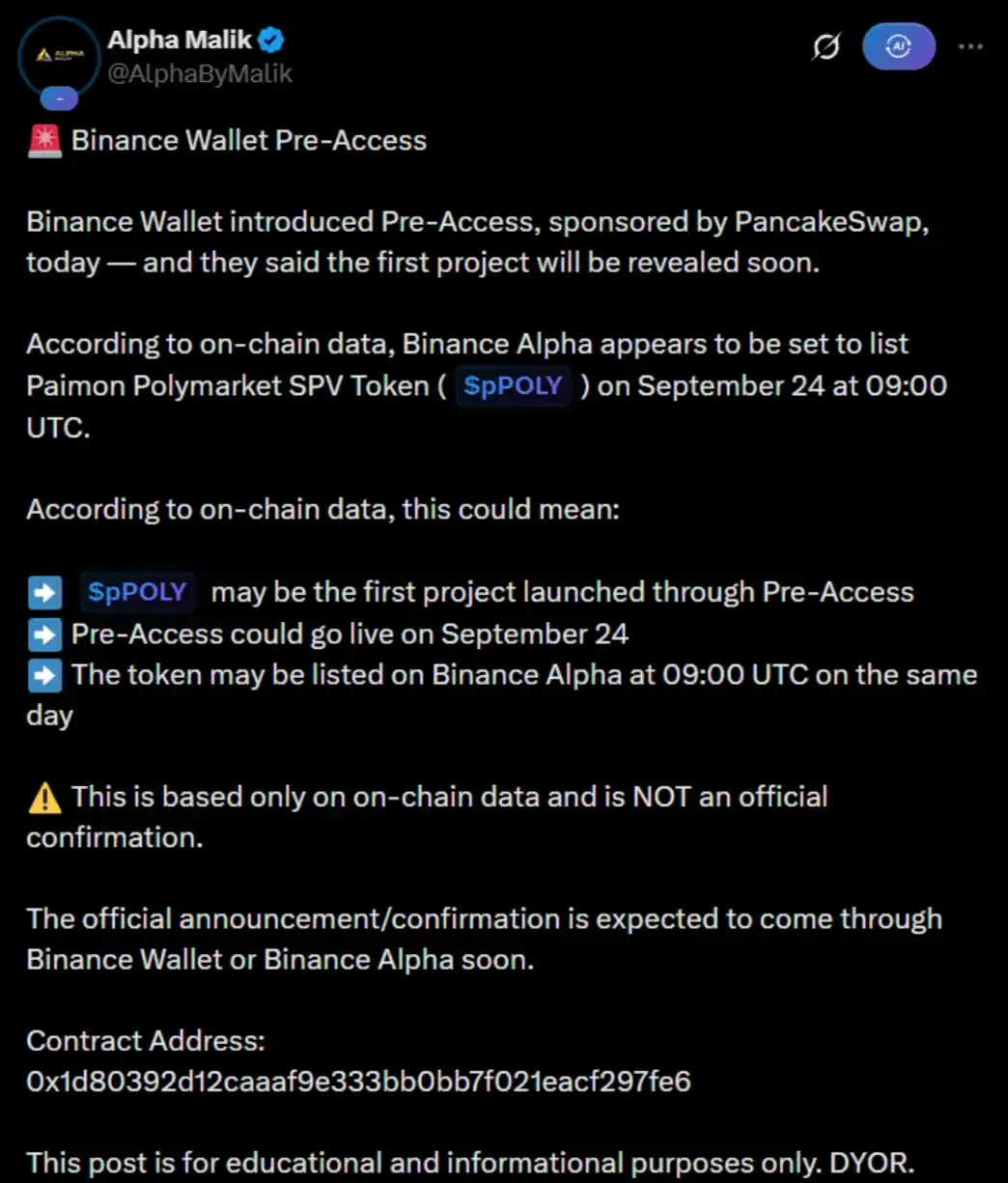
- Rumors circulating online that "Binance Wallet is launching a Polymarket Pre-IPO" are actually Paimon Finance packaging Polymarket-related private equity into an on-chain SPV token, $pPOLY, and are not shares officially issued by Polymarket.
- Binance has made clear that Pre-Access assets do not represent direct equity in the underlying company and do not guarantee that a future IPO will be completed.
On September 20, a screenshot about "Binance Wallet is about to launch Polymarket Pre-IPO" circulated on X.
Polymarket was founded in 2020 by Shayne Coplan, who serves as CEO. Users can use funds to trade on the possible outcomes of politics, sports, and global events. In early September, media reports said that 1789 Capital was leading a funding round of about $1 billion, bringing the platform's post-money valuation to $21 billion.
If viewed through the lens of "going public," Polymarket's series of moves over the past few months suddenly make sense: a wave of executives from Amazon, Uber, the NYSE, Coinbase, and Robinhood joined in quick succession; power over the U.S. business was redistributed; the on-chain order book is being prepared for a rewrite; and the company also began filling out CFO, compliance, risk control, and government relations roles.
It appears the platform is outfitting itself with a framework that looks more like that of a financial company.
Big-Company Executives Arrive to Pave the Way for an IPO
On September 10, Warren Jenson joined Polymarket as its first company-level CFO. He previously served as a finance chief at Amazon and several other giants, and has long overseen finance, capital strategy, and long-term planning at large companies.
A few days later, Collin McKinney Hill, a former DoorDash general manager and chief of staff to the founder of Bridgewater, took the role of vice president of operations.
Other core team members include Travis VanderZanden, who previously worked at Uber, overseeing growth; former Coinbase executive Dan Lee leading the U.S. business; former Robinhood executive Megan McGrath serving as chief compliance officer; and Hayk Mkrtchyan, who previously oversaw the core matching system at the NYSE, becoming head of engineering for Polymarket's U.S. exchange.
These people come from different companies, but their backgrounds correspond to the gaps a large financial platform is most likely to expose: finance, operations, growth, U.S. business, compliance, product, and trading infrastructure are almost all being overhauled.
According to The Information, Dan Lee, who was recruited from Coinbase, has gradually taken over Polymarket's U.S. business at the practical working level. According to people close to the company, employees report to Lee rather than to Justin Hertzberg, the nominal CEO of the U.S. business.
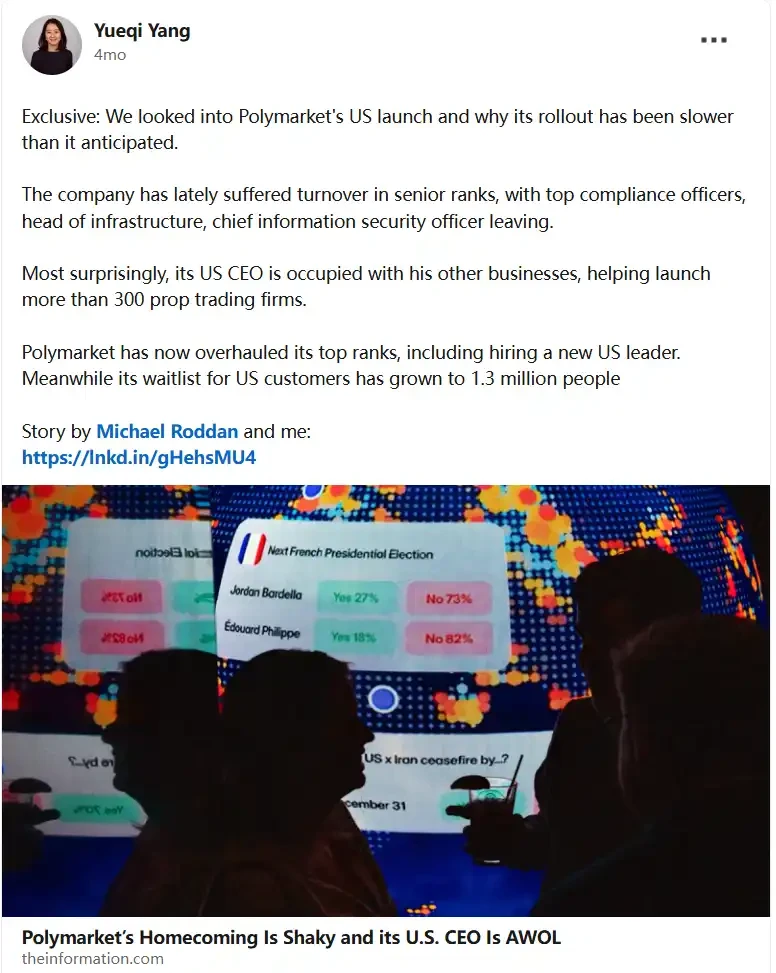
A more direct change took place in the engineering team. Josh Stevens, who joined in March this year as vice president of DeFi engineering and previously served as senior vice president of engineering at Aave, publicly said that the code built quickly in the early days could no longer be salvaged for the long term, and that the team was preparing to rewrite the matching engine.
His reasoning was also straightforward: the platform is already an exchange handling user funds, not a small product that can be freely iterated through trial and error.
If these moves are viewed through the logic of an IPO, this looks very much like an urgent effort to fill out the organizational capabilities of a financial platform.
At a $21 Billion Valuation, Who Holds This Platform?
At present, the market's valuation anchors for Polymarket are roughly distributed between $15 billion and $21 billion. The only investor with reliable, publicly available data is Intercontinental Exchange, ICE, the parent company of the New York Stock Exchange.
As of June 30, 2026, ICE held about 22% of the platform's issued shares and also has the exclusive right to nominate and vote on one director. If converted on that basis alone, ICE's 22% stake corresponds to about $4.6 billion; calculated on a fully diluted basis of 14%, it would be about $2.9 billion.
Unlike ICE, other financiers can only be roughly estimated based on the amount invested in each round and the post-money valuation at the time: Blockchain Capital holds about $2.3 billion (11%), 1789 Capital holds about $300 million (1.4%), and CEO Coplan holds about $2.3 billion (11%).
It is worth noting that Trump Jr., the eldest son of Donald Trump, serves as a partner at 1789 Capital and was already a member of Polymarket's advisory board as early as August 2025.

An Equity Transfer Packaged as an IPO
In this screenshot from September 20, perhaps not only Polymarket deserves attention, but also Paimon Finance. The screenshot links "Polymarket is about to IPO" with $pPOLY, and the full name of $pPOLY is Paimon Polymarket SPV Token.
Paimon is a platform that tokenizes private equity and Pre-IPO assets. Its model is to package assets related to unlisted companies into on-chain tokens. The company has previously placed related assets of private companies such as SpaceX, OpenAI, and Anthropic into the same product system.
Binance, mentioned in the screenshot, has also made the nature of this kind of product very clear: Pre-Access assets are provided by third parties, and Binance Wallet is only the access point; such assets do not represent direct shares in the underlying company, nor do they guarantee that the relevant company will necessarily complete an IPO in the future.
So the more accurate statement is not "Polymarket is issuing its own Pre-IPO stock," but rather "Paimon may be packaging private equity related to Polymarket into a token that can circulate on-chain."
For Polymarket, the real IPO may not have begun yet; but trading around IPO expectations has already appeared in advance.