Broadcom's Hidden Ambitions: AI Money Is Flowing Beyond GPUs


- Core Thesis: Broadcom's latest earnings show its AI semiconductor business (including custom ASICs and interconnect) is becoming a high-growth second curve, with FY2027 revenue projected at $115 billion. This signals that major AI customers, beyond GPUs, are accelerating efforts to optimize inference costs through custom chips — as AI infrastructure investment expands from individual chips to full-system ecosystems.
- Key Elements:
- Broadcom's Q3 AI semiconductor revenue reached $16.7 billion, exceeding guidance, with next quarter projected at $21.7 billion, up over 200% year-over-year; FY2027 AI chip revenue is projected at $115 billion, potentially reaching $230 billion by FY2028.
- The core logic behind ASICs is that as inference workloads scale, specialization optimizes per-token cost and power efficiency — not simply replacing GPUs. Google, Meta, and OpenAI (developing the Jalapeño processor with Broadcom) are all positioning in this space.
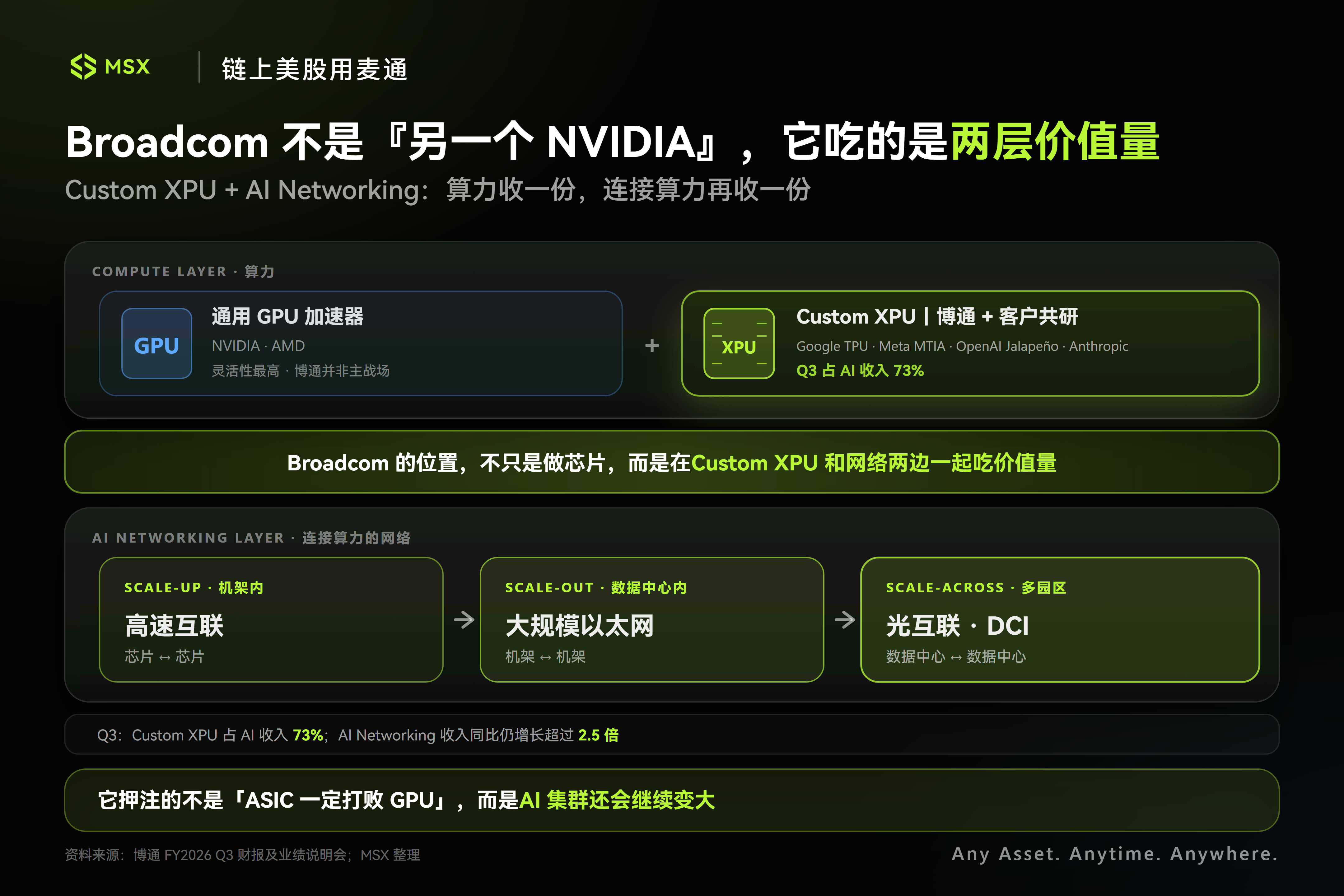
- Broadcom operates on two parallel tracks: custom XPUs and AI networking (Ethernet, SerDes, etc.). Networking revenue accounts for approximately 40% of AI semiconductor revenue, with the company expecting it to settle around 30% over the long term — reflecting its bet on continued growth in AI cluster scale and interconnect complexity.
- Although Broadcom has contracts signed with customers like Google through 2031, major clients are introducing multi-vendor strategies with players like Marvell. Whether Broadcom can remain in the core supply chain is the key question going forward.
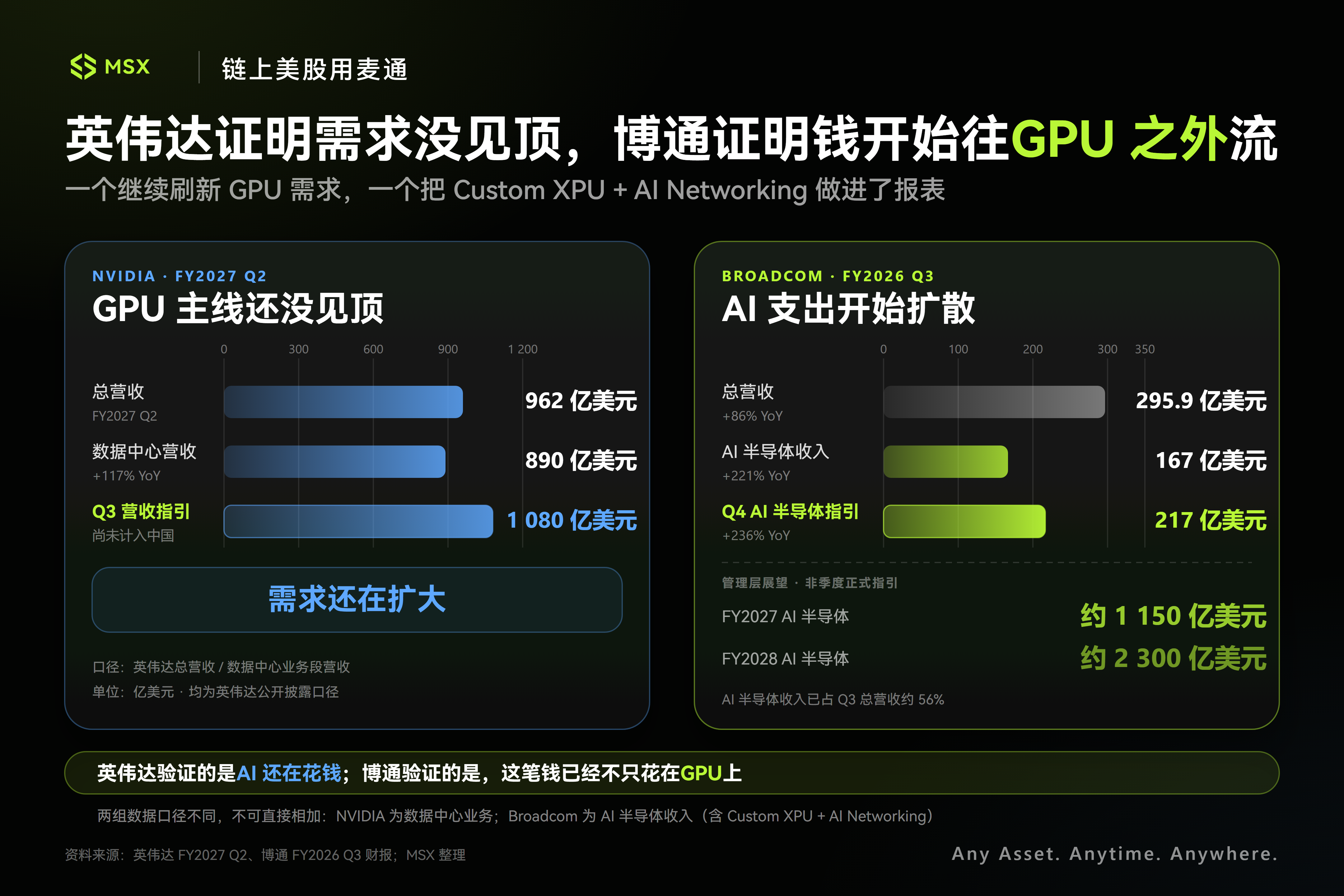
Last week's Nvidia earnings proved that demand for AI compute is far from peaking.
And after Broadcom's earnings last night, the other piece of the puzzle is also coming into focus.
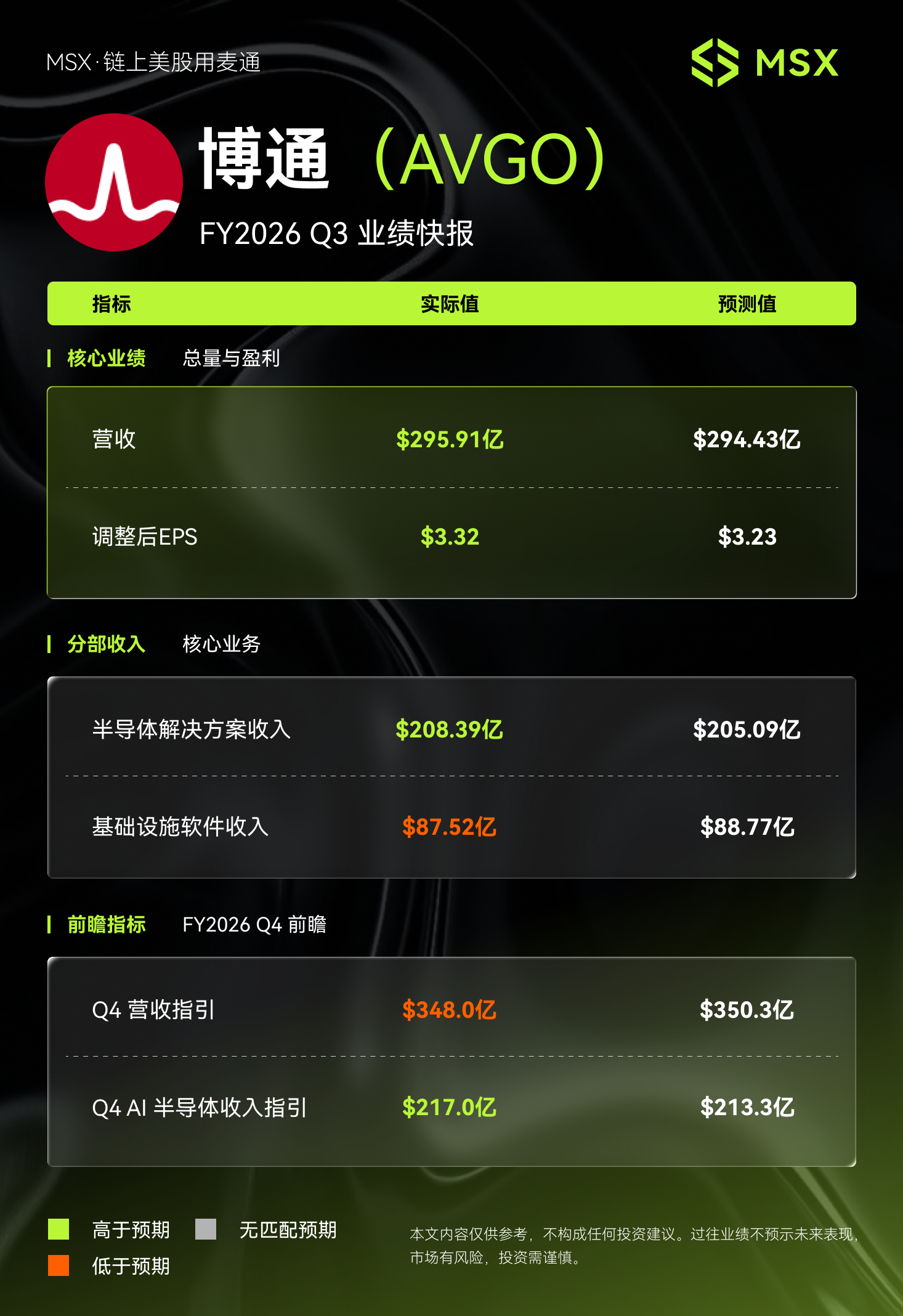
Q3 AI semiconductor revenue came in at $16.7 billion, above the prior guidance of $16 billion, with next quarter's guidance jumping directly to $21.7 billion. More critically, management projects roughly $115 billion in AI chip revenue for FY2027, and even sees $230 billion by FY2028.
So arguing over whether ASICs count as AI's second growth curve is already somewhat moot — AI spending is no longer flowing exclusively into GPUs.
At least for Broadcom, this trajectory is already hitting the financials, and the forward numbers are even bigger than previously anticipated. What really matters going forward is whether major projects from Google, OpenAI, Anthropic, and others can land on schedule — and how much of that Broadcom ultimately captures.
If all goes smoothly, the show goes on.
1. GPUs Keep Racing Ahead, but Big Tech Is Also Making New Moves
The truly informative takeaway from Nvidia's earnings is that even from this elevated base, cloud providers, AI companies, and model labs still haven't stopped expanding compute capacity.
However, as AI CapEx scales from billions to tens of billions, and ultimately into the hundreds of billions or more annually, procurement logic is bound to shift.
Large companies are already starting to ask more pointed questions: What does it actually cost to complete a given AI workload? How much useful compute can be produced from the same 1GW of power? And if certain workloads have become highly stable, is it still necessary to run everything on the most expensive hardware?
This is precisely the backdrop against which ASICs are becoming increasingly important.
Of course, understanding ASICs simply as "cheaper GPUs" isn't quite accurate — their real advantage comes from specialization.
Designing a custom chip isn't cheap in itself: upfront R&D is massive, development cycles are long, and you have to solve an entire stack of integration challenges spanning software, advanced packaging, networking, systems, and supply chain.
But conversely, once a workload is stable enough and deployment scales from tens of MW to hundreds of MW and eventually to GW levels, improvements in unit cost, performance-per-watt, and overall system TCO can rapidly compound.
That's why Google has long committed to TPUs, Meta keeps expanding MTIA, and OpenAI has begun co-developing its own processors with Broadcom. All of them recognize that even migrating just a portion of the most stable, highest-volume workloads from general-purpose chips to custom silicon can unlock enormous economic value.
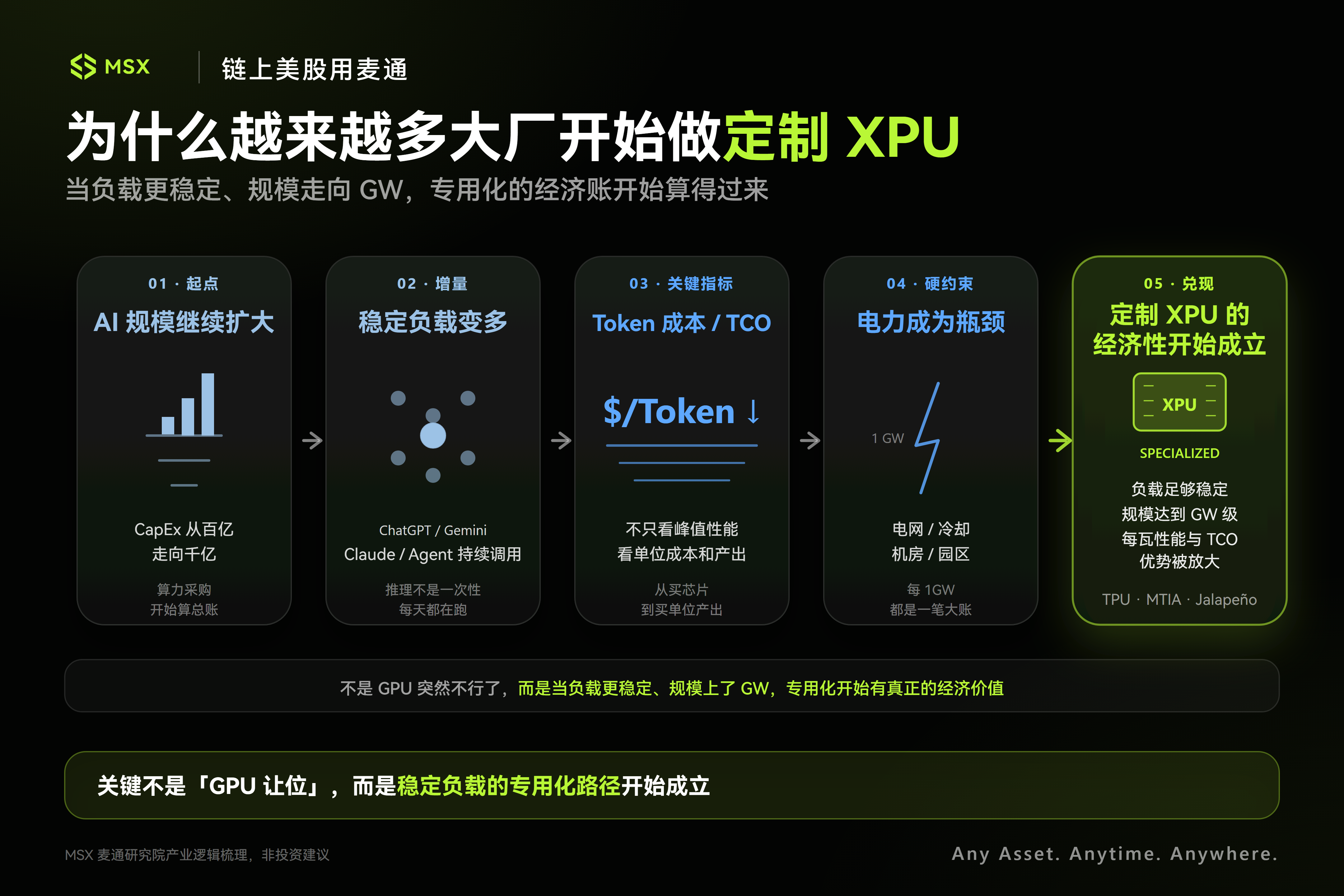
Looking at it more broadly, this shift is also benefiting from several conditions maturing simultaneously — and the most critical variable is that inference is becoming an increasingly dominant source of incremental workload.
As we all know, model training tends to be episodic, but once ChatGPT, Gemini, Claude, and a growing number of agents truly enter production, inference becomes a daily, continuous operation.
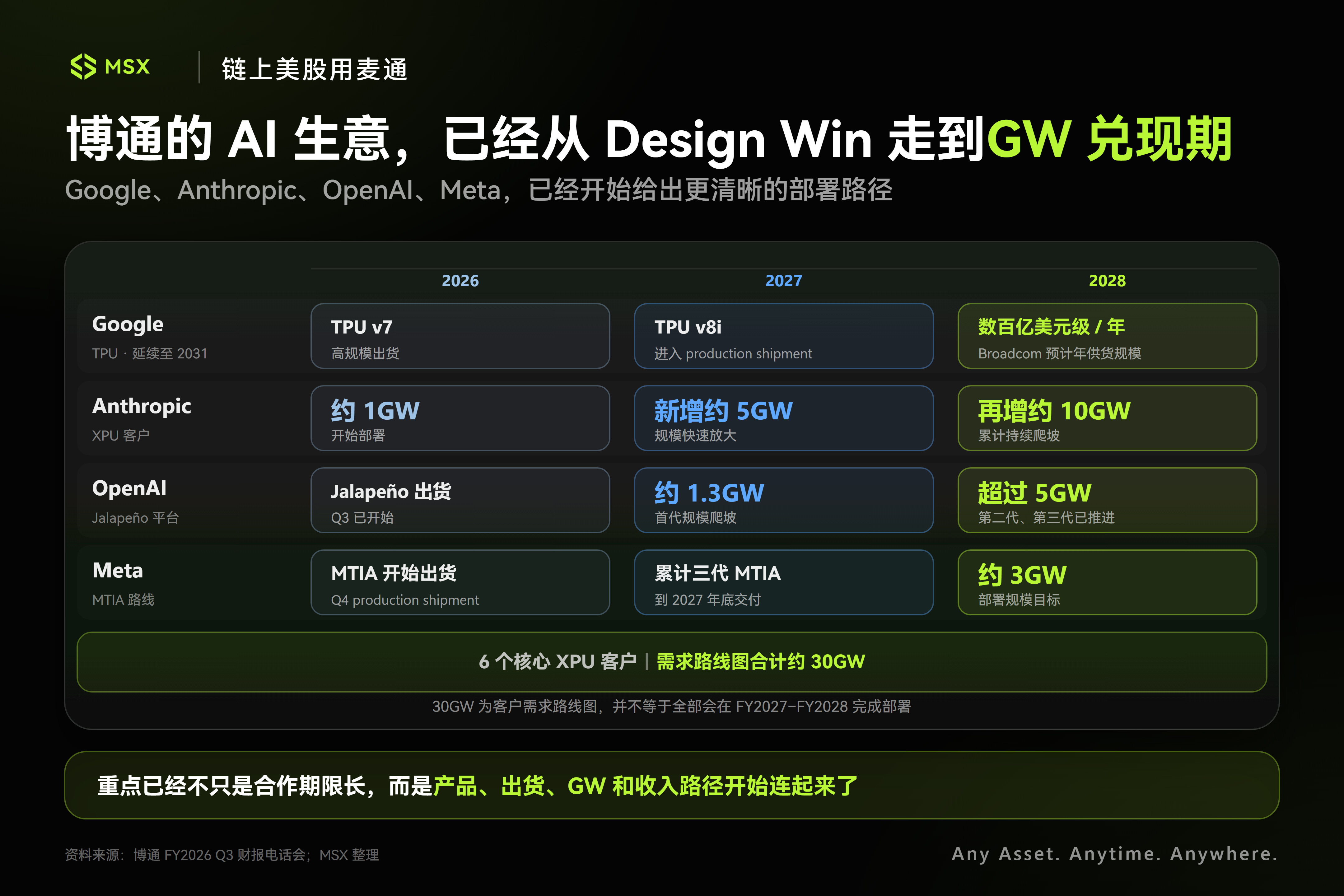
Especially as call volumes grow and model architectures and service patterns stabilize, inference naturally lends itself to workload-specific hardware optimization. In June of this year, OpenAI officially unveiled its first co-developed Intelligence Processor with Broadcom — the "Jalapeño" — positioned specifically for LLM inference.
What's particularly notable is that this isn't an isolated chip. OpenAI and Broadcom have explicitly defined it as the first generation of a multi-generational compute platform, with deployment planned to begin in late 2026 and expansion targeting GW-scale capacity over time.
Meta's roadmap is very similar, advancing four generations of MTIA within two years, focused on recommendation, ranking, and generative AI, with multiple products explicitly adopting an inference-first design philosophy. In April of this year, Meta further expanded its partnership with Broadcom; the first phase of deployment has already exceeded 1GW, with subsequent plans extending to multiple GWs, and the multi-generational collaboration running through 2029.
This shows that today's largest AI customers are shifting from purely chasing peak performance toward an entirely different set of rules: can tokens be produced more cheaply?
As AI truly enters commercialization, the cost per million tokens, the amount of useful compute generated per watt of electricity, and the TCO of an entire data center will all matter more and more.
At its core, ASIC adoption is really about major AI companies trying to bring that cost control back into their own hands.
2. Broadcom's Real Bet Isn't Just ASICs — It's the Entire AI Cluster Getting Bigger
Understanding this makes Broadcom's earnings much easier to read.
Last quarter, Broadcom's total revenue reached $22.187 billion, up 48% year-over-year; AI semiconductor revenue hit $10.8 billion, up 143% year-over-year.
The company's guidance for the current quarter is even more aggressive: total revenue of approximately $29.4 billion, with AI semiconductor revenue expected to reach $16 billion — up over 200% year-over-year.
What does $16 billion mean? It's roughly 54% of Broadcom's projected total revenue for the quarter.
In other words, if guidance is met, AI semiconductors alone could contribute more than half of Broadcom's revenue — and that's already including infrastructure software businesses like VMware.
Put simply, AI is directly reshaping this company's revenue mix.
But there's an easy misconception here: the $16 billion can't be directly equated with "ASIC revenue." It also includes AI networking products such as Ethernet switch chips, SerDes, PCIe, and optical interconnects.
Last quarter, networking already accounted for nearly 40% of AI semiconductor revenue. Hock Tan also noted that this proportion may be near a cyclical high, with the longer-term figure more likely to settle around 30%.
So Broadcom is actually seeing two businesses expanding simultaneously — Custom XPUs on one side and AI Networking on the other — and that's the biggest differentiator versus many pure-play chip companies.
As AI clusters scale from thousands of chips to tens of thousands, hundreds of thousands, and beyond, how compute is interconnected becomes increasingly critical in itself.
Broadcom is further breaking down AI networking into scale-up, scale-out, and scale-across: from high-speed in-rack interconnects, to large-scale networks within data centers, to connections across multiple data centers.
As long as AI clusters keep getting bigger, Broadcom is well positioned: if major cloud providers expand their custom ASIC efforts, Broadcom can participate through Custom XPUs; if GPU clusters continue to grow, the open Ethernet networking market can likewise keep expanding.
This places Broadcom in a uniquely interesting position — it's essentially betting on the continued rise in complexity across the entire AI infrastructure stack.
Of course, this doesn't mean the business is without competition.
Although Google has signed a long-term agreement with Broadcom to co-develop future generations of TPUs and components for next-generation AI racks — with the agreement extending as far as 2031 — Google has also recently expanded its custom chip collaboration with Marvell.
This at least signals that major customers won't casually hand over their entire future architecture to a single supplier.
3. After $100 Billion, What Comes Next?
The market already knew Broadcom's AI business would be strong.
So the real question heading into this earnings report wasn't whether the $16 billion could be achieved — and fortunately, the answer has arrived.
At least for now, Broadcom's story is no longer about "whether a second growth curve exists" — it's about how long that curve can ultimately run. But that also means the market will become increasingly demanding from here.
Previously, $100 billion alone was the surprise. Now that $115 billion and $230 billion figures are on the table, the focus shifts to how these numbers will actually be delivered.
Can Google, Meta, OpenAI, and Anthropic projects scale to GW levels as planned? Will second and third-generation chips continue to win orders after the first generation ramps into production? Can the networking business keep growing in step with cluster scale?
These factors matter far more than selling a few extra billion dollars' worth in any given quarter.
Another issue is becoming increasingly unavoidable: major customers won't rely on just one supplier.
Google has already begun expanding partnerships with other vendors, and Meta and OpenAI will likely maintain multi-supplier systems as well. So Broadcom's current advantage is real — but it hasn't reached the point of "customer lock-in."
From this perspective, whether Broadcom can prove it deserves to remain at the core of these customers' supply chains over the long term will be a decisive battleground.
Regardless, Broadcom's earnings serve as a reminder that custom silicon, networking, and interconnect — areas that once felt more like "supporting cast" — are gradually moving to center stage.
It's also a reminder to the market that this round of AI infrastructure investment may be far from the point where only zero-sum competition remains.
As long as the big players keep building larger clusters, buying more power, and computing more tokens, new bottlenecks will keep emerging — and new profit pools will grow alongside them.
The AI business is evolving from a single chip into an entire infrastructure stack — and that's where the real imagination lies.