每周编辑精选 Weekly Editor's Picks(0829-0904)


- Core Takeaways: This week, the blockchain and crypto market focused on new Fed Chair Warsh's hawkish debut at Jackson Hole, where he advocated retiring forward guidance and returning to data discipline. Combined with U.S. Treasury supply pressures and rising energy prices, the market is once again worried about "stagflation." Meanwhile, the Robinhood Chain ecosystem has rapidly risen with its "stock-token pairing" Meme coin innovation, becoming a market hotspot and speculative focus.
- Key Elements:
- Fed Chair Warsh made it clear in his Jackson Hole speech that the "forward guidance" tool's mission is complete, and monetary policy will return to a data-dependent approach. He also pledged that "there is still work to be done" unless inflation is confirmed to be moving toward the 2% target—a reading the market took as hawkish.
- The U.S. macro outlook faces the dual challenges of an "interest rate problem" and a "supply problem." Under the pressure of $10.5 trillion in debt, long-end Treasury yields are under strain, while oil's return to $90/barrel intensifies the "stagflation" trading logic.
- Japan's 10-year government bond yield broke above 3%, hitting a nearly 30-year high. Combined with a weakening yen and expectations of BOJ rate hikes, market concerns over a large-scale unwinding of the "yen carry trade" have suddenly intensified, potentially triggering chain reactions across global markets.
- The Robinhood Chain ecosystem is this period's focal point. Its "stock-token pairing" model for issuing Meme coins (e.g., pairing AI with NVDA) has broken through to mainstream attention, with platform daily revenue at one point surpassing Ethereum's. However, analysts note that the model lacks underlying value support, and its short-squeeze logic has structural flaws.
- The token launch platform Pons has formed a positive flywheel of "token issuance → revenue → buyback" on Robinhood Chain, with the platform token PONS rising 5x in a week. However, its sustainability depends on whether Meme momentum can hold and whether breakout projects emerge.
- Ethereum's supply side is showing signs of tightening: ETF net inflows of nearly $700 million in a single week, increased staking, and a 15% decline in exchange balances. The convergence of these forces may be building momentum for a new market cycle.
- The Hyperliquid ecosystem has officially kicked off HIP-4 permissionless deployment, with prediction market project Outcome being the first to launch, sparking a Builder-era battle over entry points, liquidity, and users.
The information flow moves too fast, and in-depth analysis articles can easily be drowned out by hot topics. The "Weekly Editor's Picks" column retrieves these valuable pieces of content from the vast sea of information, helping you filter out the noise, retain insights, and spark inspiration.

Macro Landscape
At 10 PM Beijing time on August 28, Federal Reserve Chairman Kevin Warsh delivered a speech at the Jackson Hole Global Central Bank Symposium, marking his first address at this major annual central bank gathering since taking office.
In his remarks, Kevin Warsh stated that the "forward guidance" tool used during unconventional times has fulfilled its mission in a normal economic environment and should be retired, with monetary policy needing to return to data dependence and decision-making discipline.
Regarding AI as a variable of this era, he acknowledged that its profound impact on productivity, labor markets, and the structure of capital returns remains unknown, and the Fed must maintain prudent observation. Meanwhile, he explicitly outlined seven principles to guide policy implementation: anchoring the 2% inflation target, balancing the employment mandate, using short-term interest rates as the primary tool, paying attention to monetary aggregates, and maintaining restraint and purposefulness in communication. These principles sketch a governance approach of returning to orthodoxy and avoiding policy function overload.
On the assessment of conditions, he believes the labor market is broadly consistent with full employment, but inflation remains well above target—PCE is up 3.7% year-over-year, with more than half of its components rising above 3%. He pledged not to preset a policy path but made clear that unless there is confidence that inflation is moving toward target at a clear pace, the Fed "still has work to do."
With $10.5 Trillion in Debt Weighing Down, Can the Fed Suppress Rates with Just Rhetoric?
Although Fed Chairman Warsh insisted in his Jackson Hole speech that he would "not provide forward guidance," he triggered dramatic market moves through dense signal releases. However, long-end yields fully gave back their declines by the close, as the bond market realized the real pressure comes from the supply side.
Current market volatility is primarily an "interest rate problem" (a reaction to the Fed), while the long-term challenge is a "supply problem"—one that will not disappear with a few words. Investors should distinguish between the two and watch for follow-up developments from the September Fed meeting, the Bank of Japan decision, and the Treasury buyback window.
Oil Returns to $90, Why Are Global Markets Repricing "Stagflation"?
The energy shock is changing market assessments of inflation and the rate path. Weak job openings, construction spending, and manufacturing data originally pointed to economic cooling, but rising oil, diesel, and natural gas prices could push headline inflation higher. This presents the Fed with a more difficult combination: weakening growth without necessarily synchronized relief in price pressures.
Energy prices, interest rate markets, and risk assets can no longer be priced separately; if refined fuel prices remain persistently high, the Fed's policy space may narrow further, and long-end Treasuries will simultaneously bear pressure from inflation, fiscal deficits, and AI financing demand.
Options market positioning on tail risks for rates has noticeably increased, but this reflects investors hedging against extreme scenarios, not a confirmation that rates have decisively entered an accelerating upward phase.
Japan's 10-year government bond yield broke above 3% this week, hitting a nearly 30-year high, and the resulting ripple effects are spreading globally.
The breach of this key threshold, combined with continued yen weakness and rising expectations of Bank of Japan rate hikes, has sharply heightened concerns over a large-scale unwinding of the "yen carry trade." U.S. Treasury Secretary Bessent has publicly warned that disorderly moves in the yen market could trigger forced liquidations, impacting global markets and ultimately raising borrowing costs for American households and businesses.
Currently, the market has fully priced in a 25-basis-point rate hike by the Bank of Japan in September—a pace far more aggressive than the central bank hinted at earlier this year.
Also recommended: The Fed's "Quiet" Balance Sheet Expansion: You Think It's Tightening, But Is It Actually Frenetically Buying T-Bills?
Investment and Entrepreneurship
Robinhood Chain Hasn't Issued a Token, So Which Altcoins Are Cashing In on the Growth?
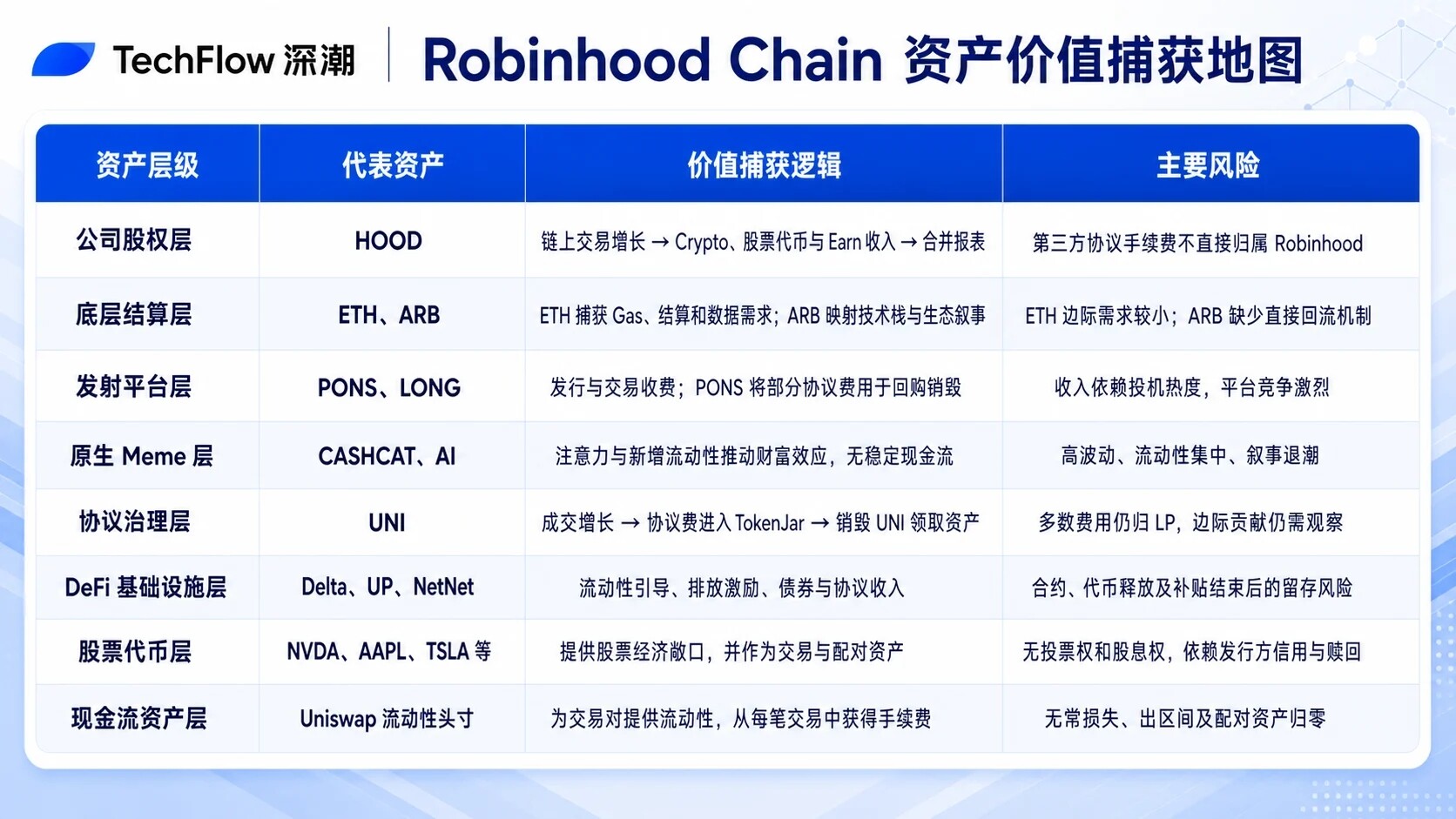
Uniswap captures the dominant share of trading on Robinhood Chain, with protocol fees driving token burns; Lighter has become the perpetual contract gateway for Robinhood Wallet; Morpho underpins the lending infrastructure behind Robinhood Earn; 10% of Robinhood Chain's revenue flows to the Arbitrum ecosystem.
UNI is the biggest beneficiary, followed by LIT, with MORPHO and ARB being relatively weaker.
Eight Layers of Assets, Two Logics: A Full Breakdown of Robinhood Chain's Wealth Effect
Also recommended: Extracting $10 Million in 10 Months, an Arbitrage Master Reveals New Strategies, and Machi Big Brother's Token Launch Ends in Failure, Old Hands Collectively Stumble in New Arenas.
CeFi & DeFi
Bitcoin's Biggest Landmine Has Been Defused
Strategy's recent series of trades may appear to be "selling low and buying high," but they have temporarily alleviated the STRC de-pegging and the cash reserve issues it exposed. This also signals that the market's most feared hidden risk has been phase-wise resolved.
Airdrop Opportunities and Interaction Guides
Meme
Another $100M+ "Golden Dog" Emerges on Robinhood Chain, Token-Stock Paired Memes Feed Back into RWA
AI is the leading Meme coin in the token-stock pairing sector. It is paired with NVDA, the Nvidia stock token on Robinhood Chain, and over the past month of community development has established an AI community treasury, using creator fees and 50% of trading fees to buy back and burn token supply—0.82% of the total token supply has already been burned.
The explosive popularity of the Meme coin AI also benefits from the empowerment of LONG, the token launch platform behind it. In the early stages, LONG even airdropped NVDA stock tokens to AI holders. LONG is a Meme coin launch platform within the Robinhood Chain ecosystem, and with its innovative "token-stock pairing" Meme launch model, LONG has become the leading Meme launch platform on Robinhood Chain.
Buying token-stock paired Meme coins is essentially a dual bet: wagering both that the Meme coin will outperform the stock relatively, and that the stock's dollar price will move favorably. There is no 1:1 redemption relationship between the Meme coin and its underlying stock token—the stock token merely serves as the quoted asset in the liquidity pool, not as collateral for the Meme coin. The token-stock pairing provides no value floor for the issued Meme coin.
Another significant meaning of token-stock paired Meme coins is that they broaden the use cases for stock tokens. Meme trading driving stock token volume is exactly the development Robinhood hopes to see.
Three Ways to Play Meme Token-Stock Pairs on Robinhood Chain
"Alternative assets" on Robinhood Chain: stock tokens, stock Meme coins, Launchpad platform tokens, lending assets; LP-type: Meme coin liquidity pools, stock token liquidity pools, leverage stock liquidity pools; Token-stock linkage type: Meme coin reverse short squeezes, underlying stocks lifting Meme coins.
Why the Short Squeeze Myth of Stock-Paired Meme Coins Is Doomed to Fail
The core issue with the short squeeze strategy not working is the disparity in scale, and controlling stock tokens does not equal controlling real stocks.
Once token scarcity pushes the on-chain HIMS price far above the actual stock price, Robinhood's authorized participants can mint new stock tokens to arbitrage the price difference. Minting new tokens does require purchasing additional real stocks as underlying backing, so issuance increases would bring some buying pressure to the underlying stock. But hoarding existing tokens does not in itself force the purchase of equivalent amounts of HIMS common stock. Its main result is prompting the platform to issue more stock tokens, expanding token supply, and pulling the on-chain token price back closer to the real stock price.
To achieve the legendary short squeeze, more advanced TEQ (tokenized equities) would be needed.
Witnessing the birth of an entirely new narrative is truly fascinating. There are certainly speculative profit opportunities here, but more importantly, countless unprecedented financial mechanism designs will emerge in the future.
For further reading: JINQIAN Goes from $80 Million to Zero in Two Hours, "Token-Stock Pairing" Becomes a Customized "Pig Butchering" Scam.
Where to Provide Liquidity for Stock Tokens? A Quick Look at Five Emerging AMMs on Robinhood Chain
up.: 100% of protocol revenue returned to token holders; Fables: points program launched, TGE in October; RAMSES: well-known Arbitrum AMM arrives; Delta: automatically converts protocol fees into liquidity; Ekubo: Starknet veteran project's "regilding" fails.
"Tech hotspots, celebrity news, corporate memes, and market sentiment" intertwine to form new narratives.
No Time to Sit Idle On-Chain, Which Robinhood Chain Assets Offer a Second Entry Opportunity?
PONS: platform generating nearly $1 million in daily revenue; HMM: turning trader hesitation into a "thinking cat"; DELTA: providing liquidity management tools for Robinhood Chain; microduck: tying open-source robotic ducks to the Nvidia stock narrative; YOLO: bringing WallStreetBets' "YOLO" culture to Robinhood Chain; AI: a token-stock Meme paired with Nvidia stock; BONER: turning men's health stocks into the most direct adult joke; SPACEHOOD: a token-stock Meme betting on SpaceX hype.
Platform Earning Nearly $1 Million Daily, Can PONS—Up 5x in a Week—Keep Soaring?
Enthusiasm from the "P faithful" for Meme coins on Robinhood Chain continues to run high, and PONS, the platform token of token launch platform Pons, is experiencing another surge—driven by Pons' rapidly growing token issuance volume and trading share on Robinhood Chain.
Pons has formed a positive flywheel: more token launches mean higher revenue, which fuels stronger buybacks.
To assess whether PONS can continue rising and for how long, focus on three key points: how long the current Meme hype on Robinhood Chain can last; whether Pons can hold its position as the leading launch platform; and PONS' market cap may need to advance further toward $500 million or $1 billion, potentially requiring the emergence of a truly mainstream Meme coin.
Buying a Nasdaq Company for $1.8 Million, Then Using Meme Coins to Engineer a Short Squeeze
If on-chain demand can truly be converted into buying pressure for underlying stocks through the minting and collateral mechanisms of stock tokens, then what Robinhood Chain has birthed is not just a new batch of Meme coins—it could be an entirely new capital machine connecting crypto attention to Nasdaq small-caps.
Also recommended: A Practical Guide to FOMO: From Finding People to Finding Coins, How to Play Social Trading?
Ethereum and Scaling
ETF and Staking Tighten Supply in Tandem, Is ETH Brewing a New Rally?
US spot Ethereum ETFs saw net inflows of nearly $700 million in a single week, approximately 42 million ETH has entered staking, exchange balances have dropped about 15% since early June, and corporate treasuries continue to accumulate. These converging forces are compressing the amount of ETH available for immediate sale.
ETH's circulating supply has tightened noticeably compared to June, and as new capital enters a thinner market, it could produce greater price elasticity.
The market now needs to confirm: whether institutional inflows can persist, whether ETH/BTC can hold its rebound, and whether staking and corporate holdings will continue to absorb new supply.
New Ecosystems
HIP-4 Battle Begins, Who Will Become the Next trade.xyz?
The launch of Outcome, a prediction market project in the Hyperliquid ecosystem, marks Hyperliquid's first salvo in the HIP-4 permissionless deployment initiative, and signals that Hyperliquid's expansion into the prediction market sector has officially entered the Builder era.
Teams such as Unit, Skew, and trade.xyz have also expressed interest or begun laying out HIP-4 plans. A battle over prediction market entry points, liquidity, and users on Hyperliquid is now underway.
Also recommended: A New Era of On-Chain Governance on Solana: Deflationary Pressure Sharply Increased, Burn Proposal Unexpectedly Shelved.
Weekly Hot Topics Catch-Up
Policy and Macro Markets
US-Iran conflict reignited (causes and impact);
Trump again demands the Fed cut rates, boldly claiming US GDP