After Changxin, Unitree Rises: The Value and Weight of the First Humanoid Robot Stock


- Key Takeaway: Unitree Technology has debuted on the STAR Market as the "first humanoid robot stock," with its market cap briefly surging to 445 billion yuan on the first day of trading. Driven by its "low float, high market cap" characteristics and the heat surrounding the AI + robotics sector, the stock has risen over sixfold from its IPO price. However, the high valuation coexists with the reality of early-stage commercialization, and its future trajectory will depend on performance validation.
- Key Elements:
- On its first trading day, the opening price was 1,100 yuan, up 629.44% from the IPO price of 150.80 yuan, with a profit of approximately 475,000 yuan per lot. The online lottery rate was a mere 0.018%, setting a new record on the STAR Market.
- Following the issuance, the total share capital stands at 404 million shares, with unrestricted floating shares initially accounting for only 7.44%, highlighting a "low float, high market cap" profile. Strategic investors include DeepSeek, Tencent, and the National Social Security Fund, with lock-up periods of up to 36 months.
- In 2025, non-GAAP net profit reached 600 million yuan, and humanoid robot shipments exceeded 5,500 units, ranking first globally. However, revenue from scientific research and education accounts for over 70%, while industrial applications represent only about 9%. In Q1, non-GAAP profit declined by 52.55% year-over-year.
- Founder Wang Xingxing holds approximately 31% of the company directly and indirectly, corresponding to a market value of over 110 billion yuan, making him the "new richest person among the 90s generation." Meituan's stake has gained over 33.3 billion yuan in paper value, while Shunwei Capital's affiliates have gained over 15.2 billion yuan.
- Overseas competitor Figure AI is valued at approximately $40 billion (about 280 billion yuan), and Tesla's Optimus is planned for mass production by the end of 2026. To become the "world's top stock," Unitree's market cap would need to approach 500 billion yuan or more.
- The A-share market is currently in a phase driven by three main themes: AI computing power, semiconductor localization, and embodied intelligence. Unitree's listing provides a valuation anchor for the robotics sector.
Original|Odaily Planet Daily (@OdailyChina)
Author|Wenser (@wenser 2010 )
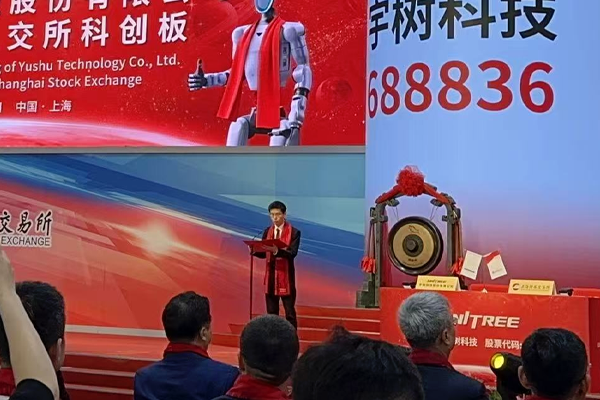
On August 19, Unitree Technology (688836.SH) officially listed on the STAR Market of the Shanghai Stock Exchange, marking the arrival of A-shares' "first humanoid robot stock." The opening price surged to 1,100 yuan, up 629.44% from the IPO price of 150.80 yuan, far exceeding the average first-day gain of 466.61% for STAR Market new listings this year. Its market capitalization briefly soared to 445 billion yuan. In this year's A-share wealth-creation feast—characterized by "approval in just 73 days, nearly 9.8 million subscription accounts, and an online lottery rate of merely 0.018%"—each lot of 500 shares yielded a profit of approximately 475,000 yuan, far surpassing earlier estimates, translating to a return of roughly 6.3 times the principal.
Following SpaceX's "largest IPO in human history" overseas and the "domestic memory leader CXMT's IPO," Unitree Technology has taken the capital stage under the banner of "the only profitable humanoid robot manufacturer," and was met with strong investor enthusiasm from the opening bell.
As of the time of writing, Unitree Technology's share price is hovering around 892 yuan, with a market capitalization of approximately 361 billion yuan, a turnover rate of 55.25%, and trading volume exceeding 15.3 billion yuan. Against the backdrop of rapid advancements in AI and hard technology, Unitree's listing itself is a microcosm of the main market narrative.
What Is Unitree Technology Worth? The Market's Answer: 350-450 Billion Yuan
After the IPO subscription period concluded, we previously presented a range of representative market views on "what constitutes a reasonable market value for Unitree Technology" in our article "How Much Is the 'First Humanoid Robot Stock' Unitree Technology Really Worth?". In hindsight, the most aggressive forecast from Yu Wenchao, an early investor in Unitree and partner at Dunhong Capital, has proven closest to the market's pricing. He stated: "A market cap exceeding 200 billion yuan after listing is entirely reasonable, and I believe it could even surpass 400 billion yuan in the short term. Compared to valuations of similar overseas companies, this is not exaggerated." Considering the near-450-billion-yuan peak shortly after the opening and the current figure of over 360 billion yuan, the reasonable valuation range for Unitree Technology has been revised upward from 200-250 billion yuan to 350-450 billion yuan.
High Valuation, Low Float: Unitree Technology Stages Another SpaceX and CXMT-Style Rally
Notably, the reason Unitree Technology's market cap could surge to over six times its offering value—aside from the market's fervent enthusiasm and optimistic expectations for humanoid robots—mirrors situations seen in many crypto projects and historic IPOs like SpaceX and CXMT: they are prime examples of "low float, high valuation."
According to a Shanghai Stock Exchange announcement, Unitree Technology previously disclosed an offering price of 150.80 yuan per share, with a total share capital of 404 million shares post-offering. Of this, the initial tradable float was 30.0877 million shares, representing just 7.44% of total share capital. The offering price corresponded to a static price-to-sales ratio of 35.89 times on a diluted basis for 2025, higher than the average of comparable companies.
This dynamic was also evident in the retail subscription data: Unitree issued 40.4464 million shares in this offering, accounting for only 10% of the post-offering total share capital. After the clawback mechanism was triggered, 9.707 million shares were ultimately allocated online, with 9.7846 million valid subscription accounts, resulting in a final lottery rate of 0.0181%—a figure that simultaneously set new records for both the lowest lottery rate and the highest number of participating accounts among STAR Market IPOs. A total of 19,414 winning numbers were drawn, with each lot of 500 shares requiring payment of 75,400 yuan. Online abandonment totaled only 8,734 shares, with zero institutional abandonment—a strong indication of willingness to pay up.
On the other hand, the strategic placement allocated to institutions, coupled with founder Wang Xingxing's substantial shareholding, ensures limited selling pressure and prevents any retail stampede on the first day of trading.
It is understood that nine investors—including the National Social Security Fund, DeepSeek, Tencent, CNPC Kunlun Capital, China Southern Power Grid, and China Telecom's Tianyi Capital—collectively received approximately 8.09 million shares, with subscription amounts totaling around 1.22 billion yuan. Among them, DeepSeek was allocated 933,400 shares worth 141 million yuan, with a lock-up period of 36 months—far exceeding the conventional 12-month period for institutions. The two parties have signed a strategic cooperation memorandum to jointly conduct research in three areas: general artificial intelligence, high-performance robotics, and AI large models. The National Social Security Fund received an equivalent allocation across three portfolios, with a 12-month lock-up. Tencent, CNPC, China Southern Power Grid, and Tianyi Capital each received approximately 900,000 shares, with amounts around 136 million yuan.
Prior to Unitree Technology's listing, the most criticized or debated point was its price-to-earnings (P/E) ratio of 219 times.
However, calculated based on 2025 non-GAAP net profit, the corresponding P/E ratio drops to 92.92 times; the diluted static price-to-sales ratio for 2025 stands at 35.89 times. While still higher than the average of comparable companies, this is considerably more reasonable than the "219" figure. In hindsight, considering that most comparable domestic and international companies have yet to turn a profit, while Unitree achieved 600 million yuan in non-GAAP profit in 2025 and shipped over 5,500 humanoid robots—the highest globally—the 150.8 yuan offering price actually represented a value trough.
Founder Wang Xingxing Tops Wealth Charts: Crowned "Richest Person of the Post-90s Generation"
Unitree Technology's surge has directly propelled founder Wang Xingxing's personal wealth to new heights.
According to the prospectus, Wang Xingxing—Chairman, General Manager, and CTO of Unitree Technology—directly holds 86,714,964 shares of the company, representing 21.4395% of total share capital post-offering. Additionally, prior to the offering, he indirectly held a 9.5367% stake through the equity incentive platform Shanghai Yuyi. In total, Wang Xingxing's direct and indirect combined shareholding in Unitree Technology is approximately 31%, with his holdings valued at over 110 billion yuan—securing him the title of "China's Richest Post-90s Individual," a wealth accolade of considerable significance.
Previously, this title belonged to Liu Jingkang, founder of Insta360, who had briefly been named the richest post-90s individual with a net worth of 20.2 billion yuan.
Of course, the beneficiaries of Unitree Technology's successful listing and surging market cap extend beyond Wang Xingxing to include numerous investment institutions and individuals behind the company. At the employee level, Yang Zhiyu (head of mechanical structure), Chen Li (head of sales and service), and Zhang Yangguang (head of algorithms and software) hold indirect stakes of 0.49%, 0.26%, and 0.15% respectively through Shanghai Yuyi. Based on a 350-billion-yuan market cap, their shareholdings are valued at 1.715 billion yuan, 910 million yuan, and 525 million yuan respectively—propelling them alongside Wang Xingxing into the"Billionaires' Club."
The Wealth-Creation Feast Around Unitree's Listing: Meituan's Wang Xing, Xiaomi's Lei Jun, and DeepSeek's Liang Wenfeng
Meituan: Unrealized Gains Exceed 33.3 Billion Yuan from IPO, Holding Approximately 35.1236 Million Shares
As the largest external shareholder of Unitree Technology, Meituan-affiliated capital, through entities including Hanhai Information, Chengdu Longzhu, and Galaxy Z, holds a combined total of approximately 35.1236 million shares, with unrealized gains at one point exceeding 33.3 billion yuan from this IPO.
Liang Wenfeng: Unrealized Gains of 1.1 Billion Yuan from Unitree IPO
DeepSeek founder Liang Wenfeng, through his affiliated entities—DeepSeek, High-Flyer Quant, and Jiuzhang Asset—secured a combined allocation of approximately 1.1916 million shares via strategic placement and offline subscription. Based on the 150.8 yuan offering price and the peak opening price of 1,100 yuan, Liang Wenfeng's unrealized gains from the IPO once exceeded 1.1 billion yuan. At the current market cap of 360 billion yuan, his shareholding is valued at approximately 1.06 billion yuan, still representing unrealized gains of around 882 million yuan.
Lei Jun: Shunwei Capital Affiliates See Unrealized Gains Exceeding 15.2 Billion Yuan
Lei Jun's Shunwei Capital affiliate, overseas investment vehicle Astrend IV, holds 16.106 million shares of Unitree Technology, representing approximately 3.98% of post-offering total share capital, making it the company's fifth-largest shareholder. Its stake has seen unrealized gains exceeding 15.2 billion yuan.
It's worth noting that Shunwei Capital participated in Unitree's Series A round as early as 2021, investing tens of millions of dollars. Earlier this year, Lei Jun reflected on this investment with some emotion: "Thank you, Wang Xingxing, for giving us the opportunity to invest in Unitree five years ago."
Beyond the aforementioned institutions and individuals, Unitree Technology's shareholder list also includes a host of prominent institutions and internet tech giants: Sequoia Capital China holds 7.11%, Matrix Partners China holds 5.45%, and Tencent, Alibaba, and ByteDance are also on the shareholder roster.
Repositioning Unitree's Ecosystem Coordinates: Can It Become the "World's First Humanoid Robot Stock"?
For Unitree Technology today, the IPO is far from a finish line where it can afford to rest. A new challenge has emerged: how to evolve from China's "first humanoid robot stock" into the "world's first humanoid robot stock." With its current market cap of approximately 360 billion yuan, Unitree's position in the global humanoid robot arena is not yet firmly secured.
Overview of Overseas Competitors: Figure AI, Boston Dynamics, Optimus in Close Pursuit
Looking overseas, the highest-valued company is Figure AI, with a valuation of approximately $39-40 billion, equivalent to roughly 280 billion yuan. Despite a monthly production of only about 150 units and no public listing yet;
Boston Dynamics, renowned in the industry but with a checkered history, is valued at just $3.4 billion, approximately 22.9 billion yuan. Currently under Hyundai Motor, it is set to begin initial commercial deliveries in 2026;
1X Technologies is valued at around $10 billion, Physical Intelligence at approximately $5.6 billion, Apptronik at about $5.5 billion, and Agility Robotics at roughly $2.1-2.5 billion (already listed via SPAC).
Tesla's Optimus has no standalone valuation, being subsumed within Tesla's overall market cap of approximately $1.33 trillion, with mass production planned to commence by the end of 2026.
Domestic Comparables: AGIBOT, UBTech, Dobot Lagging Far Behind
Among domestic comparable companies, AGIBOT Robotics, after a backdoor listing via Shangwei New Materials, has a market cap of approximately 68.3 billion yuan. UBTech's Hong Kong market cap is around 42.7 billion HKD (approximately 36.7 billion yuan), and Dobot is at roughly 10.9 billion HKD (approximately 9.36 billion yuan).
Meanwhile, countless embodied intelligence companies are queuing up for the next IPO slot: On July 24, AGIBOT officially announced the initiation of its Hong Kong listing process; market rumors suggest a target valuation of around $20 billion, with cornerstone round targets of HK$40-50 billion. Yunshenchu (also one of the "Hangzhou Six Little Dragons") has had its STAR Market IPO accepted. Other embodied intelligence companies including Galbot, Leju Robot, Zhi Pingfang, Autobots, LimX Dynamics, Zhongqing Robotics, and Astribot are also accelerating their efforts.
Additionally, companies such as Galaxea AI, Songyan Power, Xingdong Epoch, Fourier Intelligence, and Force Aether have completed their share reform—according to incomplete statistics, more than 50 robot-related companies are already queuing at the door of the Hong Kong Stock Exchange alone.
However, behind the intensifying competition and narrowing opportunity window, the "inversion between market valuation and actual deliveries" poses another real challenge for the robot sector: Figure AI's valuation was previously more than four times that of Unitree, yet its annual deliveries are far lower. This disparity has only begun to narrow following Unitree's listing, but valuation differences between domestic and international markets remain objectively present. To grow into the world's first humanoid robot stock, Unitree Technology's market cap will need to reach at least 500 billion yuan.
Market Cap Projections and Future Trajectory: A Compilation of Multiple Perspectives
Regarding the future trajectory of Unitree Technology's share price, the market presents three schools of thought.
The optimists believe Unitree is a scarce pure-play humanoid robot target in A-shares—already profitable, ranking first globally in shipments, with the DeepSeek strategic partnership unlocking imagination for AI+robotics, and backing from long-term capital such as the National Social Security Fund and Tencent. This scarcity premium could push market cap above 400 billion yuan in the short term.
The cautious camp points out that the 219x diluted P/E ratio already prices in high growth expectations. Q1 profit declines indicate earnings volatility. Over 70% of humanoid robot revenue still comes from scientific research and education, with industrial penetration still shallow. The digestion path for the planned production capacity of 190,000 units/year from the fundraising projects remains to be validated. U.S. FCC regulations introduce uncertainty for overseas sales of new models. High valuations will require sustained earnings growth to justify.
The neutral view suggests that after an initial post-listing surge, the stock will enter a period of "earnings validation" with high-level volatility. Following the path of hard-tech new listings like CXMT, the share price will gradually return to being fundamentally driven, with subsequent trends depending on the pace of industrial scenario deployment and commercial breakthroughs in embodied large models.
Addressing these issues and valuation trajectory, Wang Xingxing also responded to several questions during the earlier IPO roadshow. Beyond the previously mentioned "remote-control toy controversy" and "P/E ratio controversy," Wang addressed valuation, competitive advantages over overseas rivals, U.S. FCC regulations, and commercialization plans:
On Valuation: Wang noted that most listed and pending-listing companies with similar core businesses in the industry have yet to turn a profit, whereas Unitree has already achieved strong profitability. The offering valuation is the result of market-based pricing, consistent with the company's operating conditions and industry prospects. He also reminded investors that he hopes people buy the stock because they believe in the company's value, not for speculation, and that the company will disclose detailed information in a timely manner through