






Bithumb's Semi-Annual Report: A $76 Million Loss, Who Swallowed the Profits?


- Core Takeaway: Bithumb recorded a net loss of 108.691 billion KRW in the first half of 2026. While this appears to reflect deteriorating profitability, its core business remains profitable. The losses were primarily driven by non-operating items, including cryptocurrency asset disposal/valuation losses (approximately 68.55 billion KRW) and newly added litigation provisions (approximately 36.87 billion KRW).
- Key Factors:
- Operating revenue fell 48.7% year-over-year to 168.77 billion KRW, with transaction fees accounting for 99.995% of total revenue; operating profit dropped 83.4% to 14.93 billion KRW.
- Net loss on cryptocurrency asset disposals reached 61.37 billion KRW (compared to approximately 4.18 billion KRW in the same period last year, a 12-fold surge), compounded by valuation losses of 7.19 billion KRW, bringing total losses to approximately 68.55 billion KRW.
- Litigation provisions increased by 36.87 billion KRW over six months to 39.55 billion KRW, approaching the approximately 36.8 billion KRW fine imposed by South Korea's Financial Services Commission in March for anti-money laundering violations.
- Marketing expenses were slashed by 70% to 34.89 billion KRW, but rigid costs such as payment processing fees (46.26 billion KRW) and salaries (30.91 billion KRW) saw only limited reductions, causing the operating margin to fall from 27.4% to 8.8%.
- Total assets decreased by 831.469 billion KRW in six months, with 86% of the decline stemming from a drop in member KRW deposits (down 715.581 billion KRW), partly affected by adjustments in allocations to cash and short-term financial products.
- The market value of customer-custodied cryptocurrency assets fell 32.7% to 12.05 trillion KRW, but the quantities of custodied BTC, ETH, and XRP actually increased—the market value decline was mainly due to falling coin prices (BTC's unit price dropped approximately 30.5%), not large-scale customer withdrawals.
Original author: KarenZ, Foresight News
When reading financial reports, the most misleading metric is often not the numbers themselves, but focusing solely on net profit.
Bithumb recorded a net loss of KRW 108.691 billion (approximately USD 76.44 million) in the first half of this year. At first glance, this seems to suggest the exchange has lost its profitability, but the reality is more complex.
A closer look at the income statement reveals that Bithumb's core exchange business remains profitable. The main factors dragging the bottom line into the red are losses from crypto asset disposals, valuation losses, and litigation provisions.
In other words, to properly understand Bithumb's earnings report, one must distinguish at least four things: how much the exchange business earned, how much the company's own crypto holdings lost, how much was set aside for regulatory and litigation risks, and how much cash flow changed due to customer fund movements.
Core Business Still Profitable, But Net Profit Eroded by Two Types of Non-Operating Losses
In the first half of 2026, Bithumb generated operating revenue of KRW 168.77 billion (approximately USD 119 million), down 48.7% year-over-year; operating profit stood at KRW 14.93 billion (approximately USD 10.5 million), down 83.4% year-over-year.
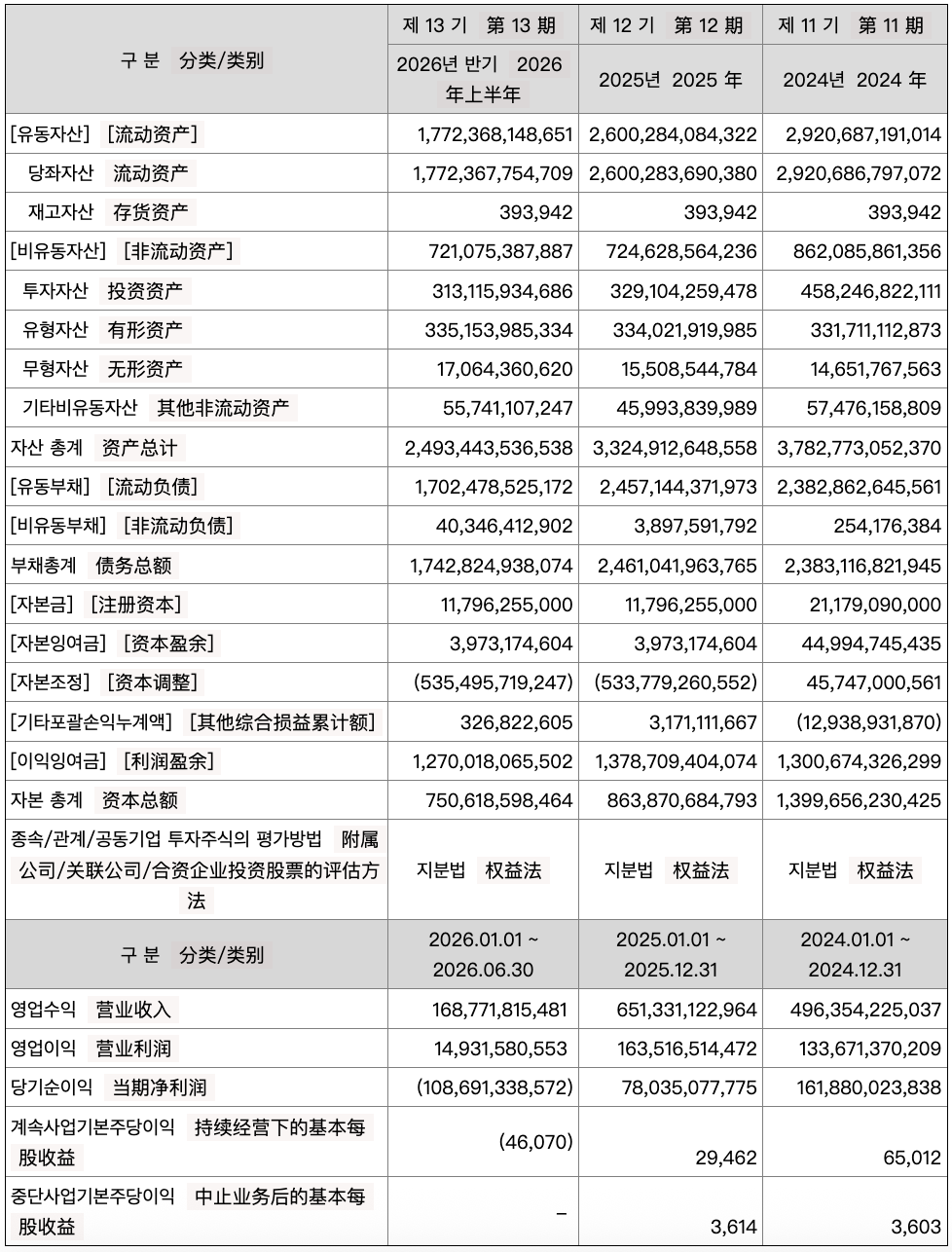
What actually pushed the company into losses were non-operating items. During the reporting period, Bithumb's non-operating expenses reached KRW 155.05 billion (approximately USD 109 million), ultimately resulting in a net loss of KRW 108.69 billion (approximately USD 76.44 million). In comparison, the company recorded a net profit of KRW 55.04 billion (approximately USD 38.71 million) in the same period of 2025.
The first major loss came from Bithumb's own crypto asset holdings and losses on crypto asset disposals.
In the first half, the company recognized gains on crypto asset disposals of KRW 11.99 billion (approximately USD 8.43 million), while simultaneously recognizing disposal losses of KRW 73.36 billion (approximately USD 51.59 million). After netting the two, the net disposal loss stood at approximately KRW 61.37 billion (approximately USD 43.16 million).
According to the financial report, these crypto asset disposals were primarily related to business purposes such as user activity rewards and blockchain network fees. Notably, disposal losses in the same period of 2025 were only approximately USD 4.18 million, but surged to approximately USD 51.59 million in the first half of 2026—more than 12 times the year-ago figure.
It is worth mentioning that on February 6, Bithumb experienced a Bitcoin misdelivery incident. Bithumb later disclosed that the incident involved erroneously sending Bitcoin to 695 users, with a recovery rate exceeding 99%. However, the company did not separately disclose the final financial impact of the incident in its semi-annual report.
Additionally, the company recognized crypto asset valuation losses of KRW 7.19 billion (approximately USD 5.05 million). Combining the net disposal losses with valuation losses, crypto asset-related net losses total approximately KRW 68.55 billion (approximately USD 48.21 million).
The second impact came from litigation provisions.
As of the end of 2025, Bithumb's litigation provisions stood at KRW 2.68 billion (approximately USD 1.88 million); by the end of June 2026, this figure had risen to KRW 39.55 billion (approximately USD 27.81 million), an increase of KRW 36.87 billion (approximately USD 25.93 million) over six months.
This increase is very close to the fine of approximately KRW 36.8 billion imposed on Bithumb by the Financial Services Commission in March. The regulator determined that Bithumb violated anti-money laundering obligations for virtual asset service providers, customer identity verification, and trading restrictions.
Putting together the approximately KRW 68.55 billion (approximately USD 48.21 million) in net crypto asset losses and the approximately KRW 36.87 billion (approximately USD 25.93 million) in new litigation provisions, the combined total comes to approximately KRW 105.42 billion (approximately USD 74.14 million)—very close to the company's semi-annual net loss of KRW 108.69 billion (approximately USD 76.44 million).
Of course, this is merely an approximate comparison to help understand the sources of profit and loss, and should not be treated as a complete reconciliation of the income statement, as taxes, interest income, and other non-operating items also affect the final result.
Revenue Nearly Halved Despite Significant Subsidy Cuts
Bithumb's first-half operating revenue was approximately USD 119 million, down 48.7% year-over-year.
First, the market downturn directly hit Bithumb's core business. Nearly all of its revenue comes from trading fees: first-half fee income was KRW 168.763 billion, accounting for 99.995% of operating revenue, rounded to 100% in the financial report. In 2025, other exchange revenue was still USD 10.6 million, but by the first half of this year it had shrunk to less than USD 6,000.
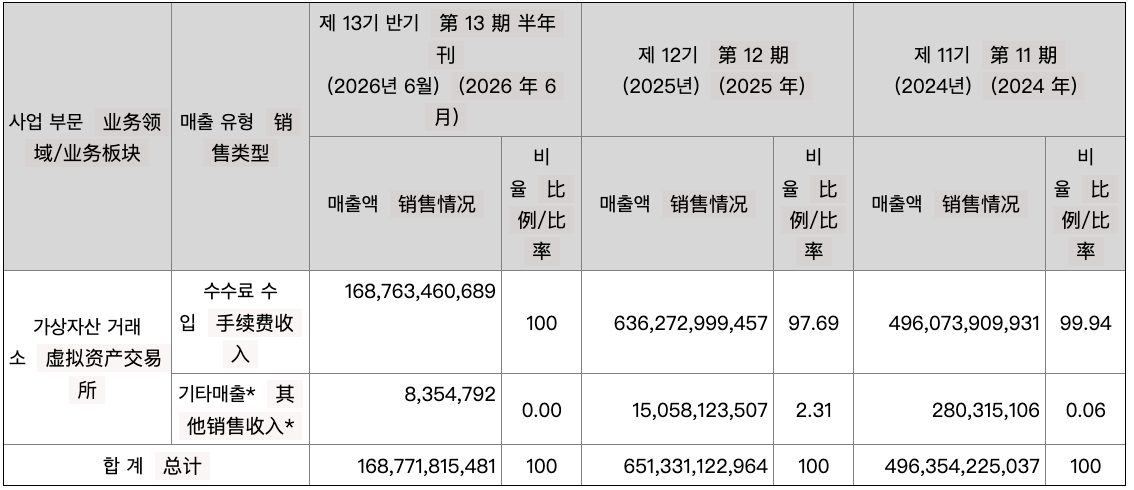
The financial report attributes this segment to lending service fees and market data query fees, but does not disclose the specific reasons for the sharp decline, so further inference is not possible.
During the same period, operating costs and SG&A expenses fell by a combined 35.6%, but the pace of cost reduction still lagged behind the revenue decline.
As a result, the company's operating margin fell from 27.4% in the same period of 2025 to 8.8% in the first half of 2026.
The most noticeable change was in marketing expenses. Bithumb's sales and promotional expenses dropped from KRW 117.07 billion (approximately USD 82.33 million) in the same period of 2025 to KRW 34.89 billion (approximately USD 24.54 million), a reduction of about 70%. The company has clearly scaled back its efforts to attract users through rewards and subsidies.
However, several relatively rigid costs did not decline in tandem. Payment processing fees remained at KRW 46.26 billion (approximately USD 32.53 million), down only about 2% year-over-year; salary expenses were KRW 30.91 billion (approximately USD 21.74 million), down about 6.5% year-over-year.
These figures reveal an easily overlooked issue: an exchange can quickly cut activity rewards, but it is difficult to compress payment, technology, compliance, and personnel costs at the same speed.
When market trading volume declines, this highly fee-dependent structure is directly reflected on the revenue side. Cutting marketing investment can protect some profit, but it cannot solve the problem of concentrated revenue sources.
Total Assets Shrank by USD 584 Million—Where Did the Money Go?
As of the end of June 2026, Bithumb's total assets fell from KRW 3.32 trillion (approximately USD 2.337 billion) at the beginning of the year to KRW 2.49 trillion (approximately USD 1.752 billion), a decrease of KRW 831.469 billion (approximately USD 584.3 million) over six months.
At first glance, this asset decline looks even more alarming than the net loss. But an exchange's balance sheet cannot be interpreted in the same way as an ordinary company's, because a significant portion of both assets and liabilities comes from customer deposits.
Compared to the end of 2025, Bithumb's member KRW deposits on its books fell from KRW 2.04 trillion (approximately USD 1.430 billion) to KRW 1.32 trillion (approximately USD 927.3 million), a decrease of KRW 715.581 billion (approximately USD 502.9 million), accounting for about 86% of the total asset reduction during the period.
Cash and cash equivalents decreased by KRW 773.428 billion (approximately USD 543.5 million), but the company simultaneously increased short-term financial products by KRW 80 billion (approximately USD 56.22 million).
Therefore, a large portion of the total asset decline corresponds to the decrease in customer KRW deposits, as well as the company's allocation adjustments between cash and short-term financial products.
Another easily confused area is Bithumb's proprietary crypto assets versus customer-custodied crypto assets.
As of the end of June, Bithumb's proprietary crypto assets on its books were approximately KRW 194.099 billion (approximately USD 136.4 million); customer-custodied crypto assets were approximately KRW 12.05 trillion (approximately USD 8.468 billion).
The market value of customer-custodied crypto assets fell from KRW 17.90 trillion (approximately USD 12.581 billion) at the beginning of the year to KRW 12.05 trillion (approximately USD 8.468 billion), a decline of about 32.7%. However, the decline in market value cannot be directly equated with customers withdrawing assets in large numbers. During the same period, the quantities of BTC, ETH, and XRP held in custody by Bithumb all increased; taking BTC as an example, the unit price at the end of the reporting period fell by approximately 30.5%. This suggests that at least part of the shrinkage in custodial asset market value was driven by falling coin prices, and customer fund flows cannot be judged solely based on changes in total market value.
Summary
This financial report conveys a more complex signal: the core trading business remains profitable, but revenue has declined significantly, and non-operating losses and regulatory costs have amplified the final loss.
Going forward, what truly deserves attention is not just whether net profit can turn positive, but also whether trading revenue can recover, whether crypto asset-related gains and losses can narrow, and how much ongoing regulatory costs the company will have to bear.





