Snapshot of the 2026 Crypto Perpetual Futures Market: Open Interest Shrinks Significantly, DEXs Steadily Rise


- Key Takeaway: From 2025 to early 2026, the structure of the crypto perpetual futures market has undergone a significant shift. The market share of decentralized perpetual platforms has grown notably (peaking at 13%), yet centralized exchanges still account for over 90% of trading volume. Overall market trading volume and open interest have contracted, while smaller and mid-sized platforms have been more aggressive in listing new contracts.
- Key Elements:
- The 11 leading centralized exchanges recorded an average monthly trading volume of $7.1 trillion in 2025, which dropped to $4.7 trillion in the first four months of 2026, a 34% year-over-year decline.
- In 2025, the total annual trading volume of decentralized perpetual futures reached $6.38 trillion, marking multiple-fold growth compared to $1.5 trillion in 2024.
- From January 2025 to April 2026, MEXC and BingX led the industry in the number of new contract listings, with 879 and 565 contracts respectively, primarily focusing on long-tail tokens.
- In April 2026, the trading volume share of decentralized perpetual contracts fell back to 10%, with centralized exchanges regaining dominance over 90% of the market.
- Hyperliquid leads the decentralized perpetual market, recording a trading volume of $190.28 billion in April 2026, accounting for 3.9% of the total industry contract volume, ranking ninth.
- Total open interest fell from $120.35 billion at the start of 2025 to $99.09 billion at the end of April 2026, while the share of open interest on decentralized perpetual platforms rose from 3.6% to 13.5%.
- New decentralized platforms such as Pacifica, Extended, and Variational are rapidly expanding through points airdrop campaigns, each capturing a monthly market share of 3%-4%.
Original Author: CoinGecko
Original Compilation: Chopper, Foresight News
The perpetual futures exchange landscape is undergoing a structural transformation. Since BitMEX pioneered the perpetual contract trading model in 2016, centralized perpetual futures exchanges have consistently served as the core liquidity hub of the crypto market, with annual trading volume reaching a staggering $85.3 trillion in 2025.
Driven by rapid product iteration and a significant surge in on-chain trading activity, decentralized perpetual futures exchanges have evolved from niche protocols into highly competitive market participants. CoinGecko has released its 2026 Crypto Perpetual Futures Trading Market Report. Below are the key takeaways from the report:
- From January 2025 to April 2026, MEXC and BingX led the industry in new perpetual contract listings, with 879 and 565 contracts respectively.
- The average monthly trading volume of the top 11 centralized perpetual exchanges dropped to $4.7 trillion in 2026, compared to $7.1 trillion in 2025.
- The average monthly trading volume of the top 12 decentralized perpetual exchanges rose to $611.57 billion in 2026, up from $531.65 billion in 2025.
- Driven by Hyperliquid, decentralized perpetual contract trading volume surged in 2025, with its peak market share relative to centralized contracts reaching 13%.
- The open interest share of decentralized perpetual exchanges continued to rise in 2025, currently standing at 13.5%, with Hyperliquid occupying the top position.
Diverging Listing Rhythms, Smaller Platforms More Aggressive
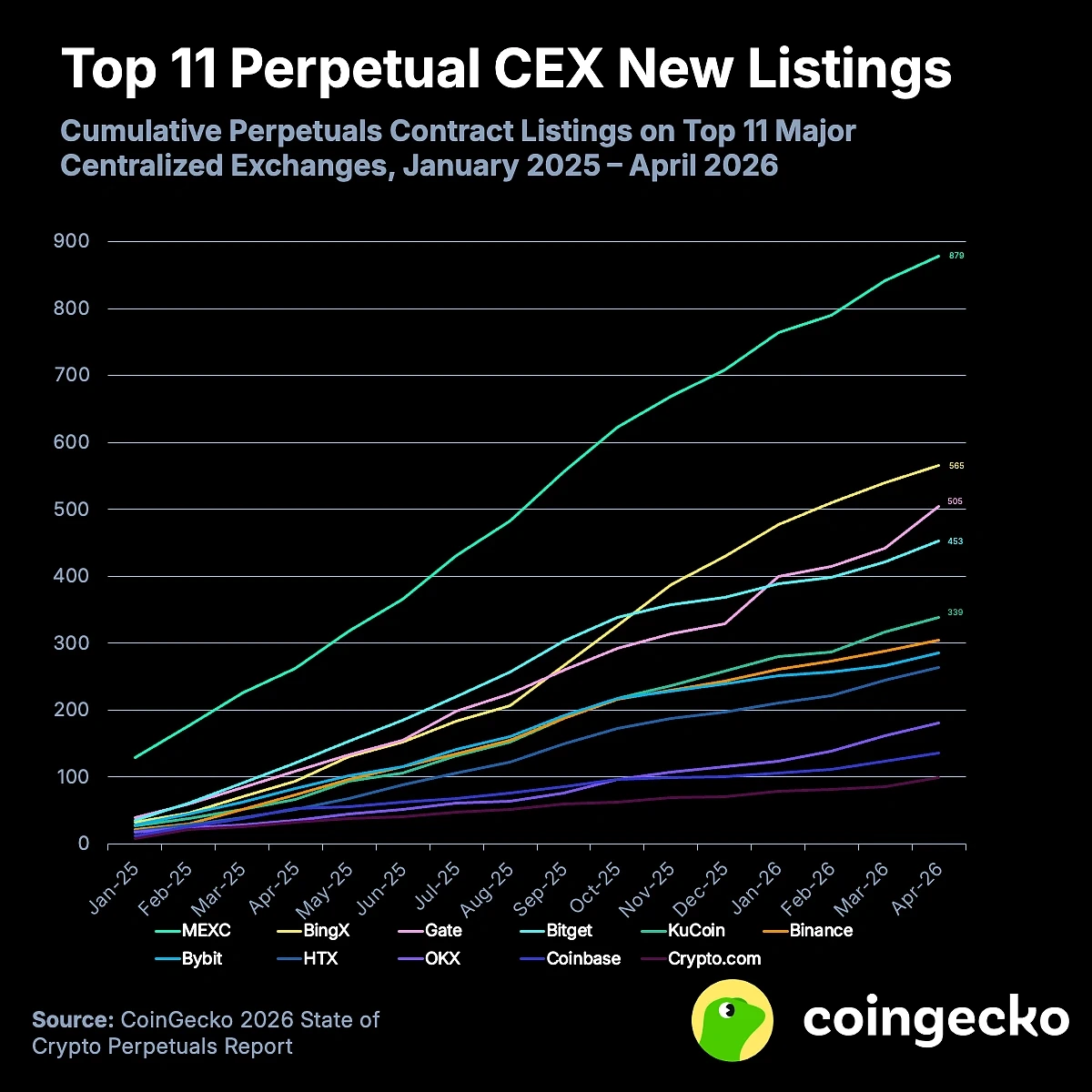
Since January 2025, MEXC and BingX have ranked first and second in the industry for new perpetual contract listings, adding 879 and 565 contracts respectively, with monthly averages of 55 and 35 contracts. Both platforms focus primarily on long-tail token contracts.
Among the top 11 exchanges, six listed fewer than 20 new contracts per month on average, adopting a more conservative approach. Crypto.com had the fewest new listings, adding only 2 contracts in December 2025, with its peak monthly addition reaching just 13 in April 2026.
Large exchanges generally prioritize listing perpetual contracts, with relatively fewer new spot trading pairs. Over the past 16 months, Binance added 305 perpetual trading pairs but only 125 spot trading pairs, with new contracts concentrated mainly on meme coins and AI-related tokens.
High-volume listing platforms like MEXC, BingX, and Gate have also aggressively expanded their spot token offerings. Leveraged trading demand for niche tokens is relatively low, and the risk tolerance threshold for this audience is higher.
Due to regulatory requirements, the listing process for perpetual contracts takes longer than for spot trading, and trading activity for niche tokens remains relatively limited. Since January 2025, CoinGecko has listed a total of 7,803 new tokens, but only 1,030 of these tokens have been listed for perpetual contracts across the top 11 centralized exchanges.
Centralized Contract Trading Volume Declines Year-on-Year
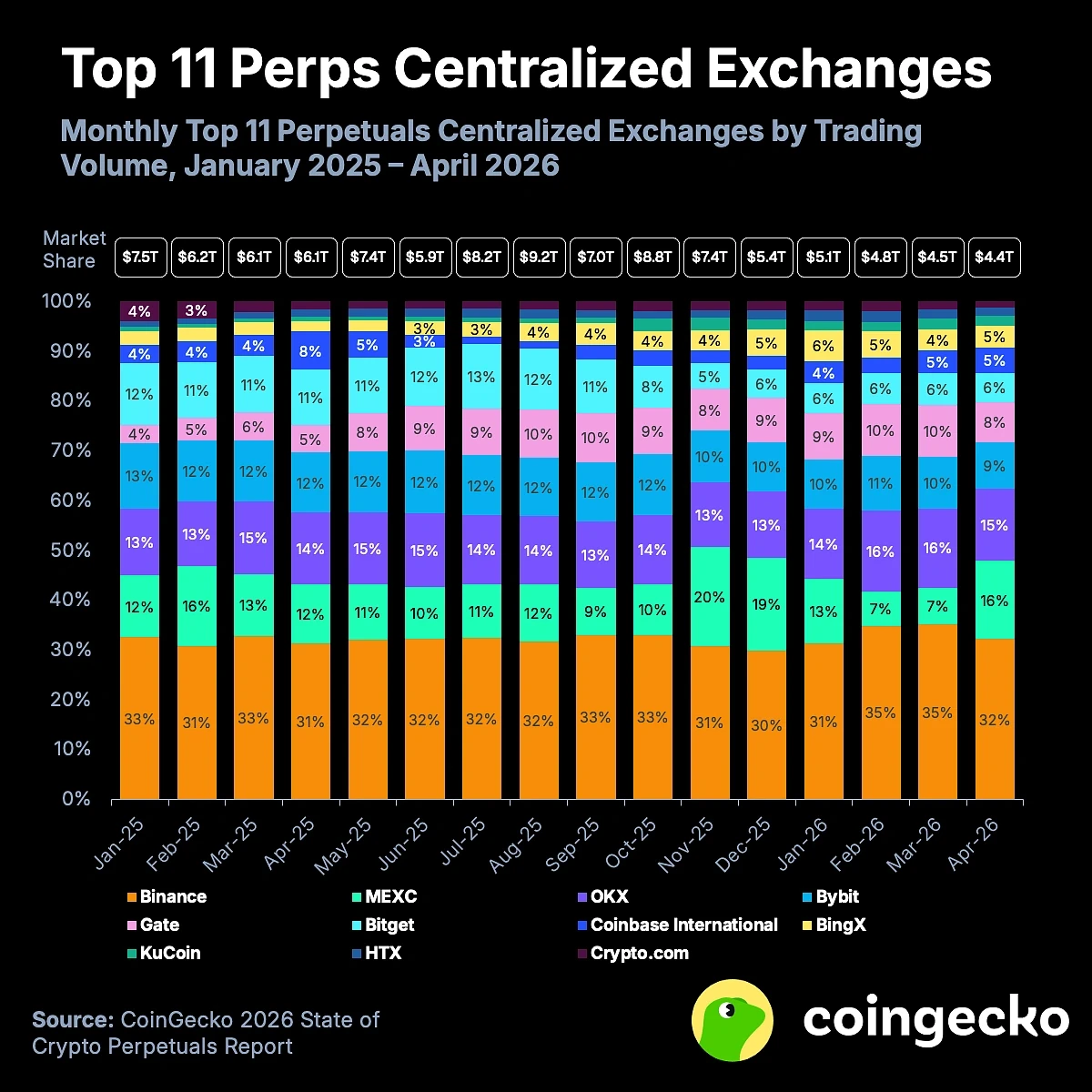
The average monthly trading volume of the top 11 centralized perpetual exchanges in the first four months of 2026 was $4.69 trillion, a 34% decline from $7.11 trillion in 2025.
BingX bucked the trend this year, growing its market share from 3% in 2025 to 5%, now ranking seventh in the industry. Bitget saw a decline in trading volume, with its average monthly volume falling from $740.62 billion to $287.08 billion, though it still holds a 6% market share, ranking sixth.
Binance and OKX solidified their leading positions, with their market shares slightly increasing. In the first four months of 2026, they held 33% and 15% of the market share, respectively.
Decentralized Contract Scale Steadily Rises, New Platforms Rapidly Gain Traction
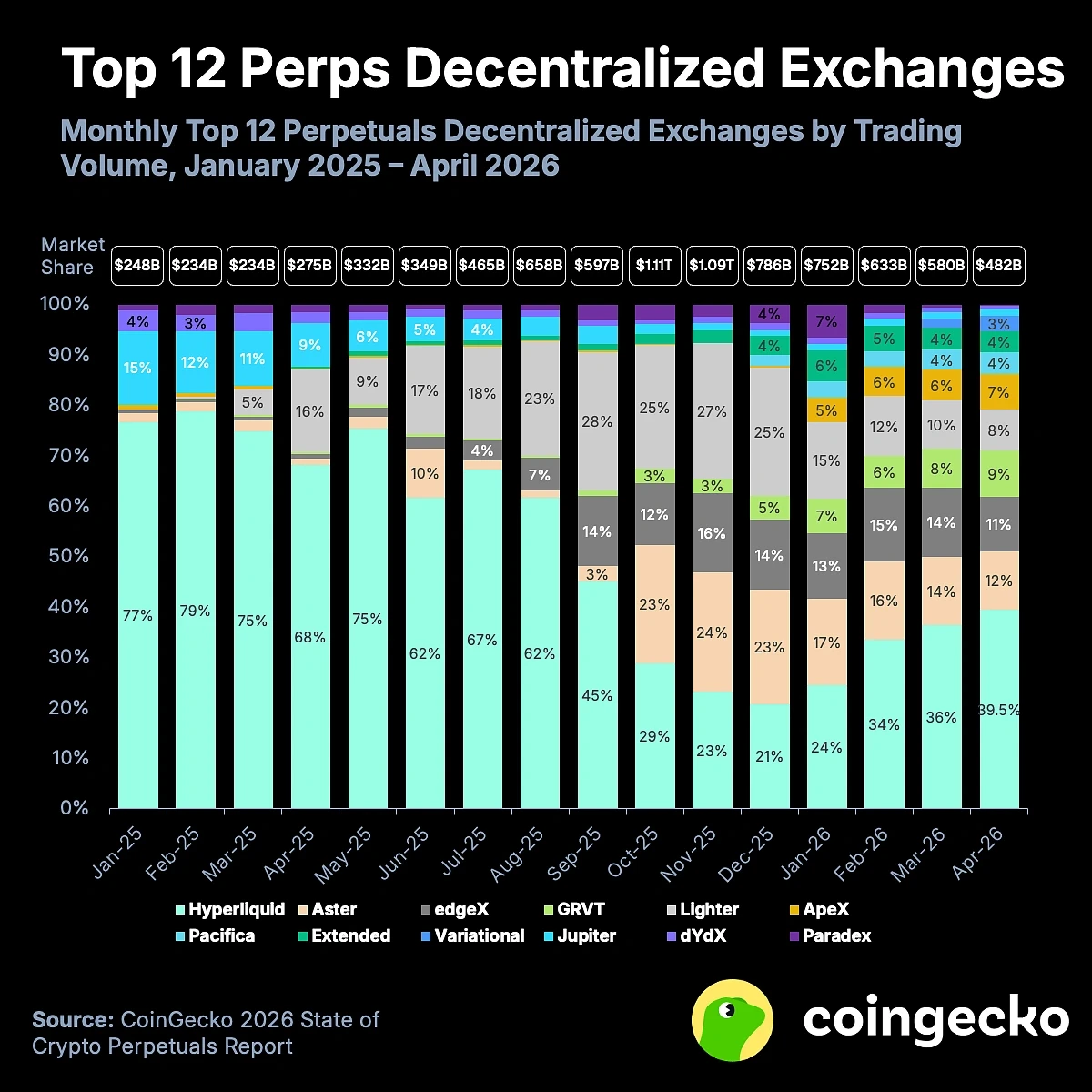
In January 2026, decentralized contract trading volume reached $751.59 billion, before declining month by month to $481.84 billion in April. This figure still far exceeds the sub-$300 billion levels seen in the same period of 2025.
In 2025, total annual trading volume for decentralized perpetual contracts reached $6.38 trillion, multiplying several times from $1.5 trillion in 2024. Even with overall market pressure, the industry's transaction volume in 2026 is expected to remain flat or even surpass last year's figures.
Newer decentralized contract platforms such as Pacifica, Extended, and Variational continue to expand their market share. All three have launched points programs, likely as precursors to future airdrops. In April, their respective market shares were 4%, 4%, and 3%, already rivaling established platforms like Jupiter and dYdX in size.
Decentralized Contract Share Peaks Then Retreats, Leading Projects Dominate
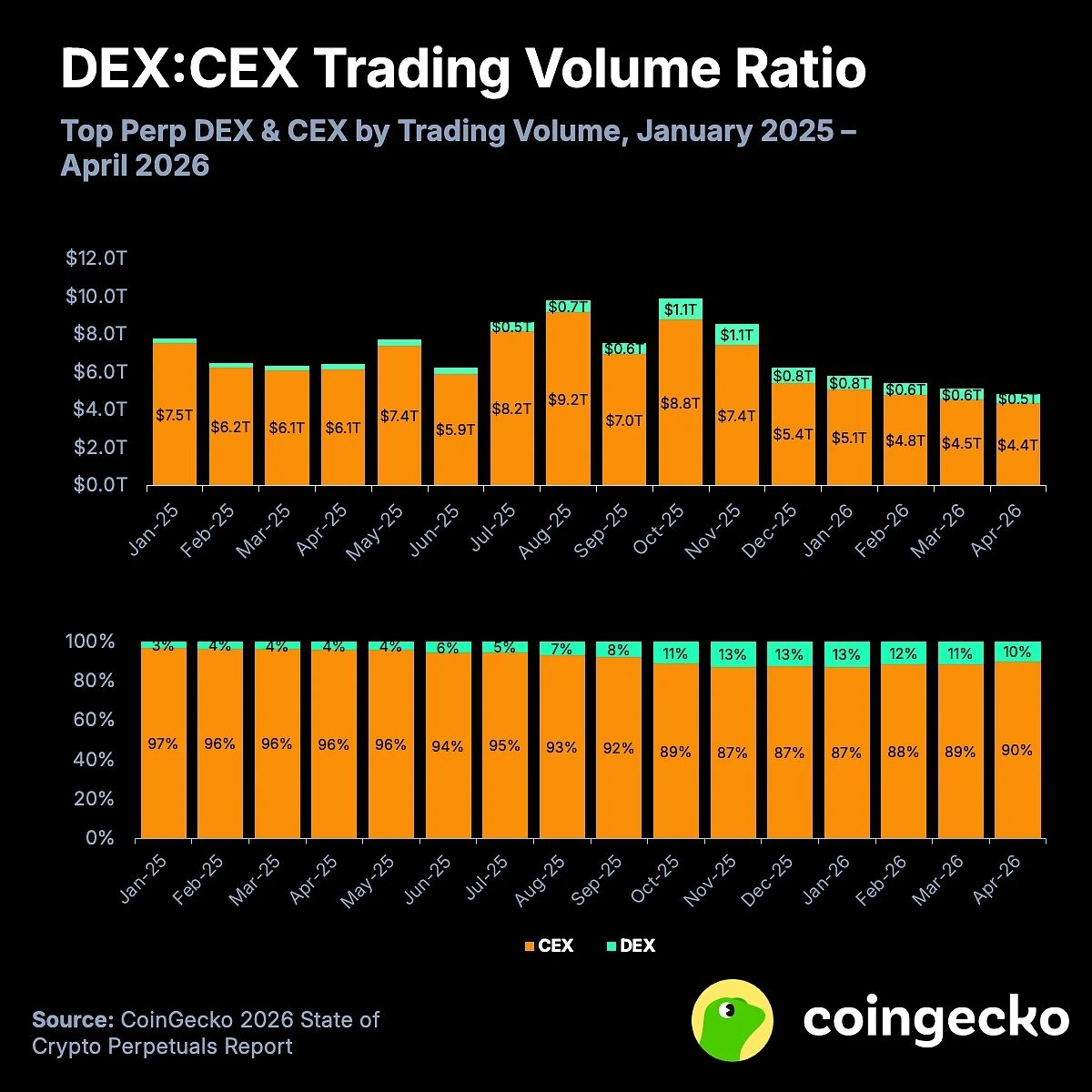
The ratio of decentralized to centralized perpetual contract trading volume rose steadily throughout 2025, starting at just 3% at the beginning of the year and surging to 13% by year-end. This ratio has since declined in 2026, falling to 10% by April, as centralized exchanges reclaimed over 90% of market dominance for the first time since October 2025.
Hyperliquid generated the majority of decentralized contract trading volume, with $190.28 billion in April, accounting for 3.9% of the entire industry's contract volume. This placed it ninth overall, slightly behind BingX's $196.81 billion, and ahead of KuCoin's $83.71 billion.
While the growth rate of decentralized contracts has temporarily slowed, emerging platforms like Pacifica are attracting capital based on expectations of point-based airdrops, suggesting potential for their market share to rebound.
Overall Open Interest Shrinks, Decentralized Contract Share Rises Significantly
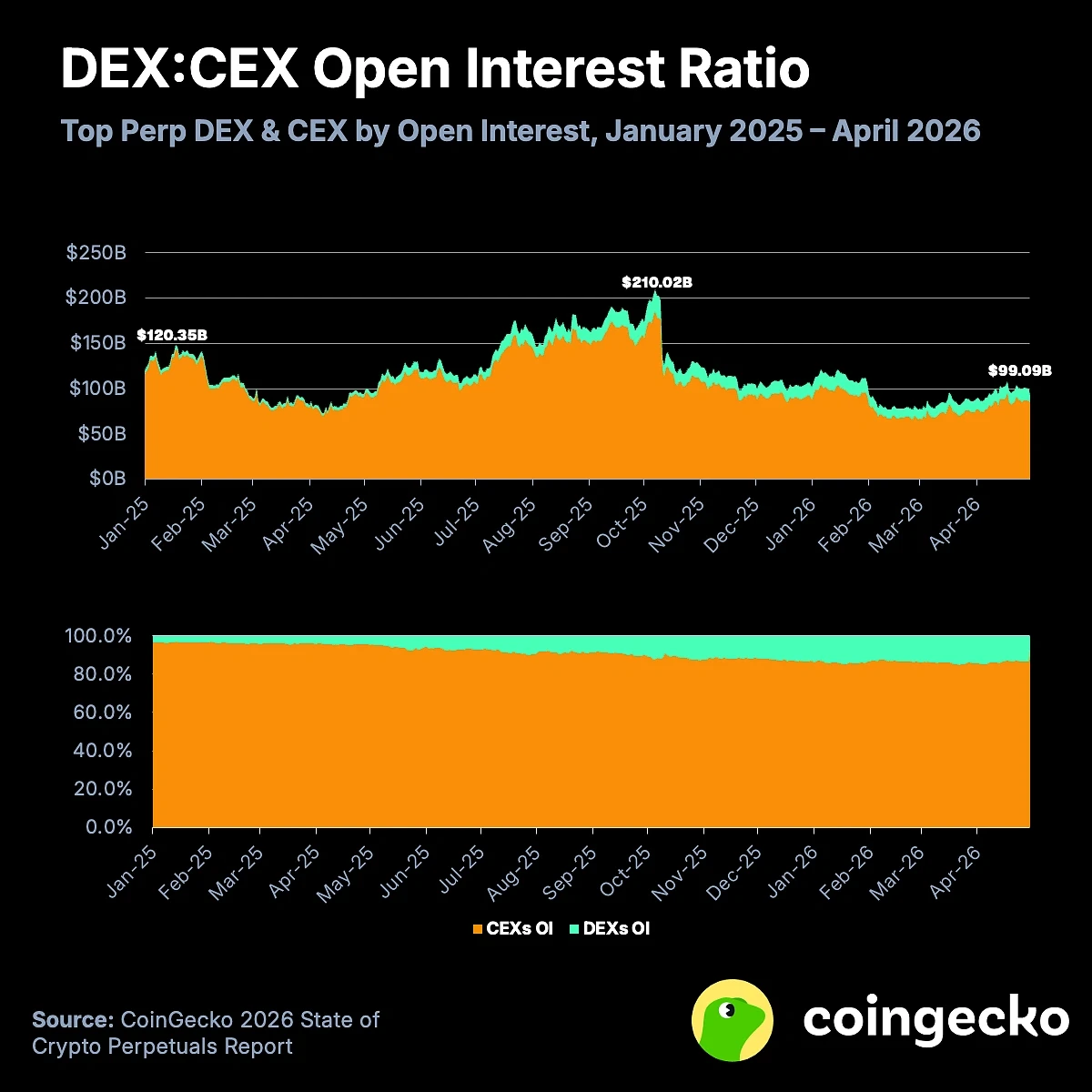
Total open interest in the crypto market declined from $120.35 billion at the start of 2025 to $99.09 billion at the end of April 2026, more than halving from the all-time high of $210.02 billion recorded before the liquidation event on October 7, 2025.
Centralized exchanges continue to hold the vast majority of open interest, but their share has declined from 96.4% at the beginning of 2025 to 86.5% at the end of April 2026. Since October 2025, the open interest share of decentralized contracts has consistently remained above 10%.
Furthermore, the on-chain adoption of Real World Assets (RWA) is driving the development of decentralized contracts, allowing crypto users to participate in traditional financial market trading through these platforms without needing to cash out. However, centralized exchanges are also following this trend, sequentially launching RWA perpetual contracts, further intensifying competition in this sector.