






黄仁勋、奥特曼、孙正义「抱团20年」


- 核心观点:英伟达、OpenAI与软银SB Energy合作建设俄亥俄州大型数据中心,英伟达为OpenAI的20年租约提供最高1050亿美元兜底担保,以提前锁定土地、电力和算力资源,应对AI基础设施扩张的融资瓶颈。
- 关键要素:
- 项目位于俄亥俄州PORTS-Pike园区,计划建设10GW新能源发电能力和约8GW AI工厂容量,分阶段于2028年陆续投用。
- 英伟达采用残值担保结构,仅在OpenAI停止租赁且资产出售无法覆盖最低价值时补足差额,风险敞口随租金支付逐步下降。
- 黄仁勋指出,前沿AI实验室资产负债表不及云巨头,增长受算力可用性而非算法或客户需求限制,英伟达仅选择少数优质场地介入。
- OpenAI现有及计划承诺对应约12GW英伟达计算能力,预计到2030年相关部署机会约值6000亿美元。
- 《华尔街日报》分析显示,9家科技公司(含Alphabet、亚马逊、微软等)AI相关表外承诺合计近3万亿美元,为当前租赁负债和长期债务总和的3倍。
- Meta的Hyperion数据中心为例,截至6月未开始的租赁总义务达3470亿美元,尚未完整计入资产负债表,支付前不反映于报表。
- Alphabet截至6月购买承诺和合同义务达8110亿美元,三个月前为3320亿美元,部分能源协议持续至2054年,但未解释季度激增原因。
Author: Su Yang
Editor: Xu Qingyang
Source: Tencent Technology
OpenAI is locking in compute capacity for the next 20 years ahead of time, while Nvidia is extending its reach beyond chips.
On August 17, local time in the US, Nvidia, OpenAI, and SoftBank-backed SB Energy confirmed a partnership to build a large-scale data center in the United States. Under the arrangement, SB Energy will handle development and operations, OpenAI will be the tenant, and the data center will run entirely on Nvidia compute.
Among the three parties, the most closely watched role is Nvidia's. It serves not only as the compute supplier, but also provides up to $105 billion in downside protection for OpenAI's long-term lease, while directly investing in the project's construction. A deal that would typically involve only a developer, a tenant, and financing institutions now includes a chipmaker in a central role.
Why is Nvidia willing to take on such risk, and why is OpenAI locking in a 20-year compute lease?
One fact and trend stands out: as demand for compute swells, land, electricity, and data center capacity have become "chokepoint" resources, prompting players across the industry to compete for them. But in Jensen Huang's view, frontier AI labs do not have balance sheets as strong as those of cloud giants, which led to the approach of "chipmaker participation in guarantees."
In reality, however, the cloud giants are also "carrying heavy loads."
According to a Wall Street Journal analysis of the latest financial filings from nine major tech companies, these firms' combined AI-related off-balance-sheet commitments (not recorded on balance sheets, mainly consisting of forward payment obligations from chip purchases and long-term data center leases) have reached nearly $3 trillion — three times their combined current lease liabilities and long-term debt.
A 10GW Lease, Backed by Nvidia
The data center project, developed jointly by OpenAI, SoftBank's SB Energy, and Nvidia, is located at the PORTS-Pike campus in Ohio, US. The plan calls for at least 10GW of new renewable energy generation capacity. Once completed, the campus will exclusively deploy Nvidia computing infrastructure, ultimately yielding roughly 8GW of AI factory capacity.
Construction will proceed in two phases. Phase one is planned at 4.25GW, with the first 800MW expected to come online in 2028, primarily leveraging existing AEP Ohio infrastructure. After that, the project will require continued development of power plants, transmission lines, and other grid facilities before expanding data center capacity to the target level.
Nvidia may also fulfill an additional 3.75GW of capacity guarantees based on future demand, although this portion currently carries uncertainties regarding infrastructure and permitting approvals, and Nvidia has no obligation to lease all of it.
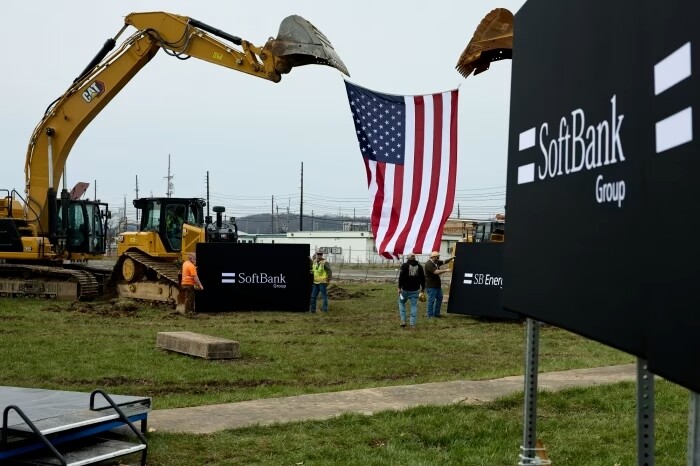
The southern Ohio data center campus broke ground in March this year
SB Energy and SoftBank plan to invest at least $4.2 billion to build new regional grid infrastructure. SB Energy is responsible for constructing, owning, and operating the data center, while OpenAI will use the capacity as it is built and delivered.
Currently, OpenAI has signed a 20-year lease with SB Energy. According to the agreement, OpenAI only begins paying rent after the corresponding capacity is completed and available for lease.
Signing a long-term capacity agreement ahead of time allows OpenAI to lock in its future compute needs. But this does not mean Nvidia will pay OpenAI's full 20-year rent.
Under the agreement, Nvidia's maximum payment obligation (or total payment cap) for this deal is $105 billion, primarily covering infrastructure costs such as land, electricity, and data centers.
Nvidia is using a residual value guarantee structure: if OpenAI stops leasing, SB Energy must find another tenant. If no new lease is secured, it would consider selling the relevant assets. Only when the above approaches still fail to cover the agreed minimum value would Nvidia step in to make up the difference.
Thus, the $105 billion guarantee corresponds to the residual value of the completed data center assets, and it takes effect in stages as the project is built and brought online, roughly covering the period from 2028 to 2030. As OpenAI pays rent and data center capacity comes online progressively, Nvidia's actual risk exposure will also gradually decline.
Nvidia's willingness to do this comes down to that very risk exposure. Even if OpenAI reduces its usage in the future, the completed compute capacity can still be transferred to cloud service providers, enterprises, AI labs, and startups.
Locking In Land and Power Ahead of Time
On the same day the announcement was made, Jensen Huang wrote an article explaining why Nvidia is getting involved in such projects. His rationale: AI factories require more and more inputs. In the past, advanced chips, packaging, memory, and networking were the primary investments for AI infrastructure. Now, land, electricity, and data centers must also be secured in advance.
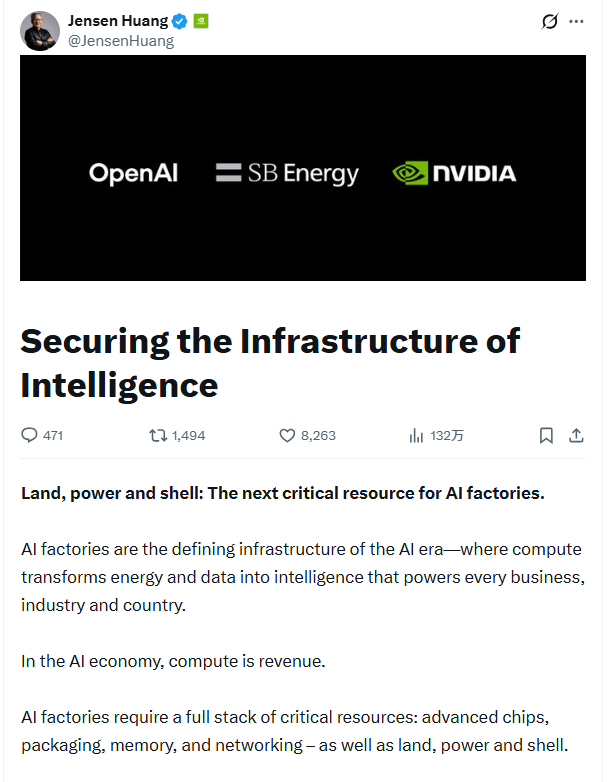
In Huang's view, large cloud service providers and investment-grade companies typically have sufficiently large balance sheets and the ability to sign long-term contracts and build their own infrastructure. But frontier AI labs do not necessarily have those capabilities.
These companies' training and inference needs are growing rapidly, and their revenue may increase accordingly. However, to lock in decades of land, electricity, and data center capacity upfront, they need stable cash flow and sufficiently strong financing capabilities — precisely what many AI labs currently lack.
Thus, a new bottleneck has emerged.
Huang wrote that these companies' growth "is not limited by algorithms or customer demand, but by compute availability."
Nvidia's involvement in data center infrastructure (LPS — Land, Power and Shell) is aimed at solving this problem. That said, this does not mean Nvidia plans to offer similar services to all customers. Huang emphasized that Nvidia will only select a small number of high-quality sites with clear, long-term computing needs.
Huang revealed that each generation of Nvidia AI factory systems deployed at the PORTS-Pike campus could correspond to roughly 1.5 million Nvidia GPUs, or approximately $150 billion to $200 billion in Nvidia revenue.
The "each generation" part is crucial. For Nvidia, within a 20-year agreement cycle, what is actually locked in is the infrastructure that will host its computing systems over the long term, not a fixed order for a specific GPU generation.
OpenAI's long-term commitment further amplifies this opportunity.
Huang stated that OpenAI's existing and planned commitments correspond to roughly 12GW of Nvidia computing power. If PORTS-Pike continues to expand, that capacity will increase further. At this scale, by 2030, deployment opportunities related to OpenAI would correspond to approximately $600 billion in Nvidia compute value.
In the past, chipmakers "taking equity stakes" in customers sparked discussions about circular financing. Now the relationship has deepened further: chipmakers are directly deploying data centers and providing downside protection for their construction. On one hand, this serves as "backing" for frontier labs' compute needs; on the other, data center construction will generate sustained orders for the chipmakers themselves.
$3 Trillion in Off-Balance-Sheet Commitments
The compute story at PORTS-Pike is not just about Nvidia and OpenAI.
Over the past two years, AI companies and big tech firms have been frantically building data centers, but a growing share of this infrastructure is not being purchased outright. Instead, it is being secured through leases, long-term purchase agreements, joint ventures, and other financing structures.
A recent Wall Street Journal analysis of the latest securities filings from nine major tech companies — including Alphabet, Amazon, Microsoft, Meta, Oracle, Nvidia, Broadcom, SpaceX, and AMD — found that, as of their most recent filings, these companies' AI-related off-balance-sheet commitments total roughly $3 trillion.
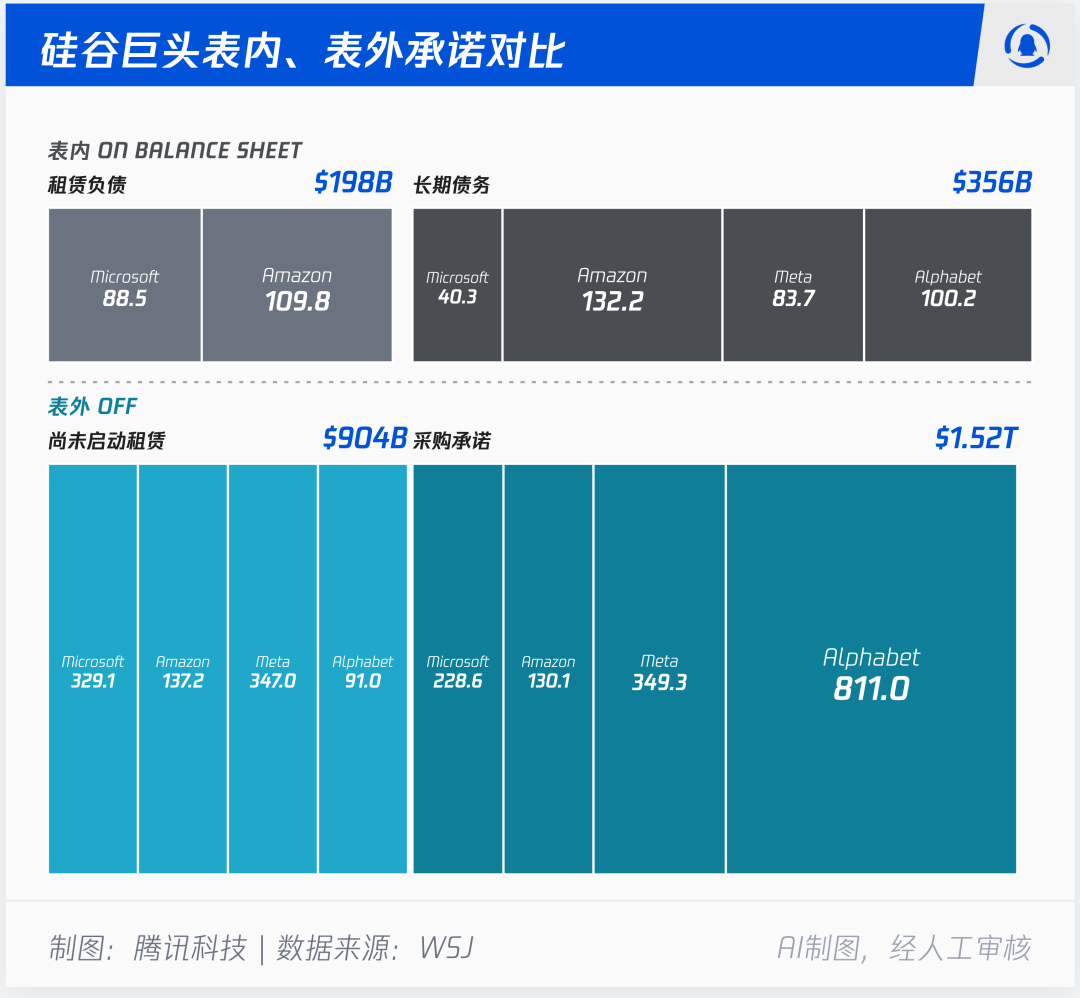
Compared to roughly $600 billion in capital expenditures over the past year, the off-balance-sheet commitments these companies have signed are far larger.
Meta's Hyperion data center is a typical example.
This data center in Louisiana covers an area equivalent to 1,700 football fields. A fund managed by Blue Owl Capital holds a joint venture responsible for its construction. Meta is a limited partner and the tenant, with its rent providing cash flow to bondholders.
Until rent payments begin, this obligation will not be fully reflected on Meta's balance sheet. As of June this year, Meta disclosed total lease obligations not yet commenced of $347 billion, including the Hyperion project.
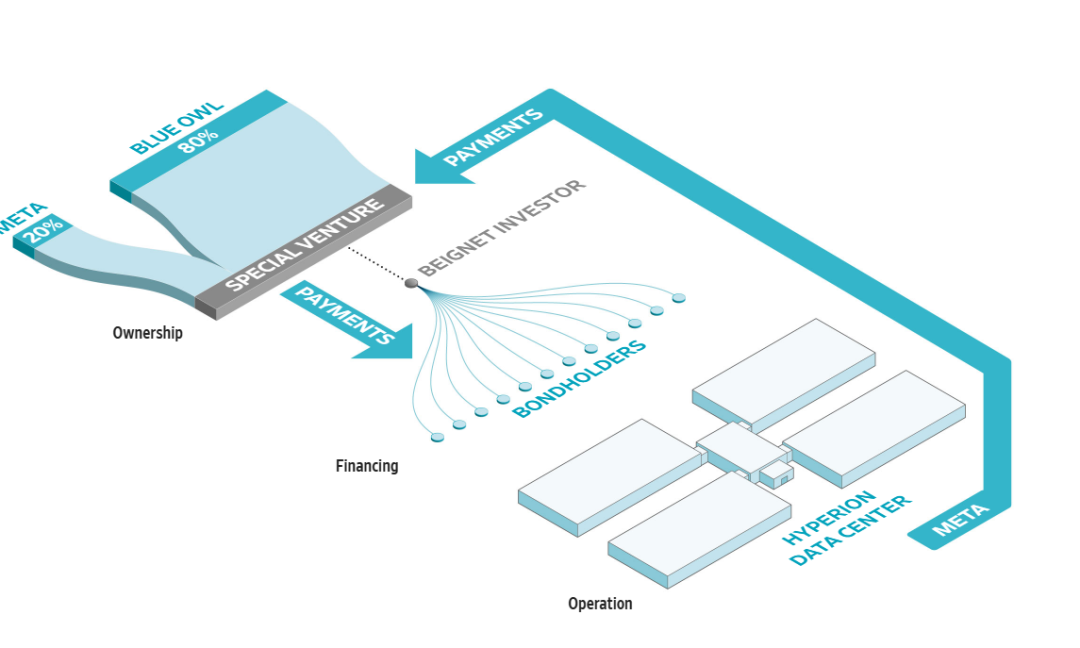
As of June, Meta had leased the Hyperion data center in Louisiana, but rent payments had not yet begun, and the related lease obligations had not been fully recorded on the balance sheet
According to the statistics, the nine companies' combined lease payment commitments not yet commenced total approximately $1.2 trillion — about four times the amount disclosed a year earlier. Purchase commitments and other contractual obligations reached approximately $1.9 trillion.
Among these, Alphabet's change is particularly notable.
As of June 30, Alphabet's purchase commitments and contractual obligations reached $811 billion, up from $332 billion just three months earlier. Alphabet explained that these obligations mainly relate to "technology infrastructure and inventory," as well as agreements securing energy supply for data centers. Some energy agreements even extend to 2054. However, Alphabet did not provide a detailed explanation for why its commitments increased by nearly $480 billion in just one quarter.
The risks of expansion are not limited to data center leases and chip purchases. Some companies' commitments also include purchasing equity in other companies or providing guarantees for other tenants' leases. Nvidia itself has committed to $27 billion in equity investments between April 26, 2026 and the end of its fiscal year 2027.
But another risk lies in debt expansion. Some tech companies have begun频繁 tapping capital markets for debt financing. In their most recent earnings reports, Alphabet and Amazon posted negative free cash flow, with capital expenditures exceeding the cash generated by their operating businesses.
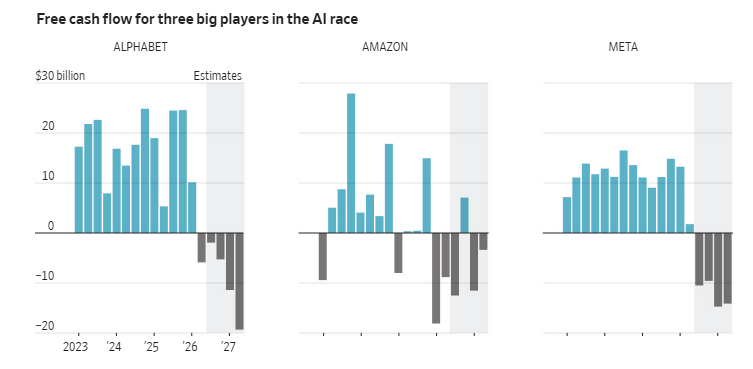
Alphabet, Amazon, and Meta's previously healthy cash flows (teal bars) are expected to collectively turn negative (gray bars) for the remainder of 2026 and into 2027
And these figures do not yet fully reflect the cash flow pressure that trillions of dollars in future off-balance-sheet commitments could bring. More problematic is the fact that many purchase commitments and long-term leases cannot be easily cancelled. In other words, even if future AI demand falls short of expectations, companies would still have to pay for the agreements they have signed. In such a scenario, the giants would be forced to cut other spending and may need to borrow further to sustain this infrastructure.
Morgan Stanley's accounting analysts warned in an April report that as such off-balance-sheet commitments become more frequent, larger in scale, and more complex in structure, it will become increasingly difficult for investors to assess a company's true leverage level.
For now, PORTS-Pike stands at the forefront of this trend. But who can guarantee that compute demand will continue to expand aggressively without ever slowing down?


