






被币安索赔4.73亿美元,U卡龙头RedotPay还能顺利IPO吗?


- 核心观点:币安关联实体起诉加密支付卡龙头RedotPay,指控其违反合作协议,将超47万名Binance Card用户导向自家产品并挪用资金,索赔4.728亿美元,该诉讼或影响RedotPay赴美IPO进程。
- 关键要素:
- 币安指控RedotPay通过Binance Pay获取约3.04亿美元用户资金,未按约定隔离,部分被用于RedotPay Card充值,索赔总额4.728亿美元。
- RedotPay成立于2023年,用户超800万,年支付量140亿美元,年化营收1.8亿美元,占据加密U卡市场约52.8%份额,位列第一。
- RedotPay去年完成三轮融资共1.94亿美元,估值突破10亿美元,计划最早今年在纽约IPO,目标估值超40亿美元,潜在融资超10亿美元。
- 双方2023年11月达成合作,2025年3月重新签署协议要求资金隔离并限制用途,币安于2026年3月关闭合作通道。
- 诉讼在香港与新加坡两地提起,RedotPay已回应将积极抗辩,称不影响日常经营,但IPO前需向投资方解释早期增长来源的合规性。
Original by Odaily Planet Daily (@OdailyChina)
Author: Asher (@Asher_0210)

RedotPay, the leader in crypto payment cards (U-Cards), has been sued by its former partner Binance.
Last night, according to Bloomberg, multiple Binance-affiliated entities filed a lawsuit against RedotPay's three co-founders, Gao Zhangpeng, Chan Wa Choi, and Yao Chao, accusing them of breaching agreements between the two parties by directing over 470,000 Binance Card users to RedotPay, and seeking $472.8 million in damages. Binance stated that since the partnership began, RedotPay received approximately $304 million in user funds through Binance Pay, but failed to isolate these funds as agreed, with some ultimately being used to top up RedotPay Cards.
RedotPay subsequently responded, stating that the lawsuit will not affect the company's current or future daily operations, and that it will vigorously defend against all allegations. As the case has entered the judicial process, the company will not comment further on the specific disputes.
To give readers unfamiliar with the U-Card sector a general sense of who Binance is suing, RedotPay currently commands half of the crypto payment card market and is reportedly targeting a $4 billion valuation.
Solidifying Its Position as the Top Crypto U-Card Provider, RedotPay Is Preparing for a US IPO
Founded in April 2023, RedotPay primarily offers stablecoin payment cards, multi-currency wallets, fiat currency exchange, and global transfer services. Users can deposit stablecoins like USDT and USDC into RedotPay and use virtual or physical cards for online subscriptions, offline purchases, and cross-border payments. Currently, the company has surpassed 8 million users, with an annual payment volume of $14 billion and annualized revenue of approximately $180 million.
Since 2024, RedotPay has consistently held the top position in the crypto U-Card market.According to Paymentscan data, in July this year, the total transaction volume of the crypto U-Card sector was approximately $749 million, with RedotPay's transaction volume reaching $395 million, accounting for about 52.8% and securing a dominant first place; Ether.fi's transaction volume was $100 million (13.4%), ranking second; KAST's transaction volume was $89.6 million (11.9%), placing third.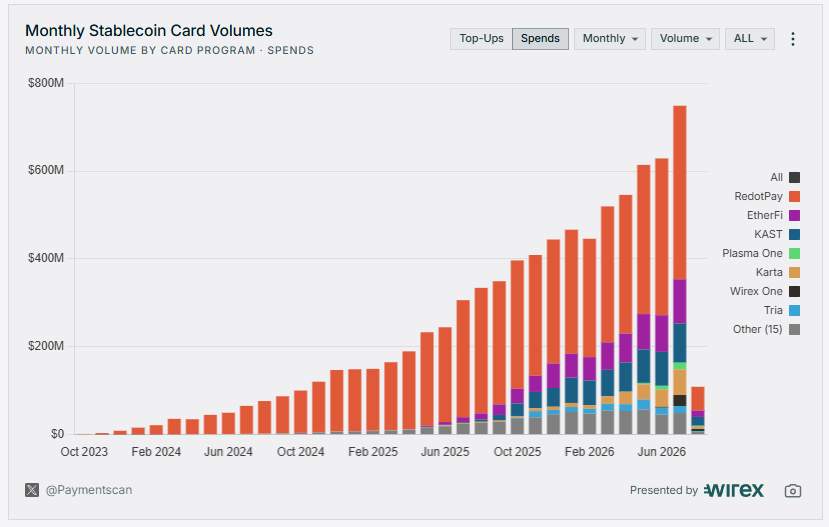
Last year, RedotPay completed three funding rounds totaling $194 million:
- In March, RedotPay completed a $40 million Series A funding round, led by Lightspeed. At that time, the company had over 3 million users;
- In September, RedotPay completed a $47 million strategic funding round, led by Coinbase Ventures, pushing its valuation past $1 billion, with users growing to over 5 million;
- In December, RedotPay completed a $107 million Series B funding round, led by Goodwater Capital, with participation from Pantera Capital, Blockchain Capital, Circle Ventures, HSG, and others.
After becoming a unicorn in the crypto U-Card payment space, RedotPay began preparing for a US listing. The company plans to pursue an IPO in New York as early as this year, with a potential fundraising size exceeding $1 billion and a target valuation of over $4 billion. It is also in talks for a new funding round of up to $150 million.
RedotPay's Early Growth Came from Binance Pay
In November 2023, RedotPay partnered with Binance, integrating with Binance Pay. Users could directly use funds from their Binance accounts to top up their RedotPay Cards via a mini-program within the Binance app (officially announced on December 15).
Binance Pay is a crypto payment tool launched by Binance, allowing users to directly use assets in their Binance accounts for transfers and payments; Binance Card, on the other hand, was Binance's crypto U-Card for everyday spending scenarios, making it a direct competitor to RedotPay Card.
By integrating with Binance Pay, RedotPay gained a direct connection to the funds and users within Binance accounts. Binance users could convert stablecoins for fiat exchange, in-app transfers, and other payment scenarios without the complex process of withdrawing to a blockchain.
For RedotPay, which was only six months old at the time, this channel not only lowered the barrier for users to top up and use crypto payment cards, but also allowed it to directly reach mature users who already held stablecoins and were familiar with crypto payment processes.
What Is Binance's Side of the Story?
Initially, the scope of the partnership between RedotPay and Binance included using Binance Pay funds to top up RedotPay Cards. Users could directly use assets in their Binance accounts to fund their RedotPay Cards. This meant that funds and user demand originally within Binance's payment ecosystem were funneled into RedotPay's own payment card system.
Shortly after their first collaboration, disagreements arose over top-up issues, and the first agreement was terminated after roughly six months. In March 2025, Binance and RedotPay signed a new agreement that explicitly required the segregation of Binance Pay funds and restricted their use, permitting them only for fiat exchange, in-app transfers, and purchasing RedotPay-branded merchandise, prohibiting their use for topping up RedotPay Cards.
It wasn't until March 2026 that Binance discovered RedotPay was still allowing related funds into its own card business, and subsequently shut down the cooperation channel the following month. Binance estimates that during the partnership, approximately $304 million in user funds flowed to RedotPay through Binance Pay. Beyond the funds, Binance believes it also lost a more critical asset—its Binance Card users who were generating real-world spending.
In Binance's lawsuit, RedotPay's three co-founders are accused of leveraging the channels and user touchpoints gained from the previous partnership to direct over 470,000 Binance Card users to RedotPay. Binance argues that RedotPay entered the Binance payment ecosystem as a partner, learning about cardholder needs, top-up habits, and usage scenarios during the collaboration. Subsequently, when Binance Card was discontinued at the end of 2023, RedotPay used these existing user entry points to absorb this customer base into its own payment card product.
Binance was responsible for accumulating users, building brand trust, and holding funds, while RedotPay swooped in at the final step to capture top-ups and spending. Users were still paying with stablecoins, but the card they used changed from Binance Card to RedotPay Card, and the associated transaction volume, fees, and subsequent revenue also flowed to RedotPay.
Binance's $472.8 million claim consists of two parts: the $304 million in funds that flowed to RedotPay through the cooperation channel, and the subsequent commercial losses incurred due to customer attrition.
More Troublesome Than the $472.8 Million Claim Is Explaining Early Growth Sources Before the IPO
Currently, the $472.8 million is not a confirmed payout for RedotPay, but merely the amount claimed by Binance-affiliated entities. Whether the court will uphold all of Binance's allegations, what the final compensation amount will be, and whether the two parties will settle, remain unanswered.
However, the timing of this lawsuit is potentially devastating for RedotPay. The lawsuit filed by Binance-affiliated entities against RedotPay's three co-founders in Hong Kong (with a related lawsuit in Singapore) lands precisely during the critical window as RedotPay prepares for its US IPO. The company has been advancing its New York listing plans and has been in contact with investment banks including JPMorgan, Goldman Sachs, and Jefferies. For potential investors, the company's current $180 million annualized revenue and $14 billion annualized payment volume are certainly important, but how these figures were achieved will also significantly impact the final valuation.
Binance's lawsuit directly targets the most sensitive part of RedotPay's growth story: the source of its early customers. During subsequent IPO due diligence, underwriters and investors may need to reassess:
- Whether RedotPay breached its cooperation agreement with Binance;
- Whether Binance Pay funds were segregated as agreed;
- Whether the process of converting over 470,000 Binance users was compliant;
- The potential compensation risks arising from the lawsuits in Hong Kong and Singapore.
RedotPay's previous management changes have also heightened these concerns. Over the past year, at least five senior employees have held their positions for less than 12 months, the head of compliance role changed twice, and the company at one point advanced its IPO plans without a Chief Financial Officer. Now, Binance has brought the funding and user issues from their early partnership before the court.
This lawsuit may not directly kill RedotPay's IPO, but it could very likely disrupt its fundraising and listing timeline. The company not only needs to prove that its existing business can continue to grow normally, but also needs to explain to investors how much of its growth over the past three years came from natural market expansion, and how much was built upon its cooperation channel with Binance.


