Web3 Payment Track Research Report (Part 1): A Comprehensive Breakdown of Industry Background, Protocol Standards, Major Players' Positioning, and Global Regulatory Dynamics


- Core Thesis: Web3 payments are undergoing a paradigm shift from narrative-driven to infrastructure-grounded development. Stablecoins, with an annual settlement volume of $33 trillion, have surpassed traditional card networks to become the core of next-generation payment infrastructure, while the rise of AI Agent payments and specialized stablecoin chains will reshape the global flow of financial value.
- Key Elements:
- Stablecoin on-chain settlement volume totaled approximately $33 trillion in 2025, up 72% year-over-year, exceeding the combined transaction volume of Visa and Mastercard; after removing noise, real economic activity amounted to roughly $28 trillion.
- The average fee for global cross-border remittances remains as high as 6.36%, with settlements taking 3–5 business days. Approximately 1.3 billion adults remain unbanked, highlighting significant structural pain points in the traditional payment system.
- The stablecoin market exhibits a dollar-denominated duopoly, with USDT and USDC jointly commanding over 83% market share. Tether has become the world's largest non-sovereign holder of U.S. Treasuries, with an exposure of $141 billion.
- The driving force behind merchant adoption of stablecoins lies in cost advantages: traditional card networks charge 1.5%–3.5% per transaction, with an average settlement delay of about 1.9 business days, whereas stablecoins enable near-real-time settlement.
- Technological evolution is advancing on dual tracks: account abstraction (ERC-4337 and EIP-7702) lowers the barrier to on-chain operations, while payment giants (Stripe, PayPal, Visa) abstract on-chain complexity on the custody side, jointly driving mass adoption.
- The rise of AI Agent payments is creating new demand from the machine economy, where individual transaction amounts are below one cent but daily transaction frequencies can reach millions—exposing the structural inadequacies of traditional card networks in micro-payment scenarios.
Original Author: Rosa, Researcher at Web3Caff Research
Picture this scene: on an early morning in 2026, an AI Agent runs quietly under your authorization — it compares prices across global data markets, calls three APIs to complete data collection, pays $0.07 to finalize a transaction, invokes cloud computing power and automatically reserves $0.02 for settlement, and finally pays $0.01 to a downstream Agent that generates reports. The entire process requires no bank account, no credit card, no SWIFT code, yet settlement completes in 4 seconds. This is not science fiction, but millions of real transactions currently being processed by x402 and the MPP protocol at this very moment.
This digital contrast is redefining "how value flows." In 2025, stablecoins surpassed the combined transaction volume of Visa and Mastercard with $33 trillion in on-chain settlement volume; more than 100,000 AI Agents are running a payment economy imperceptible to humans: individual transactions are under 1 cent, yet daily transaction frequency can reach millions, with fees approaching zero. At the same time, the global average cost of cross-border remittances remains as high as 6.36%, settlement still takes 3–5 business days, and 1.3 billion adults remain outside the traditional banking system. The industrial power transition over "who defines the next-generation payment infrastructure" is escalating from a Web3 industry narrative into a structural issue for the global financial system.
This research report takes Web3 payment infrastructure as its central theme, systematically deconstructing the paradigm shift in the Web3 payments sector from 2025–2026, moving from "narrative-driven" to "infrastructure deployment," and answering the three fundamental questions that will determine the industry's trajectory over the next five years: Who dominates protocol standards? Which infrastructure layers will become the entry points for value accumulation? And who will hold the power to define the market amid the upward spiral of regulation and commerce?
Note: Due to length constraints, this research report is published in three parts. This is Part 1 (including: Chapter 1 Macro Background: The Historic Turning Point of Web3 Payments; Chapter 2 Stablecoins: The Core Infrastructure of Web3 Payments). Part 2 covers (Chapter 3 AI Agent Payments: The Emerging Machine Economy Layer; Chapter 4 Web3 Strategies of Payment Giants and Traditional Financial Institutions). Part 3 covers (Chapter 5 The Rise and Competition of Stablechain Sector; Chapter 6 Global Regulatory Dynamics; Chapter 7 Comprehensive Conclusions and Trend Analysis)
Table of Contents
- Chapter 1 Macro Background: The Historic Turning Point of Web3 Payments
- Industry Paradigm Shift: From Narrative-Driven to Infrastructure Deployment
- Structural Pain Points of Traditional Payments vs. Comparative Advantages of Web3 Payments
- Merchant Payments Have Crossed the Usability Threshold
- Chapter 2 Stablecoins: The Core Infrastructure of Web3 Payments
- Explosive Market Growth During 2025-2026
- USD Duopoly Landscape and Reserve Yield Model Accelerate Connections to Traditional Finance
- Stablecoin Payment Use Cases: Expanding from Exchange Settlement to Real Commercial Flows
- UX Architecture Evolution: From On-Chain Assets to Mainstream Payments
- The Rise of "Stablechains": Vertical Integration of Payment-Specific Infrastructure
- Chapter 3 AI Agent Payments: The Emerging Machine Economy Layer
- The Concept of Agentic Commerce and Its Payment Requirements
- Agent Payment Tech Stack: Layered Architecture from Settlement to Governance
- Competitive Landscape of Major Protocol Standards
- Benchmark Case: The Landmark Significance of AWS AgentCore Payments
- Risks in Agent Payments
- Chapter 4 Web3 Strategies of Payment Giants and Traditional Financial Institutions
- Stripe: Full Transition to Stablecoin Settlement Rails
- PayPal: Dual-Track Progress with PYUSD and AI Agents
- Visa: Dual-Track Stablecoin Strategy for Card Networks
- Mastercard: Tokenized Credentials and Stablecoin Infrastructure on Parallel Tracks
- Entry Paths for Traditional Financial Institutions
- Chapter 5 The Rise and Competition of the Stablechain Sector
- The Structural Inevitability of Stablechains
- Positioning and Comparison of Major Stablechains
- Future Trend Speculation: Multi-Chain Coexistence Rather Than a Single Winner
- Chapter 6 Global Regulatory Dynamics
- United States: The GENIUS Act Establishes a Federal Regulatory Framework
- European Union: Full Implementation of MiCA and Market Restructuring
- Hong Kong, China: Asia-Pacific Compliance Pilot Zone
- Horizontal Comparison of Global Regulatory Frameworks
- Chapter 7 Comprehensive Conclusions and Trend Analysis
- Assessment of Industry Development Stage
- Five Core Trends
- Future Outlook
- Key Points Structure Diagram
- References
Chapter 1 Macro Background: The Historic Turning Point of Web3 Payments
Compliance Notice: Stablecoins are virtual currencies (Tokens), and you should be aware that issuing or participating in Token investments is subject to regulations and restrictions of varying severity in different countries and regions. In particular, issuing Tokens in Mainland China may constitute "illegal issuance of securities," and providing cryptocurrency trading matching services or other crypto-related activities also constitutes "illegal financial activities" (Readers in Mainland China are strongly advised to read the Compilation and Key Summary of Laws and Regulations Related to Blockchain and Virtual Currencies in Mainland China). The following content is solely an objective analysis of the progress of stablecoin adoption and market feasibility strategies, and aims to explore and analyze how blockchain-based application scenarios are developing responsibly under the global regulatory environment. Therefore, please do not use this information for related decision-making, and strictly comply with the laws and regulations of your country or region, refraining from any illegal financial activities.
Industry Paradigm Shift: From Narrative-Driven to Infrastructure Deployment
The Web3 industry is undergoing a profound paradigm shift. The previous narrative cycle of Web3 payments centered primarily around "exploring the application of on-chain assets in payments," yet real-world adoption was long constrained by asset volatility, user experience issues, regulatory uncertainty, and insufficient merchant acceptance. The new development in 2025–2026 is that the industry's growth logic has shifted from asset-price-driven to compliance-driven incremental growth and infrastructure integration. Stablecoins, as digital assets pegged to fiat currency value, have effectively mitigated price volatility within compliant frameworks, becoming the mainstream on-chain settlement medium while offering 7×24 cross-border accessibility. The entry of payment giants and cloud platforms has allowed Web3 payments to spill over from native user circles into traditional commercial networks.
The key to this turning point is not the maturity of blockchain technology itself, but the resonance of three catalysts. First, the stablecoin market has reached sufficient scale to support liquidity demands in real commercial scenarios. Second, regulatory frameworks are becoming clearer, enabling banks, payment companies, and corporate clients to assess compliance pathways. Third, AI Agents have introduced new machine-to-machine payment demands, exposing structural deficiencies in traditional card networks and bank account systems when facing micropayments, automatic authorization, and per-use settlement. Together, these three factors have moved Web3 payments from the question of "whether it can work" into an industrial competition phase centered on "who defines standards, who controls the entry point, and who captures value."
Structural Pain Points of Traditional Payments vs. Comparative Advantages of Web3 Payments
The traditional cross-border payment system faces three structural pain points: First, high costs — according to World Bank data from Q3 2025, the average fee for cross-border remittances is approximately 6.36% [1], far exceeding reasonable thresholds; second, low efficiency — SWIFT's average settlement time is 3–5 business days, involving multiple correspondent banks with opaque node tracking; third, coverage gaps — approximately 1.3 billion adults globally remain unbanked, and the traditional financial system severely under-serves underbanked regions [2].
Web3 payments offer four structural advantages: First, settlement time can shift from banking business days and correspondent bank routing to near-real-time on-chain confirmation. Second, payment networks shift from permissioned account systems to wallet address systems, potentially covering users without bank accounts or those facing difficulty receiving cross-border payments. Third, programmable transactions enable conditional payments, streaming payments, automated reconciliation, and smart contract escrow. Fourth, the cost structure of micropayments differs from fixed card network fees, making them more suitable for new scenarios such as API calls, data access, and machine-to-machine payments.
However, comparative advantages do not imply wholesale replacement. The New York Fed notes that local fast payment systems such as FedNow, RTP, same-day ACH, Venmo, and CashApp offer advantages of low cost, immediacy, and regulatory oversight for domestic payments; stablecoins' differentiation lies more in global reach, the ability to transact without bank accounts, and on-chain transfer capabilities. [3] Therefore, stablecoins are most likely to break through first in scenarios where traditional systems show clear weaknesses, rather than serving as a one-size-fits-all replacement for all payment methods.
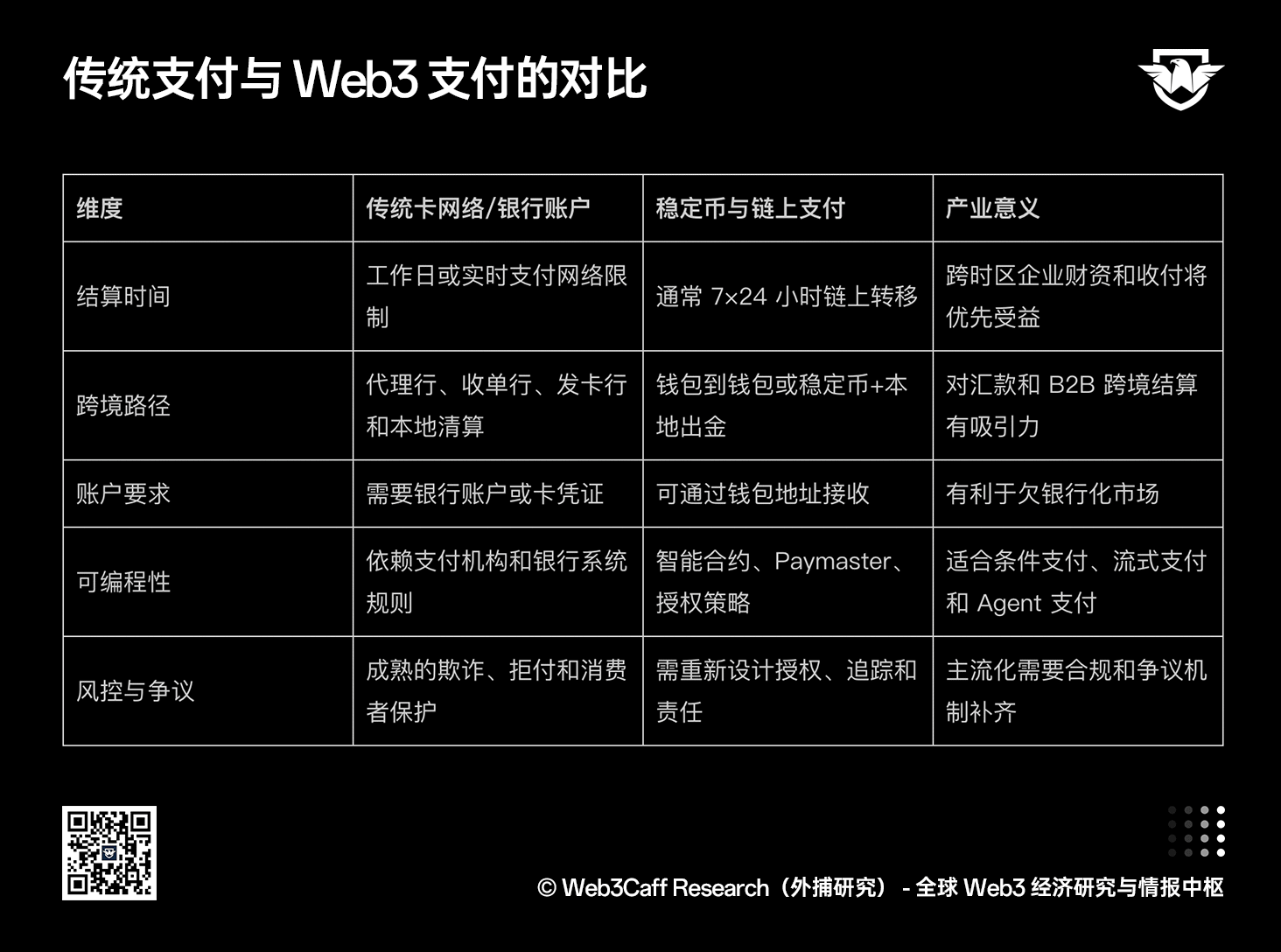
Comparison of Traditional Payments vs. Web3 Payments, Source: Compiled by Rosa, Researcher at Web3Caff Research
Merchant Payments Have Crossed the Usability Threshold
In 2025, stablecoin payments by merchants crossed a threshold that most retailers had not anticipated. According to Artemis Analytics data (as reported by Bloomberg), stablecoin on-chain settlement volume reached approximately $33 trillion in 2025, up about 72% year-over-year, surpassing the combined payment volume of Visa and Mastercard [4][5]. Even after excluding "noise" such as arbitrage and bot transfers, Chainalysis estimates "real economic activity volume" at approximately $28 trillion, already approaching or exceeding the processing scale of traditional card organizations, and believes that stablecoin payment flows could match Visa and Mastercard's off-chain transaction volumes at some point between 2031 and 2039 [4].
The reason stablecoins can approach card organizations in settlement volume lies in merchants' long-standing dissatisfaction with traditional card network costs. For every card transaction processed, merchants bear three layers of fees: the interchange fee paid to the issuing bank, the assessment fee paid to Visa or Mastercard, and the processor markup from the acquiring processor. Depending on card type, transaction method, and merchant category, these three combined typically consume 1.5% to 3.5% of each sale. Using a $100 purchase as an example, merchants pay an average of approximately $2.24 in card processing fees; for a merchant with $1 million in monthly volume, this means approximately $22,400 flowing to intermediaries each month. E-commerce merchants often face even higher costs because card-not-present transactions carry higher assessment fees and fraud risk premiums. Beyond percentage fees, card settlement cycles also tie up merchants' working capital for extended periods — as of early 2026, the average card settlement time is approximately 1.9 business days (nearly 3 calendar days when weekends are included). For a company with $10 million in monthly volume, a roughly 3-day settlement delay translates to approximately $25,000 in annual financing costs. There are also the hidden costs of chargebacks: regardless of the dispute outcome, each disputed transaction costs merchants $20 to $100 in fees, typically on top of already-shipped goods. [6]
When on-chain settlement volume can already rival card organizations, and the fees, in-transit capital occupation, and chargeback costs of traditional card networks are clearly quantifiable, adopting stablecoin payments for merchants is no longer a wait-and-see experiment but an economic choice with clear numbers — this is precisely the hallmark of having crossed the "usability threshold."
Chapter 2 Stablecoins: The Core Infrastructure of Web3 Payments
Compliance Notice: Stablecoins are virtual currencies (Tokens), and you should be aware that issuing or participating in Token investments is subject to regulations and restrictions of varying severity in different countries and regions. In particular, issuing Tokens in Mainland China may constitute "illegal issuance of securities," and providing cryptocurrency trading matching services or other crypto-related activities also constitutes "illegal financial activities" (Readers in Mainland China are strongly advised to read the Compilation and Key Summary of Laws and Regulations Related to Blockchain and Virtual Currencies in Mainland China). The following content is solely an objective analysis of the progress of stablecoin adoption and market feasibility strategies, and aims to explore and analyze how blockchain-based application scenarios are developing responsibly under the global regulatory environment. Therefore, please do not use this information for related decision-making, and strictly comply with the laws and regulations of your country or region, refraining from any illegal financial activities.
Explosive Market Growth During 2025-2026
The stablecoin market experienced explosive growth during 2025–2026. According to data from Artemis Terminal, the total stablecoin supply has grown approximately 2.6× over the five years since September 2021, with growth being non-linear. Notably, nearly $100 billion was added in 2025 alone, with total stablecoin market capitalization first touching an all-time high of $310 billion on December 12, 2025, and further breaking through $323 billion in May 2026. However, market growth leveled off during Q4 2025 and Q1 2026.
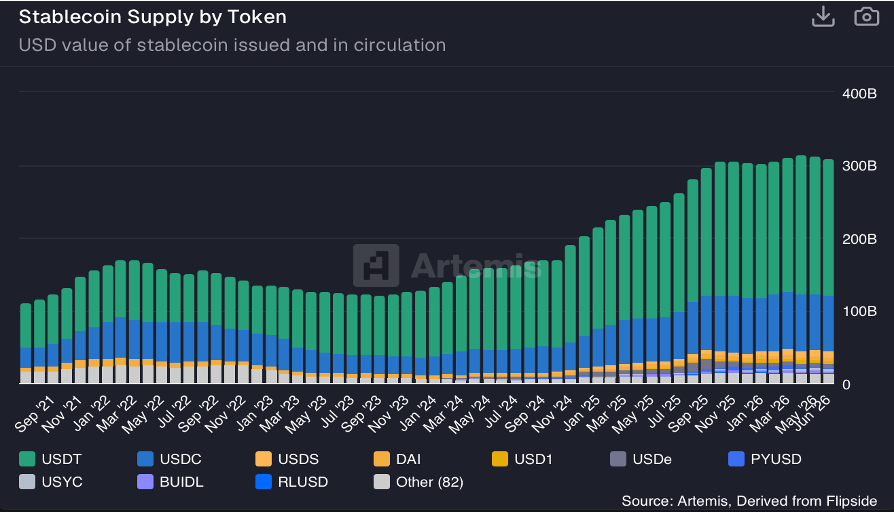 Stablecoin Market Circulating Supply Trend Chart, Source: Artemis Terminal
The market growth trajectory of 2025–2026 coincides with a series of significant events. On January 23, 2025, the White House issued the "Executive Order on Strengthening American Leadership in Digital Financial Technology"; on July 18, 2025, the "Guiding and Establishing National Innovation for U.S. Stablecoins Act" (GENIUS Act) was signed into law. [7] Driven by these two major policies, the United States officially established a federal regulatory framework for stablecoins.
The growth in the first half of 202