POAP Shuts Down: The End of an On-Chain Souvenir Experiment


- Core Thesis: POAP, a former pioneer of on-chain souvenir badges, has officially shut down after more than five years of operation. Its failure did not stem from speculative bubbles, but rather from the fact that the ceiling for market demand in the niche segment of digital memorabilia is too low to sustain a viable long-term business model — reflecting the widespread dilemma facing the utility-driven transformation of NFTs.
- Key Elements:
- POAP co-founder Isabel Gonzalez announced on August 3 that the project would officially shut down, following its transition to maintenance mode in March, when the creation of new badges was halted. On-chain data remains accessible.
- The project originated from the 2019 ETHDenver hackathon and rapidly rose to prominence during the 2021 NFT boom, becoming an iconic tool for community engagement and on-chain identity credentials. It attracted participation from brands such as Adidas and Porsche.
- In 2022, POAP secured a $10 million seed round led by Archetype. By mid-2023, the platform had over 37,000 issuers and had minted more than 6.7 million badges in total.
- The pivot to a profitable model failed: due to the cost burden of long-term free minting, the platform began charging commercial clients in April 2023, but this failed to reverse its decline, and no sustainable path to survival was found.
- Industry ripple effects: Around the same period, NFT projects from giants such as Starbucks, Meta, and Reddit were also shut down or scaled back. The common cause was treating NFTs as an end rather than a tool, and the inability to sustain operational costs after market hype subsided.
Original Author: Eric, Foresight News
On the evening of August 3, Beijing time, POAP co-founder Isabel Gonzalez announced that after more than five years of operation, POAP would officially be shutting down its services.
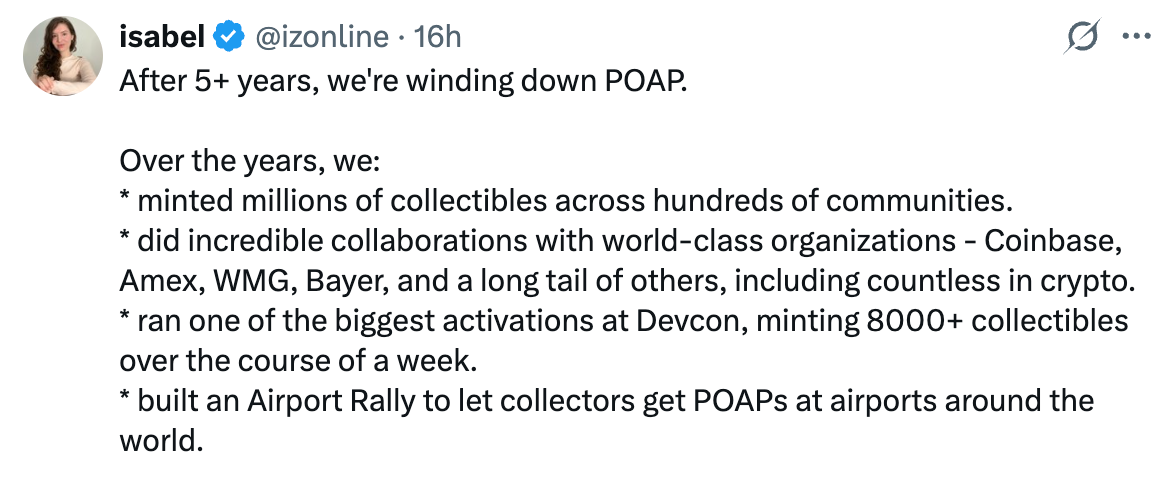
In fact, this farewell had already begun back in March of this year, when POAP announced that it would enter maintenance mode starting March 16. New issuers could no longer create new badges through the platform's interface, and existing features would only remain operational without active development. A few months later, maintenance mode turned into a complete shutdown. Already-minted POAP badges will remain on-chain, and users can still view them through wallets and block explorers, but the platform itself—which once carried countless on-chain memories—will officially close its doors.
POAP's story began at the ETHDenver hackathon in February 2019. At that time, founder Patricio Worthalter distributed the first batch of digital badges to attendees, who claimed an ERC-721 token via links distributed on-site as proof of their attendance on-chain. The idea became a "business" in 2021. That year, the NFT market heated up across the board, and POAP happened to ride the wave of community operations. Large and small offline conferences, online AMAs, and Discord community events all began issuing their own POAPs, and collecting badges became an identity game for crypto natives—a wallet's POAP list served as a verifiable on-chain resume.
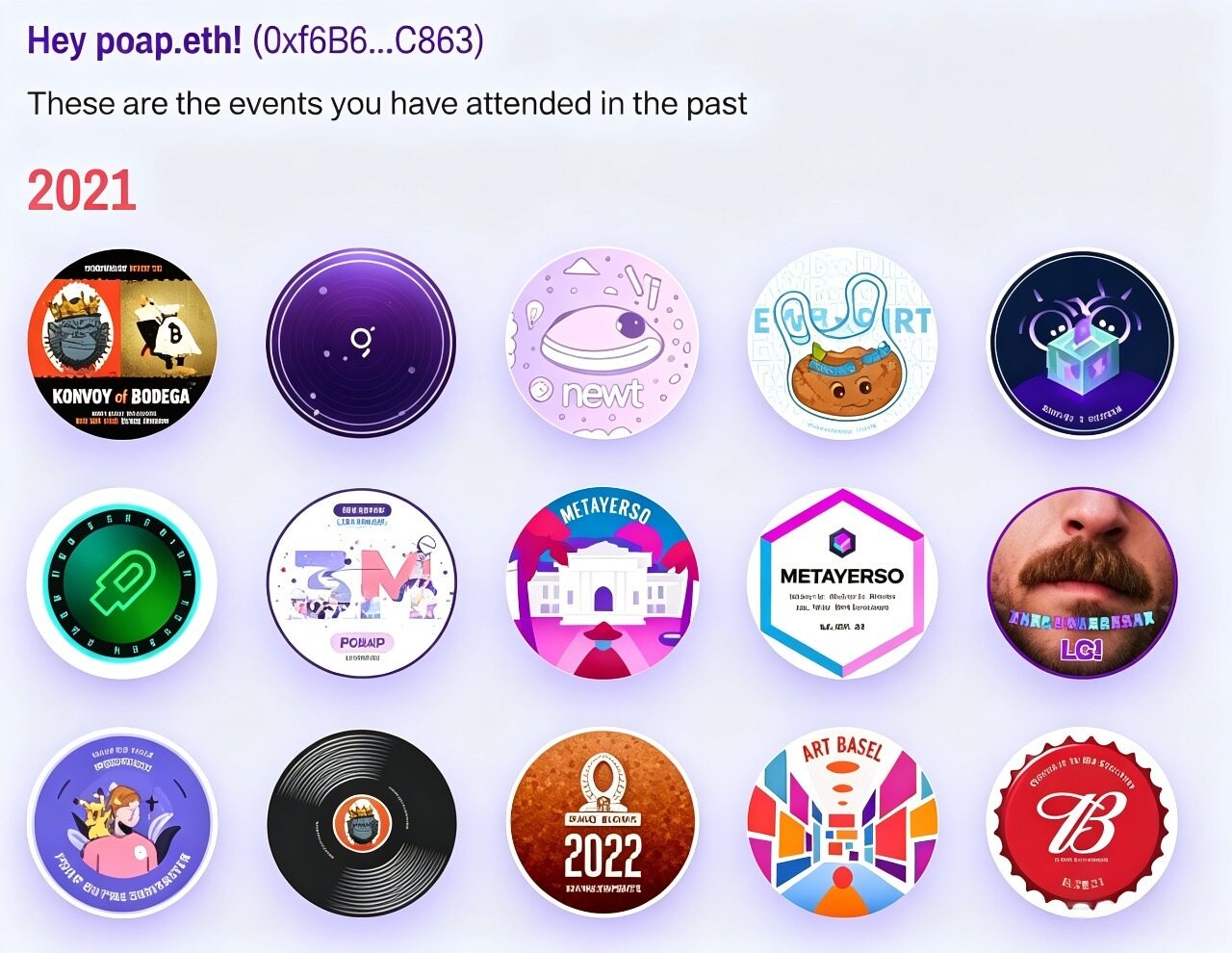
Around this resume, a wide range of use cases emerged within the industry. Some events made holding a specific POAP a prerequisite for entry—without the corresponding badge, attendees couldn't access the venue or private channels. Some projects included POAP holders of a specific event in their whitelists for airdrops, using this to filter out genuine participants rather than sybil farmers. In DAO governance, some attempted to use POAPs to measure community contributions, giving badge holders greater weight in voting. At its peak, even brands outside the crypto space joined in—Adidas, Porsche, Johnnie Walker, and TIME Magazine all used POAPs for event marketing.
In May 2021, BanklessDAO's BANK token airdrop used previously distributed POAP NFTs from Bankless as one of its primary criteria. In January 2022, the MEV-resistant DEX Cow Swap also included users who held CoW POAPs in its token airdrop list.
In 2022, POAP raised a $10 million seed round led by Archetype, with participation from Sapphire Sport, Collab+Currency, Protocol Labs, and others. By mid-2023, POAPs minted by over 37,000 issuers on the platform had surpassed 6.7 million.
Shortly after the funding round, starting in the second half of 2022, NFT trading volumes and floor prices continued to decline. Although POAPs, as commemorative credentials, didn't rely on speculation, they also lost the ground for community expansion. POAP had long offered free minting to all users—an advantage during its growth phase, but a burden in a period of stagnation. In April 2023, the platform announced it would begin charging commercial clients, with Isabel Gonzalez stating this was necessary for the platform's long-term sustainability.
But in the end, this monetization pivot failed to turn things around. In the March announcement, Gonzalez admitted that the platform had found a clear niche market but had never discovered a way to survive within it. Notably, just one month before POAP decided to enter maintenance mode, Espresso—which had raised nearly $60 million in total funding—included users who had obtained POAPs at various Espresso online and offline events in its airdrop target list.
At the time, the team said it was shifting toward building underlying standards for open collectibles, but the decision to shut down current services itself already signaled how low the ceiling of this niche market truly was.
POAP is not the only "NFT experiment" to collapse in the past two years. Starbucks shut down its Odyssey loyalty program in March 2024, less than a year and a half after launch. The project, which issued Journey Stamp NFTs on Polygon, remained in closed beta throughout its existence, and its first series priced at $100 per piece didn't even sell out. Participant complaints were blunt: they had to watch a 20-minute video and take a quiz just to collect badges, when all they really wanted was a cheaper cup of coffee.
Meta exited even earlier, ending support for NFT features on Instagram and Facebook in March 2023. Reddit's Collectible Avatars were once seen as the most successful NFT case among Big Tech, with over 33 million cumulative mints—but by 2024, monthly secondary market trading volume had fallen to around $100,000, and the project lead departed in early 2025. In September of that year, Reddit announced the termination of its creator program, the avatar shop closed in November, and the built-in Vault wallet was fully removed before New Year's Day 2026.
The problems plaguing these projects are strikingly similar. They were all launched when bull-market sentiment was at its peak, treating NFTs as an end rather than a tool, using the concept of on-chain credentials to package things that didn't actually require blockchain. Starbucks' loyalty program could have been fully implemented with traditional points, and Reddit's avatar collecting would lose nothing in user experience without NFTs. When market sentiment can no longer sustain operating costs, and when symbolic value cannot be converted into real cash flow, shutdown is simply a matter of time.
POAP's exit is particularly poignant because it was the least speculative project among this group. Its problem was never a bubble—it was the ceiling. Digital commemorative badges represent a real but narrow need, too small to sustain the future of a company that had raised tens of millions of dollars. The badges are still on-chain, but the people who issued them have already left the stage. This is perhaps the most common ending the crypto industry has seen in recent years.