






When Meta is about to sell its computing power, is the "horror story" of the AI bull market about to begin?


- Core Thesis: Meta's plan to sell its surplus AI computing power has sparked market concerns that tech giants' capital expenditure growth may have peaked and that AI infrastructure is transitioning from scarcity to oversupply. However, this essentially reflects an uneven utilization rate of computing power and a shift in industry value from "hoarding computing power" to "efficiently utilizing computing power."
- Key Elements:
- Meta, unable to immediately absorb its pre-built computing power with its proprietary models and products, is now turning to sell this computing power or offer cloud services externally to recover costs. The market reacted positively initially (stock up 8%), but this has put pressure on third-party cloud service providers like CoreWeave and hardware stocks.
- The logic underpinning the bull market – that of a “computing power shortage” – is showing cracks. Meta's surplus computing power is not a signal of industry-wide oversupply, but rather exposes a mismatch between long-cycle supply and short-cycle demand. Simply put, Meta has the computing power but lacks the capability to efficiently convert it into models and products.
- Global AI computing power demand over the next 3-5 years remains enormous (Google, Amazon, and Microsoft each plan dozens of GWs), making Meta's 5GW of computing power a drop in the bucket. The core issue is not a shortage of GPUs, but a shortage of top-tier models and products that can effectively utilize these GPUs.
- What the market truly fears is the "horror story": the return on AI investment remains uncertain, while the certainty of tech giants' capital expenditure is starting to waver. The capital market is beginning to reward companies that "control depreciation costs" and is shifting attention to who can more efficiently use computing power to achieve a closed revenue loop.
- The Meta incident marks a transition in the AI industry from a phase of indiscriminate hardware stacking to one where resources are concentrated among a few top players capable of closing the loop between "computing power, models, products, and revenue." The winner-takes-all elimination round has truly begun.
What is the biggest fear in the AI bull market?
It's not that a particular company's model temporarily falls behind, nor that a specific chip generation underperforms expectations. Rather, it's the market beginning to doubt whether the capital expenditures of tech giants—considered the most certain variable over the past two years—can continue to grow indefinitely.
On July 1, according to Bloomberg, Meta is preparing a new cloud computing business, planning to sell potential surplus AI computing power to external customers, while also considering offering a managed model service similar to AWS Bedrock.
Following the news, Meta's stock price briefly rose over 10% during trading, eventually closing up 8%. Meanwhile, CoreWeave and Nebius fell 13% and 17%, respectively. On the other side, during the Asian session, the sell-off spread to AI hardware. South Korea's KOSPI briefly dropped about 7%, with both Samsung Electronics and SK Hynix falling over 8%.
Overnight, Meta transformed from one of the most aggressive super-buyers in the computing market into a potential seller.
This sudden industry shake-up has also caused the first visible crack in a fundamental belief that has underpinned the entire AI bull market for the past two years: Does this mean AI infrastructure has shifted from scarcity to surplus, and that the two-year-long computing power arms race among giants is about to reach a turning point?
Or has Meta exposed another, harsher reality: Is the market truly short of GPUs, or is it short of the ability to convert GPUs into models, products, and revenue?
1. Everyone needs more computing power, but Meta has too much?
Over the past two years, the underlying logic of this AI bull run boils down to two words: 'scarcity.'
More precisely, it's a structural bull market driven by an explosion in demand, a shortage in supply, compounded by a frantic expansion of capital expenditure by tech giants.
For instance, the initial shortage was in high-end GPUs and advanced packaging capacity. Then the bottleneck spread outward—HBM, high-speed optical modules, and network equipment became undersupplied. Next, it extended to data center space, power capacity, gas turbines, electrical equipment, and high-density cooling. Today, the supply-demand tension has reached ordinary DRAM, NAND, enterprise SSDs, and even HDDs, once considered 'assets of a bygone era.'
In a sense, the hype across the entire AI supply chain over the past two years has been like an ever-lengthening list of out-of-stock items, displaying a clear 'barrel effect' and sector rotation. This means that as long as demand for model training and inference continues to grow, and new computing capacity, power, and data centers cannot be released promptly, every scarce link caught in the middle will have a chance to gain stronger pricing power. Upstream manufacturers can also raise prices, lock in long-term contracts, and have the incentive to keep expanding production.
For this reason, tracing further back, the true engine of this bull run isn't just NVIDIA, SK Hynix, or power equipment companies themselves. It is precisely the ever-growing AI demand expectations and capital expenditures of tech giants like Microsoft, Meta, Amazon, and Google:
How much the upstream giants are willing to spend determines how many GPUs, storage units, and network devices they will buy; how many data centers they will build; and how much third-party cloud computing and long-term power resources they will lock in. This, in turn, directly influences the upper limit of prosperity for the entire AI supply chain.
According to Bridgewater estimates, the combined investment by Alphabet, Amazon, Microsoft, and Meta in expanding AI infrastructure in 2026 is projected to be around $650 billion, nearly 60% higher than the roughly $410 billion in 2025. Furthermore, a May Reuters report, citing estimates from Goldman Sachs and Morgan Stanley, suggested that global AI-related capital expenditure—covering data centers, power, equipment, and software—could reach approximately $800 billion in 2026.
In a sense, this is a 'food delivery war' of the AI world, but on a much larger scale.
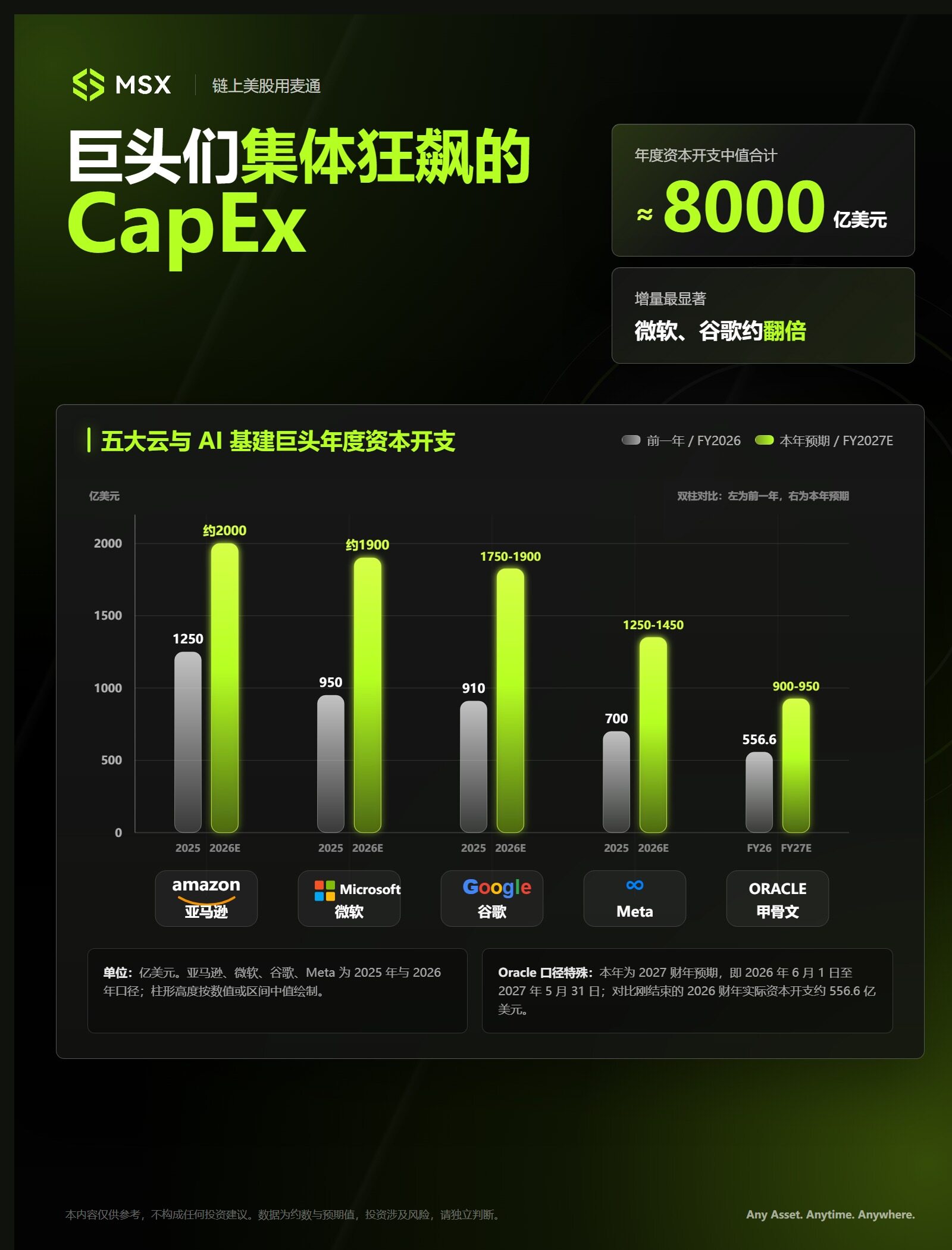
Among these, Meta hasn't pulled back; instead, it has stepped on the gas.
It has already raised its 2026 capital expenditure guidance from $115-135 billion to $125-145 billion. As of the end of the first quarter this year, Meta also had approximately $237.7 billion in non-cancellable contractual commitments (though these are performance obligations to be fulfilled over multiple future years), a significant portion related to servers, data centers, network infrastructure, and third-party cloud computing power.
Strictly speaking, Meta's current consideration of selling some computing capacity externally does not mean it suddenly judges the entire industry no longer needs more compute, let alone that it's preparing to exit the AI arms race. On the contrary, precisely because data center construction cycles often take years, Meta must prepare capacity in advance based on more aggressive demand scenarios. However, once the infrastructure is built, internal model, product, and traffic demand may not perfectly align in real-time, potentially creating a temporary supply-demand mismatch.
Put bluntly, Meta is building computing power on a massive scale for the next few years, but given that its self-developed models are currently lagging behind peers and its internal products haven't fully taken off, some of the capacity already in place may not be immediately fully utilized. Rather than letting these expensive GPUs sit idle and depreciate in data centers, it makes more sense to push them to the external market to improve utilization and recover some costs.
Theoretically, Meta is not the first AI company to sell its self-built computing power. In May, xAI partnered with Anthropic, opening its Colossus 1 supercomputing cluster—equipped with over 220,000 NVIDIA GPUs—for a monthly fee of $1.25 billion.
The economic logic behind this is not complex. Resources will eventually flow to the enterprises that can best utilize their value. When a company cannot fully leverage its computing power, the most rational choice, given another enterprise is willing to pay a sufficiently high price, is to rent it out for cash rather than letting the GPUs gather dust in the data center.
However, Meta's symbolic significance far exceeds xAI's.
Because Meta does not lack user access points. Facebook, Instagram, WhatsApp, Messenger, and Threads together form one of the world's largest consumer internet product matrices. Theoretically, it should be one of the easiest enterprises to embed AI models into existing products, creating a user flywheel and absorbing computing capacity.
But at least at this stage, Meta hasn't smoothly connected models, products, cloud services, and user access points as seamlessly as Google. This creates a somewhat paradoxical mirror image—while Meta is building its AI infrastructure on a large scale, it still needs to procure external models like Gemini and computing services. Just a few days ago, reports emerged that Meta's demand for the Gemini model and computing resources is so large that Google cannot fully satisfy it, impacting some internal AI projects.
At first glance, this seems contradictory. But ultimately, it's a mismatch between long-cycle supply and short-cycle demand. Mainly, Meta's current large model applications and real-time inference needs still rely on suppliers like Google because its self-developed models cannot fully replace external solutions for now.
Therefore, Meta simultaneously 'procuring external computing power' and 'selling some of its own computing power' is not contradictory. The real issue is whether the computing power it owns can be matched with truly competitive models and products at the right time and in the right form. In other words, Meta was overly optimistic about its own capabilities, built too much computing capacity, and now its models and products can't fully utilize it, forcing it to sell.
2. Is the real shortage computing power, or models and products that can effectively use it?
The market's reaction to Meta's plan to sell computing power was very telling.
Meta's stock briefly rose over 10% during trading, eventually closing up 8%. Meanwhile, CoreWeave and Nebius plummeted 13% and 17%, respectively. The next day during Asian trading hours, the sell-off spread to AI hardware, with South Korea's KOSPI briefly falling about 7%, and both Samsung Electronics and SK Hynix dropping over 8%.
'Cloud down, hardware down, software up' became the most intuitive market snapshot at that moment.
And this reaction, at first glance, seems perfectly logical:
- This is definitely a short-term positive for Meta: If self-developed models and internal products can't fully absorb all computing capacity, then renting out some resources or offering model hosting services similar to AWS Bedrock allows Meta to recover some costs from its infrastructure, which otherwise would purely generate depreciation. It's like adding a safety cushion to hundreds of billions in capital expenditure. Worst case, like Apple, it can leverage its user traffic base to partner with the best external models. It’s not the first time Zuckerberg has executed a 'strategic pivot';
- But for CoreWeave and Nebius, this is a bolt from the blue: Meta was a major customer. Just in April, CoreWeave added approximately $21 billion to its long-term computing agreement with Meta, extending the contract term to 2032. Nebius's total agreement with Meta was also up to $27 billion. In the blink of an eye, the super-spender who was sitting across the table signing contracts has moved chairs to the same side and is now competing with them for sub-landlord business. This is naturally bad news;
The panic in the hardware supply chain stems from a deeper, reasonable market assumption: If even a giant like Meta is starting to sell computing power externally, doesn't that mean computing power supply is about to exceed demand? Aren't the giants about to start cutting capital expenditure?
However, we must clarify a core fact: Meta's internal surplus computing capacity is far from indicating the entire tech industry's computing capacity has peaked; in fact, this is a major misconception.
If we broaden the view to a 3-5 year super-cycle, we see that the expansion plans of major hyperscale cloud providers are still advancing along a seemingly insane compounding curve. To visualize the endgame of this arms race more clearly, MSX MediaTech (MSX 麦通) provides a quantitative comparison of future computing capacity for global core players.
First, look at Meta itself. By the end of 2025, external institutions estimate Meta's AI computing power is roughly equivalent to 2-2.5 million H100 GPUs (~2GW). Based on its 2026 capital expenditure guidance, it will add 2-3 GW of capacity this year. So, by the end of 2026, Meta's total computing power base could be around 5GW.
5GW sounds significant, but placed against the appetite of the entire industry, it becomes insignificant. The market's true demand anchors are planning on a completely different scale:
- Google: In May, The Information reported a stunning story: Anthropic committed to spending $200 billion on TPU computing power from Google Cloud over the next 5 years. This portion alone corresponds to ~5GW of capacity. Conservatively assuming Anthropic represents 25% of Google Cloud's demand, Google Cloud alone could be aiming for 20GW by 2028, with Google overall potentially seeing 25GW;
- Amazon: Backed by the 5GW order from Anthropic and a 2GW order from OpenAI, coupled with internal plans to double its capacity from 6.5GW in 2025 by 2027, estimated overall demand is also in the 20GW range;
- Microsoft: With the $250 billion Azure contract tied to OpenAI, estimated using the same metric, it also corresponds to a demand exposure of roughly 20GW, not to mention OpenAI's independent deployment plans like Stargate, its 10GW plan with NVIDIA, and another 10GW plan with Broadcom (though far from being realized). These aren't fully accounted for in the cloud providers' compute pools yet;
Juxtaposing these data points leads to a conclusion that is clear, even harsh: even if Meta were to open all its 5GW capacity by the end of 2026 to the outside world, compared to the 10GW or 20GW+ new capacity plans being made for the next three years, it's a drop in the bucket.
Zuckerberg surely knows this. The locomotive for the entire industry's computing buildout has long been demand from mega-model companies like Google, Anthropic, and OpenAI. Whether Meta's model stays at the table doesn't fundamentally affect the train's direction.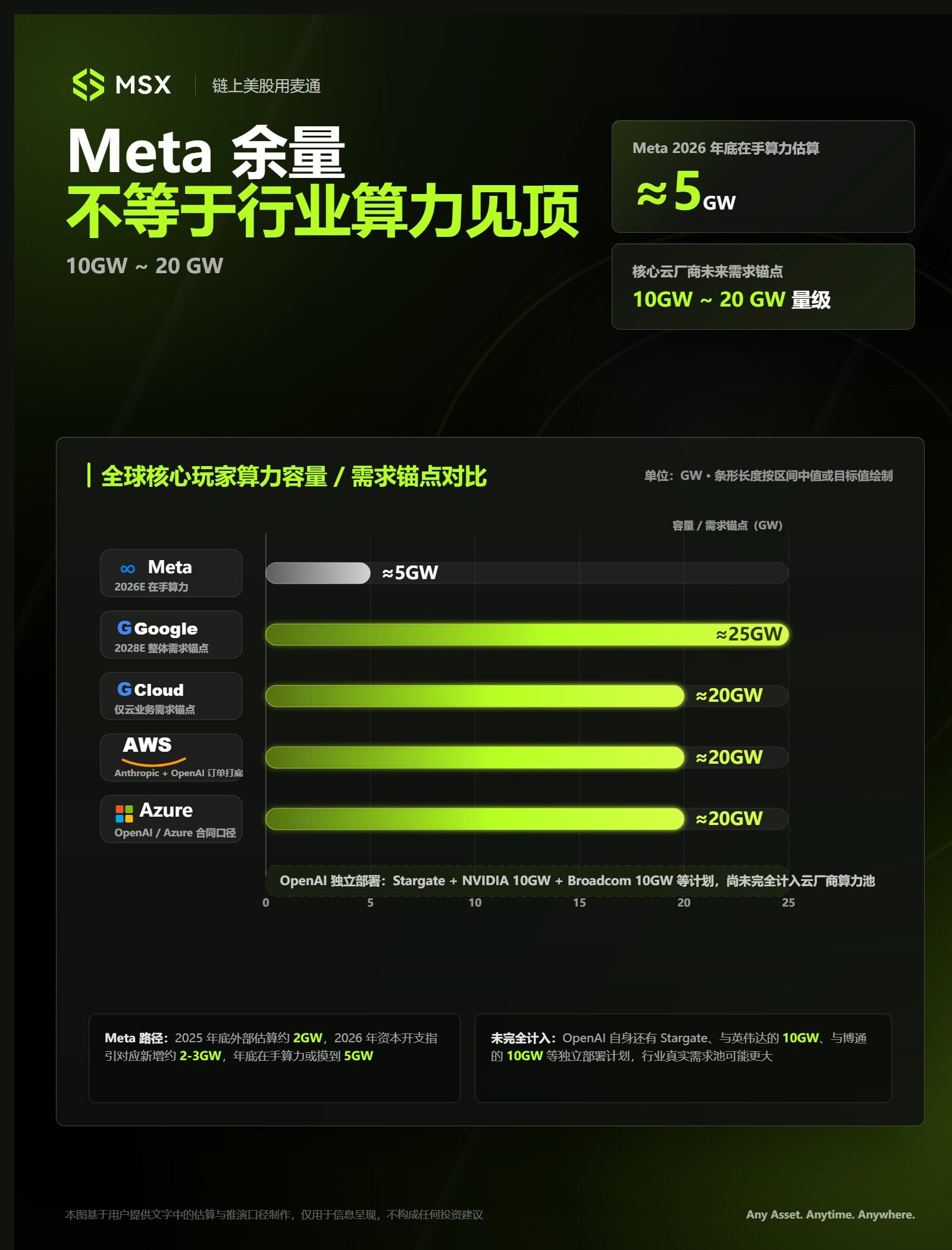
Since the industry doesn't lack demand, why does Meta have surplus computing power? This exposes a very harsh question: How can a company with billions of top-tier global traffic users fail to utilize its own 5GW capacity? Is the market truly short of computing power, or short of the models and products that can effectively use it?
From this perspective, we might even argue that Meta's renting out computing power is not necessarily a leading indicator of oversupply. Instead, it might vividly expose the extremely hungry supply-demand state of the current computing market:
Just look at the price xAI charges Anthropic for computing power: $1.25 billion/month for 500MW capacity. That translates to $300 billion/GW/year. This shows that if a player temporarily 'leaves the table' for any reason, the idle capacity they free up will be instantly devoured by leading players with stronger models and clearer monetization paths.
Therefore, MSX MediaTech believes it's too early to conclude whether Meta's move is the first alarm signaling loosening computing supply. The real thing to watch is whether this capacity will be snapped up immediately upon release, and whether the transaction price remains high enough. If that happens, it actually proves that AI computing power is still extremely scarce.
At this point, the deeper logic behind 'cloud down, hardware down, software up' begins to truly surface. The market isn't trading on 'oversupply of compute'; rather, it's trading on the restructuring and migration of computing value within the industry chain.
3. What is the real 'ghost story' the market should fear?
Here's something easily misread: Meta selling computing power absolutely does not mean Zuckerberg is giving up on the AI arms race.
On the contrary, the more Meta relies on external models like Google's and Anthropic's, the more its own product ecosystem and high advertising profit margins become vulnerable to external control. The power dynamics between AWS and Anthropic have already demonstrated this: once a model company truly masters users and core demand, even a cloud provider with massive infrastructure might be forced to cut into its own profits to retain talent and customers.
Zuckerberg can't be blind to this. Otherwise, he wouldn't be simultaneously restructuring his management team, aggressively launching the closed-source MuseSpark model to build a moat, and revising capital expenditure upwards to continue large-scale procurement this year.
So, if Meta hasn't conceded, why did the market experience such violent sector rotation? Because it unveils the prelude to a shift in the underlying pricing logic of the industry—and this is the real 'ghost story' the market should fear.
As mentioned earlier, the valuation logic for the entire AI bull market over the past two years was: AI's Return on Investment (ROI) is uncertain, but AI's Capital Expenditure (CapEx) is absolutely certain. As long as giants are frantically buying chips and building data centers, upstream players like NVIDIA, optical module makers, and the semiconductor supply chain could enjoy a deterministic premium.
'As long as AI giants increase CapEx, everything will be fine.'


