






Gate Institution Weekly: Warsh Appointed Fed Chair, Aave Lending Demand Continues to Migrate


- Key Takeaways: Last week, the crypto market remained cautious against a backdrop of macro events (US-Iran negotiations, Fed leadership change) and continued ETF net outflows. BTC and ETH experienced deep pullbacks before recovering. On-chain capital structures shifted, with TradFi trading focus rotating from commodities back to equities. Cross-chain security risks came to the fore, and the derivatives market showed a weak, low-leverage, low-volatility consolidation pattern.
- Key Factors:
- Macro Pressure and ETF Outflows: Recurring US-Iran negotiations, rising US Treasury yields to 4.56%, and the Fed leadership change dampened risk appetite. BTC and ETH ETFs saw weekly net outflows of $1.256 billion and $216 million respectively, indicating bearish market sentiment.
- On-chain Capital Migration: DEX trading concentrated towards leading protocols like Uniswap and PancakeSwap; Aave's lending demand migrated from Ethereum V3 to newer markets like Plasma and MegaETH.
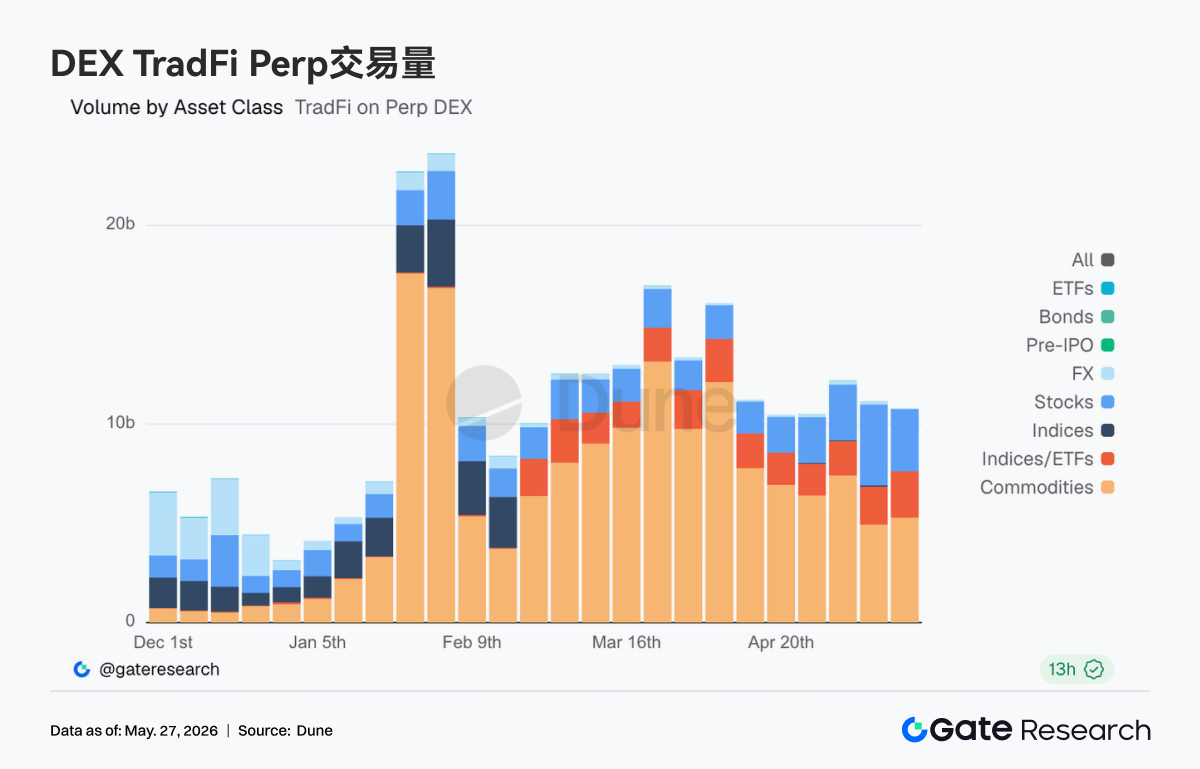
- TradFi DEX Divergence: Gold and crude oil trading remained dominant but saw reduced activity; trading volumes for equities and AI-related assets recovered, suggesting capital flowing back from macro hedging to risk assets.
- Cross-chain Security Losses: Cross-chain infrastructure has accumulated nearly $400 million in losses over the past month. Attack surfaces have expanded from bridge contracts to validation networks, TSS systems, and off-chain RPCs, prompting the market to reassess related risks.
- Weak Derivatives Structure: BTC funding rates briefly turned positive but price action remained weak; Open Interest (OI) oscillated at low levels; options implied volatility (DVOL) declined to around 36, while the skew recovered but remained negative, indicating no market panic but persistent demand for downside protection.
Abstract
• Last week, the market was driven by US-Iran diplomatic negotiations, a surge in US Treasury yields, and a change of Fed chair, leading to markedly increased volatility in global risk assets.
• Amid continued net outflows from ETFs, BTC and ETH experienced deep corrections before recovering, with overall market sentiment remaining cautious.
• On-chain capital continued migrating to execution layers like Arbitrum and Base, while the heat of capital flowing into prediction markets and macro trading directions cooled significantly.
• TradFi Perp DEX trading remained centered on gold and crude oil, but activity in stocks and AI-related assets began to pick up, indicating capital flowing back into risk assets.
• Cross-chain infrastructure has suffered cumulative losses of nearly $400 million over the past month. Attack surfaces have expanded from bridge contracts to validator networks, TSS, and off-chain RPCs, prompting the market to re-evaluate cross-chain security.
• The derivatives market exhibited a "low leverage, low volatility, weak price" structure. Although Skew has somewhat recovered, demand for downside protection has not completely dissipated.
• Institutional contract and spot market share remained stable. The market share of BTC/USDT and ETH/USDT increased by 5% month-over-month. CrossEx added spot trading from a major exchange by the end of May.
1. Market Focus Interpretation
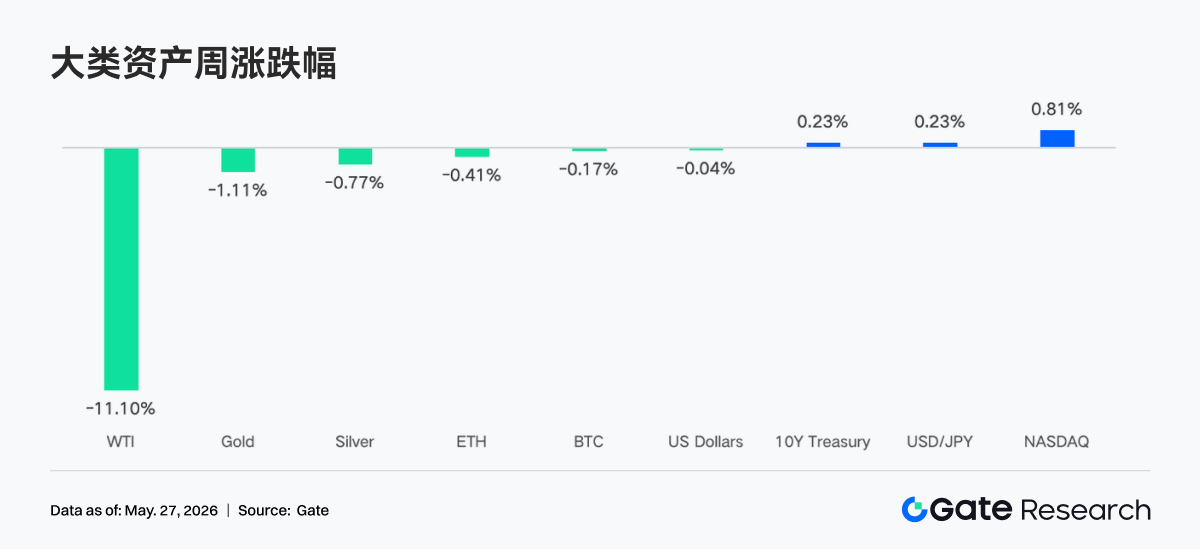
The main theme of last week's market was the US-Iran diplomatic negotiations. Trump claimed they had entered the "final stage," but Secretary of State Rubio stated on Friday that "no agreement has been reached," causing geopolitical tensions to repeatedly sway various asset classes. Suppressed by optimism over peace talks, WTI crude oil briefly fell to $98.88 per barrel. Fed Chair Powell's term ended, and Kevin Warsh was officially sworn in as the new Fed Chair on May 23. Although he hinted at an openness to rate cuts, short-term market expectations for cuts have cooled significantly. The yield on the 10-year US Treasury bond surged to around 4.56%. US stocks rose for the eighth consecutive week, but divergence was apparent. Nvidia reported Q1 revenue of $81.6 billion, an 85% year-over-year increase, significantly exceeding expectations, indicating continued strong demand for AI infrastructure. However, the stock price reaction was muted and failed to rally significantly. SpaceX officially filed for an IPO, aiming to raise $75 billion, with a potential valuation of up to $1.75 trillion.
The overall sentiment in the cryptocurrency market last week leaned towards pessimism and caution. Continued net outflows from Bitcoin and Ethereum ETFs reflect investor concerns over macroeconomic uncertainty, cryptocurrency price volatility, and the regulatory policy outlook. Notably, large-scale net outflows from Bitcoin ETFs for two consecutive weeks intensified market panic.
2. Liquidity Analysis
2.1 BTC and ETH ETFs Continue to Show Significant Capital Outflows
Last week, the BTC ETF market continued its trend of significant capital outflows. May 18 recorded a net outflow of $648.60 million, the largest single-day outflow of the week. Total net outflows for the week amounted to $1,256.30 million, expanding from the previous week's $995.50 million, indicating persistently pessimistic market sentiment as institutional investors continued reducing their Bitcoin exposure.
The Ethereum ETF market also faced capital pressure with sustained net outflows. May 18 recorded a net outflow of $86.40 million, the week's largest single-day outflow. Total weekly net outflows were $216.00 million. Compared to the previous week's $255.20 million net outflow, the pace of outflows slowed, but the overall state remained one of capital exodus, suggesting cautious sentiment towards Ethereum ETFs.
• Top BTC ETF Net Flow Product
○ MSBT (Morgan Stanley) Weekly Net Inflow: $1.10 million
• Top ETH ETF Net Flow Product
○ ETHB (BlackRock) Weekly Net Inflow: $5.50 million
○ ETHW (Bitwise) Weekly Net Inflow: $2.90 million
• Total AUM: As of May 22, AUM for BTC ETFs was $98.87 billion, and for Ethereum ETFs was $13.45 billion. The BTC ETF market experienced net outflows exceeding $1.2 billion, lowering total AUM, though it remained at relatively high levels.
• Institutional Movements: Institutional capital flows showed clear divergence this week. For Bitcoin ETFs, most products continued to face outflow pressure. BlackRock's IBIT saw net outflows exceeding $1 billion, indicating selling by large institutions. However, Morgan Stanley's MSBT bucked the trend with a small net inflow, suggesting some institutions might be making tactical allocations or hedging. For Ethereum ETFs, BlackRock's ETHB and Bitwise's ETHW recorded small net inflows, possibly related to market expectations for Ethereum's future or potential positive catalysts, but overall outflows dominated the market.
2.2 TradFi Liquidity
• TradFi Perp DEX: Over the past week, trading activity for TradFi assets on Perp DEXs remained high overall, but with clear structural divergence. Commodity assets continued to dominate, with trading related to crude oil and gold consistently contributing the majority of volume. However, as US-Iran negotiations showed signs of easing and oil prices fell, commodity trading volume cooled from earlier highs. Meanwhile, the share of stock and index trading increased, reflecting capital starting to flow back from macro and geopolitical trades towards US equities and AI-themed directions. ETF and forex trading remained relatively stable, indicating that on-chain TradFi trading demand is gradually shifting from a single-event-driven model to a more balanced multi-asset allocation structure.
• Gate TradFi Perp: Over the past week, trading volume on Gate TradFi Perp remained active overall but cooled significantly from its March peak. Structurally, precious metals continued to dominate, with gold-related trading consistently contributing the majority of volume. This reflects sustained safe-haven demand amid rapidly rising global bond yields and recurring geopolitical tensions. However, entering this week, single-day trading volume has notably declined from prior periodic peaks, suggesting that the high-frequency trading heat around gold, crude oil, and macro events is fading. Concurrently, the share of stock trading has increased, particularly in AI and tech assets, indicating some capital is starting to flow back from macro-safe-haven trades to risk assets. Index, forex, and commodity trading overall remained stable at low levels, showing that while gold remains the core theme for on-chain TradFi trading, the market structure is gradually shifting from "event-driven" to a more balanced multi-asset allocation.
• TradFi Order Book Depth: We selected XAUT, the TradFi asset with the highest trading volume, to analyze its order book depth (Delta). Last week, XAUT's order book liquidity structure underwent a "bearish-to-bullish" transition. In the early days of May 13, extreme negative Delta appeared, nearing -$2.2 million, indicating a clear bearish bias in market liquidity. This coincided with XAUT rapidly falling from around $4.70K to near $4.60K, suggesting strong sell pressure and order book withdrawals early on. From May 15 to 17, Delta turned significantly positive, consistently staying in the +$500K to +$1.3 million range. This indicates that buy orders began to accumulate, and clear bid support formed on the order book. However, prices did not rebound strongly concurrently, suggesting this was more "absorptive liquidity" rather than aggressive chasing of upward momentum. Notably, a clear recovery occurred on the 24th-25th, where green Delta bars expanded rapidly again, and prices rebounded back above $4.55K. However, the volume of active buy orders was insufficient to push XAUT into a strong upward trend.
3. On-Chain Data Insights
3.1 DEX Trading Remains Highly Resilient, Volumes Concentrate Towards Mainstream Liquidity Centers
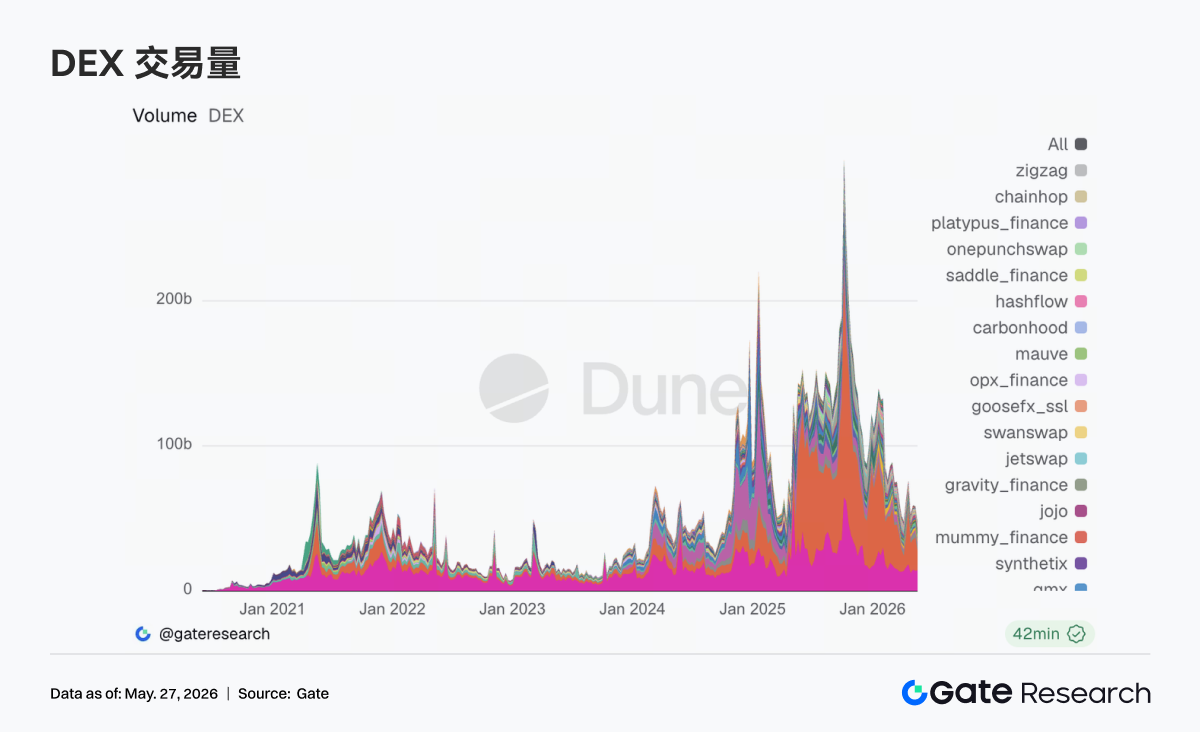
On-chain trading demonstrated strong resilience this week against the backdrop of cooling overall risk assets. After May 18, Bitcoin briefly fell to two-week lows, but DEX volumes did not collapse concurrently. Instead, capital further concentrated towards mainstream protocols with deeper liquidity and more stable execution efficiency. Uniswap and PancakeSwap continued to hold core market share, and Aerodrome on the Base ecosystem saw further increased activity. On-chain trading demand did not retreat; rather, it showed a preference for mature routing and low-slippage platforms in a volatile environment. On the Solana side, Raydium and Meteora remained at high levels, but marginal growth slowed significantly compared to previous weeks, and the heat around Meme and high-volatility liquidity pools began to cool. On the regulatory front, following the Senate Banking Committee's advancement of crypto market-related legislation in mid-May, the market's valuation of compliant trading infrastructure increased, further concentrating on-chain liquidity towards top-tier protocols.
3.2 Stablecoin Market Enters Structural Repricing Phase, Settlement Capability and Institutional Suitability Become Core Variables
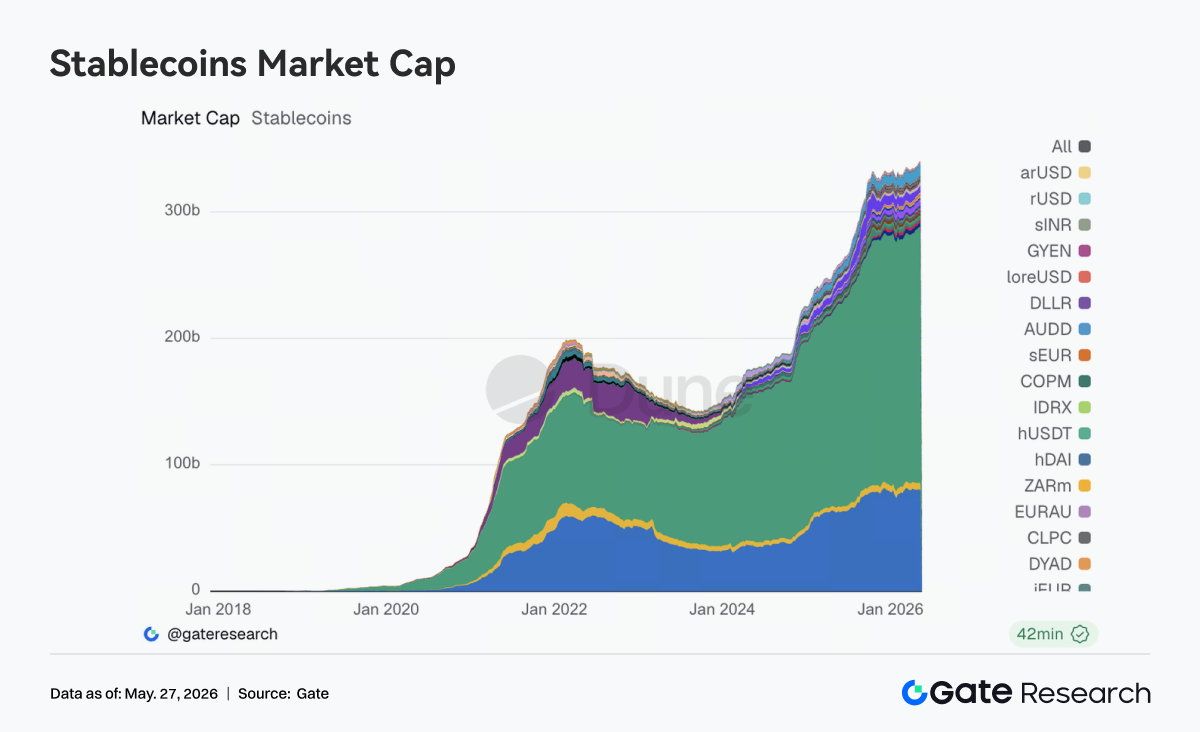
The stablecoin sector did not see rapid aggregate-level expansion this week, but internal structural adjustments continued to deepen. USDT and USDC firmly retained their dominant positions. However, the focus of new capital inflows has gradually shifted from pure scale growth towards payment, clearing, cross-chain distribution, and institutional suitability capabilities. Assets like USDS, USDe, and PYUSD still showed some absorption capacity, but the market's distinction between "yield-bearing stablecoins" and "universal USD settlement assets" became more pronounced. Circle continued to strengthen USDC's positioning in cross-chain settlement, high-frequency trading, and institutional distribution scenarios this week, with the market refocusing on stablecoin assets capable of directly interfacing with mainstream financial systems. Concurrently, regulatory discussions on stablecoin yield mechanisms and regulatory boundaries progressed, meaning the valuation logic for the stablecoin market is gradually shifting from scale-first to compliance standardization capability-first. Overall, sentiment in the stablecoin sector was stable this week, but the directional trend was relatively clear.
3.3 ETH LST Assets Under Pressure, SOL Ecosystem Assets Relatively Stable
The liquid staking sector entered a more pronounced phase of structural divergence. Core ETH ecosystem assets like Lido experienced some drawdowns, as some large-capital positions adjusted their holdings and duration allocations after the previous recovery. In contrast, SOL-side assets showed greater resilience, with Sanctum, Jito, and Jupiter Staked SOL overall maintaining stability without significant outflow pressure. The core variable affecting LST risk appetite this week remained cross-chain security and asset standardization. In mid-May, Lido provided further explanations for choosing Chainlink CCIP for wstETH's cross-chain expansion, re-strengthening the market's focus on bridging security and standardized asset frameworks. Following the events involving Kelp and cross-chain bridges, the market has started to differentiate the risk levels between native standardized LSTs and bridge-wrapped secondary assets.
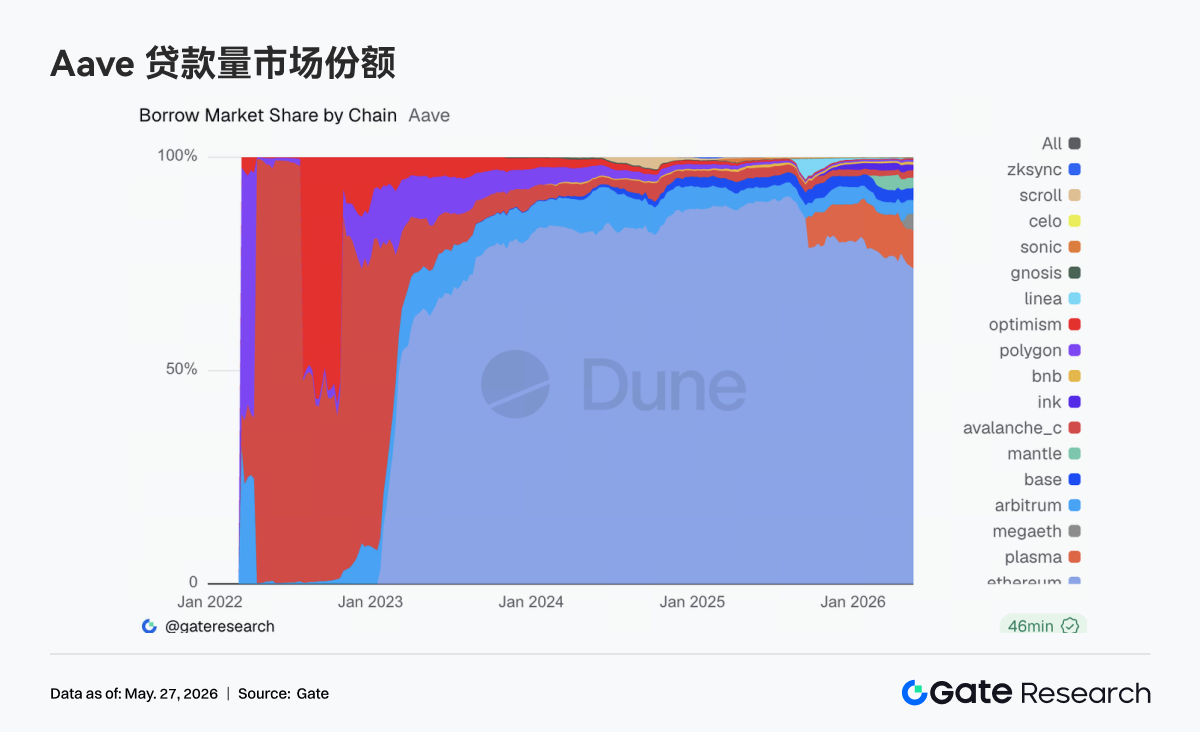
3.4 Aave Lending Demand Continues to Migrate, New Market Absorption Capacity Improves
Aave's main change this week centered on the structural adjustment of lending demand. Total borrow volume across the platform declined compared to the previous week. Ethereum V3 maintained its core position, but its marginal pull effect weakened compared to earlier stages. Meanwhile, the lending absorption capacity of Plasma and MegaETH continued to strengthen. MegaETH, in particular, stood out, with capital residence time and activity notably increasing, gradually transitioning from narrative-driven to genuine liquidity absorption. On the governance front, Aave advanced a signer rotation for the Emergency Guardian on May 20, further elevating the priority of emergency response and cross-chain risk control. Previous governance actions related to unfreezing WETH and restoring LTV also indicated the protocol is gradually transitioning from the risk management phase following the rsETH/Kelp chain of events towards a normalization and rebuilding phase. Judging from the current structure, capital is flowing back into the Aave ecosystem, but it is more biased towards on-chain scenarios with new incentives and growth potential in new markets.
3.5 Aave Rate Structure Normalizes, USD Liquidity Premium Remains Evident
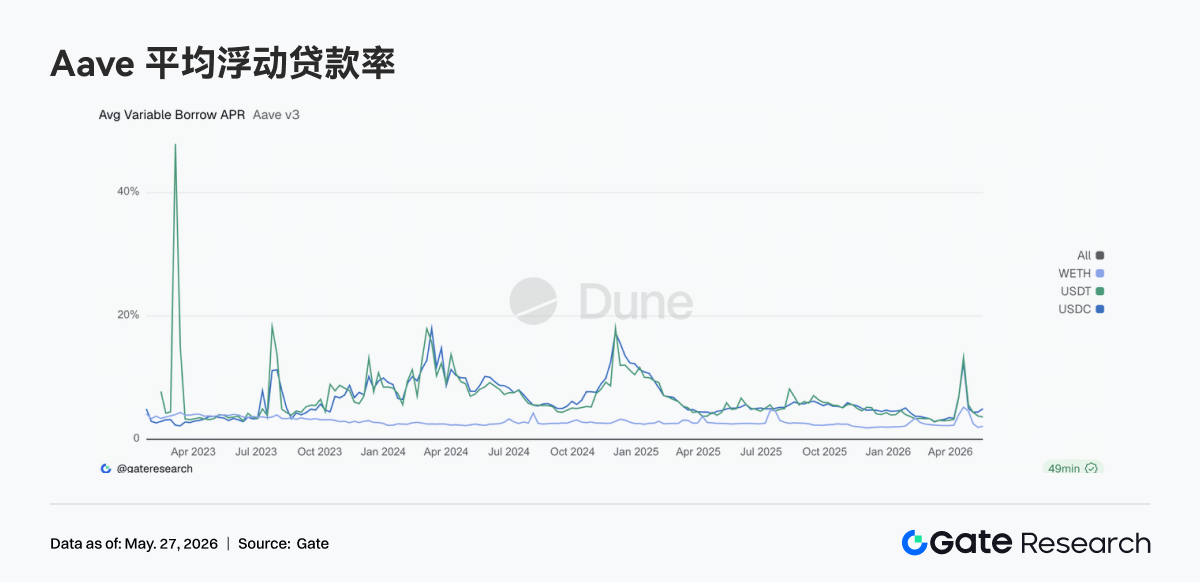
Aave's stablecoin borrowing costs have clearly retreated from the high-pressure state seen during the late-April incident. USDT and USDC funding rates have fallen back to normal operational ranges, while WETH borrowing costs have further declined. The core change in the market currently is the return of capital usage to a normal structure. Stablecoin funding demand is primarily focused on arbitrage, neutral strategies, and liquidity turnover, while no new unilateral borrowing rush has appeared on the WETH side. However, the USDC utilization rate remains relatively high, indicating that USD liquidity remains the most premium capital class in the market. Nevertheless, the overall funding environment has significantly eased the tense sentiment observed during the previous risk events. Combined with this week's governance actions further strengthening the emergency mechanism and Guardian framework, the current changes in Aave's interest rates represent a normalization repricing process following risk release.
3.6 Protocol Revenue Reverts to a Structure Dominated by Stablecoins and Infrastructure
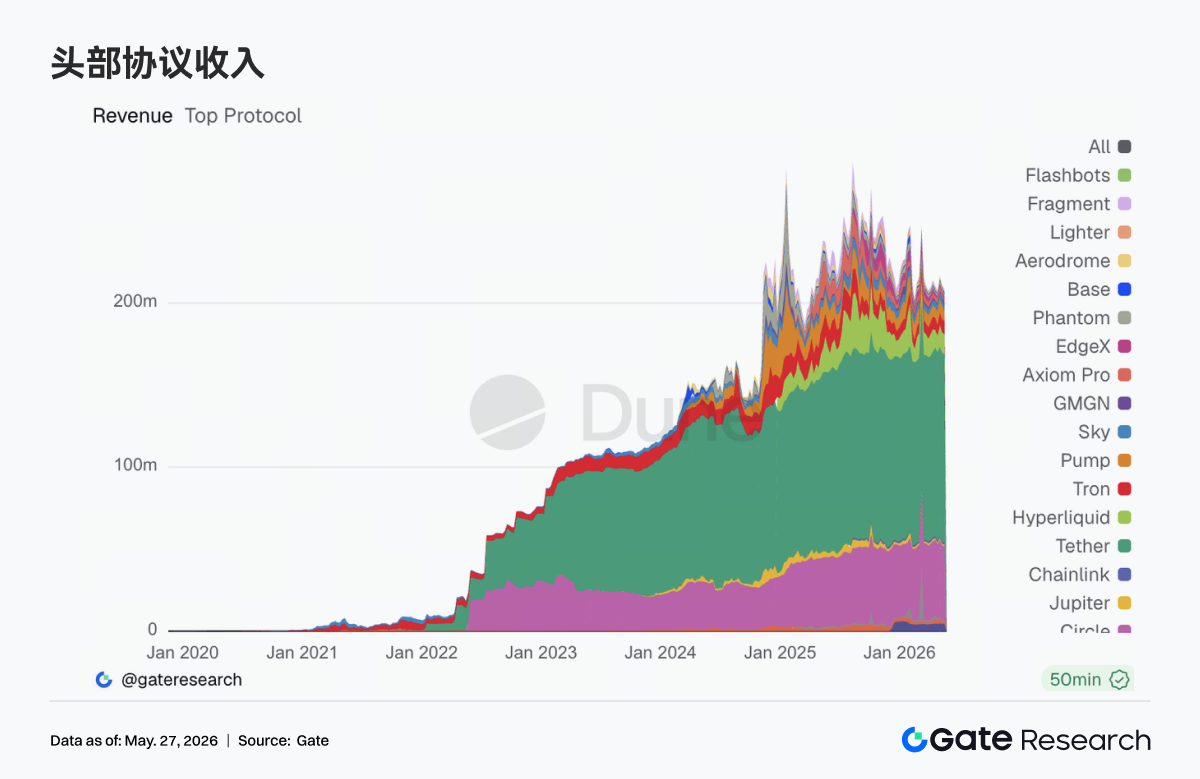
The protocol revenue structure became notably more stable compared to previous weeks. Tether and Circle maintained the most stable revenue performance, with stablecoin issuance remaining the core sector with the highest quality on-chain cash flow. Among trading protocols, Hyperliquid's revenue continued to hold at high levels, but growth momentum has clearly slowed. Revenues from protocols driven by trading front-ends and high-frequency traffic, such as Pump, Phantom, and Axiom, also began to cool. In contrast, underlying matching and infrastructure layers like edgeX and Titan Builder showed stronger resilience. Recently, Hyperliquid has continued to push expansion directions like validators, RWA perpetuals, and event markets, while Circle simultaneously strengthened USDC support for Hyperliquid. The long-term demand for efficient on-chain trading systems has not diminished. However, this week's revenue structure shows that the expansion of user activity is no longer overflowing infinitely; capital is beginning to refocus on underlying settlement, matching, and clearing layers capable of generating sustained cash flow. Overall, the logic for protocol revenue is gradually reverting to being driven by cash flow quality.
4. Derivatives Tracking
4.1 BTC Funding Rate Remains Positive but Price Weak, Leveraged Longs Under Pressure
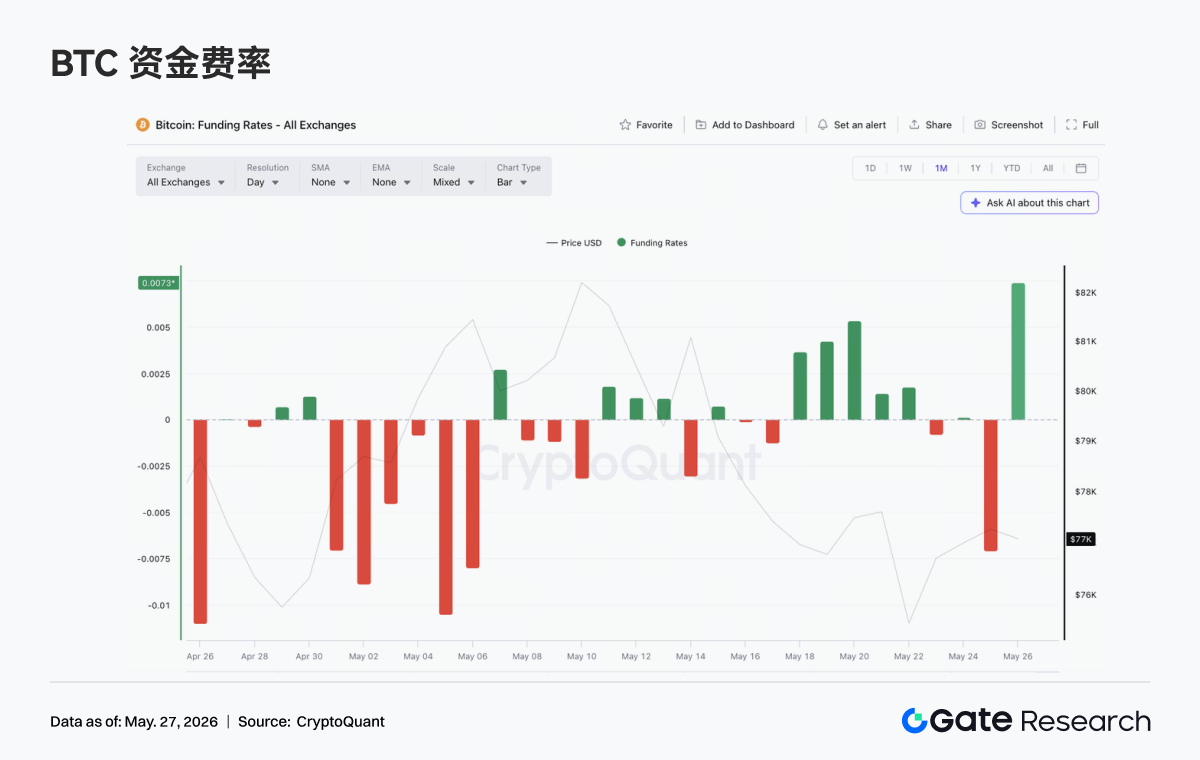
From May 18 to May 24, 2026, BTC prices overall maintained a weak, volatile range. Trading around the 77K level at the start of the week, it saw periodic bounces but failed to effectively reclaim the 78K-79K range. Prices briefly dipped sharply around May 22 and remained at relatively low levels over the weekend. In a slight divergence from price action, the funding rate remained positive multiple times between May 18 and May 22, especially from May 18 to May 20, where the positive rate rose consecutively. This indicates that despite the weak price environment, some long positions maintained leveraged exposure.
This combination of "weak price + positive funding rate" reflects the market's expectation for bottom-fishing or a rebound trade early in the week. However, as BTC failed to recover upwards, long positions in a positive funding rate environment faced sustained carrying costs, leading to a gradual decline in the funding rate, suggesting long sentiment began to cool.
Regarding OI, it oscillated within the 25B-26B range this week, significantly lower than the previous high near 29B. When prices briefly dipped rapidly on May 22, OI temporarily rose to around 26B, indicating new directional positions entering during the decline. However, OI subsequently retreated again, showing leverage capital did not form a sustained increase in positions. Overall, the derivatives market was in a low-leverage consolidation state this week, with the price decline reflecting reduced risk appetite rather than large-scale leveraged cascading.
4.2 Option Volumes Declined Then Rose; Rising Daily Option Share Indicates Increased Short-term Trading Demand
BTC option volumes overall followed a decline-then-rise, then fall again rhythm. Volume on May 18 was at a weekly high near 29K. It then fell to the 16K-19K range between May 19-20, indicating a temporary cooling of trading heat after absorbing the initial macro and price moves. Entering May 21-22, volumes re-expanded, with May 22 rising


