Preferred Stock "Domino Effect": Strive Reports $7.08 Million Loss, Strategy Risk Spreads Like a Chain Reaction


- Core Thesis: Preferred stocks issued by Bitcoin-reserve companies have shifted from income-generating assets to credit risk barometers. Their cross-holding model directly transmits the discount risk of a single company to the balance sheets of others, revealing the core transmission mechanism of systemic risk within the industry.
- Key Elements:
- Strive holds 505,000 shares of STRC preferred stock, incurring a $7.08 million unrealized loss in fair value over eight days, a direct exposure to cross-holding risks.
- Strategy launched its Digital Credit Capital Framework, establishing a $2.55 billion USD reserve and mandating coverage for the next 12 months of dividends, raising the annualized dividend rate on STRC to 12%.
- Strategy authorized up to $1 billion in buybacks for its own digital credit securities and another $1 billion for its common stock, and received approval to raise up to $1.25 billion by selling Bitcoin to replenish its reserves.
- Third-party firm Farside calculates STRC's net present value per share at only $49.887, with valuation highly dependent on dividend sustainability and the issuer's creditworthiness.
- As of June 28, Strategy held 847,363 Bitcoins at an average cost of $75,651. The current market price being below cost has intensified market focus on its reserve policy and liquidation plans.
- Subsequent market judgment will focus on STRC's discount magnitude, cash coverage for dividends, the intensity of new issuance, and whether the authorized Bitcoin sale is executed as a concrete action.
Original Author: Liam 'Akiba' Wright
Original Translation: Saoirse, Foresight News
Preferred shares issued by Bitcoin reserve companies have long ceased to be mere income-generating assets. They have become a credit benchmark for testing the health of Bitcoin corporate balance sheets. Although market focus remains on Strategy, data disclosed by Strive, the world's seventh-largest publicly-listed Bitcoin holder, provides a clear view of the real impact of risk spillover: fluctuations in the value of its holdings of Strategy preferred shares have become a definitive signal of market stress.
In an updated filing released on June 29, Strive disclosed that while its holdings of 505,000 STRC shares remained unchanged between June 18 and June 26, the fair value of this position dropped from $44.738 million to $37.658 million.
In just eight days, with no adjustment to the number of shares, the position's value evaporated by $7.08 million. Based on a simple calculation from the reported fair value, the market's valuation of Strive's STRC holdings fell from approximately $88.59 per share to $74.57 per share.
This filing does not prove that the company is insolvent, forced to sell assets, or has a completely failed capital structure. However, it reveals a more critical fact: even without a major crisis erupting, the risk associated with Bitcoin reserve preferred shares can flow through cross-shareholdings between companies, impacting the balance sheets of other firms.
As of June 26, Strive still held 19,864 Bitcoin and $141.7 million in cash and cash equivalents, with 7,829,502 of its own SATA preferred shares outstanding. However, the core signal from this financial report is not about its own asset size. It is that its exposure to Strategy preferred shares has fundamentally changed how investors evaluate the entire sector.
There has been ongoing controversy surrounding Strategy's STRC issuance: would investors treat it as a stable income instrument, or view it as a high-risk credit asset tied to Bitcoin's price, market liquidity, and Strategy's ability to pay dividends? Strive's disclosure has made this question more acute.
Cross-shareholdings of each other's preferred shares by different Bitcoin reserve companies create a clearly traceable channel for cross-company risk contagion. Once STRC trades at a discount, Strive's financial statements will reflect the asset loss in fair value. If SATA preferred shares issued by Strive also face market skepticism, the market can then gauge whether the current stress is an isolated issue or has spread across the industry through the preferred share financing model.
These reserve preferred shares were initially marketed for their stable yields, fixed par value, and regular dividends, making them highly attractive to investors seeking steady returns. However, when market focus shifts to discount rates relative to par value, cash reserve coverage, dividend adjustment mechanisms, share buybacks, and potential asset sales, the trading nature of these securities shifts entirely towards credit-risky assets.
Investors' core question now is: Does the issuer have sufficient cash, access to funding channels, and enough Bitcoin liquidity to ensure credible dividend payments?
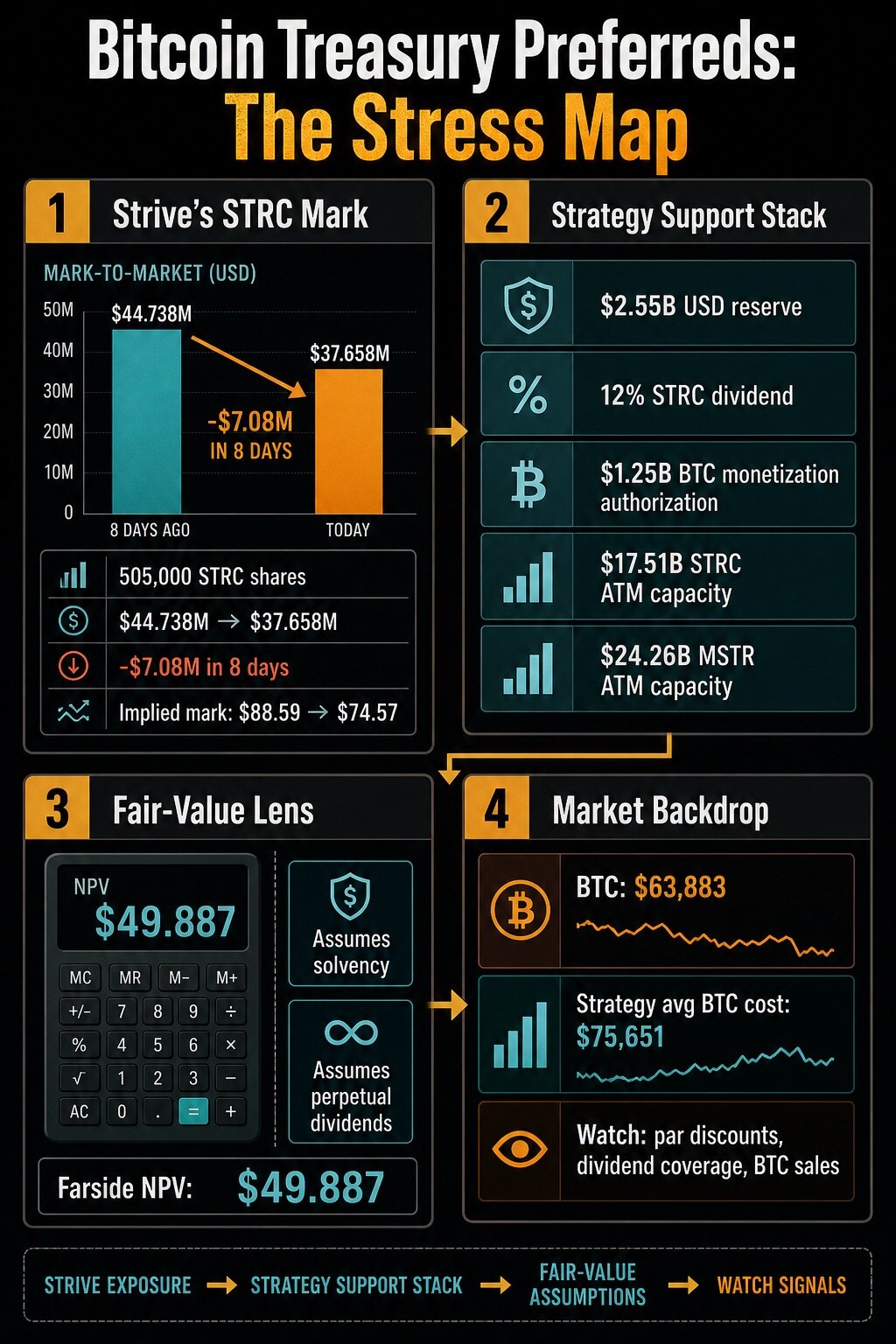
Strive's unrealized loss of $7.08 million on its STRC preferred shares over 8 days exposes the cross-shareholding risk in the industry. It also lists Strategy's full toolkit of cash reserves, high dividends, coin sales, and share issuances to stabilize the situation. Combined with a third-party calculated fair value estimate of STRC at only $49.887 and Bitcoin's market price being significantly below the company's average cost basis, this highlights the need to monitor preferred share discounts, dividend coverage ability, and Bitcoin sales actions to judge the direction of industry risk.
Strategy's New Plan: Essentially Credit Risk Management
A regulatory filing submitted by Strategy on June 29 further confirms this shift in logic. The company introduced a Digital Credit Capital Framework, accompanied by policies including dollar reserve management rules, a revised STRC dividend plan, preferred share buyback programs, common stock buyback programs, and a Bitcoin monetization plan. This set of tools is specifically designed to manage a stressed capital structure.
Strategy disclosed that its dollar reserve stood at $25.5 billion as of June 28. The board has a hard requirement that management must retain cash reserves sufficient to cover at least the next 12 months of preferred share annual dividends and interest payments, unless the board specifically approves lowering this standard. The filing also notes that reserves can be supplemented by selling tokens through the Bitcoin monetization plan or through other capital market operations.
This reserve is crucial because Strategy increased the regular annualized dividend rate on STRC to 12%, paid semi-monthly, effective for record dates on or after July 1. The company announced a cash dividend of $0.50 per share for the settlement periods ending July 31 and August 15, subject to the terms of the STRC issuance agreement.
While increasing the dividend can provide short-term support for this income product, it raises new questions about whether this high dividend can be sustained if the securities continue trading at a discount.
Strategy clearly outlined the logic linking its policies: the STRC dividend plan will comprehensively reference STRC secondary market prices, overall market yields, credit spreads, Bitcoin price and volatility, reserve coverage, capital market conditions, and the company's overall capital structure. The filing also emphasizes that STRC dividends are not guaranteed payouts and will not be unilaterally increased simply because the STRC market price is below par value.
The entire policy framework is clearly active credit management. The company also authorized up to $1 billion for repurchasing its own digital credit securities. If management determines buybacks can enhance enterprise value and optimize the capital structure, STRC will be a priority target for buybacks. An additional $1 billion was authorized for repurchasing Class A common stock. These buyback authorizations do not obligate the company to execute them, but they clearly demonstrate the full range of tools available to management if the discount risk worsens.
Within the same capital framework, Bitcoin sales were also included as a formal response measure. The board approved a Bitcoin monetization plan to raise up to an additional $1.25 billion in dollar reserves by selling Bitcoin. If management determines this is preferable to issuing more common equity or other capital market operations, proceeds from coin sales can be used to fund preferred share dividends and interest payments, as well as share buybacks.
The company explicitly stated that this plan does not mandate Bitcoin sales, but this authorization fundamentally changes the narrative: a company originally focused on accumulating Bitcoin as its core business now has a formal channel to use its Bitcoin assets to stabilize its credit system.
Fair Value Assessment, Key Test is Dividend Sustainability
Farside, a third-party entity, has made public a fair value calculator for STRC, which explains why the market's focus has long moved past nominal yields. CryptoSlate queried this tool on July 7. Under default calculation parameters, the net present value per share of STRC was only $49.887. The calculation model assumes a coupon rate of 11.50% initially, dropping to 3.60% starting from month 33.
This calculation relies on a key assumption: the company continues operations normally and pays dividends in full perpetually. This valuation is not an official price set by Strategy, nor should it be confused with Strategy's announced 12% annualized STRC dividend policy. However, it clearly reflects the core variables that preferred stock investors truly focus on: valuation is highly dependent on dividend sustainability, discount rates, and the issuer's ability to continue paying interest amid Bitcoin's price fluctuations and capital market volatility.
The broader Bitcoin market environment further amplifies this credit test. CryptoSlate Bitcoin price data shows Bitcoin trading around $62,000 on July 8, down 1.8% in 24 hours, up 5.5% over 7 days, with a total market cap of $1.24 trillion, representing 58% of the total crypto market.
However, Strategy's Bitcoin holdings data from June 28 shows the company holds 847,363 Bitcoin with an average cost basis of $75,651. While the current market price being significantly below the average cost basis doesn't force an immediate sale, it explains why the market is intensely focused on reserve policies, at-the-market (ATM) issuance mechanisms, and terms related to Bitcoin monetization.
Strategy's ATM data clearly shows this business model still has ample room for financing. Between June 22 and 28, the company did not issue any preferred shares through the ATM channel, sold only 12,669,017 shares of MSTR common stock, netting $1.1524 billion. Remaining issuance capacity stands at $17.5108 billion for STRC preferred shares and $24.2575 billion for MSTR common stock, alongside other preferred share issuance plans.
The entire business model still possesses multiple buffer tools, but the key question is: what cost will be incurred to utilize these tools when investors demand higher yields, securities are trading at significant discounts, or stronger collateral backing is required?
Two Scenarios for Determining if Risk is Widespread
Current market expectations for the future trajectory fall into two core judgment logics:
Scenario 1: Risk Contained, Affecting Only Strategy
STRC discount narrows, dollar reserves and dividend policy stabilize market sentiment, the Bitcoin monetization plan remains a backup, Strive's asset impairment is merely a one-off short-term impact from cross-shareholdings, other reserve companies in the sector are unaffected, and pressure is concentrated solely on Strategy.
Scenario 2: Risk Broadly Contagious
STRC maintains a deep discount long-term, the dividend increase fails to calm the market; the company becomes increasingly reliant on the common stock ATM channel, the Bitcoin monetization plan moves from authorization to actual sales; simultaneously, Strive's own SATA preferred shares come under synchronous pressure, no longer viewed as an independent product but grouped with STRC as a high-risk asset by the market. At this point, Bitcoin reserve preferred shares would evolve from a single company problem into a systemic risk for the entire sector.
Existing filings do not prove that the second scenario has occurred, but they sufficiently explain the root of market concern: Strive's STRC position directly translates Strategy's discount risk into a fair value loss on another company's financial statements.
The framework introduced by Strategy integrates dividends, cash reserves, share buybacks, ATM issuance, and potential Bitcoin sales into a unified risk buffer system. Farside's valuation tool highlights that the company's viability and the assumption of perpetual dividends are the core determinants of preferred share value.
The key indicators for subsequent market observation are clear: whether the discount of STRC and SATA relative to par value widens, whether the cash coverage ability for dividends is credible, whether the company increases the pace of common or preferred share ATM issuance, and whether Bitcoin sales remain only authorized.
Strive's subsequent financial disclosures will be a critical signal to determine whether the loss on its Strategy preferred shares is an isolated incident or the first public evidence of Bitcoin reserve credit risk spreading across the industry through the preferred share model.