






South Korea's interest rate hike may land next week; can the "bearish" KOSPI hold up?


- Core View: Led by a hawkish governor, the Bank of Korea is expected to initiate a rate hike soon. Combined with foreign capital flight and structural risks from leveraged ETFs, the Korean stock market, already in a technical bear market, faces the triple challenge of tightening liquidity, valuation pressure, and increased volatility.
- Key Elements:
- Bank of Korea Governor Rhee Chang-yong has clearly signaled the need for an opportune moment to raise the benchmark interest rate. The market expects a 25 basis point hike on July 16, which would be the first rate increase since August 2021.
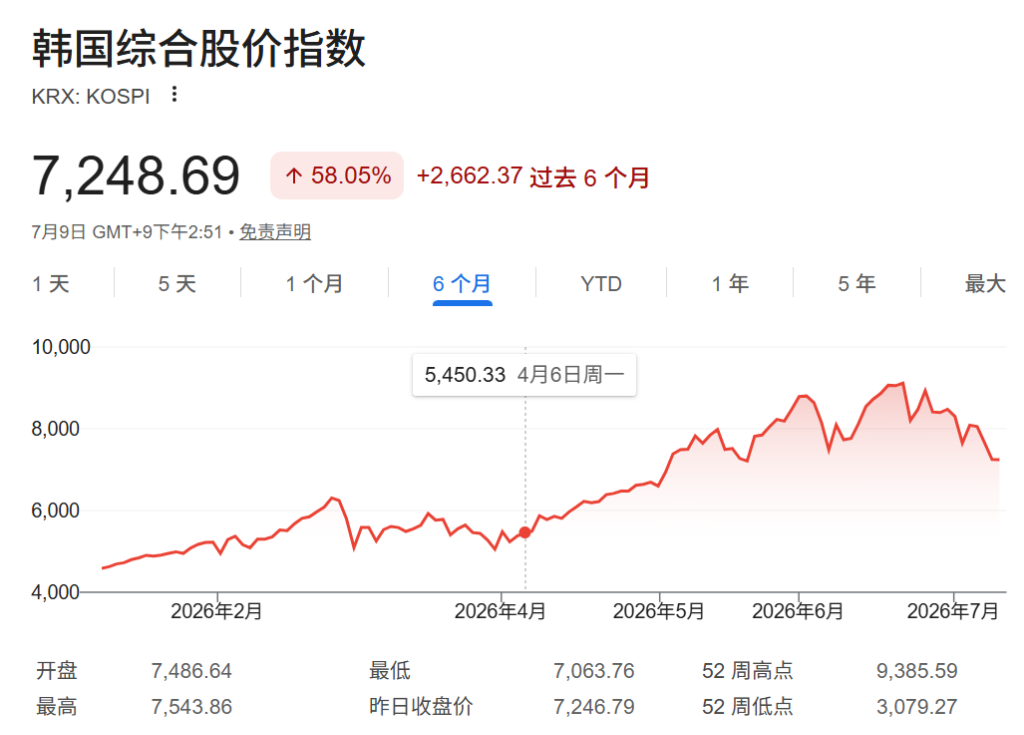
- The KOSPI index has fallen over 20% from its June peak, entering a technical bear market. Circuit breakers were triggered on July 7. In the first half of the year, net selling by foreign investors on the KOSPI reached 148 trillion won.
- South Korea's June CPI rose 3.2% year-on-year, significantly exceeding the 2% target. The driving force of inflation is shifting from oil price pass-through to demand-side pressures from semiconductor company bonuses and stock market wealth effects.
- Citi expects the Bank of Korea to hike rates once each in July and October, with two additional hikes in January and April next year, initiating a multi-step tightening cycle.
- All 14 single-stock 2x leveraged ETFs tracking Samsung Electronics and SK Hynix have plummeted since their listing at the end of May. The hedging sells generated by their daily rebalancing create additional selling pressure on the underlying stocks, exacerbating market volatility.
- The Bank of Korea has warned that single-stock leveraged ETFs could lead to excessive concentration in a few stocks and amplify market volatility through rebalancing. Meanwhile, the government's 10 trillion won stock market stabilization fund pales in comparison to the scale of foreign selling.
- Samsung Electronics' second-quarter operating profit hit a new high, but its stock price suffered its most severe sell-off in history. This divergence between fundamentals and price action highlights AI earnings uncertainty and pressure from foreign exchange losses for foreign investors.
Original Author: Xu Chao
Original Source: Wall Street CN
The combination of hawkish signals from the Bank of Korea's governor and a technical bear market is pushing South Korea's capital market towards a tricky crossroads. The simultaneous fermentation of rate hike expectations, sustained foreign capital outflows, and structural risks from leveraged ETFs is subjecting this once sought-after market, buoyed by the semiconductor boom, to a severe test.
Bank of Korea Governor Rhee Chang-yong explicitly stated on the 9th that, considering the three factors of exceeding inflation targets, improved economic growth, and rising financial stability risks, it is "necessary to raise the benchmark interest rate at an appropriate time." The market generally expects the Bank of Korea's Financial Monetary Committee meeting on the 16th to announce a rate hike, which would be the first increase since August 2021. Following the announcement, the KOSPI index initially surged over 4% during early trading, then sharply reversed, with the dramatic shift in market sentiment reflecting investor divergence and unease.
The current macro backdrop is not optimistic. The KOSPI has fallen over 20% from its June peak, entering a technical bear market. On July 7th, the market triggered both program trading halts (sidecar) and circuit breakers in a single day, led by sharp declines in Samsung Electronics and SK Hynix. Foreign investors' net selling in the KOSPI reached 148 trillion Korean Won in the first half of the year. Against this backdrop, investors are searching for answers on whether the impending rate hike will serve as a policy signal boost or add further pressure to a fragile market.
Rhee Chang-yong Signals Hawkishness, Rate Hike Path Becomes Clearer
Since taking office in May, Rhee Chang-yong has repeatedly emphasized the necessity of rate hikes, with increasingly explicit language. In a speech marking the Bank of Korea's founding anniversary on the 12th of last month, he stated that the focus should be on price stability and "pushing forward with rate hikes as soon as possible." He again voiced this stance on the 17th, stating his intention to proactively implement policies to stabilize prices.
At a parliamentary hearing of the National Assembly's Strategy and Finance Committee on the 9th, Rhee Chang-yong cited inflation as the core reason for rate hikes, specifically pinpointing the sources of price pressure. These include not only oil price pass-through driven by Middle East tensions but also massive performance bonuses from semiconductor companies like Samsung Electronics and SK Hynix, along with the wealth effect from a significantly higher KOSPI. He argued these factors jointly boost consumption demand, stating that "the inflation rate is expected to remain elevated for a considerable period."
In its business report submitted to the National Assembly, the Bank of Korea also echoed this sentiment, stating, "Considering changes in policy conditions such as inflation exceeding targets, improved growth momentum, and rising financial stability risks, it is necessary to raise the benchmark interest rate at an appropriate time." This serves as the central bank's formal institutional endorsement of the governor's statements.
Inflation Exceeds 3% for Two Consecutive Months, Demand-Side Pressure Follows Supply-Side
At the data level, the urgency of a rate hike is clearly visible. South Korea's June Consumer Price Index rose 3.2% year-on-year, significantly exceeding the central bank's 2% target. The Livelihood Price Index, reflecting the cost of daily living, rose even higher at 3.4%. Inflation was around 2% in January and February, but broke above 3% in May following the escalation of Middle East tensions, remaining high ever since.
Rhee Chang-yong noted that inflation in the first half of the year was primarily driven by international oil prices, a supply-side shock. However, he specifically emphasized that the inflationary drivers are undergoing a structural shift. The distribution of massive performance bonuses by major semiconductor companies like Samsung Electronics and SK Hynix, and the sharp rise in the KOSPI expanding household assets, are both boosting demand-side consumption pressures. This shift implies that even if energy prices fall, the persistence of price pressures will be stronger.
The Bank of Korea expects that the easing pressure from lower international oil prices will be offset by expanding demand-side inflation, meaning "the consumer price index will continue to remain high."
Citi Expects Two Rate Hikes This Year, Two More Next Year
There is a general consensus in the market regarding the outcome of the meeting on the 16th. Citigroup economist Jin-Wook Kim expects the Bank of Korea to raise the benchmark rate by 25 basis points from 2.50% to 2.75% at next week's meeting, and signal a gradual pace of tightening.
Citi's baseline forecast includes one rate hike in July and one in October this year, followed by additional hikes in January and April next year. Jin-Wook Kim stated that he expects Rhee Chang-yong to signal quarter-point hikes for each quarter in the second half of 2026, while maintaining a data-dependent stance for the first half of 2027 without providing specific forward guidance.
Citi also anticipates that the central bank might emphasize upside risks to its 2026 growth forecast, citing the upward revision to Q1 GDP and the resilience shown in Q2 economic activity.
This trajectory suggests that this rate hike is not an isolated event, but the beginning of a multi-step tightening cycle. For the already pressured stock market, this normalization process will create persistent valuation headwinds.
Stock Market Deep in Bear Territory, Triple Risks Converge
Even before the expected rate hike materializes, the Korean stock market has undergone a sharp correction. The KOSPI has fallen over 20% from its June high, entering a technical bear market. On July 7th, trading triggered both the sidecar and circuit breaker mechanisms in a single day, closing at 7246.79 points.
Foreign capital flight is the primary source of pressure. Foreign investors net sold 148 trillion Korean Won in the KOSPI during the first half of the year, with net selling exceeding 1.3 trillion Won daily over the last two trading days, concentrated in Samsung Electronics and SK Hynix. The logic behind this exodus is clear: the KOSPI accumulated a gain of about 60% from April to June, while the Korean Won depreciated from 1200 to 1566 against the US dollar over the same period, hitting a 16-year low. The resulting exchange losses for dollar-denominated asset holders upon settlement create a natural incentive to book profits.
Leveraged ETFs constitute a second risk. Fourteen single-stock 2x leveraged ETFs tracking Samsung Electronics and SK Hynix were listed at the end of May. On July 7th, they all plunged 12% to 13%, with 13 out of the 14 products falling below their 20,000 Won issue price. The combined trading volume of the 16 single-stock leveraged and inverse ETFs that day reached 13.1 trillion Korean Won, accounting for over one-third of the total ETF market turnover. Since Samsung Electronics and SK Hynix together represent over half of the KOSPI's market capitalization, the hedging sells triggered by the daily rebalancing of these leveraged ETFs add extra downward pressure on the underlying stocks, amplifying the broader index decline.
Concentration risk is a structural隐患 that the Bank of Korea itself has flagged. In a written response to parliament, the central bank warned that single-stock leveraged ETFs could lead to excessive capital concentration in a few stocks and increase market volatility through daily rebalancing.
Limited Policy Space, the 'Semiconductor Paradox' Persists
What perplexes the market is the deep divergence between fundamentals and stock prices. Samsung Electronics reported an operating profit of 89.4 trillion Korean Won for the second quarter, with semiconductor demand structurally strengthening due to the continuous global expansion of AI infrastructure investment. Yet, this record performance coincides with a historically brutal sell-off.
The Bank of Korea has assessed this situation, noting that the semiconductor market is showing a stronger upward trend compared to past cycles. However, it also pointed out potential risks, including uncertainty in AI profit outlook, the actual contraction in investments by big tech companies, and energy bottlenecks.
The limitations of policy tools are equally apparent. Raising rates helps curb inflation and supports the Korean Won, but for a market already in a technical bear market, higher interest rates directly compress valuations. The size of the stock market stabilization fund established by the Korean government is approximately 10 trillion Korean Won, a scale vastly disproportionate to the 148 trillion Korean Won in net foreign selling seen in the first half of the year.
Deputy Prime Minister and Minister of Economy and Finance Koo Yoon-chul stated that the government is fully aware of concerns that leveraged ETFs exacerbate market volatility, and relevant authorities are discussing ways to minimize the volatility, but no specific measures have been announced yet. An official from the Financial Supervisory Service also indicated that regulators are evaluating alternatives such as tightening trading requirements for these products, but "any regulatory adjustment requires comprehensive consideration of its impact on the broader market."
The decision to raise rates on the 16th is already highly probable. The real variables are: once the tightening cycle begins, can the Korean Won stabilize, can foreign capital outflows stop, and can leveraged products achieve a soft landing? The answers to these three questions will largely determine whether the Korean stock market can find its footing and emerge from the bear market.


