






World Cup fever is upon us, and prediction markets are stepping up to the plate. How are Polymarket and its peers tearing open the door to mass adoption?


- Core Thesis: Prediction markets are transitioning from a regulatory gray area into a core piece of financial infrastructure. The 2026 World Cup, with its inherently low entry barrier, high consensus, and strong social appeal, could become the pivotal event that drives this sector into the mainstream; by integrating prediction markets, wallets are transforming from asset gateways into portals for users to engage with real-world events.
- Key Elements:
- Regulatory Frameworks Accelerating: The CFTC is intensifying its oversight of sports prediction markets to prevent insider trading; Kalshi and Polymarket have updated their rules, banning stakeholders from trading on specific markets.
- Market Landscape in Flux: Total trading volume on prediction markets hit $29.8 billion in April 2026 (up 12.4% month-over-month), but Polymarket’s volume fell by 8.9%, while the compliant platform Kalshi bucked the trend with a 13% increase to $14.8 billion.
- The Three Pillars of the World Cup: It possesses global consensus, high-frequency information flow, and strong social attributes, simplifying complex on-chain interactions into a low-cognitive-load activity of “judging an outcome.”
- Evolving Role of Wallets: By integrating Polymarket and subsidizing trial funds, imToken allows users to engage in lightweight on-chain participation around real-world events like the World Cup, reducing the steep learning curve traditionally associated with crypto.
- Risks Remain: Market manipulation, insider trading, regulatory boundaries, and users’ insufficient understanding of the “non-guaranteed-profit” nature of these markets are the main challenges facing the mainstream adoption of prediction markets.
Objectively speaking, for a long time in the past, the positioning of prediction markets within the Crypto world has been somewhat awkward.
They are popular in niche circles but not fully mainstream. While they can compress complex events into a real-time price, they have long operated in a regulatory gray area due to sensitive scenarios like politics, sports, and insider information.
However, after the start of the 2026 World Cup, this sector suddenly found itself in a position that is much easier for the general public to understand.
The reason is simple: The World Cup is arguably the world's most natural and largest prediction market scenario. Who will advance from the group stage? Who will win the championship? Can a specific team reach the quarter-finals? Has the market already priced in the win probability for a key match? These are questions that fans discuss daily, but in the past, they mostly remained confined to forums and sports media.
On platforms like Polymarket, however, these questions are transformed into tradable probabilities and price curves that change dynamically with the match progress. This is precisely why it's interesting that Web3 wallets like imToken are beginning to integrate prediction markets. It means that prediction markets are not just a trading product; they could become the entry point for ordinary users to participate in real-world events for the first time through their wallets.
1. Prediction Markets Are Entering the 'Regulatory' Sphere
If one only looks at the front-end user experience, it's easy to misunderstand prediction markets as "Web3 versions of online gambling." However, in the eyes of regulators, there is a fundamental game about defining what these markets actually are.
This is because prediction markets trade not just the price of BTC or ETH, but more broadly, the outcomes of real-world events, such as economic data, election results, policy decisions, or even more sensitive geopolitical events.
For this very reason, the regulatory issues surrounding prediction markets have never been purely financial from the start. After all, if the market corresponding to a particular event outcome is large enough, theoretically, related parties – especially those with access to non-public information – could be motivated to influence the outcome itself or trade on informational advantages.
This is the core context behind the CFTC's recent efforts to redraw the lines for prediction markets.
As is widely known, over the past two years, platforms like Polymarket have frequently broken into the mainstream spotlight during events like the U.S. presidential election, macroeconomic data releases, and geopolitical events. This has effectively accelerated the CFTC's push to classify prediction markets and event contracts as a key regulatory priority.
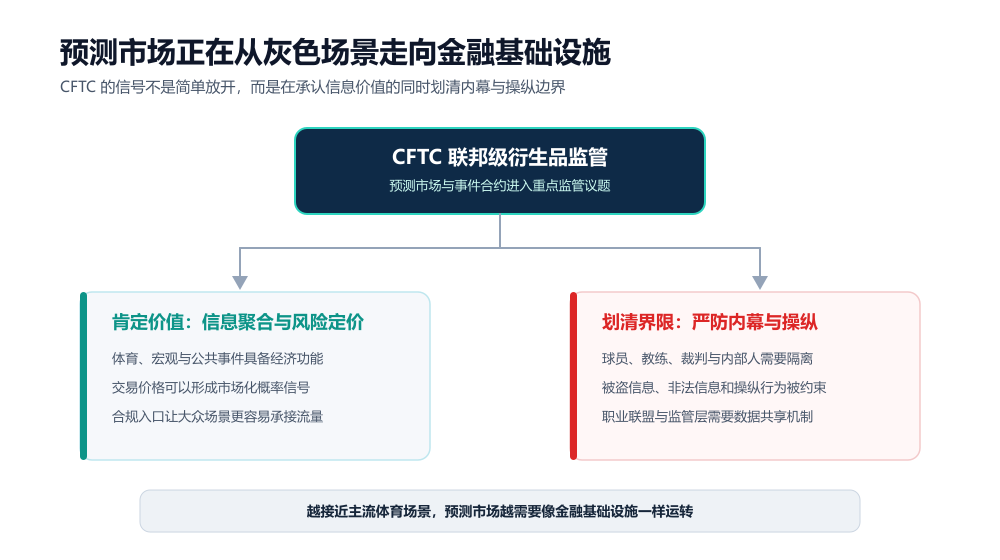
CFTC Chairman Michael S. Selig recently stated that the agency is communicating with all major U.S. professional sports leagues, aiming to strengthen the regulatory framework for sports-related prediction markets and prevent insider trading and market manipulation risks. This line of action is particularly critical for the sports market because sporting events are naturally suited for prediction but are also inherently sensitive.
Therefore, recent actions in this area almost all share a common characteristic: acknowledging the informational value of prediction markets on one hand, while accelerating the severance of the most problematic scenarios on the other.
For example, Kalshi has publicly stated it will prohibit political candidates from trading in markets related to their own campaigns and will also prevent athletes, coaches, referees, and other relevant personnel in professional and college sports from trading in markets related to their own events. Similarly, Polymarket updated its market integrity rules in March, explicitly banning trading based on stolen information, illegally obtained information, or other improper information sources, and strengthening constraints on market manipulation and information abuse.
The information-sharing mechanism established between MLB and the CFTC also indicates that both sports leagues and regulators recognize that if prediction markets enter the mainstream sports scene, the integrity of sporting events must be addressed proactively.
In other words, prediction markets are transitioning from a phase of unbridled growth towards one resembling a financial infrastructure. For Polymarket, Kalshi, and subsequent platforms, this represents both a constraint and an opportunity.
2. Why the World Cup Could Be Prediction Markets' Breakout Moment?
For prediction markets to break into the mainstream, regulatory shifts are not enough. They also need a sufficiently large public event.
The World Cup perfectly meets this criterion.
Many of Crypto's past breakout moments occurred when 'high cognitive threshold technology' combined with 'low cognitive threshold scenarios.' For instance, NFTs broke through partly because they linked on-chain assets to avatars, art, and community identity. Memes spread rapidly because they compressed complex financial behaviors into simple emotions and cultural symbols.
If prediction markets are to reach a wider user base, the best entry point isn't macroeconomic data or complex political contracts, but scenarios the general public is already willing to discuss: sports, entertainment, and events.
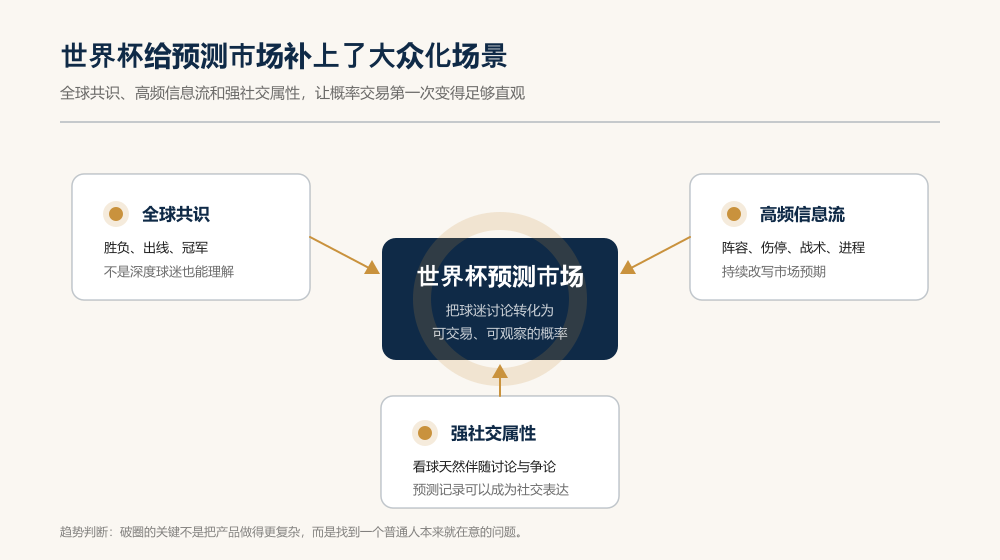
The World Cup's uniqueness lies in its inherent possession of three conditions:
- First, it enjoys global consensus. Even non-hardcore fans can understand questions like who wins or loses, who advances, and who becomes champion.
- Second, it generates a high-frequency information flow. Pre-match lineups, real-time form, injury updates, tactical changes, and match progress all continuously alter market expectations.
- Third, it possesses strong social attributes. Watching a match is rarely an isolated act; it's a process of group chats, sharing, discussions, debates, and emotional resonance.
This has similarities to traditional sports betting, but also distinct differences.
Traditional odds are largely determined by the bookmaker system, where users see a price processed by the platform. Prediction markets, conversely, emphasize peer-to-peer trading, the formation of market prices, and the transparency of outcome settlement. Especially within the native Crypto environment, fund flows, trading records, and settlement processes are more easily verifiable, giving prediction markets greater openness and observability.
Of course, this doesn't necessarily mean prediction markets are inherently 'superior' to traditional sports betting. At its core, a prediction market is still about risk trading. However, it undeniably offers a novel way to participate in events.
Notably, according to the latest disclosed data, the overall trading volume of prediction markets continued to rise in April 2026, reaching approximately $29.8 billion, a month-over-month increase of 12.4%. However, within this growing pie, Polymarket's total trading volume in April declined by 8.9% compared to March. Meanwhile, Kalshi, a competitor focusing on the compliance path and rapidly expanding through federal regulatory frameworks and sports contracts, saw its trading volume buck the trend and grow by 13%, reaching approximately $14.8 billion.
This data sends a clear signal: the fundamentals of the prediction market landscape are undergoing a massive shift.
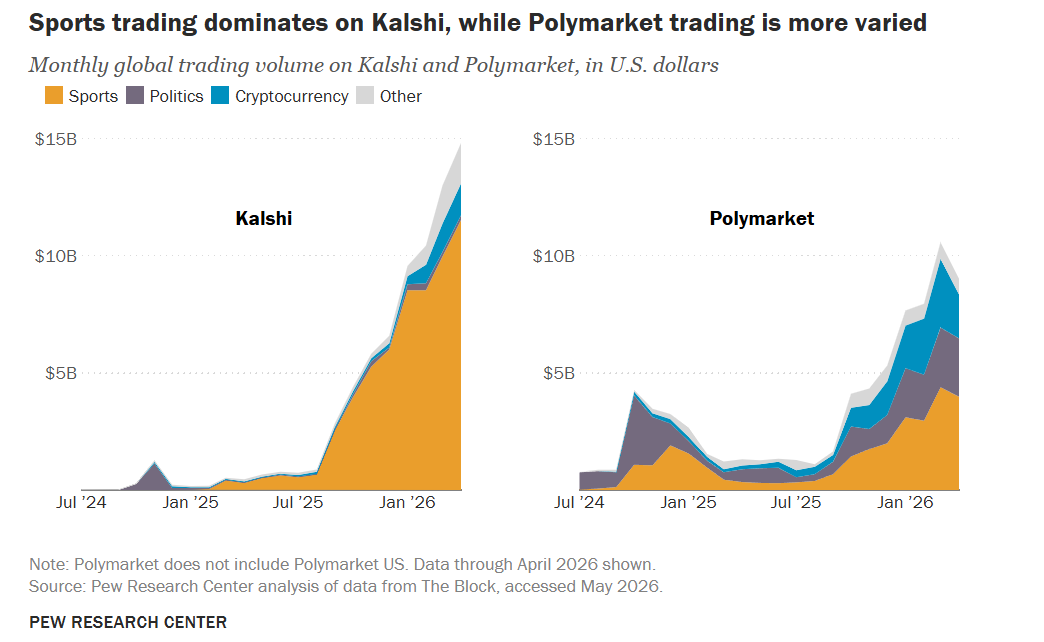
In the past, Polymarket attracted significant crypto-native capital through global political gaming, crypto ecosystem events, and macro narratives. Now, platforms like Kalshi are aggressively capturing market share by leveraging compliant user channels and sports contracts.
This also means that whoever can capture 'sports' – a domain common to all humanity – will gain a competitive advantage in the next phase of the user acquisition race.
3. From Assets to Events: A Seamless Evolution of the Wallet
This is precisely what makes imToken's World Cup prediction activity noteworthy.
Currently, users can enter Polymarket via imToken to participate in predictions on World Cup-related markets. Correct predictions yield rewards according to Polymarket's rules. Incorrect predictions still offer a chance to receive imToken-subsidized trial funds (the first 200 users receive a 5 U subsidy). Users can also share their prediction records and World Cup insights via X interactions.
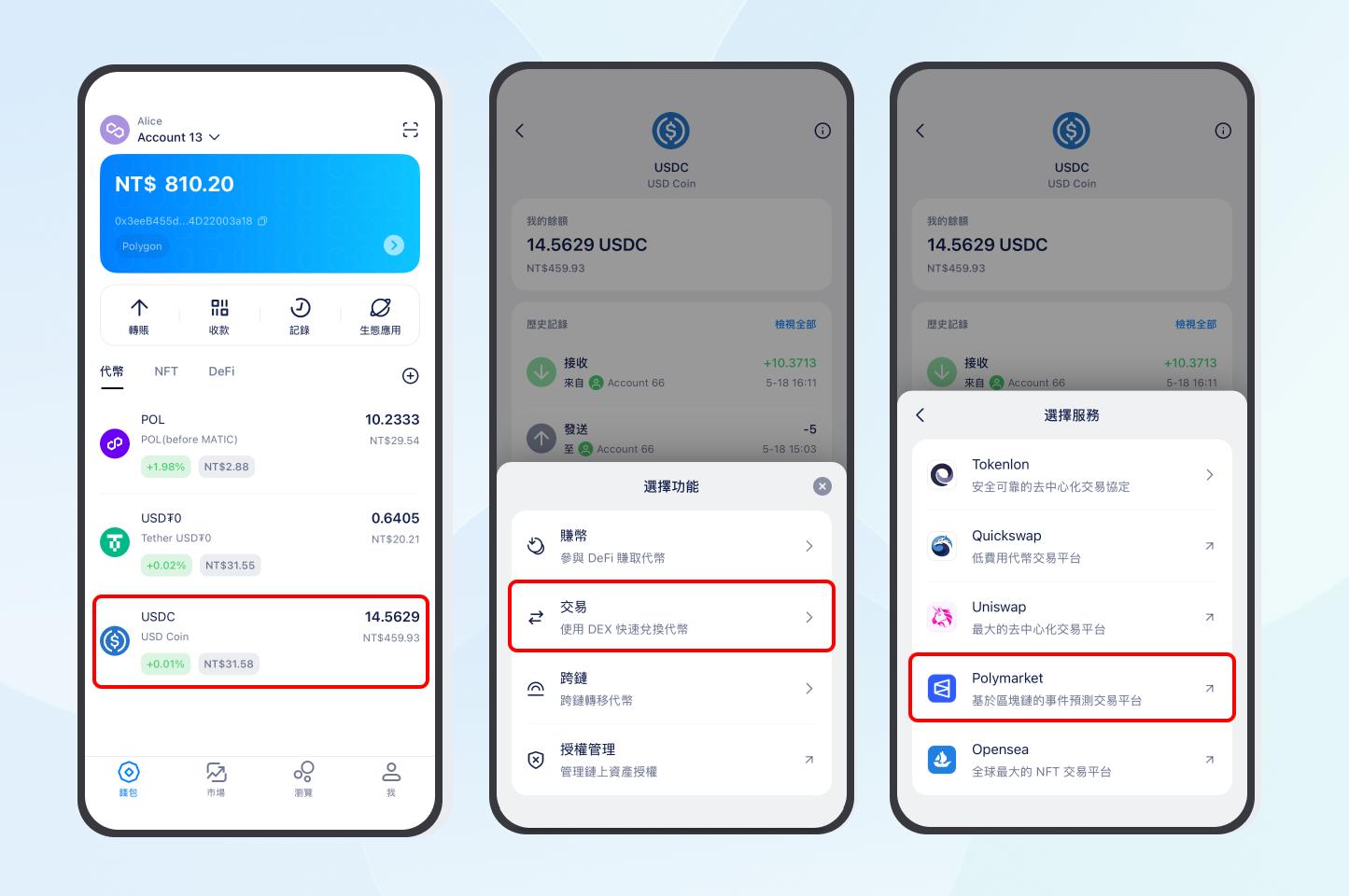
Superficially, this seems like just a World Cup campaign. However, viewed within a broader industry context, it actually points towards an extension of the wallet's role.
Historically, the wallet's core functions were asset custody and on-chain interaction. Users use wallets to send/receive tokens, connect to DApps, authorize, sign, swap, and participate in DeFi or NFT trading. Ultimately, the wallet is the gateway to the Crypto world, but this gateway has primarily revolved around 'assets.'
The advent of prediction markets offers wallets an opportunity to evolve into an 'event participation gateway.' This is easy to understand. A user cares about the World Cup not necessarily because they first cared about Crypto. A user wants to predict a match outcome not necessarily because they first understood on-chain transactions.
But when the World Cup, Polymarket, USDC, a wallet interface, and social sharing are combined, the user pathway for Crypto gets rewritten. Instead of first learning how to use a wallet to enter the complex on-chain world, the pathway becomes: first engage with a real-world event the user already cares about, completing a lightweight on-chain participation.
This is crucial for mainstream users.
Historically, the barrier for many Crypto products was that users had to first understand concepts like public chains, Gas, wallets, authorization, DEXs, and cross-chain bridges before understanding why they needed the product. Prediction markets flip this, presenting users with a clear, immediate question: Do you think this outcome will happen? Are you willing to express your judgment with a small amount of capital?
When the question is intuitive enough, the cost of product education decreases.
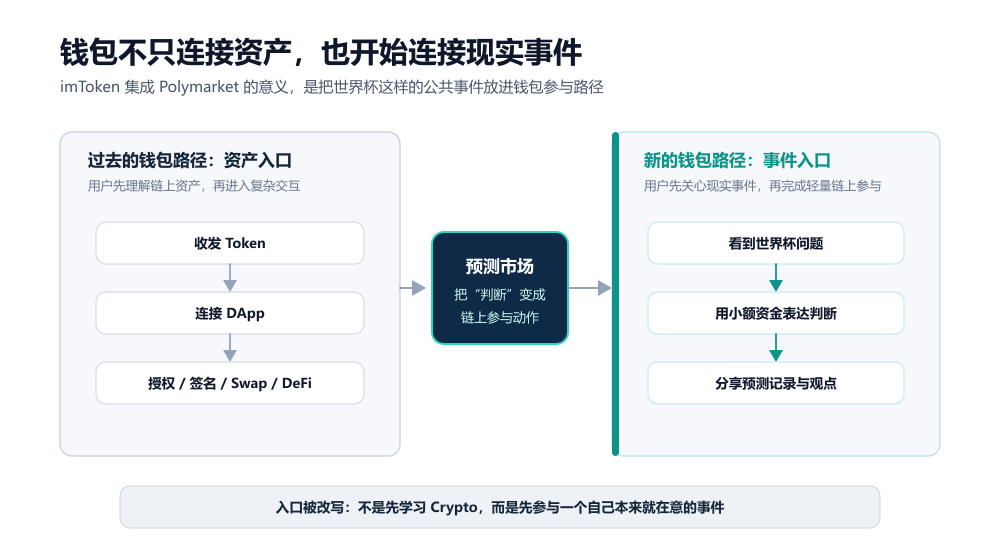
This is also the greatest significance of the World Cup for prediction markets. It's not merely about generating a wave of trading volume; it provides Crypto with a rare mainstream narrative scenario. For Crypto, this might be more important than pure trading volume.
The World Cup gives prediction markets this reason, and the wallet could become the gateway that hosts it.
Final Thoughts
Of course, prediction markets won't achieve complete mainstream adoption overnight due to a single CFTC proposal or one World Cup event.
They still face numerous challenges. Regulatory boundaries are still being defined, market manipulation and insider information need governance, user privacy and on-chain security require attention, and ordinary users need to understand that prediction markets are not a guaranteed way to make money.
But the direction is increasingly clear.
So, will the prediction market become a new breakout entry point for Crypto during the World Cup? The answer isn't necessarily a simple 'yes' or 'no.'
More accurately, the World Cup is pushing prediction markets from being a tool for niche speculators towards a broader scenario of mass event participation. As more users engage with real-world events through their wallets for the first time, the entry point for Crypto might no longer be just market prices and assets, but every ongoing public event.
Let's wait and see.





