When the World Cup Meets Agent: From Web2 to Web3, How Are Wallets Evolving Toward Agentic Wallets?


- Core Insight: AI Agents are entering the Web3 wallet landscape, transforming wallets from a "feature menu" into an "intent interpreter." Users only need to express their intent to complete on-chain interactions, marking the early stage of the "Agentic Wallet" era. The core challenge lies in balancing automation efficiency with user control and the boundaries of asset security.
- Key Elements:
- World Cup prediction markets (e.g., Polymarket) serve as a lightweight entry point for users to engage in on-chain interactions. The introduction of AI Agents further lowers the barrier to participation, allowing users to place bets via natural language on platforms like Discord or the web.
- imToken is piloting Agents in the World Cup scenario, allowing users to express their intent through Agents outside the App environment (e.g., on a web page). The Agent breaks down complex on-chain operations into automated pathways, blurring the boundaries of the wallet.
- Mastercard's launch of Agent Pay for Machines and WeChat Pay's "AI-Dedicated Card" indicate that traditional payment giants are designing identity, authorization, and risk control frameworks for AI Agents to participate in payments, facing challenges highly similar to the on-chain security issues encountered by Web3 wallets.
- The fundamental issue for Agentic Wallets is not "what AI can do," but "how users know and control what AI is doing." This requires wallets to clearly present the scope, duration, and risks of authorization to users during complex transactions.
- The key to future wallet interactions is translating complex on-chain operations into simple messages understandable to users, including Agent permissions, asset caps, operational scope, and revocability, ensuring user security boundaries under high efficiency.
The World Cup is an ideal scenario for observing changes in wallet behavior.
Topics that fans discuss daily, such as which teams will advance and how championship odds shift, become tradeable actions in prediction markets like Polymarket. Therefore, when viewed over a longer timeline, the Web3 mainstream wallet-integrated World Cup prediction activities truly serve as a lightweight entry point and starting point for users to engage in on-chain interactions (see also: "World Cup Frenzy, Prediction Markets Hit the Table: How Are Polymarket and Others Cracking the Mainstream Adoption Barrier?").
At the same time, another earlier but more transformative change is also worth noting this time: as AI Agents begin to enter the wallet scenario, the way users interact with the on-chain world may also be about to change.
For example, in its World Cup-related explorations, imToken has started to integrate AI Agents into practical use cases. Its deployed agents on the web and in Discord can help users complete betting transactions more naturally based on specific prediction needs. This allows users to not just operate within the wallet App, but to easily participate in prediction markets in scenarios like Discord or web pages, and be seamlessly guided back on-chain by the Agent.
This is arguably an early glimpse of the Agentic Wallet – the future of Web3 wallets may not be confined to a wallet application but will certainly be an "AI wallet form" that is as ubiquitous as possible.
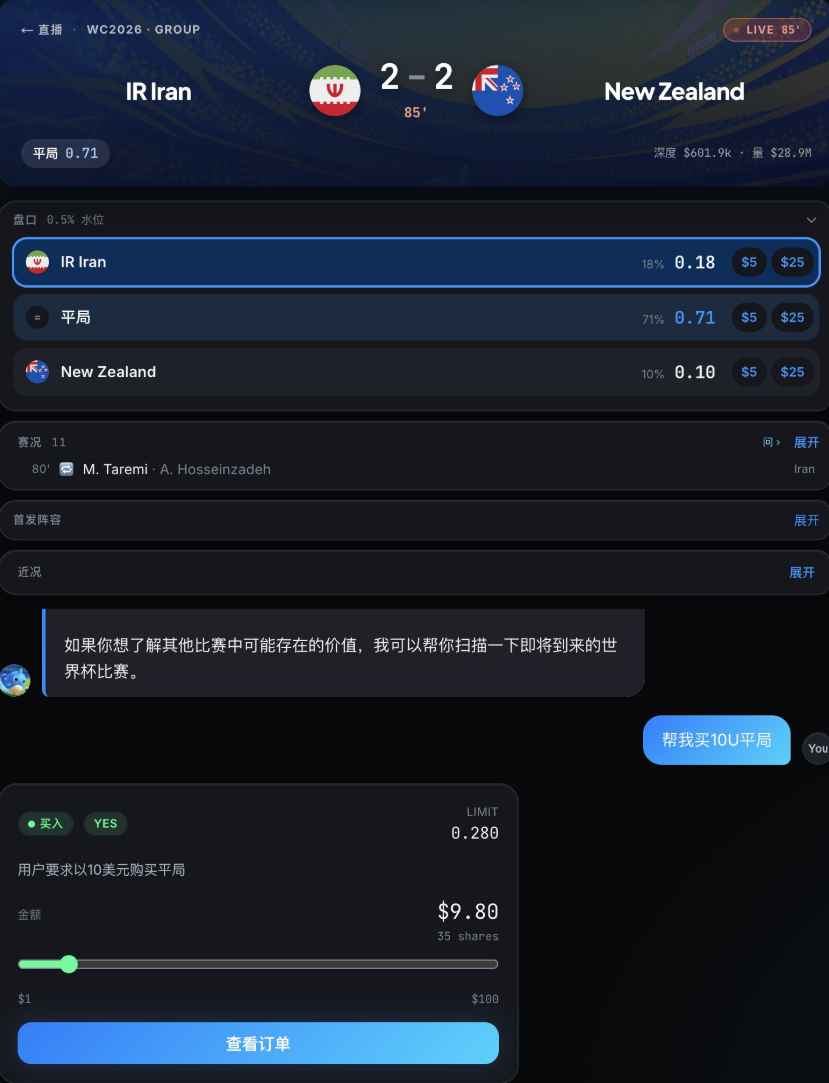
1. The World Cup Experiment: When Agents Begin to Understand "Intent"
Returning to a topic we've discussed many times, over the past decade, the core issues wallets have solved have been very clear: where assets are stored, who controls the private keys, and who signs the transactions.
For instance, users primarily open imToken to check balances, execute transfers/interactions, and manage multi-chain assets. For this reason, the wallet at this stage feels more like an asset entry point and a signing entry point. It's enough for users to know what they plan to do and then use the wallet to complete the final step.
But the change in the Agentic era is that users may not initially know exactly what they want to click or do.
For example, in the World Cup scenario, a casual user might not first think, "I need to open Polymarket, find a specific market, judge the odds, and execute a trade." They are more likely to say things like, "What's the story with tonight's match?", "I think Portugal will advance, is there a market for that?", "Are these odds already too low?", or "What's the process if I just want to participate with a small amount?"
Previously, these questions might have been scattered across WeChat groups, social media discussions, or search engines. Users had to piece the information together themselves and execute step by step. But with an Agent involved, the interaction method changes significantly: Users only need to express a general intent, and the Agent proactively breaks down the path, with the wallet then responsible for executing that path into a series of on-chain actions.
So, this is definitely not simply about adding a chat box to a wallet.
The real change is that the wallet is starting to transform from a "menu of functions" into an "intent interpreter." Previously, the wallet primarily required the user to decide whether to transfer, swap, stake, or connect to a DApp. The future wallet will likely be more direct, allowing users to simply tell it in natural language what they want to achieve.
This is precisely why a major public event like the World Cup is an excellent entry point for an Agentic Wallet. It inherently provides context, users naturally have the urge to express opinions and make judgments. An Agent doesn't need to immediately manage complex asset portfolios for users, especially high-risk ones involving intricate asset management. It can first help users find interaction paths within a specific scenario, then hand final control back to the wallet and the user.
The aforementioned agents from imToken, which can interact on-chain via web pages and Discord, are a typical example. They bring wallet capabilities to a lighter entry point, allowing users to find interaction paths through an Agent on a campaign page or a World Cup scenario, without necessarily opening the App or entering the traditional DApp browser first.
This means the boundaries of the wallet are expanding.
Previously, the wallet entry point was relatively clear: users open the App, go to the assets page, click functions, and then connect to a DApp. In the future, wallet entry points may be scattered across more places, such as web pages, Discord, Telegram, AI chat interfaces, campaign pages, developer tools, or even a lightweight wallet interface generated by the user themselves.
From this perspective, this is why we believe the World Cup predictions are not the main point; the main point is that it has allowed the wallet to stand more naturally in front of "user intent" for the first time.
2. From Agent Pay: AI is Entering the Payment Layer
If you only look within the Crypto space, Agentic Wallet might be easily understood as a narrative concept – AI helping users check market conditions, find opportunities, and execute trades, sounding like an extension of the previous AI Agent wave.
However, Mastercard's launch of Agent Pay for Machines on June 10th suddenly made this phenomenon relevant beyond just Web3.
Mastercard's definition of Agent Pay is quite clear: it enables trusted AI Agents to participate in payments under user authorization. This includes how an Agent is identified, authorized, verified within the payment network, and how merchants, issuers, and users are all aware that a transaction was facilitated by an Agent.
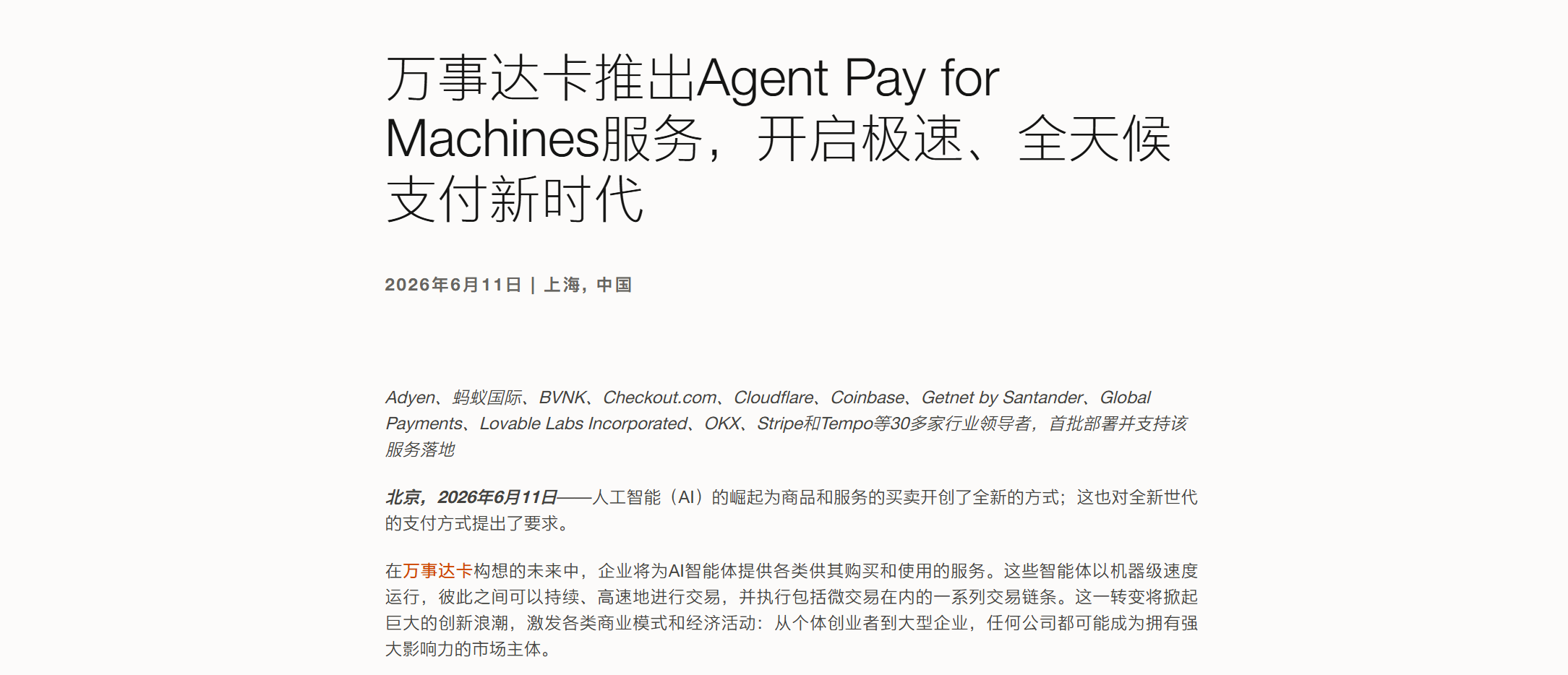
This is actually highly analogous to the problem Web3 wallets are facing.
When AI is just helping you write copy, the cost of errors is usually manageable. But once an AI starts participating in asset interactions, the question changes. It becomes about its permissions. Did it understand user intent accurately? Are the services it invokes trustworthy? Do the transactions it initiates exceed its boundaries? If the outcome doesn't match user expectations, who bears the responsibility?
The answer Mastercard provides is to redesign the identity, tokens, authorization, risk control, and dispute resolution for "trusted Agents" within the payment network.
This signal is significant. If the Agentic concept within the Web3 circle still carried a somewhat geeky, imaginative flavor, a traditional financial giant starting to design payment infrastructure for Agentic Commerce shows this matter has entered a more realistic commercial context.
Closer to home, domestic payment giants are also moving in this direction. WeChat Pay is testing AI payment features in collaboration with Tencent's AI agent product WorkBuddy, for example, launching an "AI Dedicated Card" within WeChat Wallet. Based on available information, the core of such products is not to let AI spend money freely, but to set boundaries for agent payments via top-up limits, payment authorization scopes, and password verification confirmations.
The logic here aligns with Mastercard's Agent Pay: AI can participate in payments, but it must be identified, authorized, restricted, and audited.
Web3 wallets face the on-chain version of this same problem. The difference is that traditional payment systems emphasize networks, merchants, issuers, and compliance responsibilities, whereas on-chain wallets emphasize private keys, signatures, authorizations, contract calls, and user self-custody.
It is precisely for this reason that Agentic Wallet cannot simply replicate the path of traditional payments. In traditional payments, users can rely on banks, card networks, merchants, dispute resolution, and risk control systems. But in the on-chain world, once a transaction is confirmed on the blockchain, there is often no "undo" button.
The higher the efficiency brought by AI Agents, the more crucial the wallet becomes as the final security boundary. Therefore, the future wallet must not only enable the Agent to "do things" but also ensure the Agent "can only do things within the scope permitted by the user."
This is why Web3 might actually be a more suitable environment to discuss Agentic Wallets.
3. In the Agentic Era, How Will Wallets Redefine On-Chain Interaction?
When discussing AI Agents, many people tend to lean towards an extreme vision: AI automatically trading, managing finances, finding airdrops, and executing arbitrage for me in the future.
This direction is certainly appealing. However, for a wallet, the real difficulty is not "automation" but "boundary awareness."
Because a wallet is not an ordinary application. In a regular app, if an AI recommends a wrong song, writes an incorrect sentence, or clicks on the wrong page, the worst outcome is a poor user experience. But in a wallet, if an AI misinterprets an instruction, calls the wrong contract, or grants excessive authorization, it can translate into real asset risk (see also: "Sign is Not Just a Signature: When an AI Agent Signs for You, Who Holds the Control?").
Therefore, the fundamental issue for Agentic Wallet is not "how many things can AI do for the user", but "how does the user know what the AI is doing."
This is also the reason imToken has consistently emphasized control over the past few years. From self-custody wallets to multi-chain asset management, and now to AI co-creation and Agent exploration, the truly continuous thread hasn't been an increasing number of features, but ensuring users can always understand, confirm, and control their digital world.
In the Agentic era, this thread becomes more concrete.
The wallet needs to enable users to understand who this Agent is, what capabilities it can invoke, how long the authorization lasts, whether it can operate across DApps, when re-confirmation is needed, and whether they can pause or revoke it with one click... These questions may sound cumbersome, but they are the foundation for whether Agentic Wallets can genuinely become a reality.
Because the power of an AI Agent lies precisely in its ability to simplify complex processes. A user says one sentence, and the Agent can break it down into a dozen execution steps. This is great for user experience but poses a challenge for security. The longer the path, the more intermediate steps there are, and the more crucial it becomes for the wallet to bring key decision points back to the user's attention.
Good wallet interaction in the future might not involve showing users more technical details, but rather translating complex transactions into something users can understand:
- You are authorizing a specific Agent to invoke a specific contract within the next 24 hours.
- This operation can use a maximum of X amount of USDC.
- It can only access World Cup-related prediction markets and cannot touch your other assets.
- Any transaction exceeding a certain limit requires re-confirmation.
- The authorization automatically expires after the set period.
- You can suspend this Agent at any time within the wallet.
This may sound like a distant future, but it has already started in some very small scenarios. The World Cup prediction activity serves as an event entry point, while imToken's trial web agents and Discord agents serve as community entry points.
Especially at times like this, the wallet should not retreat into the background.