






Institutions and on-chain capital are bullish on ChangXin continuing its surge, except for South Koreans


- Core View: On its first day of listing on the STAR Market, ChangXin Technology surged 465.8%, reaching a market cap of 3.28 trillion yuan. Multiple institutions hold significantly divergent views on its future valuation; optimists are bullish on its capacity expansion and technology upgrades, while conservatives focus on market restrictions and the competitive landscape.
- Key Points:
- ChangXin Technology closed its debut day up 465.8%, with a trading volume exceeding 140 billion yuan and a market cap of 3.28 trillion yuan, setting multiple A-share records.
- Nomura is extremely bullish, giving a "Buy" rating with a target price of 116 yuan, corresponding to a market cap of 7.76 trillion yuan, based on its forecast of 773.3 billion yuan in revenue and 393.1 billion yuan in net profit by 2028.
- Northeast Securities is relatively conservative, offering a target market cap range of 3.2 trillion to 5.7 trillion yuan based on perspectives of market share, profitability, and production capacity.
- Analysts point out that ChangXin's listing surge does not change the global DRAM shortage, as its production capacity is limited, and due to U.S. export restrictions, it is unlikely to enter the HBM market in the short term.
- On-chain data shows a clear divergence between long and short positions. Wallets from the U.S., Mainland China, and Hong Kong are leaning long, while wallets from South Korea are a major source of short-selling pressure.
- The market expects ChangXin's rally to continue for several days, given its circulating share is only 6.63%, and it is in a memory super-cycle, compounded by the "A-share premium effect" driving FOMO sentiment.
Original|Odaily Planet Daily (@OdailyChina)
Author|Wenser (@wenser 2010 )
Hailed as "China's first memory stock," CXMT (ChangXin Memory Technologies) finally made its debut on the STAR Market today, closing up 465.8% on its first day, with a full-day turnover exceeding 140 billion yuan and a total market value of 3.28 trillion yuan.
Simultaneously, on its listing day, it successively broke records, setting numerous A-share historical records, including "first tech stock with an opening market cap exceeding 3 trillion yuan," "top of the STAR Market by market cap," "first stock with a single-day turnover exceeding 100 billion yuan," and "first new stock with a turnover of over 100 billion yuan combined with a turnover rate exceeding 50%."
With the first-day market performance now settled, the next question arises: can CXMT's stock price continue to climb? What is its target price? Currently, market opinions remain somewhat divided.
The Debate on CXMT's Future Stock Price: Nomura Sees 116 Yuan, Northeast Securities Gives a 10-15x PE Estimate
As the "world's fourth-largest, China's largest" memory giant, CXMT's market position is undeniable.
According to data disclosed by CXMT in its listing press release, the company expects revenue for the first half of 2026 to be between 110 billion yuan and 120 billion yuan, a year-on-year increase of 612.53% to 677.31%. It also expects net profit attributable to parent company to be between 50 billion yuan and 57 billion yuan, a year-on-year increase of 2244.03% to 2544.19%. Given this, many institutions have released their own post-listing assessments.
Viewpoint 1: Nomura Gives a Buy Rating, Target Price 116 Yuan, Market Cap Over 7.7 Trillion RMB
This morning, international investment bank Nomura released a report giving CXMT a "Buy" rating with a target price of 116 yuan, corresponding to a 20x P/E ratio, implying a potential upside of 1239.5%. This valuation is twice that of US memory giant Micron (MU), meaning CXMT's stock price would be approximately 13.4 times its IPO price, corresponding to a market cap of about 7.76 trillion yuan.
Notably, in the report's title, Nomura likened the industrial value of CXMT's DRAM chips to "the jewel in China's crown." According to its model projections, CXMT's revenue will rapidly increase from 61.8 billion yuan in 2025 to 290.7 billion yuan in 2026, 560.8 billion yuan in 2027, and 773.3 billion yuan in 2028. Nomura also expects CXMT's net profit attributable to parent company to climb from less than 1.9 billion yuan to 130.3 billion yuan in 2026, 277.2 billion yuan in 2027, and 393.1 billion yuan in 2028. The compound annual growth rates for these two indicators are projected at 63% for revenue and 74% for net profit.

It's worth noting that Nomura's judgment, which is close to 2.4 times the current market cap, is not baseless. It is a comprehensive assessment based on dimensions such as capacity expansion, technology upgrades, and price increases, and is also related to CXMT's current product structure, the memory super-cycle, and the use of subsequent fundraising. For more on the reasoning behind this judgment, we recommend reading "Thirteen Times Bullish on CXMT?"
According to CXMT's prospectus, among the 57.9 billion yuan raised in this IPO, 7.5 billion yuan will be used for technical upgrades and renovations of mass production lines for memory wafers, 13 billion yuan for core DRAM process technology upgrades, and 9 billion yuan for forward-looking technology research and development. The market generally believes the final 9 billion yuan will be directed towards HBM R&D, the core business of memory giants like SK Hynix and Micron – high-bandwidth memory for AI chips.
In other words, CXMT is not content with its current main DRAM business line and is actively expanding into high-profit, high-demand sectors like HBM.
Viewpoint 2: Northeast Securities Estimates Valuation Range Converges to 3.2–5.7 Trillion RMB
Compared to the extremely optimistic Nomura, Northeast Securities offers a more conservative upside range, but still implies over 42% upside from the current market cap.
To provide a reasonable valuation for CXMT, Northeast Securities offered market cap references from the following three perspectives:
- Market Share Relative Valuation Perspective: Using US stocks as a valuation reference, by comparing and analyzing the DRAM and NAND market shares of companies like Micron, SK Hynix, Samsung Electronics, and SanDisk, they deconstructed their market caps across different businesses. Considering CXMT's long-term market share, they arrived at a target market cap of 3.49 trillion yuan.
- Profitability Breakdown Perspective: By deconstructing CXMT's historical revenue and cost structure, using price and capacity as core variables, they forecast profits for this year and next. They project a net profit attributable to parent company of 284.8 billion yuan in 2027, corresponding to a target market cap of 2.85–4.27 trillion yuan based on a 10–15x P/E multiple.
- Per-Unit Capacity Market Cap Perspective: Calculating the per-unit capacity market cap of overseas listed memory companies in the DRAM business, they derived a target market cap of 3.22–3.99 trillion yuan.
For detailed calculations and the reasoning process, we recommend reading "A New 'Stock King' for A-Shares? How to Reasonably Value CXMT?"
Viewpoint 3: Multiple ETF Fund Managers Warn IOPV May Deviate on CXMT's Listing Day
This morning, just before CXMT's listing, several ETF fund managers, including China Asset Management and Harvest Fund, issued cautionary announcements. Some of their ETFs participated in the CXMT IPO, valuing it at the issuance price. However, the ETF's Indicative Optimized Portfolio Value (IOPV) only includes CXMT's issuance price and does not reflect its market price fluctuations. Therefore, on CXMT's listing day, the ETF's IOPV may differ from its net asset value (NAV). Investors were advised to be aware of related investment risks.
According to an ETF fund manager, fund companies typically participate in IPO subscriptions for their ETFs alongside their active equity funds. An ETF's IOPV is strictly calculated based on the PCF list, and restricted shares like new stocks that are not constituent stocks are not included. CXMT's significant surge on its first day means the actual NAV of the participating ETFs will be slightly higher than the IOPV, creating a deviation. In this scenario, potential arbitrage strategies include buying the ETF while hedging with derivatives, retaining only the excess exposure from the deviation.
In simpler terms, the IOPV (reference NAV) investors see is calculated based on CXMT's issuance price of 8.66 yuan, but the actual NAV is calculated based on the market price. Therefore, the IOPV will significantly "underestimate" the fund's true value, making it appear to be trading at a discount. Essentially, this is because CXMT's opening price surged, but the display interface of the investment system has a lag, preventing investors from buying the ETF at a high price due to market volatility and incurring losses.
Viewpoint 4: Analyst Says CXMT's Surge Still Hardly Changes the Global DRAM Shortage
Today, Milk Road AI analyst Melvin published an analysis of CXMT's stock price surge.
They stated that in less than the past year, CXMT's global DRAM market share has risen from under 4% to approximately 7.7%-8%, with first-quarter revenue this year soaring 719% year-on-year to 50.8 billion yuan. This growth is primarily driven by Samsung, SK Hynix, and Micron shifting more production capacity towards AI server memory (especially HBM), creating a supply gap in the traditional DDR5 and LPDDR5 markets, which CXMT has capitalized on to fill the demand for mid-to-low-end DRAM.
However, CXMT's current production capacity is far from sufficient to meet global demand. Its current monthly wafer capacity is approximately 290,000-320,000 wafers, lower than Samsung's roughly 630,000 and SK Hynix's approximately 500,000. Furthermore, US export restrictions on advanced lithography equipment are also constraining CXMT's pace of expansion.
The analyst believes CXMT will still find it difficult to enter the HBM market in the short term, and therefore will not change the AI memory supply-demand landscape. Samsung, SK Hynix, and Micron will continue to maintain their advantages in high-profit products like HBM, server DRAM, and LPDDR5X, and the global memory shortage cycle is likely to persist.
Simply put, the analyst argues that CXMT's listing surge will not directly translate into a linear increase in market share or a supply explosion in the memory industry, offering a relatively neutral expectation of price and market cap performance from a rationally biased perspective.
Viewpoint 5: On-Chain Long/Short Divergence: US and China Addresses Bullish, Korean Addresses Bearish
Beyond institutions and analysts, there was also a clear long/short divergence for CXMT in pre-market on-chain trading.
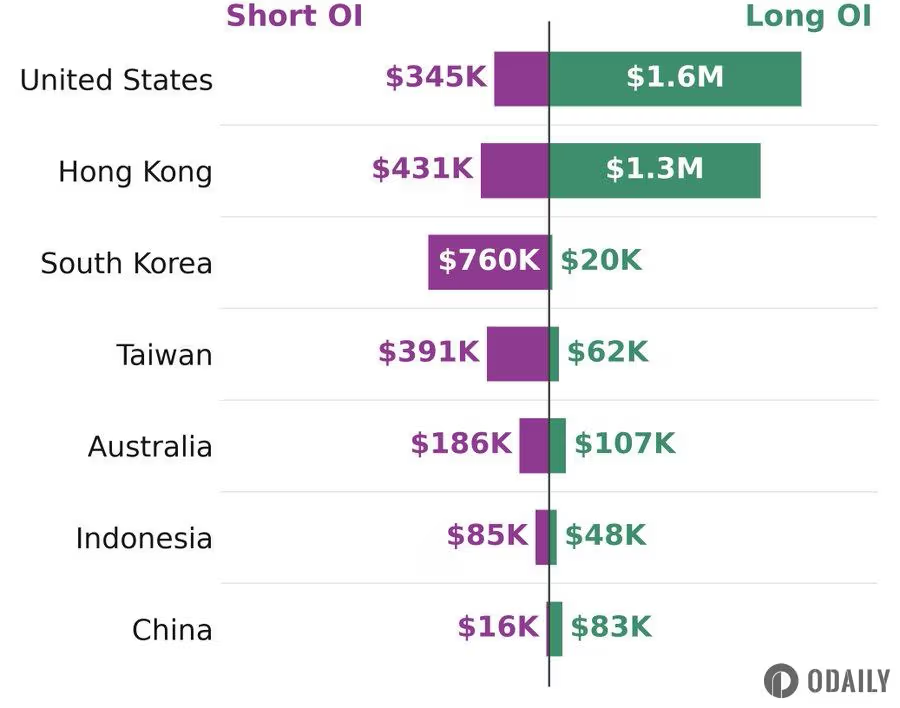
According to monitoring by HyperInsight, on the night before CXMT's listing, attributable CXMT wallets on Hyperliquid showed: wallets tagged as US, Hong Kong, and Mainland China were predominantly bullish, while wallets tagged as Korea were the primary bearish force in that sample.
Specifically, Korean wallets held approximately $760,000 in short positions, about 38 times the size of their long positions; wallets tagged as Taiwan, China were also bearish, with a net short of approximately $329,000.
On the long side:
- US-tagged wallets held $1.6 million in long positions and $345,000 in short positions, with a net long of approximately $1.255 million;
- Hong Kong-tagged wallets held $1.3 million in long positions and $431,000 in short positions, with a net long of approximately $869,000;
- Mainland China-tagged wallets held only $83,000 in long positions and $16,000 in short positions, with a net long of approximately $67,000.
Assuming the Korean-tagged wallets' $760,000 short positions were all opened before the market opened at a uniform price of $6.48, without subsequent adjustments, and with 1x leverage, the theoretical floating loss on the short positions would be approximately $48,500, a loss rate of about 6.4%. Based on today's closing data, the bulls came out on top.
Viewpoint 6: CXMT's Upward Momentum Expected to Last Several Days; Low Float, High Market Cap Will Continue to Fuel FOMO
Beyond the information above, the prevailing sentiment within the crypto market retains some confidence in CXMT's subsequent rally.
Their main points include:
First, CXMT's current freely tradable stock float is only 6.63%, highly similar to the initial performance of SpaceX's (SPCX) trading debut;
Second, the memory super-cycle remains a dominant theme in the capital markets, compounded by memory manufacturers like SK Hynix, Samsung Electronics, and Micron Technology continuously expanding production and advancing chip collaborations and new factory construction. Analysts expect SK Hynix's second-quarter earnings to significantly surpass market expectations, with industry tailwinds directly fueling bullish sentiment for CXMT;
Third, CXMT's unique status as "China's leading domestic memory stock" has made it a highly anticipated speculative target in A-shares and other capital markets. Combined with the historical "A-share premium effect," a 15-20x P/E expectation is not entirely unrealistic;
Fourth, despite "rumor mills" suggesting brokerage firms internally prohibited speculating on CXMT, market performance indicates that while institutions exercise restraint, they still pay close attention. This suggests institutional buying interest in CXMT persists, thereby reserving some momentum for subsequent price increases.
Finally, as a side note, according to Bloomberg Billionaires Index data, since CXMT's listing, the fortune of its founder, Zhu Yiming's family, has surged nearly 300% to $13.9 billion. He is reportedly preparing to distribute 40% of this as a bonus to employees. This move, perhaps following SK Hynix's practice of distributing 10% of its annual net profit to all employees, might also somewhat slow down the pace of equity monetization.
Recommended Reading
More Accurate Than Brokers? TradeXYZ Priced CXMT Ahead of Time


