






SpaceX IPO First-Day Strategy Guide: Don't Treat It Like a Regular Hot Stock


- Core Thesis: The first day of the SpaceX IPO is not a typical stock trade. Its low float (approximately 3%) and high retail allocation (approximately 30%) will lead to violent two-way volatility. Investors should abandon traditional technical analysis, shift to order flow trading, wait for the market to generate a price structure before acting, and base long-term judgments on subsequent supply tests.
- Key Factors:
- The SpaceX IPO is priced at $135, raising $75 billion, with a valuation of $1.7 trillion. However, the initial float is only about 3%, which will amplify price swings, meaning even moderate buying pressure can cause significant impact.
- The retail allocation ratio is approximately 30%, which is 3-4 times the normal level. This increases uncertainty on the first day: retail investors could either chase the stock higher or take profits, creating the first wave of supply.
- There is a potential for inclusion in the Nasdaq 100 index on the 15th trading day post-listing. This would bring in price-insensitive passive buying, potentially altering the nature of capital flows and prompting active funds to front-run the event.
- Historical hot IPOs (such as Coinbase and Airbnb) show that high attention does not guarantee a one-way upward trend. They often experience violent two-way volatility in the early stages, making them more suitable for order flow traders than trend followers.
- Share lock-up expirations will begin after the first earnings report, with phased unlocks on days 70, 90, 120, 180, and one year later. Long-term investors must monitor whether the market can absorb the new supply.
Original title: SpaceX IPO Day: What Retail Traders Don't See (The Orderflow Read)
Original Author: The Flow Horse
Translation: Peggy, BlockBeats
Editor's Note: Against the backdrop of mega IPOs, AI narratives, and the repricing of risk assets, the market discussion around SpaceX's listing is shifting from "how much is this company worth?" to "how will it trade once listed?" But as SpaceX becomes one of the most watched tech assets, a more critical question emerges: On the first day of a new stock with no price history, no mature options structure, and no clear distribution of chips, should investors understand it through a valuation framework or through market microstructure?
This article is a compilation of The Flow Horse's video content on trading strategies for SpaceX's IPO on day one. It does not focus on SpaceX's long-term fundamentals but instead deconstructs the potential capital flows, float size, index inclusion, and lock-up expiration rhythm it may face in its early listing period. The video's author is a market trader with a long-term focus on IPOs and order flow trading, offering a perspective closer to the order book and trade execution rather than traditional company valuation analysis.
In this content, the SpaceX IPO is broken down into a set of more fundamental structural issues: It's not a simple "should I buy or not" question, but a process where traders, retail investors, passive capital, and internal shareholders reprice a stock with limited liquidity across different time windows.
First, retail investors are most prone to misjudging the trading environment on day one. In the past, when retail investors traded popular stocks, they often relied on trend lines, support and resistance levels, prior highs and lows, and opening momentum. But on SpaceX's IPO day, there is no historical chart, no volume profile, no mature options structure. Before the first candle, the market has no reusable price memory. What truly determines short-term direction now are the order book, volume, VWAP, opening range, and where buyers and sellers achieve real turnover. This means if retail investors chase the first wave of the opening or prematurely use technical analysis to find so-called trends, they are likely taking on the highest risk before structure has formed.
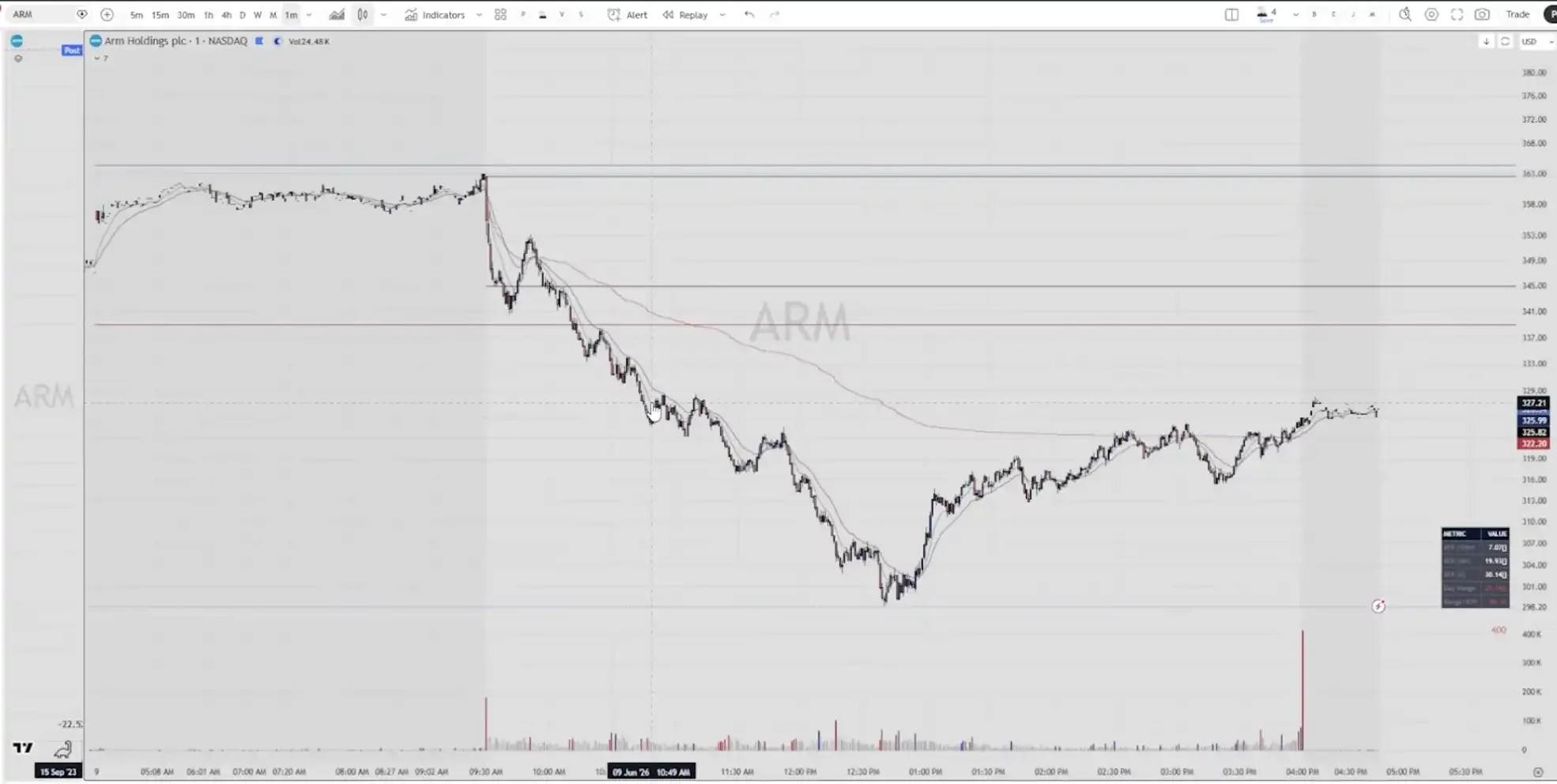
Second, past hot IPOs do not support the assumption of "inevitable one-sided upward movement early in the listing." Coinbase, Airbnb, and ARM all had extremely high attention but did not immediately provide a stable trend early in their listing; they first experienced violent two-way volatility. The market used to easily interpret hot IPOs as the realization of emotional consensus; a more accurate understanding now is that they often first become arenas for repeated turnover between short-term capital, profit-takers, and new buyers. This means that even if SpaceX has a strong narrative and high oversubscription, it doesn't mean the first week is suitable for trend followers. Those truly suited for day one participation are often traders who can quickly read order flow, control position size, and accept two-way volatility.
Third, the day-one strategy should shift from "predicting direction" to "waiting for structure." In the past, many traders habitually preset a bullish or bearish view before the open, then used the first price move to validate their judgment. But for a low-float IPO like SpaceX, it's better to first let the market draw its own structure: Is there support near $135? Is the 5-minute opening range effectively broken? Does the VWAP retracement hold? Are there constantly refreshing hidden buying or selling forces on Level 2? The core of trading now isn't to draw conclusions before everyone else, but to judge who holds the initiative after the market generates its first batch of price coordinates. This means the most important thing is not entering at the first possible moment, but avoiding being passively executed at the point of highest chaos, widest spreads, and most intense emotion.
Fourth, investors must understand that different phases are dominated by different types of capital. For the first 15 trading days, SpaceX is more like a short-term trading event driven by low float, emotional capital, and order flow. Around the 15th trading day, the expectation of Nasdaq 100 index inclusion may bring a second phase of price-insensitive buying. After the first earnings report, unlock supply begins to test market absorption. Further down the line, lock-up expirations for major shareholders at 70 days, 90 days, 120 days, 180 days, and one year will gradually provide more reliable long-term signals. In the past, IPOs were often judged by the price move on day one. Now, SpaceX looks more like a series of sequential liquidity tests. This means long-term judgments should not be based on day-one sentiment, but on whether the price can form a stable bottom after new supply enters the market.
Fifth, trading SpaceX might not only happen in SpaceX itself. Related aerospace and space economy stocks like Rocket Lab and LUNR could become proxy stocks for capital expressing the same theme during the listing period. In the past, IPO trading usually revolved around the main underlying asset. Now, when the main asset's float is too low, volatility too high, and spreads too wide, related assets might actually offer a clearer trading structure. This means the market isn't just trading SpaceX stock, but also trading the industrial narrative and liquidity spillover it activates.
If this article were compressed into one judgment, it would be: The first day of the SpaceX IPO belongs to traders; long-term judgment requires waiting for the supply test. For a trader, day one could be the "Super Bowl" of order flow trading. For an investor, the price move on day one should not be over-interpreted. In this sense, the core question of the SpaceX IPO is no longer just whether to buy on day one, but whether the participant can first determine which game they are entering: day one is about order flow, long-term is about supply absorption capacity. Mixing these two up is precisely why most retail investors lose money.
Below is the content of the video (edited for readability):
Why Most Retail Investors Could Lose Money in the SpaceX IPO
The most dangerous thing about SpaceX's IPO day is that many will treat it like trading a normal hot stock.
Normal stocks have historical price ranges, prior highs and lows, volume profiles, and ample market memory. Traders can reference past support and resistance, moving averages, options open interest, and cost basis. But an IPO day is a blank chart. Before the first candle appears, the market has zero real trading history.
This means drawing trend lines prematurely is meaningless, and chasing the first wave of a rally right at the open can easily get you blown up by a counter-move. Especially in a low-float environment, prices can spike rapidly on brief buying pressure or suddenly drop due to profit-taking or institutional supply. Retail investors looking only at the percentage gain and emotion are very likely to enter at the noisiest point.
The real trading logic for SpaceX on day one is the real-time formation of the auction mechanism. What traders need to observe is: Who is willing to bid up the price? Where are sellers constantly replenishing? At what price levels is there high volume but little price progress? This order book information is far more important than any pre-drawn technical pattern.
Trading Details: $75 Billion Raise, 3% Float, and High Retail Allocation
For this IPO, SpaceX plans to issue approximately 555 million shares, raising about $75 billion, priced at $135 per share, giving it a total valuation of around $1.7 trillion. This scale alone makes it a market-level event.
But what truly determines day-one volatility is not just the raise size, but the float. At the start of trading, the freely tradable shares are only about 3% of the total. This means even modest buying pressure can have a significant impact on the price. Retail chasing, active funds building positions, and institutional small-scale buys could all push the price away from fundamentals temporarily.
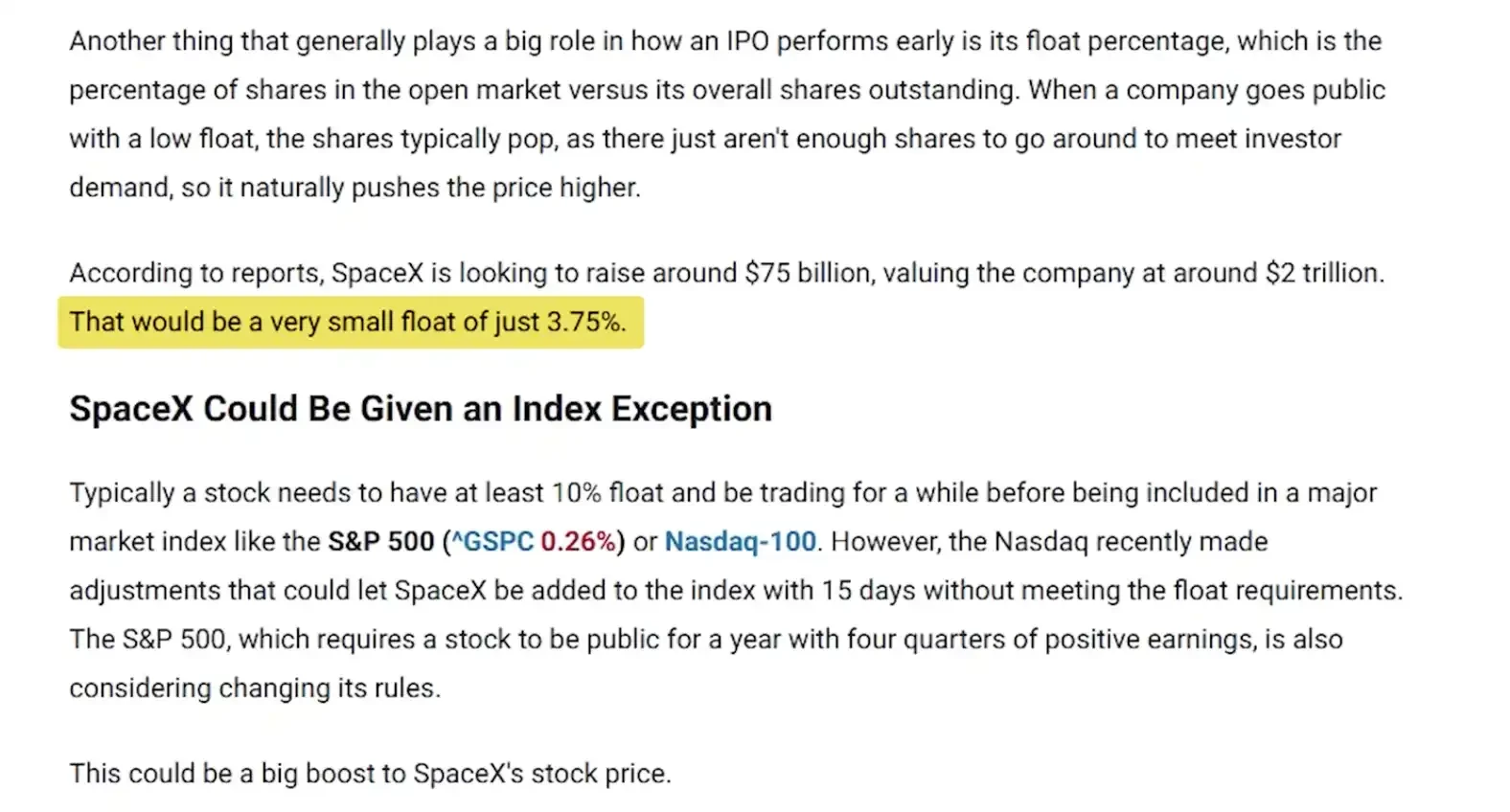
Another unique variable is the retail allocation. This retail allocation could be around 30%, which is about 3 to 4 times that of a typical IPO. This makes trading after the open even harder to read. On one hand, more retail investors receiving shares beforehand might reduce the "can't buy" FOMO chase at the open. On the other hand, these early recipients might also choose to take profits right after the open, creating the first wave of supply.
So, the core of the SpaceX IPO isn't simply judging "oversubscribed = bullish," but understanding the share structure. An extremely low float amplifies both upside and downside moves, while high retail allocation could make buying and selling forces more aggressive simultaneously on day one.
Day 15 Trading Day: Nasdaq Index Inclusion Could Change Capital Dynamics
Another key timeframe is the 15th trading day after listing. Based on current expectations, SpaceX could be eligible for inclusion in the Nasdaq 100 index (NDX). This arrangement is still subject to final rules and actual results, but the trading logic it implies is very important.
In the early listing period, price is primarily driven by fast money, retail, active funds, and emotional capital. These flows are price-sensitive and enter and exit based on volatility. But after index inclusion, another type of capital enters the market: passive flows.
The characteristic of passive flows is that it is price-insensitive. Index funds, ETFs, and related tracking products need to allocate constituent stocks according to rules. This buying is more mechanical and more easily front-run by the market.
Therefore, before the 15th trading day, active capital might try to front-run this expected buying. If the price has established upward momentum in the first two weeks, the mechanical buying from index inclusion could amplify the trend further. However, if the first two weeks are weak, this buying alone may not be sufficient to reverse the market's trajectory.
This is another way the SpaceX IPO differs from a regular day-one event: it's not a single point event, but a series of capital flow nodes.
Day One is Order Flow Trading, Not Chart Trading
The single most important judgment for SpaceX day one is: don't treat it as chart trading.
Regular traders are used to asking: Where is support? Where is resistance? Where is the prior high? Where is the volume profile? Where is the options maximum pain point? But for an IPO day, most of these questions have no answers. No historical chart means no reliable technical structure. No mature options market means no options open interest to reference.
The real questions for day one are: Where do buyers and sellers find agreement? Where does significant turnover occur? Is there buying support when the price falls below the IPO price? Is there a seller constantly replenishing supply on the way up? This is the core of order flow trading.
The first few critical price levels must be drawn by the market itself on the day. First is $135, the IPO price assumed in this analysis. Traders need to observe the price action relative to $135: Can it quickly recover after a breakdown? Can it sustain itself after moving above? If there's consistent buying support whenever it dips below $135, it suggests this level could become an early cost anchor. If it's consistently sold off every time it moves above $135, it suggests stronger supply overhead.
Second is the VWAP (Volume Weighted Average Price), representing the day's average execution cost. After the first hour, whether the price is above or below VWAP, and whether it gets support when retesting VWAP, directly reflects which side (buyers or sellers) is in control.
Finally, there are the day's high and low. After the close, the first day's high and low become the most important structural references for the following days. For a new stock with no chart history, the day-one range is the first coordinate system the market creates for itself.
Four Types of Capital Driving the Price
The price action in the early stages of the SpaceX IPO can be broken down into four types of capital flows.
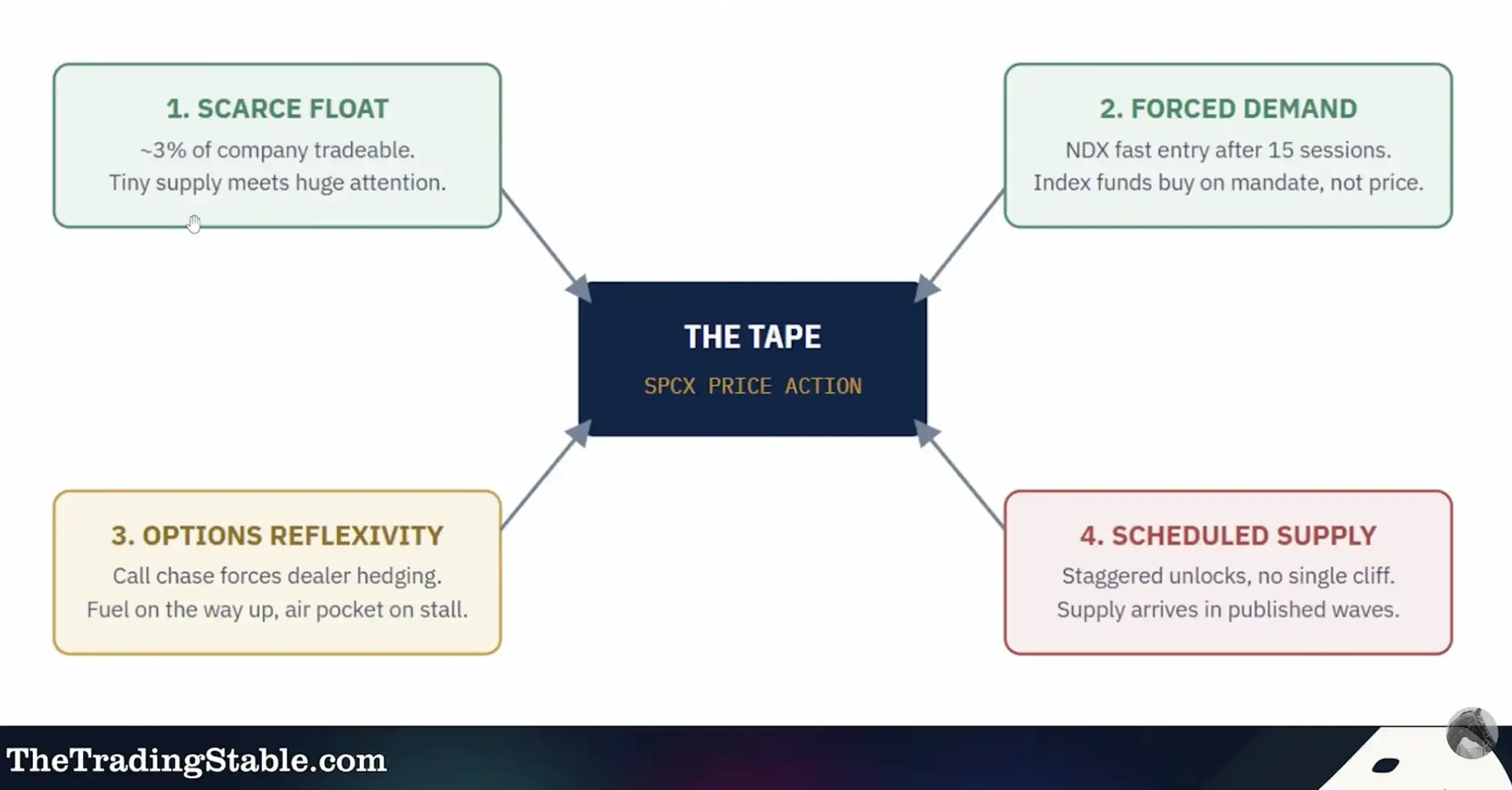
The first type is scarcity buying driven by the extremely low float. A 3% float means very few shares are available for trading. If demand concentrates even slightly, it can push the stock price up rapidly. This is why shorting blindly on day one is very dangerous. A low-float stock won't necessarily go up forever, but it can most easily "squeeze" shorts in a very short period.
The second type is passive buying from Nasdaq 100 index inclusion. If included on the 15th trading day, index funds and related products must buy according to the rules. This capital places orders based on index weight, not valuation. For bulls, this is an ideal mechanical demand. For short-term traders, this is a predictable time window to trade ahead of.
The third type is options reflexivity. Once options begin trading, retail investors buying large amounts of call options could force market makers to buy the underlying stock to hedge, creating a gamma cycle. However, this mechanism usually doesn't appear immediately on day one and may not mature until the first week.
The fourth type is share unlocks. This introduces new supply and is a risk all long-term investors must monitor. The special aspect of SpaceX is that it may not follow the standard model of a single large unlock after 180 days, but could release shares in stages.
Lock-up Expiration Schedule: Not a Single Cliff at 180 Days
A common risk point in traditional IPOs is the 180-day lock-up expiration, when early investors and employee shares are released en masse, suddenly hitting the market with significant supply. However, the SpaceX unlock structure described here is more complex: it may not be a single cliff event but a series of phased liquidity events.
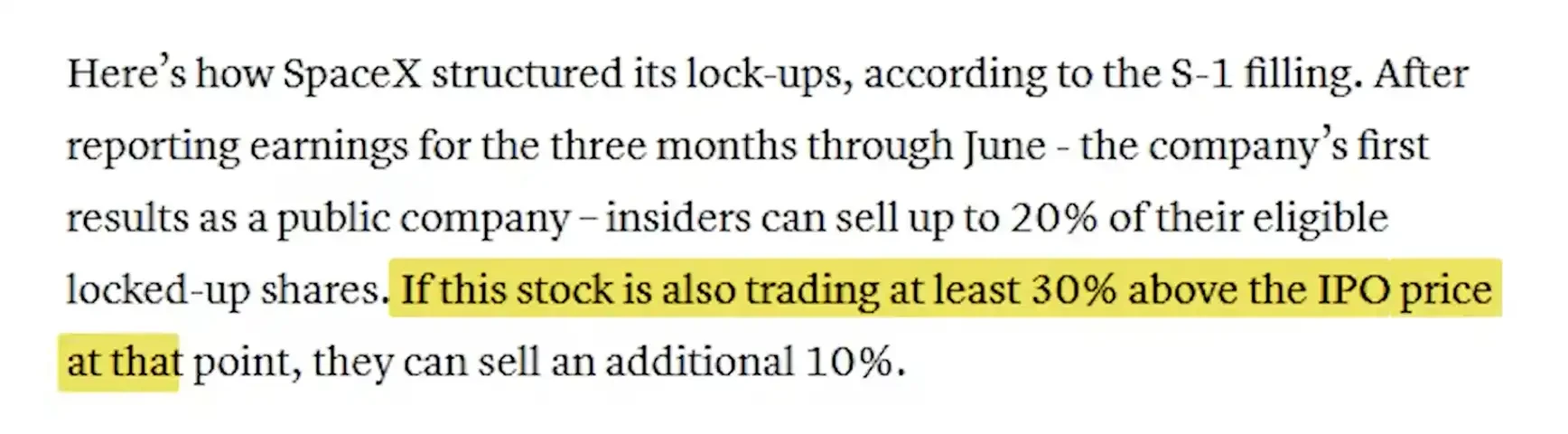
First, up to 20% of eligible shares could unlock 2 days after the first earnings report. This means the earnings report itself is not just a performance event but also a supply event. If the stock price is pushed up by sentiment before earnings, the new supply post-earnings could dampen the momentum.
Second, unlocks may also be tied to price performance. If the stock price remains 30% above the $135 IPO price for 5 out of 10 trading days before earnings, an additional 10% could unlock. This type of arrangement makes upward price moves trigger more supply, creating a dynamic balance: the sharper the rally, the more shares may become available for sale subsequently.
Subsequent timepoints are equally important. The analysis mentions potential unlocks of ~7% at day 70, day 90, and day 120, with full unlocking after 180 days. For employee shares, about 5% of employee-held stock may be eligible for sale immediately after the first earnings, without requiring additional performance or price conditions. Elon Musk and the largest holders may need to wait over a year, approximately 366 days.
These dates are particularly important for long-term investors. To determine if SpaceX has formed a true bottom, one cannot just look at the day-one price move. One must see if buying demand can absorb the new supply entering the market at each of these events.
Lessons from Past IPOs: Coinbase, Airbnb, ARM Didn't Offer One-Sided Trends from the Start
Hot IPOs can create the illusion that high market attention means a one-way upward trajectory post-listing. But the early trading of Coinbase, Airbnb, and ARM all demonstrate that hype does not equal a unidirectional trend.
The analysis notes that these hot IPOs experienced massive volatility in their early days. Coinbase's early price range was approximately 119 points, Airbnb's about 53 points, and ARM's about 22 points. The specific numbers are less important than the key takeaway: the first few days and weeks of a hot IPO are often characterized by violent two-way trading, not a stable trend.
This type of environment is better suited for scalpers and order flow traders than for typical trend followers. Trend traders need structure, but the early days of an IPO are precisely when structure is most lacking.
SpaceX could be even more extreme. It is already heavily oversubscribed and may allocate more shares to retail investors. This means at the open, there will be both chasing capital and profit-taking capital. Some will want to buy ahead of the potential day 15 index inclusion, while others see the high hype itself as a selling opportunity. The crowding of both bullish and bearish forces often results not in a clean trend, but in high turnover, high volatility, and high noise.
Day One Trading Strategy: Wait for the Market to Draw Structure, Then Act
The first rule for trading SpaceX on day one: do not chase the first wave at the open.
The opening moments are usually the time of highest noise, widest spreads, and most extreme emotion. Especially in a low-float environment, the first rally might just be a brief sweep of orders, and the first dip might just be a sharp drop due to a lack of liquidity. A truly tradable structure requires waiting for the market to form.
The first observation point is $135. If the price quickly recovers after breaking below $135 and reclaims the opening range and VWAP, it suggests real buying support underneath. Conversely, if the price repeatedly tries to move above $135 but is sold back down, it suggests sellers may be in control.
The second observation point is the 5-minute opening range. Using the 5-minute or 30-minute opening range filters out noise and prevents getting caught in early whipsaws. If the opening range is tight, a subsequent breakout is more meaningful because many short-term positions are concentrated within a narrow price band. Once the price leaves this range, stops and chasing orders are triggered more easily.
The third observation point is VWAP. One hour into trading, if the price is trading above VWAP


