






Cyber Chumaxian: Fake Taoists, AI Fortune-Telling, and the History of Northeast Mysticism


- Core Viewpoint: The article reveals the deep integration of AI technology with traditional mysticism (particularly the Northeast Chumaxian culture), giving rise to a vast and evolving "cyber mysticism" industry. The core driver of this phenomenon is not the technology itself, but the eternal human need for psychological comfort and definitive explanations in the face of immense modern uncertainty.
- Key Elements:
- Massive Market Scale: China's mysticism market is estimated to have exceeded one trillion yuan, while the global spiritual services market has reached $180.18 billion, with the AI fortune-telling segment experiencing rapid growth.
- AI as a Core Tool: Large AI models are used to generate fortune-telling reports and scripts, lowering the barrier to entry for practitioners and creating new business models like "fortune-telling prompt engineers" and AI-driven mysticism livestreams.
- Cultural Foundation of Northeast Chumaxian: The deep-rooted Shamanistic and Chumaxian traditions in Northeast China, combined with the collective anxiety brought by major social upheavals (such as the wave of layoffs), have fostered a large, mature practitioner base and market demand.
- Psychological Substitution Function: Fortune-telling, as an "external attribution" explanatory system, provides cheap psychological relief for stressed young people and is seen as "psychological counseling more suited to the Chinese physique."
- Increasing Regulatory Scrutiny: Since 2025, agencies like the Cyberspace Administration of China have launched special campaigns focusing on cracking down on the use of AI fortune-telling and divination to spread superstition and mislead netizens.
- Globalization and Cultural Export: Chinese teams have successfully marketed the combination of birth date and time (BaZi) with AI as "Eastern philosophy" to overseas markets, gaining paying users including Silicon Valley elites.
Original Author: Sleepy.md
For thousands of years, in a bid to grasp even a sliver of security in the face of unpredictable fate, the Chinese have developed an incredibly complex explanatory system. From oracle bone divination to the I Ching's Eight Trigrams, and further to the highly systematized Four Pillars of Destiny, metaphysics has always been the most secretive, yet most effective, psychological defense mechanism on this land. Even a great Confucian scholar like Zeng Guofan once confided in his diary: "The strangest thing in my life is fortune-telling."
How large is the market for this explanatory system? According to industry insiders, China's metaphysics market has long surpassed the hundred-billion-yuan mark.
Let's look at some overseas data for reference. As early as 2018, the annual revenue of the American divination industry was $2 billion. South Korea is even more staggering; with a population of 50 million, its divination industry reached a scale of $3.7 billion, with 150,000 registered practitioners, almost becoming a national profession. They even produced a fortune-telling reality TV show this year. China's market size is undoubtedly larger, not smaller.
Later, with the rise of modern technology, this traditional explanatory system was labeled as backward feudal superstition and was forcibly pushed to the margins of society. Technology attempted to completely take over the power of predicting the future with rationality and data.
But history's greatest irony lies right here. When technology reached its cutting edge, and when AI large language models demonstrated reasoning abilities bordering on the miraculous, it didn't eradicate metaphysics. Instead, it became the most convenient weapon in metaphysics' arsenal.
Recently, Shanghai police busted a fake Taoist priest ring that involved 50,000 people over six months. When faced with victims' bizarre questions about fate, these fake priests, with only a middle school education, were most adept at opening an AI large language model to search for answers. Shortly after, the Cece App, with 60 million users, was named and shamed during the annual 3·15 consumer rights TV gala. Its core business model is using free AI fortune-telling to attract traffic, which is then resold to over 20,000 live-streaming hosts on the platform who charge by the minute.
See? The most cutting-edge AI has seamlessly become an add-on for the oldest superstitions. When people pay for fortune-telling, they are never buying the cold, hard result. They are buying a process that can smooth out their anxiety. No matter how logically rigorous AI's calculations are, it cannot provide that touch of spiritual insight, nor can it convincingly play the role of a medium communicating with the divine.
And in China, if you're looking for the industrial foundation for spirit mediums, no place is larger or more mature than Northeast China.
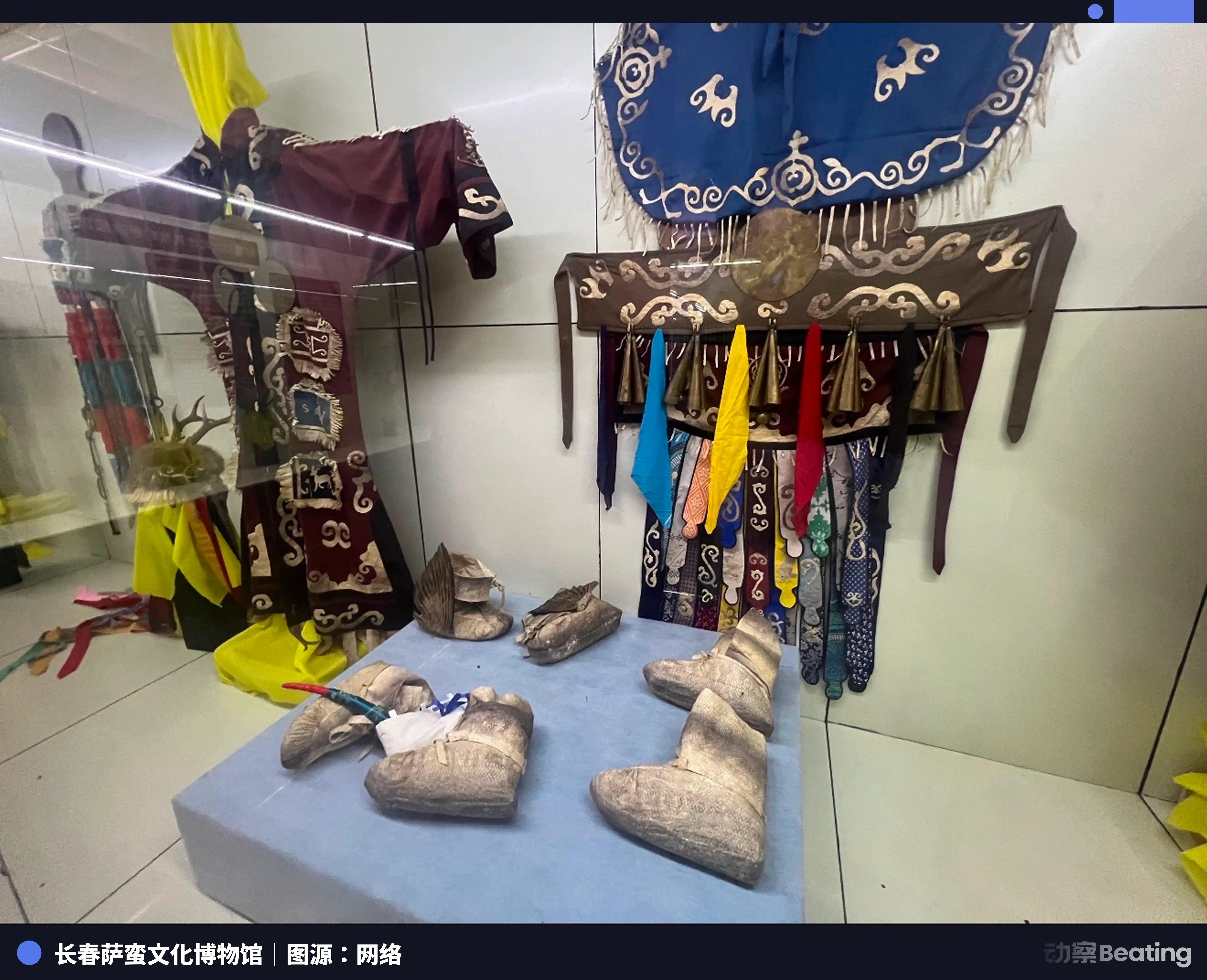
The black soil of Northeast China is deeply rooted in Shamanistic culture and the tradition of "Chumaxian" (出马仙, spirit mediums). Here, "Daxian" (大仙, great immortals/mediums) are not just a folk belief but a tangible, large-scale professional community. When the traffic红利 of the mobile internet collided head-on with the brute computational power of AI large language models, this vast community almost instinctively completed a cyber transformation.
Thus, an absurd yet perfectly fitting industrial chain took shape. AI is responsible for the "computational" power of calculation, while the practitioners steeped in Northeast China's Chumaxian culture are responsible for the "spiritual" texture. In some late-night live-streaming rooms, even genuine disciples with proper lineage are accustomed to letting AI run a preliminary destiny chart. As for those half-baked dabblers who dare to enter the field with superficial knowledge, they simply use AI-generated scripts to conduct the business of comforting hearts.
Fortune-Telling: Psychotherapy Better Suited for the Chinese Constitution
The underlying tone of Northeast Chinese metaphysics is Shamanistic culture and Chumaxian.
Tencent News previously published an article titled "One Hundred Thousand Daxian Reside in Northeast China." Bilibili UP主 and member of the folk organization "Chumaxian Association," Sun Shaoye, once estimated that in Liaoning province alone, there are over 40,000 "Daxian" making a living through "Chumaxian." This is a highly regional folk belief where a person becomes possessed by an "immortal" (仙家), suddenly gaining the ability to divine, heal, and tell fortunes.
This belief system has its own complete pantheon of spirits. Northeasterners call these five types of animal immortals "Hu Huang Bai Liu Hui": Hu Xian (fox), Huang Xian (weasel), Bai Xian (hedgehog), Liu Xian (snake), and Hui Xian (rat). After cultivating for hundreds of years, these animal spirits seek out individuals with "spiritual energy and immortal affinity" to possess, transmitting messages through the disciple's mouth. The method of selecting a disciple also has its own lore. Typically, the person suffers a great calamity or serious illness, then begins to have a fever, tremble, talk nonsense, shiver with a certain rhythm, and suddenly jolt into a trance. Their voice and demeanor change as if they were another person—this is the possession by the immortal.
The ritual to establish a Chumaxian altar is also a true spectacle. For example, having a sick person hold a rooster and walk around a certain area, burying a ceramic jar underground, or burning paper effigies at a crossroads at midnight. These practices still occur in many parts of Northeast China today; they are not distant legends. Your elders at home might have witnessed them firsthand.
Over a hundred years ago, during the "Chuang Guandong" migration, pioneers faced bone-chilling cold, wild beasts, bandits, and a completely unpredictable tomorrow. Their fear had nowhere to go. In that desperate situation of extreme insecurity, they desperately needed a powerful explanatory system like Chumaxian to embolden themselves.
From 1860 to 1911, over 20 million people poured into Northeast China. They didn't just bring hoes and seeds; they also brought the "Baojia Xian" (household protector spirits) beliefs and fox immortal systems from Shandong. These immigrants arrived in the Northeast, encountered the local Shamanistic traditions, and the two spiritual systems collided and fused into something new. The Shaman altar masters absorbed the fox immortal narrative, developing new rituals where spirit possession required establishing an altar. The fox communities of Changbai Mountain were endowed with the mysterious attribute of cultivating for millennia, becoming the new ancestral home of fox immortals.
Thus, Chumaxian took root in the Northeast. The reason this belief system could embed itself so deeply here is that this land was inherently a petri dish for suffering.
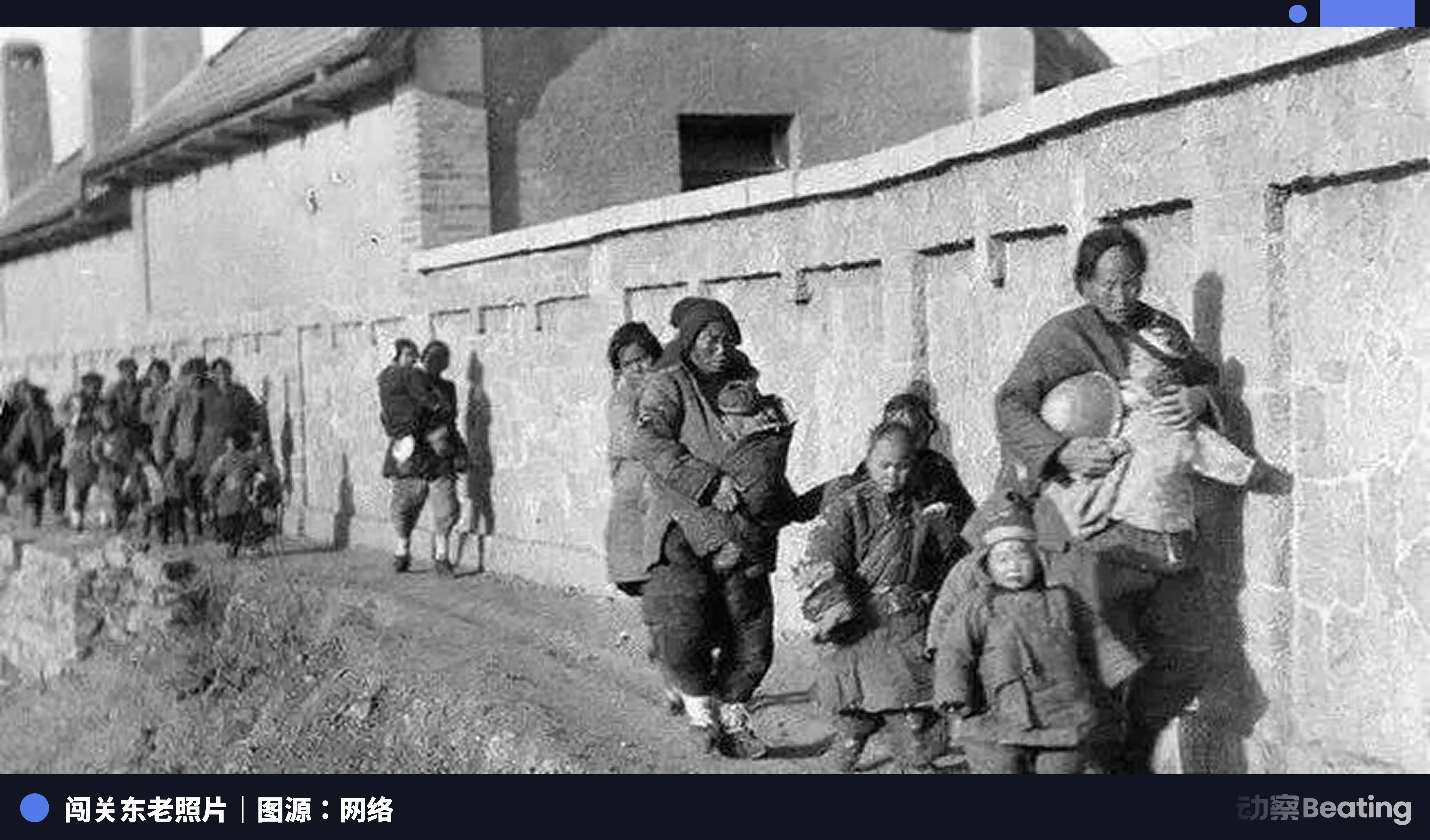
In those days, perhaps one out of every two Chuang Guandong migrants died on the journey or in the first few years of pioneering. The legend of Huang Xian's "transportation magic" reflects the collective anxiety over food shortages. The imagery of Bai Xian "rolling ingots" contains the发财梦 of the migrants. The "returning substitute" ritual existed because medical conditions were so poor, and people had an inexplicable fear of illness and disaster, using this to对抗死亡.
But what truly forged this belief system into its present form was not just suffering, but several historical events that nearly shattered it.
In 1934, Japan enforced a "Group Hamlet" policy in Northeast China, forcibly relocating and merging natural villages on a large scale, destroying traditional Shamanistic ritual spaces. In 1939, Japan implemented the "Grain Outflow" policy, seizing 70% of Northeast China's grain output, leading to a major famine. In times of famine, seeking immortals for survival became the most genuine social need, and altars反而大量涌现. Folklorists have recorded that during the Japanese occupation, some altars were forced to become information channels for the Japanese side—the first time spirits were used as tools by political power.
After the founding of the PRC, the state explicitly banned such practices. Chumaxian was denounced as feudal superstition, and practitioners went underground. They learned survival techniques: secret family传承, incorporating大量暗语 into texts to make them incomprehensible to outsiders; some learned acupuncture, using the身份 of traditional Chinese medicine to掩护 their continued practice. During the subsequent特殊历史时期, the crackdown intensified, but this system didn't die. It只是藏得更深 into every courtyard of Northeast China's countryside. According to folklorists' field research, Chumaxian practitioners of that era were "pulling curtains at midnight, secretly seeing clients."
真正的松绑 had to wait until after the Reform and Opening-up. In the 1980s, altars began to resurface. In 2006, "Shamanistic Rituals" were列入吉林省非物质文化遗产. In 2012, Changchun established the Shamanistic Culture Research Association,开始吸纳前顶香人. But what truly caused the industry's explosive expansion was 1998.
That year, layoffs from state-owned enterprises in the Northeast reached millions, coinciding with the Asian Financial Crisis. Overnight, millions lost their jobs, their单位-given identity, and their grip on the future. In Shenyang's Tiexi District, the former heart of heavy industry, a "Fortune-Telling Street" appeared,聚集了 37家堂口. Laid-off workers, unemployed female workers, and young people with no出路 queued to ask the immortals if they still had a chance to turn their lives around.
This is the underlying logic of Northeast Chinese metaphysics and the secret to its repeated resurrections. Every time the wheels of history碾过, it wasn't碾碎. Instead, it absorbed the deepest fears of that era and completed its own evolution.
The fear during Chuang Guandong was death. The fear during the特殊历史时期 was being exposed. The fear during the下岗潮 was loss. Today's fear is uncertainty. The外壳一直在换, but the thing that drives people to seek immortals has always been the same.
Today, Northeast China has experienced剧烈的经济转型阵痛 and population outflow. According to national census data, from 2010 to 2020, the three northeastern provinces saw a net decrease of 11.01 million常住人口, equivalent to the entire disappearance of a city like Harbin.
When grand historical narratives fall upon specific individuals, they become layoffs, unemployment,迷茫, and a deep sense of powerlessness towards the future. The more uncertain tomorrow is, the more the metaphysics market thrives—this is the most典型的口红效应 in economics.
When the real world fails to provide certainty, people naturally turn to supernatural forces. This psychological demand has硬是催生出了一个庞大的玄学消费市场. In this pool, Northeast China's "Daxian,"凭借独一份的文化背景和语言天赋, have稳稳当当地切走了一大块蛋糕.
"Fortune-telling is psychotherapy better suited for the Chinese constitution."
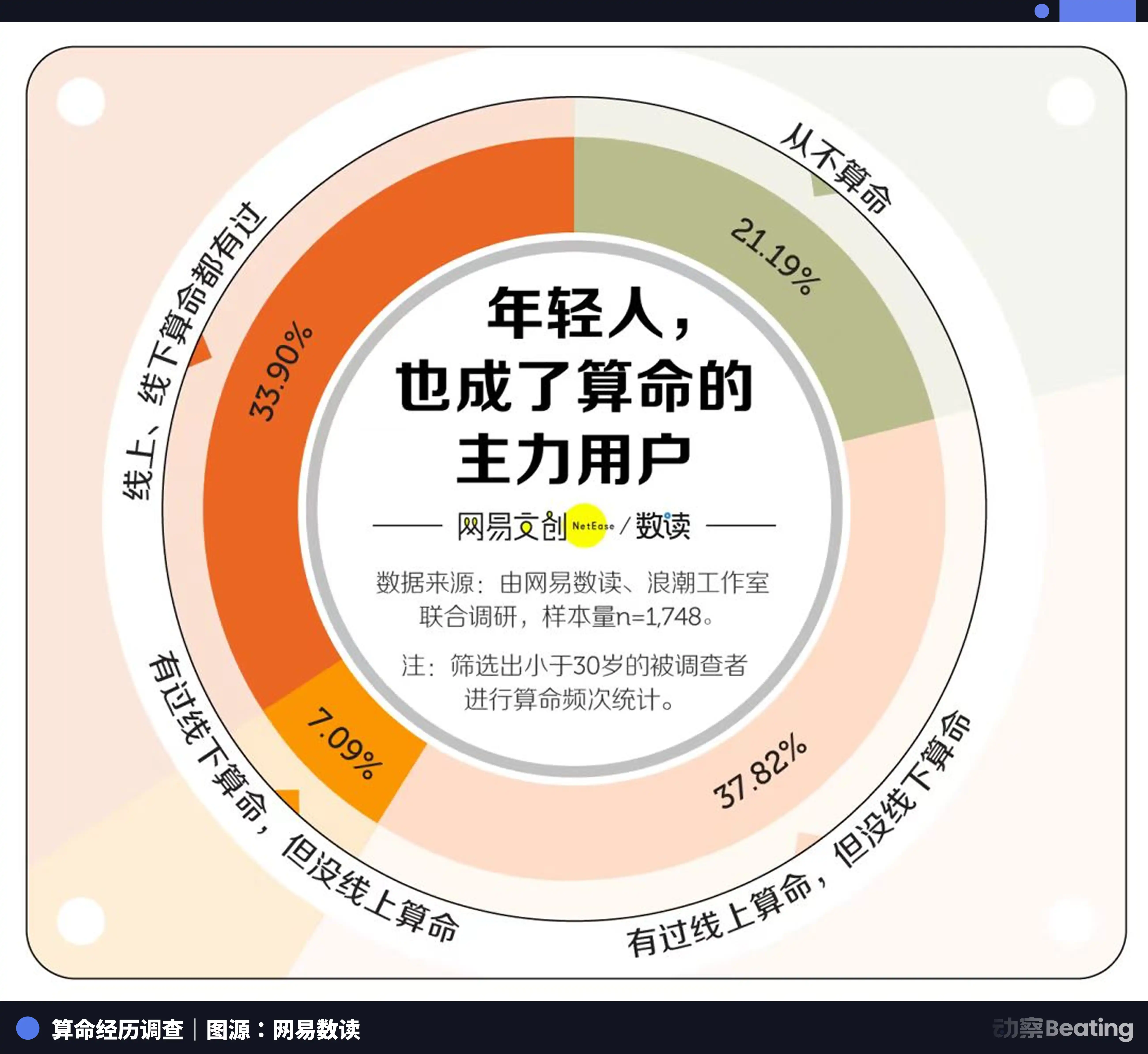
A survey by NetEase Data shows that高达 78.81% of young people have had fortune-telling experiences. Consider another set of data: Frost & Sullivan预计 that by 2025, China's泛心理健康服务市场规模 will才刚到 104亿元.
The underlying logic of Western psychotherapy is inward attribution. You're depressed, anxious, or have messed up interpersonal relationships because your原生家庭 has issues, your童年 has trauma. You need to剖析自己,接纳自己,改变自己.
This logic, placed within our East Asian society that emphasizes collectivism and shame culture, often burdens individuals with极其沉重的道德包袱. Often, when young people see a psychologist, instead of catching their breath, they陷入更深的自我怀疑 from repeatedly digging up inner wounds.
But fortune-telling is purely outward attribution. When your job fails, your relationship fails, and even drinking cold water feels like a struggle, the fortune-teller will斩钉截铁地告诉你: "This is not your fault. You are犯太岁 this year. Your八字流年不利. You are being blocked by小人."
Once this explanatory logic emerges, the boulder named "guilt" in the seeker's heart瞬间就落地了.
This psychological暗示 that "the fault is not mine" is, for young people today crushed by内卷 and anxiety,简直是最高级的精神按摩. It gives you an external target to legitimately blame, allowing you to护住最后一点自尊心 when facing life's beatings.
But ultimately, this is still a博弈 between people. Until AI entered the scene, the scale and nature of this博弈全变了.
The Fortune-Telling Industry Forced to Evolve by Algorithms
生辰八字 is essentially an extremely rigorous set of parameters and algorithms,也算是一种统计学. The Heavenly Stems and Earthly Branches are variables, the Five Elements' generation and克制 are functions, and the十年大运 and流年 are time series. This set of本土代码 that has been running for thousands of years意外地严丝合缝 with the underlying logic of modern AI.
According to reports, a startup called MirrorAI used real cases from the Hong Kong Fortune-Telling Master Competition as training data for its large language model. According to MirrorAI's team tests, the AI's accuracy in predicting users' past experiences已接近资深命理师水平, far exceeding the原生大模型's 40% baseline.
This number意味着 that in pure "deduction," AI has already摸到了行业头部的天花板. Those low-end fortune-tellers who rely solely on memorization and套路忽悠人 are being按在地上摩擦 by free AI large language models. Faced with this降维打击, the traditional fortune-telling industry didn't die; it was反而被逼得进化了. Some institutions预测 that by 2025, China's AI fortune-telling market will突破 1200亿元. The global astrology app market is also growing from about $3 billion in 2024 at an annual rate of 20%. This speed is比绝大多数所谓的「风口赛道」都猛.
When fortune-telling becomes a computational service with几乎为零的边际成本, the industry's power center换人了. In the past, it was about who mastered complex命理知识. Now, the core assets are who can use AI tools while also providing情绪价值.
A portion of savvy practitioners have already原地转型 from fortune-tellers to fortune-telling Prompt Engineers.
They早就 don't manually chart destiny anymore. Instead, they use AI to directly generate万字命理报告, only handling the最后那一哆嗦 themselves—providing emotional安抚 and话术包装. They心里门儿清: no matter how accurately AI calculates, it cannot替人跟人之间那点热乎乎的情感交流.
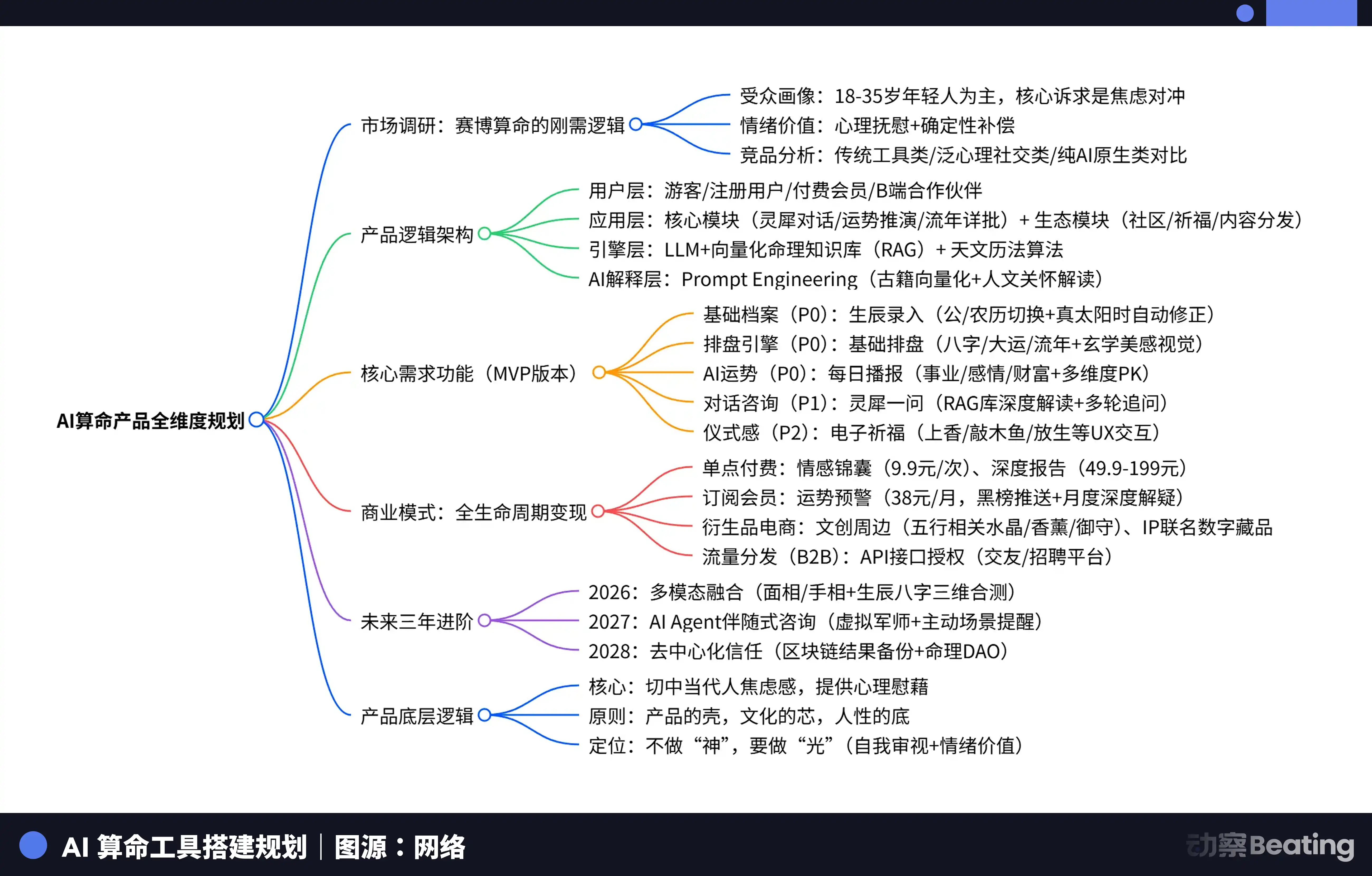
This circles back to the玄学直播产业链 mentioned earlier. Why can people with only a middle school education, or even completely ignorant of metaphysics, become masters after a month of training? Because AI handles all the most brain-intensive calculations and knowledge retrieval. They only need to演好那个能提供情绪价值的壳.
In the live-streaming rooms, the "Daxian" have虔诚连麦的信徒 on one side of the screen and疯狂运转的 AI话术生成器 on the other. What need is there now for genuine immortal possession? The large language model is their most显灵的赛博仙家. They use the most接地气的大白话 to嚼碎了 the complex destiny charts spat out by AI and feed them to the anxious young people on the other side of the screen, providing廉价但管用的心理按摩.
This效率狂飙 brought by technological降维打击 has not only收割了一遍 domestic youth but has even催生出了一场东方神秘力量的数字化远征.
When Chinese生辰八字 is translated into English by AI, will those elites sitting in Silicon Valley offices pay for this "Eastern Philosophy"?
The Mysterious Force from the East
They not only pay, they pay quite willingly. In recent years, the global market size for spiritual products and services has reached $180.18 billion. The monthly search volume for the term "feng shui" on Google is高达 200万次, primarily by欧美 users.
According to Tencent News, a five-person startup team in Shenzhen called FateTell packaged Chinese生辰八字, renamed it "The Book of Fate," and专门卖给老外. They use AI to generate巨详细的英文命理报告,硬是把这门古老的东方玄学做成了高客单价的数字商品. Their overseas user付费率高达 4%,复购率 38.7%, with 70% of revenue coming from会员订阅. The project早早开始了盈利.
This is a cultural export filled with魔幻现实主义色彩. Fortune-telling, once pointed at and骂封建迷信, now披上 AI的马甲,摇身一变成了东方哲学,一枪正中海外中产和硅谷精英命运焦虑的靶心. Those high-salaried engineers in Silicon Valley, facing裁员潮 and行业内卷,同样心里没底,同样需要一种超越理性的力量来给自己压惊.
In the古老的盘子 of玄学消费, people of different social strata are being served by completely different tools.
Young people at the底层 can only use free DeepSeek as a "数字神谕," or蹲在抖音、快手的直播间里, spending几十块钱 to draw a Tarot card and hear the主播给他们点安慰. Their questions are usually具体又微小, like "Will I pass tomorrow's interview?" or "Can I get back with my ex?"
Anxious middle-class white-collar workers are willing to spend几百上千块 on one-on-one services on apps like Cece. What they are buying is压根 not accuracy, but a树洞 willing to listen to them吐槽老板 and their partners. Their questions often掺着对


