Can Spacecoin Revolutionize Global Internet Access Through DePIN?



- Core Viewpoint: Spacecoin is a blockchain project that utilizes the DePIN model and a nano-satellite constellation, aiming to provide decentralized internet access to the globally unconnected population. Its core value lies in incentivizing community co-construction of the network through a token economy, challenging the centralized model of traditional telecom giants.
- Key Elements:
- The project aims to address the issue of approximately 2.6 billion people lacking internet access globally by deploying a low Earth orbit nano-satellite constellation, bypassing expensive ground infrastructure.
- It adopts the DePIN model, using the SPACECOIN token to incentivize users to operate ground stations to provide coverage, thereby crowdsourcing network construction and maintenance costs.
- The blockchain layer is responsible for network identity management, micro-payment settlements (users pay data fees with tokens), and verifying the coverage proof of ground stations.
- Compared to centralized services like Starlink, its differentiation lies in open protocols, permissionless access, and potentially lower usage costs.
- The project faces multiple risks, including technical execution (satellite launch and maintenance), regulatory approvals (spectrum and orbital rights), and user adoption (cryptocurrency acquisition barriers).
- The SPACECOIN token is the core of the ecosystem, used for paying data fees, rewarding operators, and participating in network governance staking.
- The token can be traded on the XT.com exchange via the SPACECOIN/USDT trading pair. The platform also offers automated tools such as spot grid trading.
In the digital age, internet access is often considered a fundamental human right. It is a gateway to education, finance, healthcare, and global communication. However, a staggering reality persists: approximately 2.6 billion people worldwide—nearly one-third of the global population—remain unconnected. Traditional Internet Service Providers (ISPs) have failed to bridge this gap, as the pursuit of profit makes building infrastructure in rural and remote areas unviable. Spacecoin emerges as a solution, aiming not just to issue a token but to launch a satellite constellation to democratize connectivity.
As the crypto world shifts its focus from purely speculative assets to projects with tangible real-world utility, a new frontier has emerged: Decentralized Physical Infrastructure Networks, or DePIN. Spacecoin stands at the forefront of this movement, proposing a radical solution to a problem that has plagued humanity for centuries. But is it technically feasible? Can a blockchain project truly compete with giants like Starlink?
This comprehensive analysis will delve into Spacecoin's operational mechanisms, its role in the DePIN revolution, and whether it represents a viable investment opportunity in the current market cycle. We will explore its technology, tokenomics, and the practical steps for trading SPACECOIN on platforms like XT.com.
The Global Connectivity Crisis: Why Spacecoin Matters
To understand Spacecoin's value proposition, we must first grasp the scale of the problem it addresses. The "digital divide" is more than a buzzword; it's an economic chasm. Traditional telecom infrastructure relies on ground-based towers and fiber-optic cables. Laying this infrastructure is prohibitively expensive, geographically challenging, and politically complex.
Consequently, vast swathes of Africa, Southeast Asia, and South America remain in the dark. Even in developed nations, rural areas suffer from slow speeds and monopolies. Spacecoin proposes a paradigm shift: moving the infrastructure to the sky and the governance to the blockchain.
Spacecoin's Vision
Spacecoin's mission is bold and simple: to provide reliable, permissionless, high-speed internet access to billions of unconnected people. Unlike traditional telecom giants that act as gatekeepers, Spacecoin envisions a decentralized network where users are not just customers but participants. By leveraging a constellation of nanosatellites, the project aims to beam internet coverage directly to devices anywhere on Earth, bypassing the need for costly ground infrastructure.
This isn't just about checking email; it's about enabling financial inclusion through DeFi, educational equity through online learning, and economic growth through global trade. Spacecoin represents a fusion of aerospace engineering and crypto decentralization.
DePIN: The Engine Behind the Revolution
Spacecoin is a quintessential DePIN project, a sector rapidly becoming one of the most exciting narratives in cryptocurrency. DePIN leverages crypto-economic incentives to crowdsource the construction of physical infrastructure.
How Spacecoin Leverages the DePIN Model
In the traditional model, a single company (like SpaceX or AT&T) bears the capital expenditure for network build-out. In the Spacecoin model, the community helps build and maintain the network.
- Decentralized Base Stations: Users can operate ground stations that communicate with the satellites.
- Token Incentives: Operators are rewarded with SPACECOIN tokens for providing coverage and bandwidth.
- Cost Reduction: By distributing infrastructure costs across a network of distributed participants, Spacecoin can theoretically offer services at a fraction of the cost of traditional providers.
This model flips capital efficiency on its head. Instead of borrowing billions to build towers, Spacecoin uses its token to bootstrap a global network of hardware contributors.
The Technology: Blockchain Meets Low Earth Orbit (LEO)
Spacecoin's technological pillars are a hybrid of cutting-edge aerospace hardware and blockchain software.
The Nanosatellite Constellation
The project plans to deploy a network of Low Earth Orbit (LEO) nanosatellites. LEO satellites orbit much closer to Earth (approximately 500-2000 km) than traditional geostationary satellites (~36,000 km). This proximity offers two key advantages:
- Lower Latency: Shorter signal travel distance makes real-time applications like video calls and gaming possible.
- Lower Launch Costs: Nanosatellites are smaller, lighter, and cheaper to manufacture and launch, allowing for faster iteration and deployment.
The Blockchain Layer for Verification and Payments
The blockchain acts as the network's settlement layer. It handles:
- Identity Management: Ensures secure, permissionless access for users without the cumbersome KYC processes typically required by traditional ISPs.
- Micropayments: Facilitates seamless, pay-as-you-go data consumption. Users pay only for the bandwidth they consume, settled in the native token.
- Proof of Coverage: The blockchain verifies that ground stations are actually providing the coverage they claim, ensuring the integrity of the reward system.
Spacecoin vs. The Giants: A Comparative Analysis
Investors often ask, "How can Spacecoin compete with Starlink?" The answer lies not in outspending Elon Musk but in offering a fundamentally different architecture and business model. Starlink is a centralized walled garden; Spacecoin is an open protocol.
Table: Spacecoin vs. Traditional ISP vs. Starlink
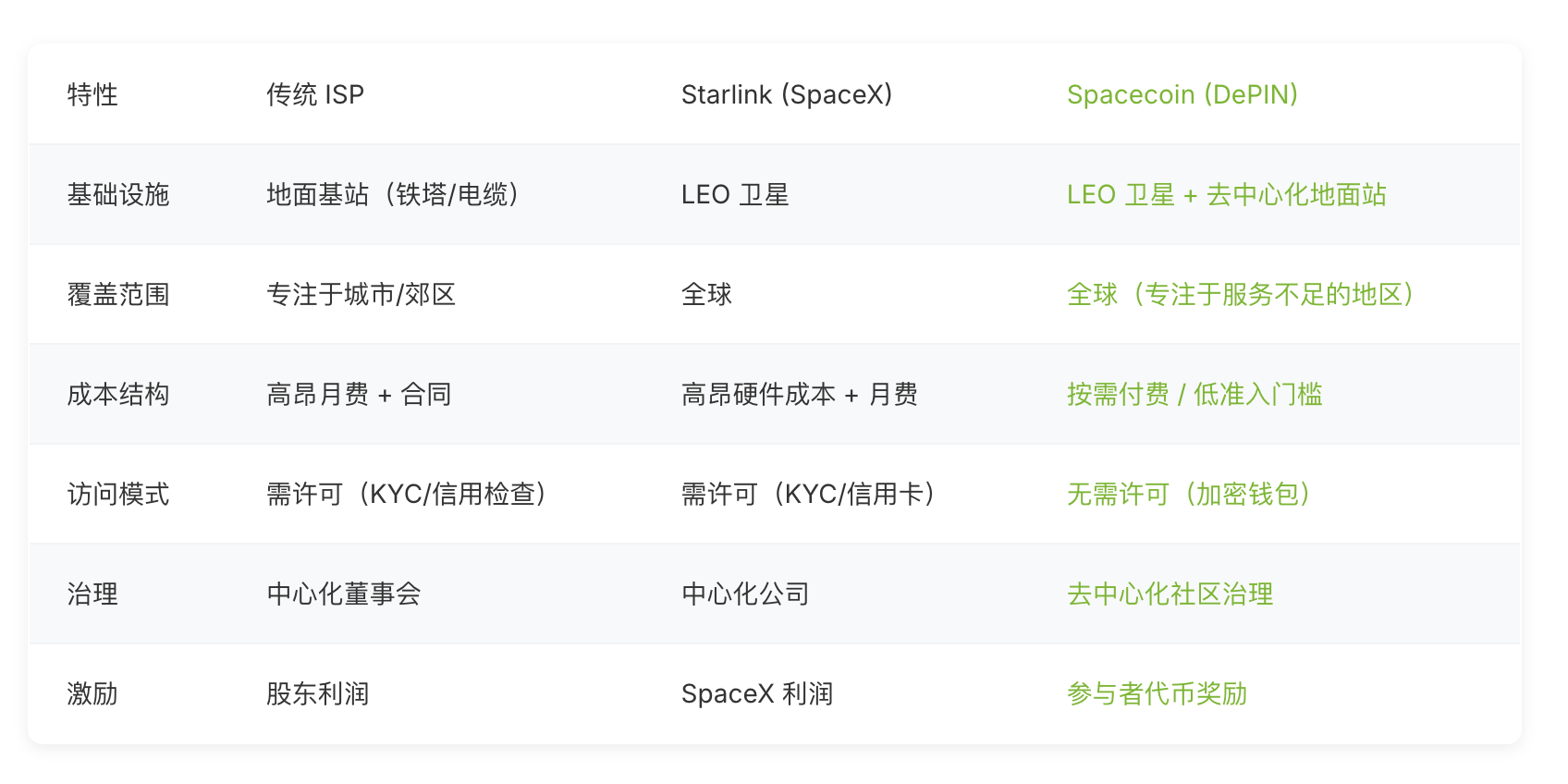
Spacecoin captures a segment that Starlink overlooks: users who cannot afford $500 hardware or monthly subscriptions, and those who require privacy and censorship resistance.
The Investment Case: Tokenomics and Market Potential
The SPACECOIN token is more than a speculative instrument; it is the fuel for the ecosystem. Its value is intrinsically linked to the network's usage and expansion.
Utility Drivers
- Payment Currency: Users pay for data with SPACECOIN. As the network grows and more users come online, demand for the token increases.
- Staking & Governance: Token holders can stake assets to secure the network or vote on protocol upgrades (e.g., where to focus satellite coverage next).
- Reward Mechanism: Ground station operators are paid in SPACECOIN. This creates a circular economy where both service providers and consumers use the native asset.
Total Addressable Market
Spacecoin's Total Addressable Market (TAM) is immense. The global telecom market is worth trillions of dollars. Capturing even a small fraction of the 2.6 billion unconnected users via DePIN represents a multi-billion dollar opportunity. Furthermore, the DePIN narrative is currently attracting significant institutional capital looking for crypto projects with real-world revenue streams.
Trading Strategically: Acquiring Spacecoin on XT.com
For investors looking to gain exposure to the future of decentralized connectivity, choosing the right platform is crucial. XT.com provides a robust environment for trading SPACECOIN, offering high liquidity and advanced tools suitable for both novice and professional traders.
XT.com is known for identifying high-potential DePIN and infrastructure projects early. The platform ensures a secure trading experience with low-latency execution, which is critical in volatile crypto markets.
How to Trade
For most investors, the primary entry point is the SPACECOIN/USDT trading pair. Here, users can buy and sell the token directly with Tether (USDT).
- Limit Orders: Recommended for investors with a specific entry price in mind. You set the price you're willing to pay, and the order executes when the market matches it.
- Market Orders: Best suited for those seeking immediate execution to capture fast price movements.
Automate Your Strategy with Grid Trading
Crypto markets never sleep, and volatility is the norm. For a project like SPACECOIN, which may experience price swings as it hits development milestones, using an automated strategy can be highly effective.
XT.com offers a powerful Spot Grid Trading Bot specifically designed for these conditions.
- Strategy: The bot automatically places buy orders at lower price levels and sell orders at higher price levels within a set range.
- Benefit: It profits from normal market "noise." Instead of holding and waiting, the bot actively trades volatility, accumulating profits from tiny price movements 24/7. This removes emotional decision-making and ensures you never miss a swing.
Risks and Challenges
While the vision is inspiring, prudent investors must weigh the risks. Spacecoin sits at the intersection of two highly complex industries: aerospace and blockchain.
- Regulatory Hurdles
Space is becoming a regulated frontier. Launching satellites requires approval from bodies like the International Telecommunication Union (ITU) and local governments. Navigating spectrum rights and orbital slot allocation is a bureaucratic nightmare that could delay deployment.
- Technical Execution
Building and launching satellites is incredibly difficult. Hardware failures, launch delays (often reliant on third-party providers), and maintaining a stable mesh network in orbit present significant engineering challenges. Unlike a DeFi protocol, you can't simply "patch" a satellite once it's in orbit.
- Market Competition
While Spacecoin differs from Starlink, it may face competition from other blockchain-based connectivity projects like Helium (for mobile) or World Mobile. The DePIN space is getting crowded, and only projects with exceptional execution will survive.
- Adoption Barriers
The target audience (the unconnected) may face barriers in acquiring cryptocurrency to pay for services. Spacecoin must ensure a seamless user experience, potentially abstracting away the crypto elements for end-users to achieve mass adoption.
Conclusion: Is Spacecoin the Missing Link?
Spacecoin represents one of the most ambitious attempts to leverage blockchain technology to bridge the digital divide. It moves beyond the realm of digital speculation into the tangible, life-improving domain of physical infrastructure. By decentralizing the ownership of internet access, it challenges the hegemony of traditional telecom giants.
For investors, Spacecoin is a long-term bet on the DePIN narrative. If the team can successfully navigate the technical and regulatory minefield of space technology, it offers immense upside potential. It's a wager on a future where connectivity is not a corporate-granted privilege but a code-guaranteed right.
Whether you're looking to support a mission for global connectivity or seeking a high-growth asset for your portfolio, Spacecoin warrants attention. With XT.com offering seamless access through standard trading and automated Spot Grid strategies, positioning in this space has never been easier. As we look to the stars, Spacecoin reminds us that crypto's next frontier might just be in orbit.
Frequently Asked Questions (FAQs)
Q: What is Spacecoin? A: Spacecoin is a Decentralized Physical Infrastructure Network (DePIN) project aiming to provide global, permissionless, high-speed internet access using a nanosatellite constellation and blockchain technology.
Q: How is Spacecoin different from Starlink? A: Starlink is a centralized service owned by SpaceX, requiring a credit card and expensive hardware. Spacecoin is a decentralized protocol. It aims to be permissionless, allows users to pay with cryptocurrency, and incentivizes the community to build and maintain the network.
Q: Where can I buy SPACECOIN? A: SPACECOIN is tradable on XT.com. You can trade directly via the SPACECOIN/USDT trading pair.
Q: What is the utility of the SPACECOIN token? A: The token is used to pay for internet data usage, reward infrastructure providers, and govern the network by voting on proposals.
Q: Is investing in Spacecoin risky? A: Yes, like all cryptocurrency investments, especially those involving complex hardware and aerospace regulations, it carries high risk. Potential investors should conduct thorough research and consider the regulatory and technical challenges involved.
Q: Can I automate trading Spacecoin? A: Yes, XT.com offers Spot Grid Trading tools that allow you to set parameters for a bot to automatically buy low and sell high, profiting from market volatility.
About XT.COM
Founded in 2018, XT.COM is a leading global digital asset trading platform with over 12 million registered users, operations spanning 200+ countries and regions, and an ecosystem traffic exceeding 40 million. The XT.COM cryptocurrency trading platform supports 1300+ high-quality tokens and 1300+ trading pairs, offering diverse trading services including spot trading, margin trading, and futures trading, alongside a secure and reliable RWA (Real World Asset) trading market. Upholding the philosophy of "Explore Crypto, Trust in Trading," we are committed to providing global users with a safe, efficient, and professional one-stop digital asset trading experience.