Can Kled AI become a disruptor in the field of decentralized computing?



- 核心观点:Kled AI构建去中心化AI计算网络,实现算力民主化。
- 关键要素:
- 利用PoR共识机制验证AI计算工作。
- 通过$KLED代币激励算力贡献与支付。
- 旨在显著降低AI开发成本与准入门槛。
- 市场影响:挑战中心化云服务,可能降低行业成本。
- 时效性标注:长期影响
The world of blockchain and artificial intelligence is rapidly evolving, with new projects constantly emerging that promise to reshape the digital landscape. Kled AI is one of the most prominent examples, aiming to build a decentralized network that combines the power of AI with the security and transparency of blockchain technology. By establishing a global marketplace for computing resources, Kled AI is committed to democratizing the development and deployment of artificial intelligence.
But what exactly is Kled AI? What makes it stand out among numerous innovative projects? This article will delve into the Kled AI ecosystem. We'll explore its core mission, technological foundation, tokenomics, and its potential impact on the AI and cryptocurrency industries. Whether you're a developer, investor, or simply a tech enthusiast, understanding Kled AI can provide valuable insights into the decentralized intelligent future.

Kled AI: Mission and Core Vision
Essentially, Kled AI aims to address a fundamental problem in the artificial intelligence industry: the high cost and centralized nature of computing power. Developing and training advanced AI models requires enormous computing resources, which are often controlled by a few large enterprises. This creates a huge barrier to entry for small companies, researchers, and individual developers, stifling innovation and leading to the concentration of power.
Kled AI's mission is to break down these barriers by creating a decentralized network that allows anyone to contribute their idle computing power and earn rewards. This builds a global, peer-to-peer marketplace of computing resources, effectively creating a "supercomputer" accessible to everyone. Its vision is to foster a more inclusive and collaborative AI ecosystem.
This project operates based on three core principles:
- Decentralization: Leveraging blockchain technology, Kled AI ensures that no single entity can control the network. This enhances security, reduces censorship risks, and facilitates the distributed allocation of resources.
- Accessibility: The platform aims to significantly reduce the cost of AI development. Developers can rent computing power from the network at highly competitive prices, making it possible to build and train complex models without huge upfront investments.
- Incentive Mechanism: Kled AI rewards participants using its native token, $KLED. Individuals and data centers that provide GPU or CPU computing power to the network can earn tokens, creating a self-sustaining economic model that encourages growth and participation.
Through this model, Kled AI envisions a future of AI innovation driven by global creativity and talent, no longer constrained by resources. This approach could accelerate progress in various fields, including machine learning, data analytics, and scientific research.
Kled AI's technological backbone
To achieve its ambitious goals, Kled AI relies on a complex technology stack that integrates blockchain, AI, and distributed computing. Understanding these components is key to unlocking the project's potential.
The architecture is built on a Layer 1 blockchain specifically designed to handle the demands of decentralized computing networks. This custom blockchain is optimized for high throughput and low latency, ensuring fast and efficient transactions and data exchange on the network. Unlike general-purpose blockchains, Kled AI's infrastructure is tailored to the specific needs of AI and machine learning tasks.
Key technology components include:
- Proof-of-Render (PoR): This is a unique consensus mechanism used to verify the computational work performed by network nodes. When a developer submits a task, the network requires the provider to provide verifiable proof that they have completed the specified rendering or computation. This ensures the integrity of the work done and prevents fraudulent activities.
- Peer-to-peer (P2P) Networks: Kled AI operates on a P2P framework, where users requesting computing power are directly connected to users providing computing power. Smart contract systems facilitate these interactions, handling everything from task allocation and resource configuration to payment processing. This eliminates the need for traditional intermediaries, reducing costs and complexity.
- AI Model Marketplace: A key component of the ecosystem is the planned marketplace, where developers can not only access computing power but also share and monetize their pre-trained AI models. This fosters collaboration, allowing developers to build upon each other's work and thus accelerate development cycles.
- Scalability Solution: Recognizing that AI tasks can be extremely resource-intensive, Kled AI prioritizes scalability in its engineering design. The network is designed to dynamically partition tasks and distribute them across multiple nodes for parallel processing. This makes it possible to efficiently handle large-scale computations that would be impractical for a single machine.
By combining these technologies, Kled AI has created a robust and secure platform for decentralized AI. It provides developers with the necessary infrastructure to train models, run inference, and deploy AI applications in a cost-effective and trustless environment.
The role of the $KLED token in the ecosystem
The native utility token, $KLED, is the economic lifeline of the Kled AI ecosystem. It is designed to facilitate transactions, incentivize participation, and govern the network. The token economics is carefully constructed to create a balanced and sustainable economy that supports the project's long-term growth.
The main use cases for the $KLED token include:
- Service Payments: Developers and users who need computing power use $KLED tokens to pay for the resources they consume on the network. This is the fundamental transaction driving the market.
- Staking and Rewards: Network participants, such as node operators who provide computing resources, are required to stake a certain amount of $KLED tokens. This serves as collateral and ties their interests to the health of the network. In return for their contributions, they will receive new $KLED tokens as rewards.
- Governance: As the network matures, $KLED token holders will have the ability to participate in the platform's governance. This may include voting on network upgrade proposals, fee structure changes, and other key decisions to ensure the project remains decentralized and community-driven.
- Transaction Fees: Like most blockchain networks, Kled AI will charge transaction fees to prevent spam and compensate validators. These fees are paid in $KLED.
The $KLED token distribution plan is designed to ensure a broad and equitable allocation among the community, development team, and ecosystem fund. Typically, a portion will be allocated to the public sale, while the remainder will be reserved for ecosystem development, marketing, and rewarding early contributors. Monitoring the Kled AI price can provide insights into market sentiment and project adoption.
Kled AI vs. Centralized Cloud Service Providers: A Comparative Analysis
To fully appreciate the innovations of Kled AI, it's helpful to compare it with traditional centralized cloud computing services offered by giants like Amazon Web Services (AWS), Google Cloud, and Microsoft Azure. While these platforms are powerful, they also have the inherent limitations that Kled AI aims to address.
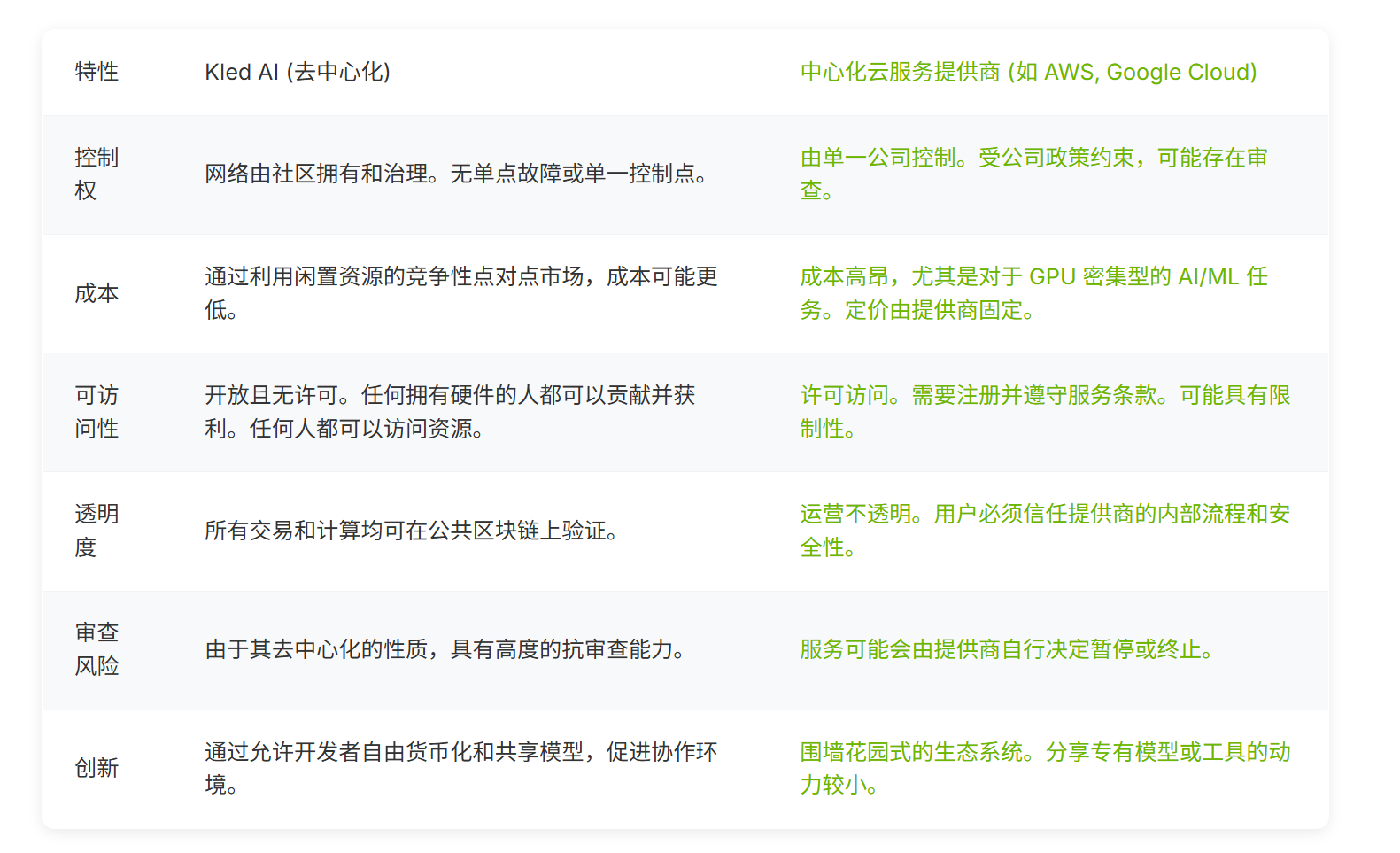
While centralized providers offer reliability and extensive support, Kled AI offers a highly attractive alternative, especially for users who prioritize cost-effectiveness, decentralization, and data sovereignty. This isn't about completely replacing these services, but rather providing a different model that empowers a wider range of users. By creating a more competitive and open marketplace, Kled AI can lower prices across the industry and foster a new wave of innovation.
Participating in Kled AI and XT.com platforms
For those interested in Kled AI's potential, there are multiple ways to get involved, from joining the network to participating in its community. As a project built on community engagement, active participation is crucial to its success.
For many, the first step is acquiring the $KLED token. Centralized exchanges play a crucial role in providing liquidity and accessibility for emerging and growing crypto projects. XT.com , known for its extensive selection of digital assets and user-friendly trading tools, is one of the platforms where users can access the Kled AI token. The exchange offers a seamless experience for users looking to add $KLED to their portfolios.
For traders, XT.com offers a robust spot market supporting KLED/USDT trading . Beyond simple trading, the platform provides advanced tools to help users optimize their strategies. For example, the KLED/USDT spot grid trading bot allows users to automatically buy and sell within a set price range, which is particularly useful in volatile markets. Furthermore, traders can explore other automated strategies to manage their positions more effectively. Using a reliable platform like XT.com provides a safe and efficient gateway to the Kled AI ecosystem.
In addition to trading, you can also contribute more directly:
- Become a provider: If you have idle computing power, especially from high-end GPUs, you can connect your hardware to the Kled AI network and earn $KLED tokens by processing tasks.
- Join the community: Participating in the project community on social media platforms such as Telegram, Discord, and Twitter is a great way to stay up-to-date, ask questions, and connect with other enthusiasts.
- Become a developer: If you are an AI/ML developer, you can start running your computing tasks using the Kled AI network at a cost that may be only a fraction of that of traditional cloud services.
Future Roadmap and Potential Challenges
Kled AI has outlined an ambitious roadmap that goes beyond its initial launch. Its long-term vision includes expanding network capabilities, fostering a vibrant developer community, and achieving widespread adoption.
Future development goals may include:
- Supports a wider range of AI frameworks: Integrates more AI/ML libraries and tools, making the platform more versatile for developers.
- Enhanced security protocols: Continuously improve network security to defend against evolving threats.
- Cross-chain interoperability: Building bridges to other blockchain ecosystems to increase the liquidity and utility of the $KLED token.
- Decentralized data storage solution: Integrating decentralized storage to provide a complete end-to-end solution for AI development.
However, the road to realizing this vision is not without challenges. Kled AI must overcome several obstacles to succeed:
- Network adoption: The success of a project depends on acquiring a sufficient number of resource providers and users. It needs to attract enough computing power to function and enough developers to create demand.
- Competition: Kled AI is not the only project in the decentralized computing space. It competes with other established and emerging players, each with its own approach and community.
- Technical complexity: Building and maintaining decentralized computing networks is technically challenging. Ensuring network stability, security, and performance at large scale will require continuous innovation and a talented development team.
- Regulatory uncertainty: The regulatory environment for cryptocurrencies and decentralized networks is still evolving. Future regulations may impact project operation and adoption.
Despite these challenges, Kled AI's focus on a specific high-demand niche market (decentralized AI computing) gives it a strong value proposition. If it can achieve its vision and build a strong, active community, it has the potential to become the infrastructure for the next generation of artificial intelligence.
Frequently Asked Questions (FAQs)
- What problem does Kled AI solve? Kled AI solves the problems of high cost and centralized control of the computing power required for AI development. It creates a decentralized marketplace where anyone can buy and sell computing resources, making AI more accessible and affordable.
- Is Kled AI a good investment? Like any cryptocurrency project, investing in $KLED carries risks. Its potential depends on the team's ability to execute its roadmap, achieve network adoption, and survive in a competitive environment. Potential investors should conduct thorough research on their own and consider the project's long-term fundamentals.
- How do I earn $KLED tokens? You can primarily earn $KLED tokens by contributing your device's idle computing power (CPU/GPU) to the network. You can also acquire them by trading them on cryptocurrency exchanges.
- How does Kled AI differ from other decentralized computing projects? While other projects focus on general-purpose decentralized computing, Kled AI is specifically tailored for AI and machine learning workloads. Its architecture and consensus mechanism (Proof-of-Render) are optimized for these tasks, which may give it an advantage in this niche market.
- How does the Kled AI network ensure security? The network guarantees security through a combination of blockchain technology, a custom consensus mechanism (PoR), and a staking system. Node operators must stake $KLED tokens, which not only deters malicious activity but also ensures that all computational work is verified before rewards are distributed, thanks to PoR.
Summarize
Kled AI represents a bold step towards the democratization of artificial intelligence. By building a decentralized, peer-to-peer computing power network, it aims to break down the economic and technological barriers currently limiting innovation in the AI field. Its combination of a custom Layer 1 blockchain, an incentive-driven token economy, and a specific focus on AI/ML workloads gives it a unique position in the cryptocurrency space.
The project's success will ultimately depend on its ability to establish a thriving bilateral market for resource providers and AI developers. While challenges such as competition and technological scalability remain, further progress is expected.
About XT.COM
Founded in 2018, XT.COM is a leading global digital asset trading platform with over 12 million registered users, operating in more than 200 countries and regions, and boasting an ecosystem traffic exceeding 40 million. The XT.COM cryptocurrency trading platform supports over 1300 high-quality cryptocurrencies and over 1300 trading pairs, offering diverse trading services including spot trading , leveraged trading , and contract trading , and is equipped with a secure and reliable RWA (Real World Asset) trading market. We are committed to the philosophy of "Explore Crypto, Trust Trading," dedicated to providing global users with a safe, efficient, and professional one-stop digital asset trading experience.