Destroying OpenAI? Sentient, the open-source AI platform, has more ambitions than that.


- Key takeaway: Sentient challenges the AI giants' monopoly with its open-source model.
- Key elements:
- It has secured $85 million in funding, with support from top venture capital firms.
- The open-source AGI network GRID emphasizes decentralization and censorship resistance.
- They launched vertical AI applications such as SERA-Crypto, which outperformed mainstream models.
- Market impact: Driving the development of AI towards an open and decentralized ecosystem.
- Time-sensitive label: Long-term impact.
Original article by Odaily Planet Daily ( @OdailyChina )
Author/ Wenser ( @wenser2010 )
AI is devouring the world at an unprecedented rate, but the world line has quietly split into two.
One branch is the expansion of the AI landscape under the monopoly of tech giants: Nvidia, leveraging its chip and graphics card resources, became the world's first publicly traded company with a market capitalization of $5 trillion; Google and Amazon have successively entered chip manufacturing, striving to gain a favorable position; the valuations of AI giants such as OpenAI and Anthropic have jumped to hundreds of billions of dollars. Another branch is the rapid development at the micro level of the AI industry: Nvidia founder Jensen Huang's prediction at CES 2025 earlier this year that "AI agents have the potential to become the next robotics industry, with an industry scale of trillions of dollars" is gradually coming true. Tens of millions of AI agents are gradually permeating all aspects of human society every day, which also means that tech giants are gradually becoming key players "holding the key to the AI world." Based on the past development of the internet industry, many people may wonder: Is AI about to become "another game belonging to tech giants?"
Sentient 's answer to this was "No".
As an open-source AI platform adhering to internet fundamentalism, Sentient previously secured $85 million in seed funding, led by prominent firms including Peter Thiel's Founders Fund, Pantera Capital, and Framework Ventures. On the inevitable path of AI engulfing the world, Sentient has chosen a route drastically different from that of tech giants. And this is precisely the "prologue to open-source AGI," which Odaily Planet Daily will systematically dissect today.
A First Look at Sentient: Riding the Banner of Open Source AI, Facing a Monopolistic Giant with a Market Value of Hundreds of Billions
Last July, Sentient announced the completion of an $85 million seed round of financing, backed by a prestigious array of investors—lead investors included Peter Thiel's Founders Fund, Pantera Capital, and Framework Ventures; participating investors included a host of well-known crypto VC firms such as Ethereal Ventures, Robot Ventures, Symbolic Capital, Delphi Ventures, Hack VC, Arrington Capital, HashKey Capital, Canonical Crypto, LD Capital, and Foresight Ventures.
It's worth noting that very few crypto projects have ever secured this amount of seed funding, let alone the strong backing of a series of prominent investors. Previously, only a handful of top-tier L1 public blockchain projects had received such powerful support. Suddenly, "Why did Sentient receive such favor from investors?" became one of the hottest topics in the crypto community. This question was quickly answered.
Aiming at OpenAI, the Sentient team faces direct competition from industry giants.
In subsequent media interviews , several partners from Sentient's lead investment firm offered their answers—
Joey Krug, a partner at Founders Fund, stated that the primary reason for investing in Sentient was its team, with co-founders Sandeep (founder of Polygon) and Pramod (Princeton University professor) demonstrating commendable technical acumen. Paul Veradittakit, managing partner at Pantera Capital, noted that if AI development remains closed-source, many key aspects of society will be vulnerable to censorship and rent-seeking. Sentient's Open, Monetizable, and Loyal (OML) AI model "has enormous potential to disrupt the AI development industry." Brandon Potts, a partner at Framework Ventures, also highly praised the team and technology, stating that "the Sentient team is the most capable of solving the economic problems of open-source AI."
Sentient's impressive seed round funding perfectly exemplified the golden rule that "investment is investing in people," and the team behind Sentient truly deserves to be called a "dream startup team" (compiled from Grok).
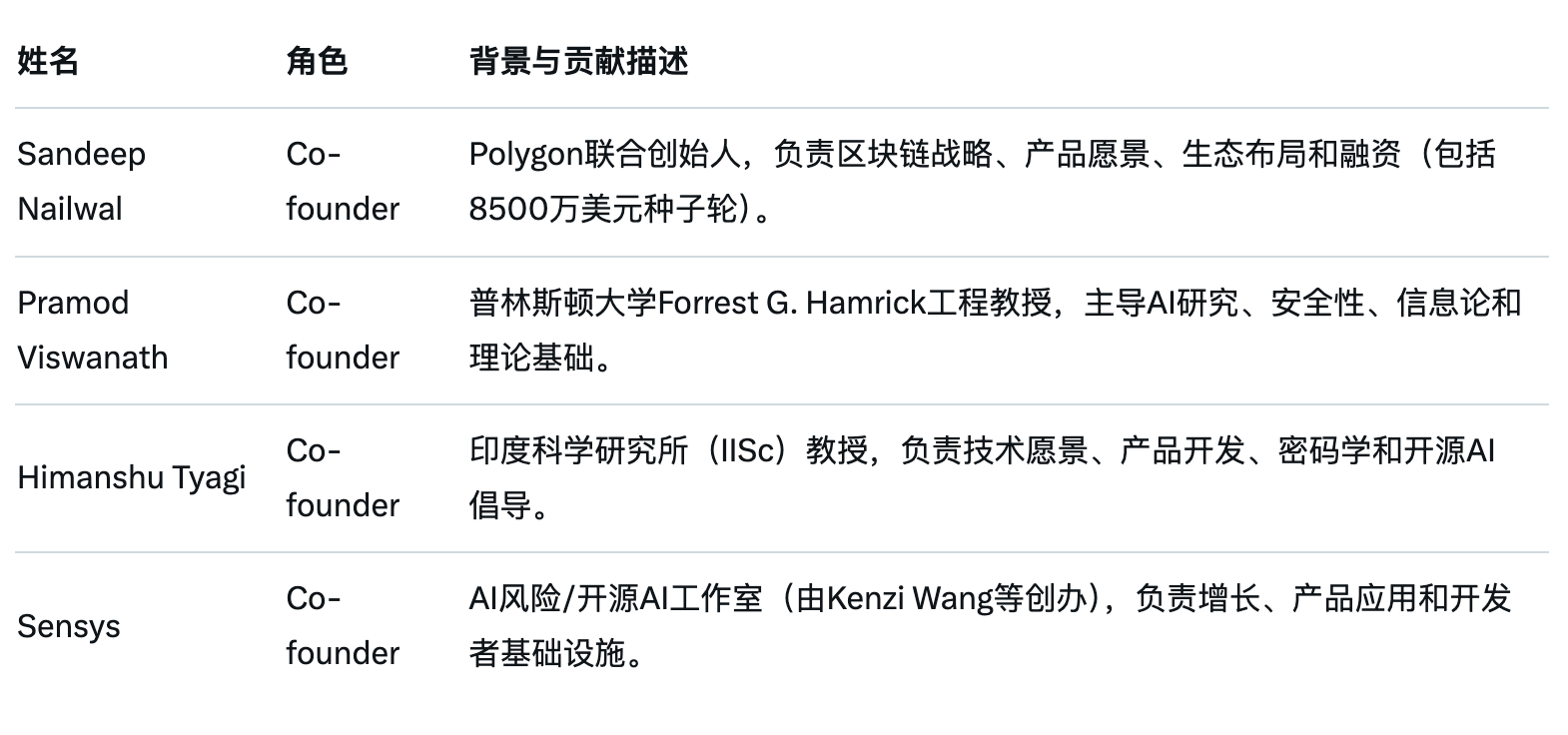
Sentient's 4 co-founders
More importantly, Sentient’s ambition was emphasized again in this interview—to compete directly with AI giant OpenAI, the company behind ChatGPT, and its main competitive strategy is to build open-source AI models with the help of community contributions.
The universal value of open-source AI platforms: decentralization, censorship resistance, and monetization.
Unlike the closed-source models of AI giants such as OpenAI, Anthropic, and Google, Sentient has chosen a "difficult but correct" path for AGI development—open-source AI platforms.
Using the analogy of "taking a taxi," the AI models and applications provided by commercial companies like OpenAI and Anthropic are like "centralized AI platforms" that put a hood over the passenger's head. The user, as the passenger, doesn't know the route, let alone whether the fare is reasonable; everything is left to the "black box arrangements" of the commercial companies. Sentient's open-source AI approach, on the other hand, presents the route, specific costs, and diverse options to the user, allowing them to choose freely. Users can even "join the platform," providing corresponding "solutions" to more users. Specifically, compared to the products of existing AI monopolistic giants in the market, Sentient's open-source AI platform has the following advantages:
1. Ensure the diversity and interoperability of AI products. Unlike the single AI models offered by various giant companies, the Sentient platform provides users with a wider selection of AI models, and these models can collaborate and interoperate to a certain extent, allowing users to enjoy a one-stop AI experience.
2. Avoiding the problems of centralized AI applications and models experiencing downtime and malicious activity. Previously, OpenAI model corpora have been involved in issues such as copyright infringement by news media. It's also an undeniable fact that AI models avoid sensitive information from the companies behind them and that centralized censorship mechanisms exist. The recent Cloudflare outage that caused ChatGPT to go offline also reflects the vulnerability of centralized AI models. In these aspects, Sentient's open-source AI can provide certain technical guarantees for the censorship resistance, security redundancy, and stable service of its output content.
3. Disintermediation and efficiency improvement in the AI field. The main advantage of open-source AI platforms comes from "coming from the masses and going back to the masses." The multilateral network built by the decentralized architecture can directly connect developers and users, matching supply and demand more efficiently, and allowing AI models to truly serve real market needs.
4. Monetization Platform Tools for AI Application and Development. Sentient's OML (Open, Monetized, Loyal) AI model and its already launched open-source AGI network GRID help AI models and applications leverage SENT token economic rewards for development, ecosystem growth, and quantitative expansion. By ensuring ownership, control, and consistency, Sentient has thus established a monetization platform network that balances AI development with commercial operations.
Based on these unique advantages, Sentinet has now established a mature open-source AI ecosystem network.
About Sentient: Starting with applications, but not limited to applications, using the ecosystem to drive network growth.
After about a year of development, Sentient has launched a series of self-developed products, including Dobby, Model Fingerprinting, and Open Deep Search, as well as a variety of network applications such as the open-source AGI network GRID (Global Research and Intelligence Directory), ROMA (Recursive Open Meta AI Agent) , and the open-source AI research agent SERA-Crypto .
Furthermore, with the emergence of GRID and the establishment and gradual improvement of the SENT token economic model, the "AI ecosystem map" built around the Sentient open-source AI platform is also in a rapid improvement phase.

According to official sources , the open-source AGI network GRID now includes over 110 partners , including...
- More than 50 professional AI agents;
- More than 50 professional data providers;
- 6 AI models;
- More than 10 computing and verifiable AI infrastructure providers.
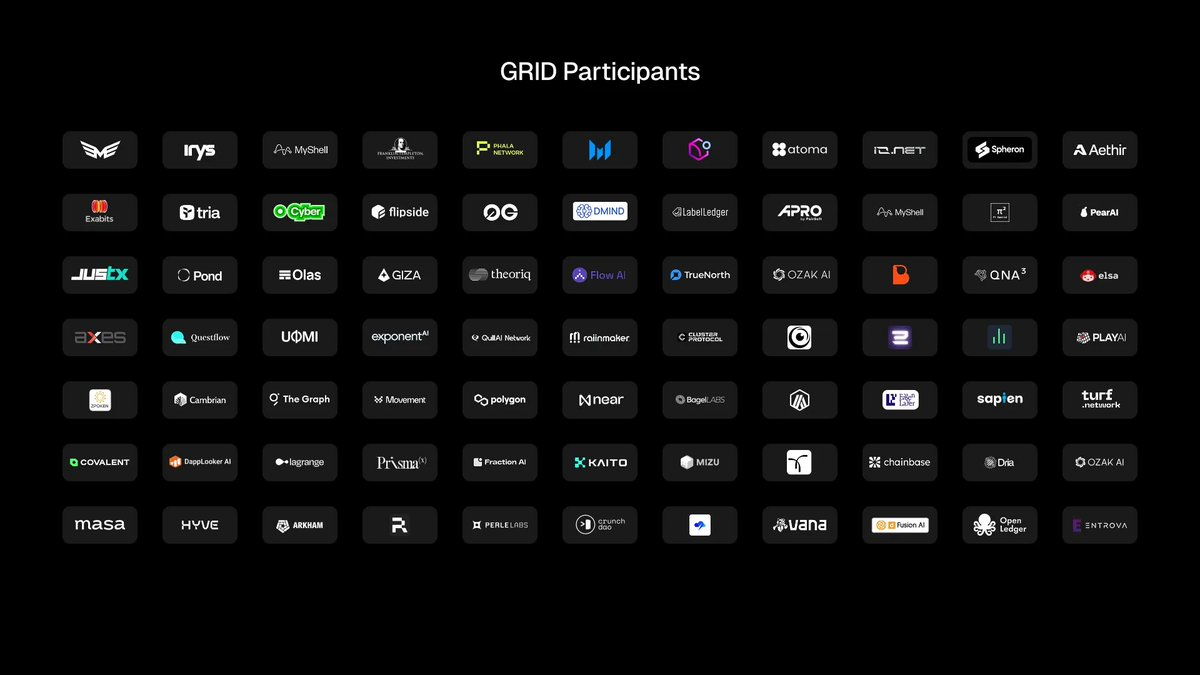
GRID Network Partners List
Representative partners include the following projects: Napkin (AI chart generation project), Exa (LLM/Large Language Model) search engine), Caldo (AI-driven people search platform), Arkham (on-chain data tracking platform), Aethir (enterprise-grade decentralized computing power platform), Kaito (encrypted social data platform), Messari Co-Pilot (encrypted insight agency platform), The Graph (blockchain index data platform), Crypto.com (cryptocurrency exchange), Polygon (public blockchain), and EigenLayer (Dobby Judge AI arbitration system network). Based on the synergistic effect of the ecosystem, Sentient's value as an open-source AI platform is mainly reflected in two aspects: first, it can attract developers, computing power providers, and data providers to participate in ecosystem building; second, it can support the development of the open-source AI ecosystem through token incentives and staking models, especially for vertical AI models and applications closely related to the cryptocurrency industry, which are expected to experience a boom.
Sentient's recently launched open-source AI research agent, SERACrypto, is a prime example. It's worth elaborating on this further—combining AI with cryptocurrency market data to assist trading decisions has long been a genuine need for countless individuals and a research focus for many developers. However, due to the illusion of large models, the difficulty in updating market data in real time, and the complexity of on-chain state queries and wallet account operations, a truly "AI agent designed for crypto investment research" has remained elusive.
SERA Crypto was thus born. This AI Agen, which focuses on "semantic embedding and inference agent architecture", won the honor of "the number one open source agent on DMind" as soon as it was launched. In real-time encryption benchmark tests that include time correlation, data consistency, research depth and correlation, SERA Crypto ranked first with a score of 34.3. Its overall performance even outperformed mainstream AI models such as GPT-5, Grok 4, Gemini 3 Pro and Perplexity Finance, and all operations were completed within 45 seconds.
By combining the advantages of route definition, data clarity, architecture optimization, and structural reasoning, SERA was able to sift through the flood of information—both "comprehensive but useless" and "small but beautiful but misleading"—to extract real-time, usable, and instructive reasoning information. As a result, the Sentient team successfully created a "more cryptocurrency-savvy AI Agent," rather than the previously thoughtless "rigid machine assistant" that only summarized and recited statements. Of course, SERA's creation also owes much to the Sentient community's nearly 300,000 users and over 22 million user queries.
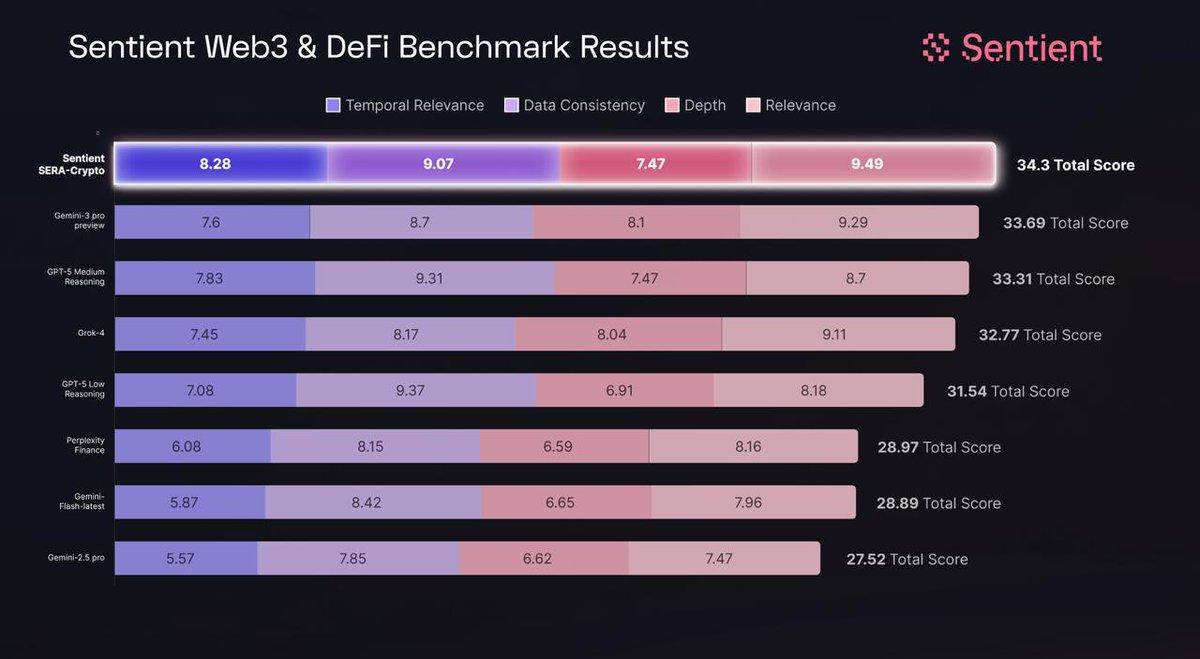
SERA Crypto model ranked first in overall performance.
From now on, users can use SNET tokens to access various AI applications (including various platform intelligent agents) through the Sentient open-source platform to meet their real AI application inference needs; Sentient ecosystem developers can receive SENT token incentives through user payments; in addition, the SENT token staking model can ensure the smooth operation of the economic cycle system within the ecosystem to a certain extent.
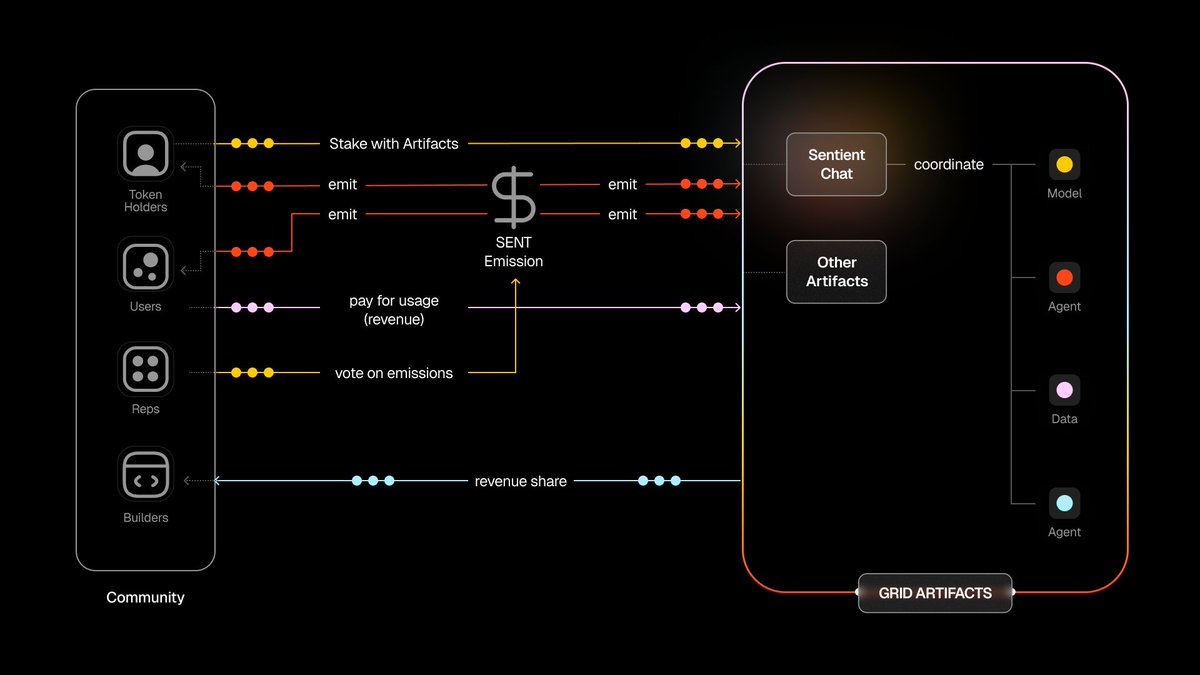
GRID Network and Sentient Community Ecosystem Flywheel Diagram
Ultimately, the monetized AI ecosystem built on the Sentient open-source AI platform took shape. Subsequent optimization efforts evolved into attracting more AI users and developers to participate and join with better AI models and applications. The latter, in turn, further spurred the creation of more high-quality AI models and applications, collectively building a four-in-one development flywheel of "users-tokens-developers-products".
SENT Token Overview: The "Core Energy" Powering Open Source AI Platforms
As the "engine" that supports the continuous operation of the vast Sentient ecosystem, the SENT token plays a crucial role.
Previously, the SENT token had been listed on OKX pre-market and Binance futures ; on December 6, Coinbase officially announced that it would add SENT to its listing roadmap. Since then, as the core token of the Sentient ecosystem, SENT has successfully achieved the achievement of "listing on 3 major CEXs".
Previously, Sentient officially announced the end of the first season of its event on November 17. At that time, the token airdrop was mainly aimed at Sentient community members (including Discord community members), AI chat users, crypto KOLs, open source researchers, and others. On November 18, the official airdrop registration link officially opened, with the original deadline set for November 29. Subsequently, the official registration deadline was extended to December 5 .
According to subsequent official announcements and statements from official personnel , further SENT token incentives for the community will be closely related to contributions to social media content on platforms such as X and the share of AI mind recognition on encrypted social data platforms such as Kaito.
Beyond the usual pathways of participating in Sentient Chat platform and application usage, AI model, AI Agent, and application development , helping the Sentient ecosystem expand its publicity and marketing efforts may be the main theme of the SNET token Q2 airdrop event. For more details, please follow the official X account or visit the official website .
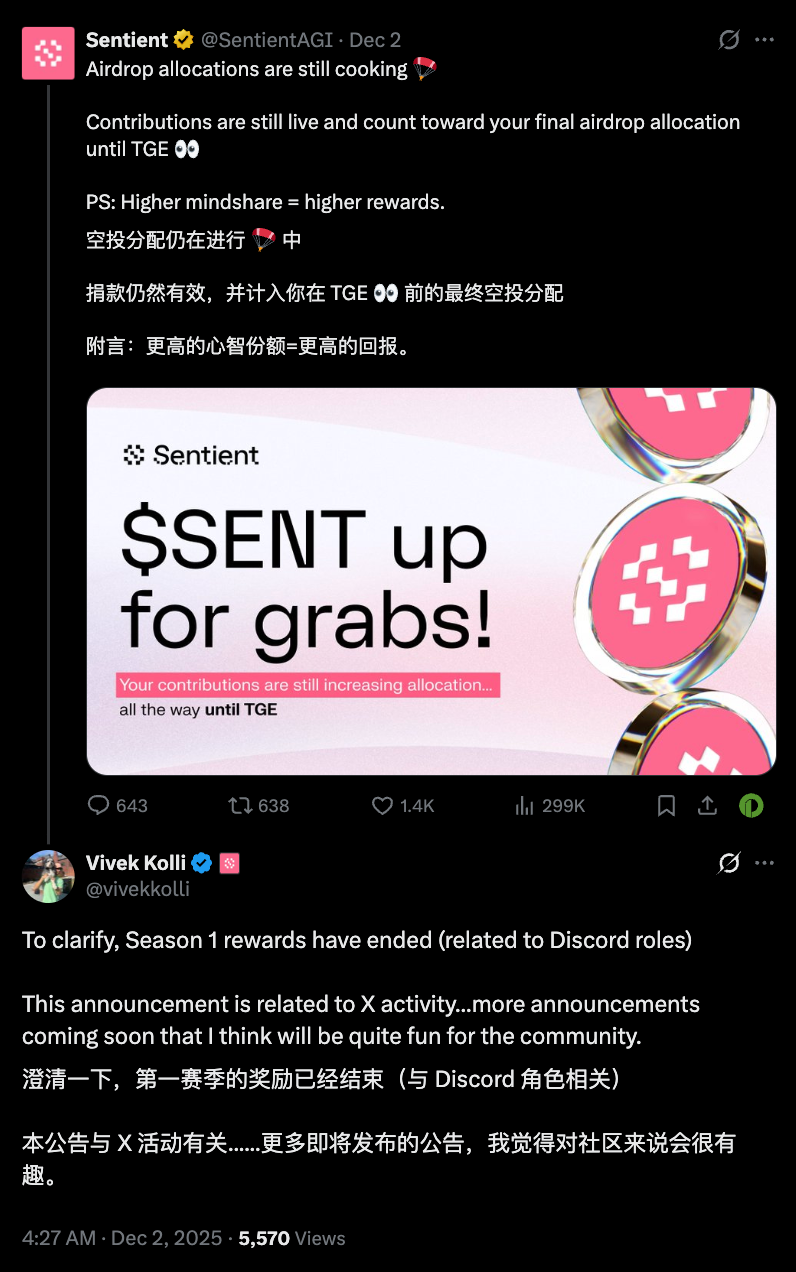
Officials openly hinted
Conclusion: The limits of self-evolution in open-source AI far exceed human imagination.
As the development of closed-source AI models gradually falls into a stalemate of homogenization, open-source AI may become an important force to push artificial intelligence into deeper waters. Just as the open-source Android system led to the rapid development of smartphones and the advent of the mobile Internet, open-source AI platforms represented by Sentient are not just creating an AI chat application, but a complete open-source AI ecosystem—including underlying protocols, system architecture, as well as specific models and AI agent applications.
More importantly, unlike closed-source AI models and applications which are developed behind closed doors, open-source AI can achieve "self-evolution" to a certain extent. This is the direction that Sentient decided on from the very beginning when it chose this "difficult but correct path".
While OpenAI was struggling with the constant stream of new products from its competitors and was forced to shut down Sora, Sentient was determined to forge a more universal path for AI development that aligns with the goals of the open-source community. In this pioneering era where carbon-based life is guiding silicon-based life, the open-source AI platform brings not only the dawn of an AGI network, but also an open-source AI ecosystem that prioritizes loyalty, monetization incentives, consistent service, and less of the "AI illusion."