






The 5 most noteworthy L1 public chains in 2026: The main evolution from DeFi to RWA


- 核心观点:L1公链格局走向多链并存,各有侧重。
- 关键要素:
- 评估标准转向真实应用、稳定性和监管清晰度。
- 以太坊是核心结算层,拥有最深流动性和开发者生态。
- Solana、BNB Chain等在不同细分赛道(如性能、用户入口)占据优势。
- 市场影响:推动基础设施分工,影响投资与开发方向。
- 时效性标注:中期影响
Layer 1 public blockchains form the underlying infrastructure of the entire crypto ecosystem, playing a crucial role in transaction security, final settlement, and liquidity transfer between decentralized applications. Even with the recent surge in popularity of Layer 2, Rollups, and various application chains, the underlying L1 public blockchains remain the true determinant of the ecosystem's stability and potential. In essence, all Web3 applications ultimately rely on L1 for security and settlement.
A series of events in 2025 fundamentally changed how the market evaluates L1 public chains. Scalability is no longer just about TPS; smooth user experience, network stability, the existence of real-world applications, and a gradually clarifying regulatory environment are becoming equally important metrics. Narratives such as real-world asset tokenization (RWA), payment scenarios, and institutional participation have also moved from the conceptual stage to initial implementation, forcing the market to rethink which public chains are truly prepared for the next phase of growth.
This article is aimed at investors, developers, and traders, helping you to see which public chains are continuously accumulating real activity, users, and long-term value as we head towards 2026.

TL;DR Quick Summary
- Even as Layer 2 and application chains continue to evolve, Layer 1 public chains remain the core infrastructure for ensuring security, completing final settlement, and supporting liquidity.
- The current market places more emphasis on real-world usage, network stability, and regulatory clarity, rather than solely on transaction speed.
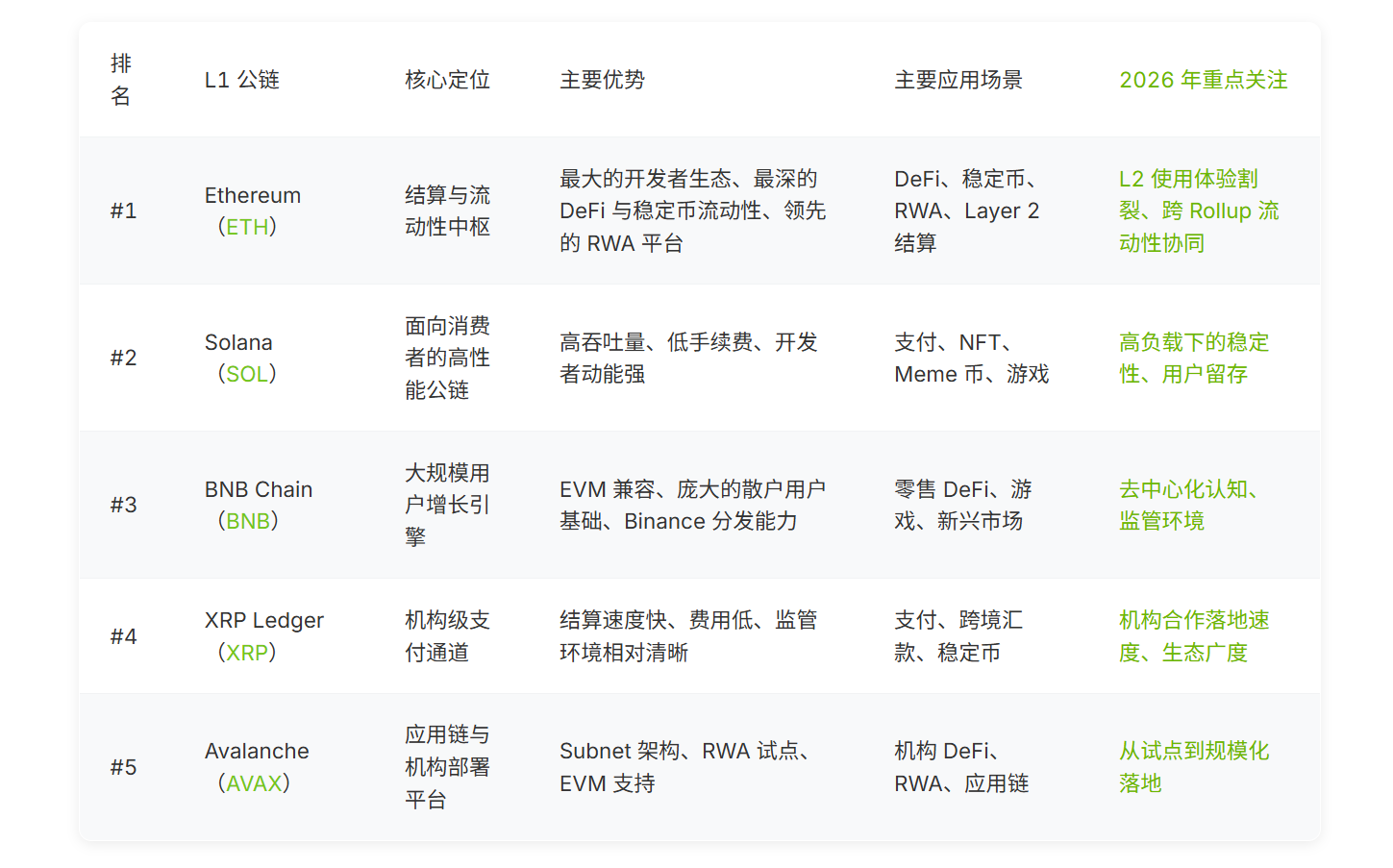
- Ethereum maintains its lead in settlement and liquidity, while Solana, BNB Chain, XRP Ledger, and Avalanche each hold an advantage in their respective niche markets.
- Looking ahead to 2026, the L1 public chain landscape is moving towards a multi-chain coexistence rather than a single winner taking all.
- The public blockchains that can win in the long run will depend on developer activity, the scale of real users, liquidity depth, and the execution and resilience across cycles.
Ranking Methodology Explanation | How to Evaluate the Most Promising L1 Public Chains in 2026
The rankings in this article are not based on roadmaps or verbal promises, but on real market signals. We use a unified evaluation framework to observe the performance of each Layer 1 public chain in a real-world environment, starting from actual operation.
The core evaluation dimensions include:
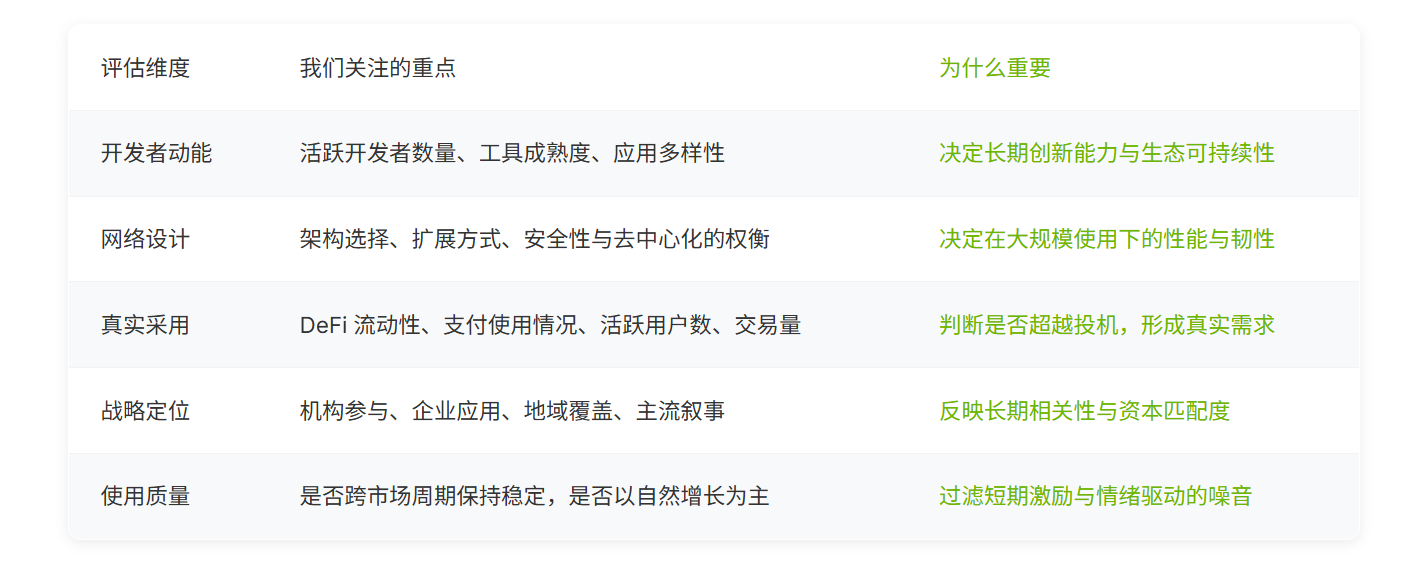
During the evaluation process, we place particular emphasis on the ability to sustain use across cycles and network resilience. We remain cautious about short-term bursts of growth or growth reliant on high subsidies or incentives. The ultimate goal is to identify L1 public chains that have proven their value and are capable of maintaining this advantage into 2026.
#1 Ethereum (ETH): The core settlement layer and liquidity foundation of Web3
Ethereum remains the core settlement layer of the entire crypto economy. While many new public chains compete on speed or cost, Ethereum's true advantage lies in its crucial role as the default underlying network in terms of security, liquidity, and ecosystem collaboration.
 Ethereum has consistently maintained the highest total value locked (TVL) among all Layer 1 public chains for many years, further confirming its dominant position as the core settlement layer for DeFi (Source: DeFiLlama).
 Nearly 60% of the global stablecoin supply runs on the Ethereum network, making it the most important liquidity hub in the crypto market (Source: DeFiLlama).
Ethereum boasts the largest developer community in the crypto industry, and its core standards, such as the Ethereum Virtual Machine (EVM) and ERC-based token specifications, have become industry-standard. This standardization has generated a powerful network effect. The vast majority of decentralized applications, wallets, and infrastructure tools are either built directly on Ethereum or are naturally compatible with the Ethereum ecosystem.
 The number of active developers in the Ethereum EVM ecosystem is nearly four times that of Solana, demonstrating Ethereum's strong competitive advantage at the developer level (Source: Developer Report).
In its scaling approach, Ethereum did not choose to endlessly stack performance at the main chain level, but instead adopted a modular strategy. The Layer 2 network is responsible for execution and throughput scaling, while the Ethereum mainnet focuses on security and final settlement. This division of labor allows Ethereum to achieve a significant increase in transaction capacity through Rollups while maintaining a high degree of decentralization.
 In 2025, the total asset size of the Ethereum Layer 2 network decreased by approximately 22% year-on-year, reflecting the risk of ecosystem fragmentation caused by the coexistence of multiple rollups in the short term (Data source: L2Beat).
Ethereum continues to lead in key areas that determine long-term adoption, including:
- The deepest DeFi liquidity in the market
- The world's largest stablecoin issuance and usage
- Dominates the field of real-world asset tokenization
- Institutional participation continues to increase, and regulatory awareness is gradually becoming clearer.
As traditional financial institutions begin to explore tokenized funds, bonds, and on-chain settlement solutions, Ethereum remains their top choice for underlying platform.
Key points to watch in 2026:
- The problem of fragmented user experience caused by the coexistence of multiple Layer 2 instances
- Liquidity coordination and interoperability across Rollups
- Is the expansion and upgrade to simplify the user experience continuing?
Despite the challenges that still exist, Ethereum will remain the central hub for settlement and liquidity in Web3 as we head toward 2026. Its ecosystem depth and maturity are still unmatched by other Layer 1 public chains.
#2 Solana (SOL): A high-performance L1 architecture designed for consumer applications
Solana positions itself as a Layer 1 public blockchain focused on speed, low fees, and a real-time user experience. In its technological approach, Solana has taken a different path from Ethereum. It prioritizes high throughput at the main chain level, rather than distributing performance pressure through modular scaling.
 In 2025, Solana accounted for the highest daily transaction share among all blockchains, contributing approximately 55% to 80% of the total network transaction activity, fully demonstrating its high-frequency usage characteristics (data source: Artemis).
 Solana's average transaction fees are more than 100 times lower than Ethereum's, highlighting its significant advantage in cost efficiency (Source: Token Terminal).
This design philosophy makes Solana highly attractive to application developers targeting ordinary users. Faster confirmation times and negligible transaction costs make the on-chain experience closer to Web2 products, especially suitable for scenarios such as payments, games, NFTs, and high-frequency trading.
 In terms of trading volume on decentralized exchanges, Solana ranks first among all blockchains, demonstrating its strong appeal in transactional applications (Source: Artemis).
After experiencing early developmental fluctuations, Solana's ecosystem clearly matured between 2024 and 2025. Developer activity continued to increase, application quality improved steadily, and user engagement grew simultaneously across multiple sectors.
Solana's core advantages are mainly reflected in:
- The Meme Coin, NFT, and Digital Collectibles sectors are highly attractive.
- DeFi activity has clearly recovered and continues to expand.
- Payment scenarios and merchant integration are gradually increasing.
- Clearly focusing on on-chain entry points for mobile devices and general users
From a broader perspective, Solana represents an alternative public blockchain paradigm to Ethereum. Ethereum emphasizes modularity and Rollup scaling, while Solana insists on a single, high-performance main chain. This divergence has become one of the most representative and long-standing debates in Layer 1 public blockchain design.
Key points to watch in 2026:
- Network stability under sustained high load
- The degree of decentralization and hardware requirements of verification nodes
- Can the technological performance advantage be translated into long-term user retention?
Whether Solana can continue to expand its influence in 2026 depends on whether its performance advantages can continue to drive the implementation of real-world consumer applications and form a stable user base.
#3 BNB Chain (BNB): An adoption engine connecting retail and emerging markets
BNB Chain plays a unique role in the Layer 1 public blockchain landscape, primarily serving as an entry point connecting retail users with emerging markets. Its design prioritizes ease of use, low transaction costs, and rapid deployment, rather than pursuing ultimate decentralization.
Because it is compatible with Ethereum ecosystem tools, developers can quickly deploy their applications to BNB Chain. At the same time, BNB Chain is deeply integrated with Binance's exchange, wallet system, and user portal, creating a distribution capability that is difficult for other public chains to replicate. This combination has kept it among the networks with the highest number of users and transaction activity for a long time.
 After excluding Solana, BNB Chain ranks first in daily transaction volume among all networks, demonstrating extremely strong user activity (data source: Artemis).
BNB Chain's ecosystem advantages are mainly reflected in the following aspects:
- DeFi applications targeting retail users
- Decentralized exchanges with large trading volumes
- Games and incentive-driven applications
- For users in emerging markets who are highly sensitive to cost
The BNB token itself provides long-term support to the ecosystem through various use cases and deflationary mechanisms, creating a positive cycle between network usage and token demand.
Key points to watch in 2026:
- Market perception and management of decentralization
- Regulatory developments affecting Binance and related services
- Can it continue to drive innovative applications beyond retail scenarios?
BNB Chain 's core advantage lies in its scale effect. Even though it may not be as decentralized in concept, it remains one of the most effective Layer 1 public chains for bringing new users into the Web3 world.
#4 XRP Ledger (XRP): A compliance-focused institutional-grade payment network
XRP Ledger has taken a development path that is quite different from most smart contract platforms. From its inception, it has focused on payments, settlements, and value transfers, rather than general-purpose application execution, which determines its unique position in the public blockchain ecosystem.
It is this focus that has allowed XRP Ledger to maintain a long-term stable operating record. The network offers fast settlement speeds, low transaction costs, and a consistently stable online presence. Therefore, XRP Ledger has long been closely associated with cross-border payments, international remittances, and institutional-grade funding channels.
 XRP Ledger completes ledger settlement approximately every 4 seconds, which is faster than Ethereum's block time of about 12 to 14 seconds and close to Solana's sub-second block confirmation (data source: XRPSCAN).
 XRP Ledger can process dozens of transactions per second, higher than Ethereum's processing capacity of about 15 transactions per second, but still lower than Solana's throughput of thousands of transactions per second (Source: XRPSCAN).
For XRP, one of the most important turning points came from the gradual clarification of the regulatory environment. As legal uncertainty decreased, market liquidity began to return, exchange support resumed, and institutional participation accelerated significantly.
 The lawsuit filed by the U.S. Securities and Exchange Commission against Ripple in 2020 was finally settled in 2025, marking a significant turning point in the regulatory environment for XRP (Source: Reuters).
At the same time, the application boundaries of XRP Ledger are constantly expanding, including:
- Native automated market making mechanism
- Sidechain and richer programmability
- Further exploration around tokenized assets and stablecoins
Rather than directly competing with Ethereum's general-purpose smart contract ecosystem, XRP Ledger focuses on filling a niche area that many Layer 1 public chains struggle to cover efficiently: a high-efficiency, compliance-oriented global payment infrastructure.
Key points to watch in 2026:
- The actual implementation and speed of institutional cooperation projects
- Can more related application scenarios be expanded beyond payment?
- Diversity of developers and application types
The impact of XRP Ledger in 2026 will largely depend on its ability to integrate more deeply into the global payment system and continue to play a role in real-world financial scenarios.
#5 Avalanche (AVAX): An application chain and customized deployment platform for institutions
Avalanche stands out among many Layer 1 public chains with its flexible multi-chain architecture. Unlike centralizing all applications in a single execution environment, Avalanche allows projects to create customized subnets according to their own needs, enabling more precise configuration in terms of performance, compliance, or governance structure.
 Avalanche deploys asset transfer, smart contract execution, and Subnet coordination on the X, C, and P chains respectively, enabling institutions and enterprises to build highly customized application chains (Data source: Avalanche Academy).
This model is particularly attractive to institutions and enterprises. They can retain control over compliance, performance, and governance while continuing to leverage the openness and interoperability advantages of public blockchains.
Avalanche's core advantages are mainly reflected in:
- Supports licensed or application-specific Subnet deployments.
- Significant progress has been made in the pilot program of tokenizing real-world assets.
- Lowering the migration barrier by making C-Chain compatible with Ethereum development tools.
- Continue to expand its presence in institutional and corporate experiments.
Rather than pursuing large-scale retail adoption, Avalanche focuses on becoming an infrastructure layer connecting decentralized finance and traditional finance, providing a reliable foundation for customized blockchain deployments.
Key points to watch in 2026:
- Can the pilot project be transformed into a long-term, stable production-grade application?
- Liquidity depth and synergy between different subnets
- Can it gain wider market recognition beyond institutional circles?
Whether Avalanche can further amplify its influence in 2026 depends on whether its flexible architecture and partnerships can be transformed into sustainable and quantifiable on-chain activities.
List of L1 public chains still worth watching
Besides the top five, several other Layer 1 public chains continue to advance their technology and ecosystem development. As the market environment changes, they still have room to increase their influence in the future.
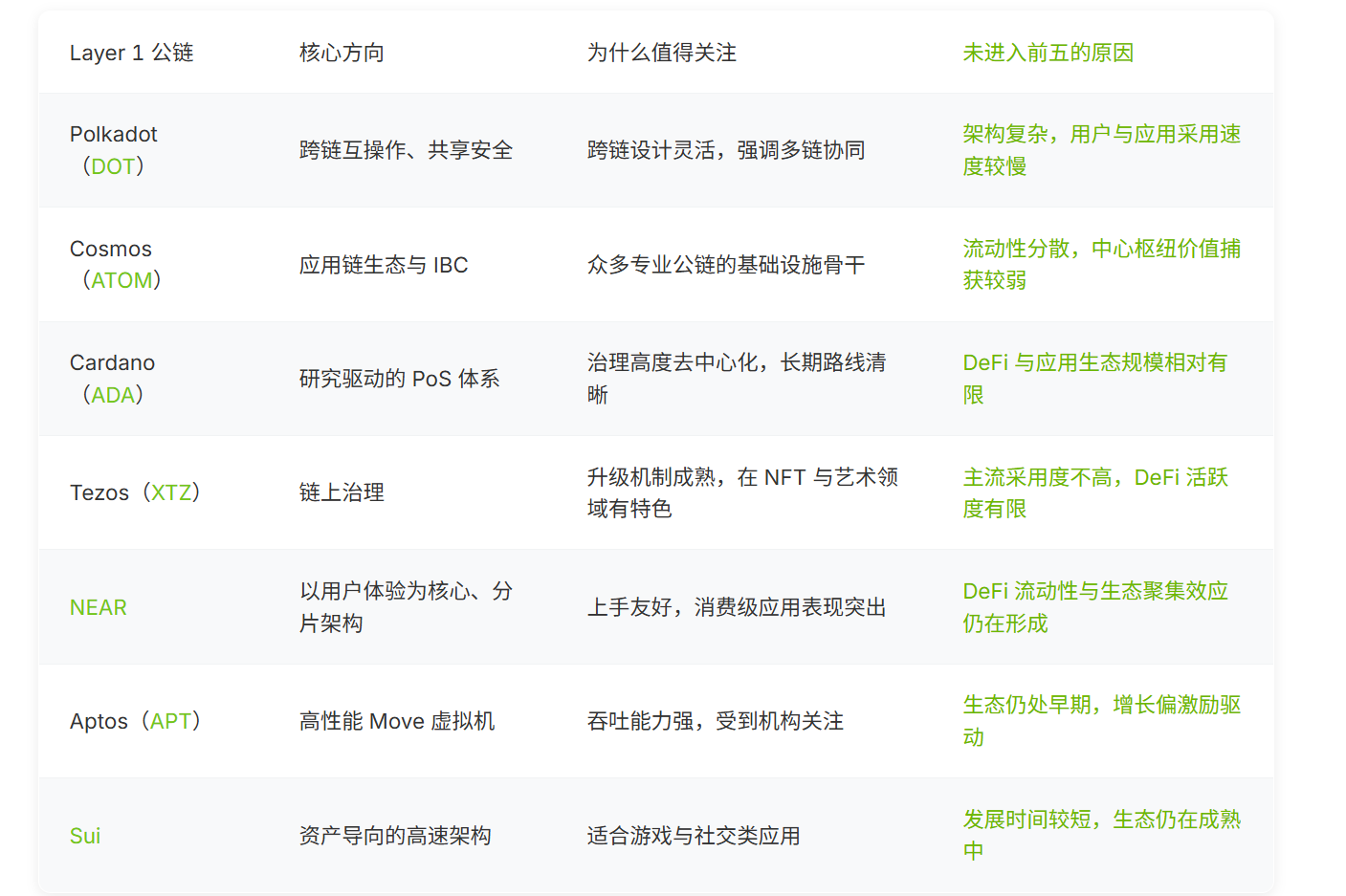
These public chains are still worth monitoring, but at the current stage, they are slightly inferior to the top five in terms of scale, liquidity, or continued adoption across cycles, so they are temporarily placed on the watch list.
Looking ahead to 2026 | How to determine which L1 public chains are truly winning?
The future of Layer 1 public chains is not about a single winner taking all, but rather a gradual shift towards multi-chain coexistence. Different public chains play different roles in the crypto economy, each focusing on its strengths, and together forming a new infrastructure landscape.
The five Layer 1s heading towards 2026 perfectly illustrate this trend of specialization:
- Ethereum is responsible for handling settlement, liquidity, and institutional-grade assets.
- Solana continues to push the boundaries of high-performance experiences for the general public.
- BNB Chain drives mass adoption through ease of use and distribution capabilities.
- XRP Ledger connects crypto assets with the global payment system.
- Avalanche offers customized deployment capabilities that connect DeFi with traditional finance.
As 2026 approaches, the most noteworthy signals include long-term developer commitment, sustained user activity, sustainable revenue streams, and the resilience of networks across different market cycles. Layer 1 public chains capable of translating their technological architecture into long-term economic activity will determine the next phase of Web3 development.
Frequently Asked Questions about the L1 public blockchain
1. What is a Layer 1 public blockchain?
Layer 1 refers to the underlying blockchain itself, which is responsible for transaction verification, network security, and final settlement, and does not rely on other chains to complete its core functions.
2. Since Layer 2 already exists, why is Layer 1 still important?
Layer 2 still relies on Layer 1 for security and settlement, so Layer 1 remains the foundation of the entire blockchain ecosystem.
3. Is a higher TPS the most important metric for measuring Layer 1?
No. The current market is more focused on user experience, network stability, liquidity, and real-world adoption than just transaction speed.
4. Why is Ethereum ranked number one in 2026?
Ethereum boasts the largest developer ecosystem, the deepest liquidity, and continues to lead in DeFi, stablecoins, and real-world assets.
5. Can multiple Layer 1 public chains succeed simultaneously?
Yes. Different Layer 1 public chains each focus on different scenarios, such as payments, consumer applications, or institutional use cases.
6. What factors should investors consider when evaluating Layer 1 public chains?
The focus should be on developer activity, real user base, liquidity depth, revenue sustainability, and overall performance across market cycles.
About XT.COM
Founded in 2018, XT.COM is a leading global digital asset trading platform with over 12 million registered users, operating in more than 200 countries and regions, and boasting an ecosystem traffic exceeding 40 million. The XT.COM cryptocurrency trading platform supports over 1300 high-quality cryptocurrencies and over 1300 trading pairs, offering diverse trading services including spot trading , leveraged trading , and contract trading , and is equipped with a secure and reliable RWA (Real World Asset) trading market. We are committed to the philosophy of "Explore Crypto, Trust Trading," dedicated to providing global users with a safe, efficient, and professional one-stop digital asset trading experience.


