






Before Moonbirds launched its token, it initiated the "Birbillions Project"


- Core Viewpoint: Through the issuance of the $BIRB token, the Moonbirds project has officially begun its transition from a digital NFT project to a hybrid business model combining "Meme culture + physical consumer goods," with the goal of building a crypto-native consumer goods company generating $1 billion in annual revenue.
- Key Elements:
- Foundation for Transformation: The Moonbirds NFT series has accumulated over $1 billion in trading volume. Its parent company, Orange Cap Games, shifted its focus from IP management to product operations through an acquisition and has already generated approximately $8 million in annual revenue from physical collectibles.
- Business Model: Proposed the "Birbillions Theory," aiming to merge the rapid spread of memes with the sustained revenue-generating capability of physical businesses, creating a flywheel effect of "attention → product → revenue → distribution."
- Physical Leverage: Its Vibes TCG card game sold over 8.6 million cards in the past year, generating $6 million in primary sales, and entered over 100 global retail channels, providing a real consumer foundation for the ecosystem.
- Token Design: $BIRB has a total supply of 1 billion tokens, with 65% allocated to the community. It introduces a 24-month Nesting 2.0 staking mechanism designed for long-term value alignment rather than short-term profit-taking.
- Benchmarking Target: The project benchmarks against traditional consumer goods companies like Pop Mart, attempting to capture cultural value through tokenomics and build a sustainable revenue model that does not rely on transaction fees or token dumping.
Moonbirds officially announced that its native token $BIRB will officially launch its TGE on Solana on January 28, with a total supply of 1 billion tokens. This blue-chip NFT project, which once generated over $1 billion in trading volume, is officially embarking on a transformation from digital collectibles to a hybrid "Meme + Physical" business model.
Just before the TGE, Moonbirds' parent company, Orange Cap Games, officially released the "Birbillions Thesis" whitepaper, outlining an ambitious goal: to build a crypto-native consumer goods company with $1 billion in annual revenue.
Referred to as the "Ten Billion Birb Plan."
This is an incredibly audacious goal. So why is the team daring to set it?
1. Starting with Moonbirds: A Not-So-Smooth Development Timeline
That Crazy NFT Era
Going back to 2022, the NFT market was at its peak frenzy.
Moonbirds burst onto the scene with 10,000 pixel-style owl PFPs, minting at 2.5 ETH, roughly $7,500 at the time. They sold out within two days, with trading volume exceeding $280 million in the first week.
That number seems staggering even today. How did Moonbirds manage it? Many might remember their "nesting" mechanism: holders could lock their NFTs on-chain to earn rewards, visual upgrades, and gain access to exclusive opportunities related to sub-collections like Oddities and Mythics.
This staking system was indeed an excellent marketing case during the NFT hype of that era. It genuinely enhanced community stickiness and laid the groundwork for subsequent ecosystem expansion. To date, the Moonbirds series has surpassed $1 billion in cumulative trading volume, with a floor price around 2 ETH.
The Turning Point
But the bull market wasn't permanent. Starting in the second half of 2022, controversies surrounding copyright, positioning, and communication methods gradually accumulated, eroding community trust. By the end of 2023, Moonbirds and a host of other once-famous NFT series were no longer the "center of discussion," often relegated to being seen as relics of the previous cycle's glory.
Change came in May 2025: Moonbirds was acquired by Orange Cap Games from Yuga Labs. This changed one crucial thing: Moonbirds went from being a "managed IP" to a "product being operated."
Since then, Moonbirds has embarked on a transformation path similar to Pudgy Penguins: trading card games, blind box figurines, graded collectibles, and partnerships with top global toy distributors. Expanding from Ethereum to multi-chain, from purely digital assets to a physical product matrix, Moonbirds underwent a qualitative transformation. The number of unique wallets holding Moonbirds and birb IP surged from around 10,000 to nearly 400,000, spanning multiple chains including Ethereum, Solana, and TON.
Think about it: after the NFT wave subsided, besides Penguins and Moonbirds, how many other NFTs have you heard of?
Even the name "Moonbirds" has started to take a backseat, replaced by the lighter, more colloquial, and more easily remixed "Birb" and "Birbish."
What Exactly is the $BIRB Token?
The issuance of the $BIRB token is the most critical link in Moonbirds' transformation strategy. The token will serve as the "ecosystem coordination layer," connecting meme propagation, physical product sales, community incentives, and other aspects. According to currently available information, part of the 1 billion $BIRB total supply will be airdropped to Moonbirds NFT holders, sub-collection holders, and holders of soulbound tokens obtained through community activities. Over 256,957 unique addresses have already claimed 419,039 SBTs in preparation for the airdrop qualification.
2. Deciphering the "Birbillions Thesis": A Whitepaper That Doesn't Talk About Vision
If you read the original "Birbillions Thesis" whitepaper released just before the TGE, you'll notice one thing:
This Really Reads Like an Academic Paper
"The central thesis of this paper is that sustainable crypto assets must succeed in both aspects. It must be absurd enough to attract attention, foster engagement, and accelerate cultural propagation; simultaneously, it must be real enough to convert that attention into lasting economic activity. More importantly, this economic activity should inherently drive meme propagation during its generation process, especially spreading beyond the crypto sphere. This is not a compromise between two paths but a synthesis: viewing memetic and entrepreneurial qualities as complementary rather than opposing elements."
It really doesn't look like a whitepaper at all, more like a research report from a16z or a PhD dissertation on blockchain market studies.
Summarized simply:
On one side of the crypto industry are memes. Fast, highly propagative, low barrier to entry, emotionally charged, but also quick to fade.
On the other side are enterprises. They can survive, generate revenue, but many crypto business models essentially involve repeatedly charging their most active users.
OCG (Orange Cap Games, the parent company of Moonbirds and Birb IP) believes that these two paths, fighting separately, will eventually hit a ceiling. A truly sustainable structure must possess both capabilities simultaneously: memes are responsible for diffusion, enterprises are responsible for consolidation. Moonbirds isn't trying to "balance" the two; it's treating them as different stages within a single flywheel. Memes create attention, attention is captured by physical products, products generate real revenue, revenue in turn expands distribution, and distribution creates new attention.
Why Launch a Token Now?
One practical reason this logic seems viable today is that technology is no longer the main differentiator. Faster chains, lower fees, more complex VMs have almost no perceptible difference for marginal users. What's truly scarce is something that can be understood, remembered, and repeatedly discussed.
You don't need to explain what on-chain assets are to an outsider; you just need to put a character they're willing to showcase and collect into their hands. "In the new era of cryptocurrency development, technology is no longer the bottleneck; the key to growth lies in distribution."
Meanwhile, "OCG has generated approximately $8 million in revenue this year through the sale of physical collectibles, and this is only our second year of operation." From a revenue logic standpoint, Moonbirds already meets the conditions for a token launch.
Where Does This $8 Million Come From?
To understand why Moonbirds dares to talk about $1 billion in revenue, one must first understand OCG's other ace card: Vibes TCG.
Vibes is a physical + digital hybrid trading card game developed by OCG based on the Pudgy Penguins IP, officially launched in December 2024. It's somewhat similar to the Yu-Gi-Oh! collectible cards you might be familiar with from childhood, but not entirely the same; its collectible value and community recognition are completely different.
Since its launch, Vibes TCG has performed beyond most expectations:
- Sold 8.6 million cards in the past year, generating $6 million in primary sales
- Over 350,000 online matches
- Entered 100+ global retail channels, including well-known card game retailers like Star City Games, securing partnerships with GTS and Asmodee (the world's second-largest toy distributor)
- Launched a digital version on the Epic Games Store, entering mainstream game distribution platforms
Choosing to make a physical card game is a seemingly traditional but actually extremely clever strategy. From Magic: The Gathering to Pokémon, from Yu-Gi-Oh! to Hearthstone, card games have consistently been one of the categories best suited for generating sustained repurchases and community stickiness. Players don't just buy and leave; they continuously purchase booster packs, participate in tournaments, and trade rare cards.
Secondly, TCGs are naturally suited for IP extension. Pudgy Penguins' cute imagery and rich character settings can be naturally translated into card mechanics and visual design. Each card tells a character's story; each match extends the IP's worldview.
During the Solana Birbathon, the team confirmed that Moonbirds will appear in the third version.
More crucially, physical cards are genuine retail products. They can enter Walmart, RT-Mart, any toy store or card shop. This distribution capability is something purely digital NFTs can never achieve. When a child sees a Pudgy Penguins card booster pack in a toy store, they don't need to know what blockchain is; they just need to think these penguins are cute and want to collect them.
Think about it from another angle: TCG players are actually the world's most perfect "quasi-crypto users": accustomed to paying for scarcity, accustomed to high volatility in secondary markets, accustomed to appraisal and collection. For these card enthusiasts, transitioning from a $100 collectible card to a $100 Birb card involves almost no cognitive barrier. When these millions of card holders start entering the ecosystem via $BIRB, this "consumption-driven rather than speculation-driven" buying pressure forms the most solid foundation supporting the revenue target.
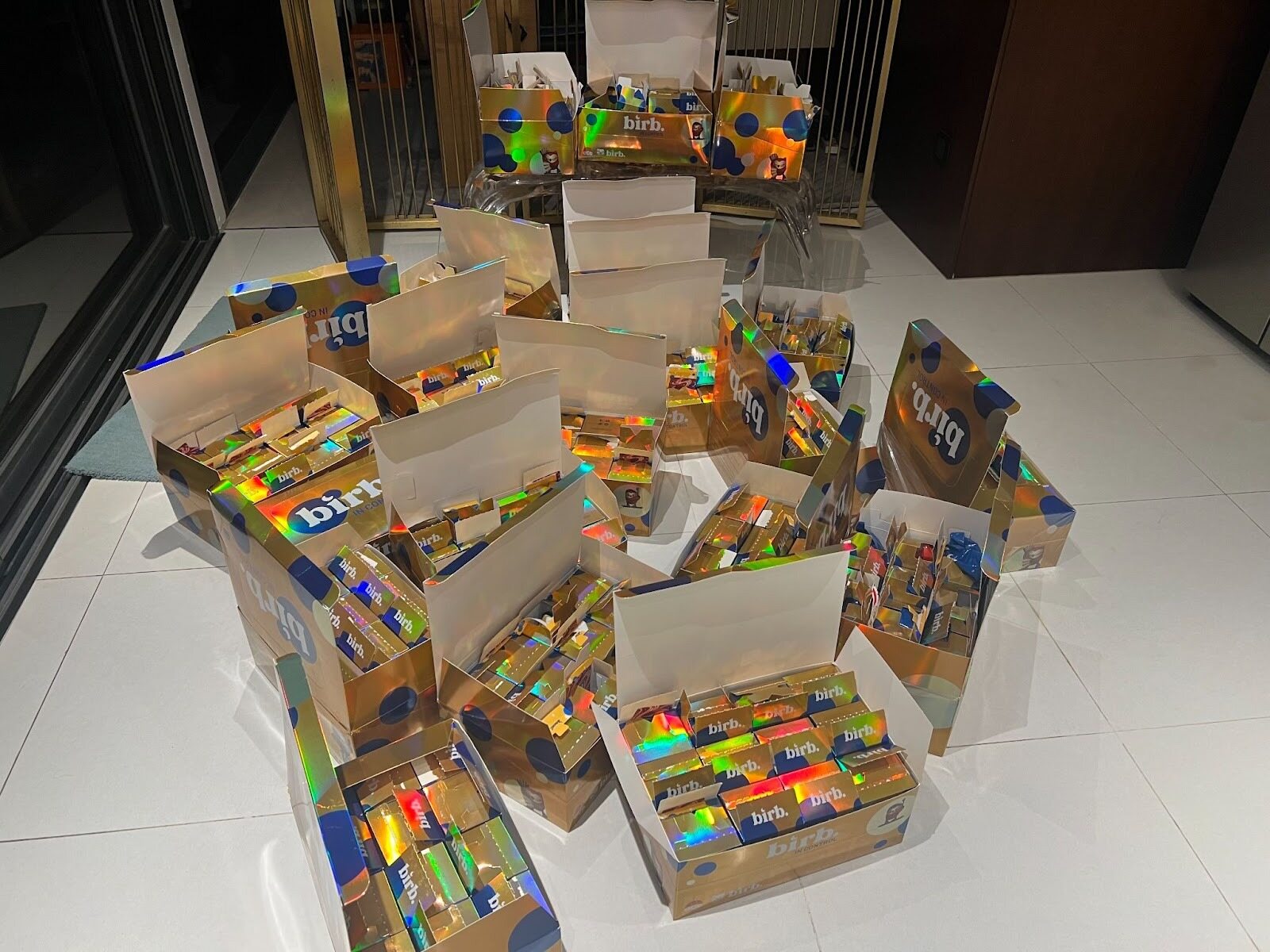
Someone opened 277 boxes in 6 hours
Not Benchmarking Against Penguins, Not Against BAYC, But Against Pop Mart
A goal repeatedly mentioned in the whitepaper is to build a crypto-native company that achieves scale through consumer goods sales, not relying on transaction fees, liquidations, or token sales.
This is also why OCG started benchmarking against Pop Mart. Pop Mart's publicly traded stock is an effective tool for measuring the value of Labubu's revenue; similarly, the token serves a specific function relative to Moonbirds. Labubu created immense cultural value—free marketing, social validation, secondary market vitality—but a significant portion of this value couldn't be captured through the stock price. $BIRB's design aims to bridge this gap.
The Birbillions Goal: The Ten Billion Birb Plan?
The word "Birb" itself is interesting. Short, phonetically clear, rooted in internet culture. It's familiar enough to feel like it should exist; silly enough to spread quickly; yet specific enough to be "owned."
The core goal proposed in the whitepaper is direct: to build the first crypto-native consumer goods company with $1 billion in annual revenue, without relying on transaction fees, leveraged liquidations, or token issuance.
But this goal isn't unattainable: Pop Mart generated about $900,000 in revenue in its second year of operation, and around $20 million in the two years before its IPO. OCG generated approximately $8 million in revenue through physical collectibles in its second year of operation. Over the past 12 months, the Vibes card game sold over 8.6 million cards, generating over $6 million in primary market sales. During the same timeframe, Moonbirds' growth rate actually surpassed Pop Mart's, despite having fewer SKUs, lower brand recognition, and a less mature retail network.
"The core proposition of the Birbillions thesis is this: when these two are fused into a single flywheel—attention converts to product, product converts to revenue, revenue flows back into distribution—you can build the first crypto-native consumer goods company to achieve $1 billion in annualized revenue. This is exactly how consumer companies have always won: winning shelf space, winning repurchase behavior, and making culture propagatable."
3. Tokenomics Design: Long-Termist Thinking and the Community Incentive Package
Just this week, Moonbirds officially unveiled the $BIRB tokenomics model. This design is quite interesting, revealing the team's deep consideration for long-term value creation.
65% Allocated to Community: An Unexpected Commitment
Moonbirds chose a rather aggressive community allocation ratio: 65% of the total supply.
There's a key design philosophy here: Moonbirds splits this 65% community share into five different incentive modules, each corresponding to different aspects of ecosystem development:
- Holder Rewards (27%): Core incentives for Moonbirds, Mythics, and Oddities NFT holders, aimed at building stronger community cohesion.
- Ecosystem Partner Expansion (12%): Performance-based allocation mechanism for acquiring high-value partners, driving user growth, and executing regional brand activations.
- Value Chain Incentives (10%): Rewards community members contributing to the project's physical infrastructure, incentivizing operational excellence.
- Liquidity (8%): Ensures healthy market depth and convenient trading experience, used for CEX listings, deposit campaigns, and market-making services.
- Innovation Reserve (8%): Strategic reserve set aside for the ecosystem's future development.
It's evident that Moonbirds' understanding of "community" isn't limited to "holders" but encompasses the entire ecosystem's participants, including partners, contributors, liquidity providers, etc.
Nesting 2.0
Simultaneously, Moonbirds launched the Nesting 2.0 protocol, a design brimming with long-termist thinking:
- NFT holders can deposit their Moonbirds, Mythics, or Oddities into the Nesting protocol.
- Upon deposit, they receive an SBT as proof.
- Over the next 24 months, on the 28th of each month, nested NFTs can claim 1/24th of their total allocation.
- If nested for only part of the time, rewards are proportional.
- NFTs nested within the first 7 days are considered nested for a full month, giving early participants a buffer.
This design avoids massive sell pressure at TGE while giving holders a reason for long-term participation. To maximize token rewards, one needs to stake their NFT continuously for a full two years.
This restraint might actually be a more responsible attitude. After all, if you truly believe this project is meant to last 10 years or more, building a genuine consumer brand, what matters is whether the token and ecosystem still exist in one year, two years, five years, and can continue creating value.
Community Reaction: Should One Be a Long-Termist?
After the tokenomics were announced, community reactions showed clear polarization.
Some holders expressed dissatisfaction. A user named Gomie bluntly criticized: "This isn't 2021 anymore. Staking is outdated and cumbersome. Calling staking 'Nesting 2.0' is just a gimmick. OG Moonbirds holders have waited 4 years for an airdrop, and the Moonbird team says 'I see your 4 NFTs, here are 2 more for you.'"
But there were also voices defending Moonbirds' choice. Prominent KOL Garga.eth (Greg Solano) tweeted to justify the design:
"OCG is not the Moonbird team from 4 years ago. They didn't get any mint funds or royalties from 4 years ago."
He further pointed out: "You either want to be part of the Moonbirds community long-term and stay engaged in the game, or you don't. Your NFT is already worth way more than when Spencer took over the project, and you'll get some airdrop on day one regardless."
Spencer and Orange Cap Games only acquired Moonbirds in June this year, launching a token just 7 months later. "Many NFT projects and protocols promised ecosystem tokens over 5 years ago and still haven't had a TGE (though many have point programs). Some protocols completely abandoned airdrop promises and just did an ICO."
He believes that many top-tier NFT projects like Azuki and Doodles launched tokens last year, but from the current perspective, holders don't seem to embrace the ecosystem tokens; most only care about the NFT itself.
"Birb airdropped part of the tokens to NFT holders on day one, then lets them claim monthly over the next 24 months. This is a bold and risky strategy, putting NFT holders on a vesting schedule, because many NFT holders prefer to treat airdrops as a 'cash-out moment,' selling and moving on. Some will definitely do that. So I don't blame Spencer for trying to create a situation where NFT holders are long-term aligned with the token."
Conclusion: A High-Stakes Bet on a New Model
The $BIRB TGE is not an endpoint but the starting point of a larger experiment.
The core question of this experiment is simple: In 2025, what should a crypto project rely on to survive?
Momentary hype and speculation? Or real products and sustained revenue? Short-term token price spikes? Or long-term brand value accumulation?
Moonbirds' answer is clear: the "Ten Billion Birb Plan" wants both, but in a different way.
The team is betting that: consumer goods logic can take root in the crypto world, and physical products can create real value for tokens.
The community is betting that: this team can deliver on its promises, this brand can grow continuously, and these two years of waiting will yield greater returns.
The market is betting that: this "not-quite-like-a-token-launch" token launch can truly carve out a new path for NFT project transformation.
A year from now, when we look back at the $BIRB TGE, what will we see? A failed case of evaporated market cap, disbanded community, and a token going to zero? Or a successful transformation with growing revenue, expanding user base, and steadily rising token value?
Regardless of the outcome, in an industry saturated with quick money and speculation, the fact that there are still people willing to seriously build products, patiently cultivate brands, and believe in long-termism is, in itself


