






What exactly is the "new media" that a16z talks about? New media is a shift in power


- Core Viewpoint: Top venture capital firms like a16z are heavily investing in "new media." The core is not about content format but recognizing that in an era of information overload, the truly scarce resource is "agency"—the ability to drive collective action. This marks a shift in power structures from institutions to individuals.
- Key Elements:
- a16z has newly established a new media team and believes that marketing expertise has replaced computer science as the key capability. Its essence is competing for "agency"—the power to define narratives and drive action.
- In the new media era, the value creation chain has flipped from "capital → company → market" to "agency → community → market → capital." Capital itself no longer automatically translates into success.
- The truly scarce resources today are "consensus" and the ability for "synchronized action"—making a group of people believe in the same thing and act at the same time. This constitutes the new leverage.
- New media platforms (like X, Substack) transform media from an institutional asset into personal capital, enabling individual creators to directly accumulate influence and bargaining power to influence others' decisions.
- New media has a structural flaw: influence does not equal ownership. The concept of ICM (Internet Capital Markets) aims to convert narratives and consensus into tradable, holdable capital structures, solving the problems of pricing and sustaining influence.
- As AI lowers the barrier to coding, the most scarce leverage in the next cycle will be "new media"—the scalable ability to disseminate narratives, judgment, and taste.
Original Author: Julie Chen (@0xJuliechen)
a16z raised $1.5 billion. What exactly is the "new media" they are betting on?
On X, everyone is a KOL, with millions of monthly traffic. Traffic is no longer valuable. What's valuable is attention, the power of "belief," and the right to be scarce.
This article explains a16z's new media, agency, how to make traffic on Twitter meaningful, and ICM.
🌟🌟
@a16z raised $1.5 billion at the start of the new year, flooding all major platforms. With all that money, they told a story of "all in on America, believing in AI + crypto and technology."
Two months ago, they also specifically established a new media team to help a16z itself and its portfolio companies with "new media."
AI/Web3 companies in Silicon Valley have also been hiring recently, offering high rewards to find a "storyteller" — someone who can write threads, shitpost, and tell stories.
a16z's new media partner directly stated: Marketing majors have replaced computer science as the "hot commodity."
What a16z has truly valued in recent years is not the content itself, but the way power is being restructured.
New media is just the surface.
The real change is: Who has the qualification to make people act (agency).
1️⃣ Why has "New Media" been elevated so highly in the past two years?
Because the path of the attention economy has basically run out of tricks.
- Extreme content surplus
- Distribution costs approaching zero
- Being seen no longer constitutes an advantage
What's truly scarce now is not exposure.
It's two things:
- Whether your judgment is trustworthy
- Whether you can turn "belief" into "action"
This is also why you can clearly feel a shift:
Before, media was more about telling stories and setting narratives;
Now, media is starting to directly influence decisions and trigger actions.
When content is no longer scarce,
What becomes truly valuable is no longer 'what you said,'
But — what happens next.
This is the core meaning behind a16z repeatedly discussing new media.
It's not about the forms like threads, podcasts, or short videos,
But that the distribution structure has changed, and the power structure has changed along with it.
A simple comparison:
Old Media
- Scarce distribution (TV, newspapers, platforms)
- Value concentrated in institutions
- Creators are essentially employees
New Media
- Decentralized distribution (X / YouTube / Substack / Podcasts)
- Individuals themselves become nodes
- Creators directly accumulate influence and bargaining power
The real change can be summed up in one sentence:
Media has shifted from an institutional asset to personal capital.
And once media becomes personal capital,
It is no longer just an 'exposure tool,'
But begins to become a power tool.
When media belongs to an institution, it's your exposure tool;
When media belongs to an individual, it becomes your ability to influence others' decisions.
And influencing decisions is power.
2️⃣ Agency
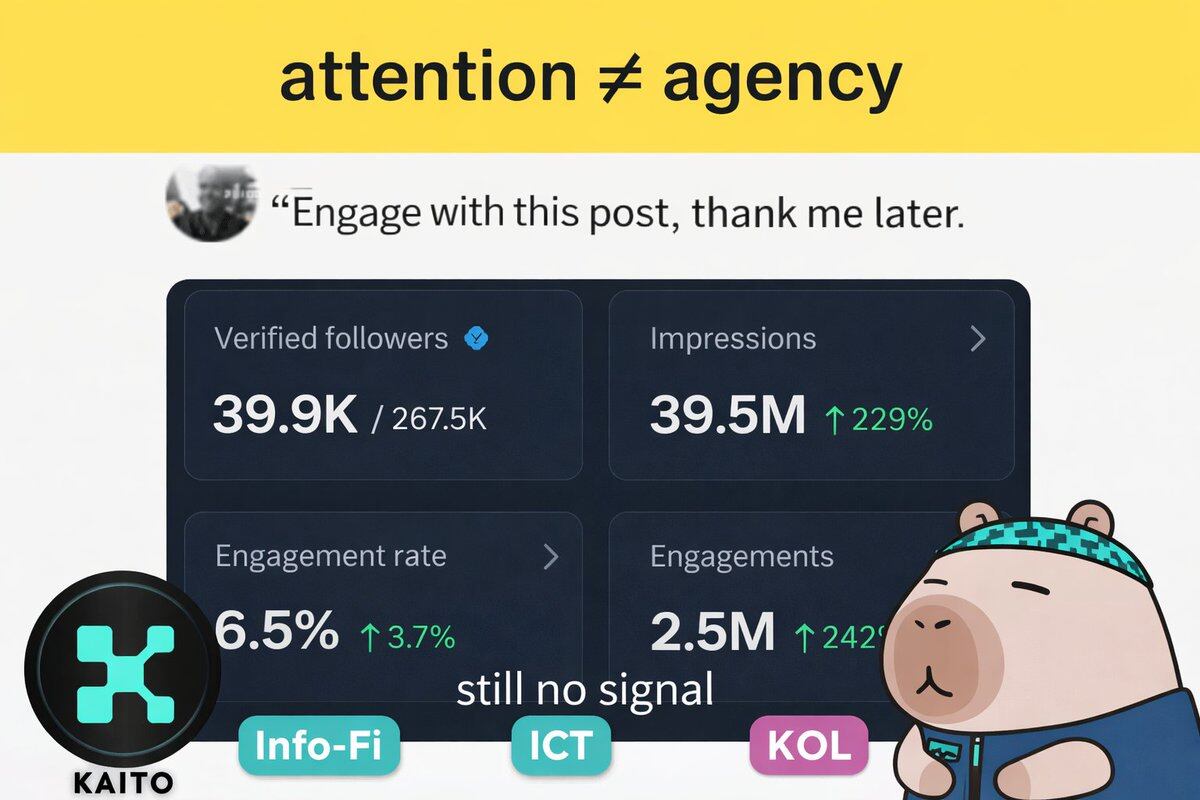
The end goal of new media is not page views,
But agency.
Agency means others are willing to act with you, trust your judgment, and pay for your concepts.
Packy mentioned in "The Power Brokers":
The goal of a Fund is to generate carry with as few people as possible, in as short a time as possible.
The goal of a Firm is to build sustained, long-term advantages through scale.
This distinction explains one thing:
Why in traditional VC, media capability has always been "icing on the cake";
While at a16z, it has been directly built into infrastructure.
For a long time, the default sequence we assumed was:
Capital → Company → Market
Capital came first, determining everything.
But in a world of extreme media saturation, this sequence has flipped:
Agency → Community → Market → Capital
Why is it that now "there's a lot of money, but it's hard to get things done"?
Because capital no longer automatically translates into action.
- Distribution is not scarce
- Attention is extremely noisy
- Trust cannot be bought with a budget
We've seen this many times in the crypto space (won't give examples to avoid offending):
There's plenty of money, but projects still fail to launch.
Valuations are high, but no one is truly willing to participate.
The narrative is complete, but no one follows through with execution.
It's not because of insufficient capital.
It's because of a lack of agency.
The truly scarce resource now is not capital.
It's:
- The ability to make a group of people believe in the same thing simultaneously
- The ability to make them act at the same point in time
Whoever can do this,
Holds the real leverage.
So I'm not praising, but using a16z to explain a structural change that is happening.
3️⃣ What does New Media solve? What is it still missing?
If media can form consensus, and consensus can drive action, then the market is the settlement layer for consensus.
Why ICM (Internet Capital Markets) inevitably emerges after new media:
Because new media has a natural structural defect:
- Influence ≠ Ownership
- Traffic can be monetized, but it is not composable, not holdable long-term
- Creators still rely on platform revenue sharing, brand partnerships, and advertising cycles
The concept of ICM was first proposed by @solana, and it precisely fills this gap:
- Transforming narratives / consensus / culture
- Into tradable, holdable, collaborative capital structures
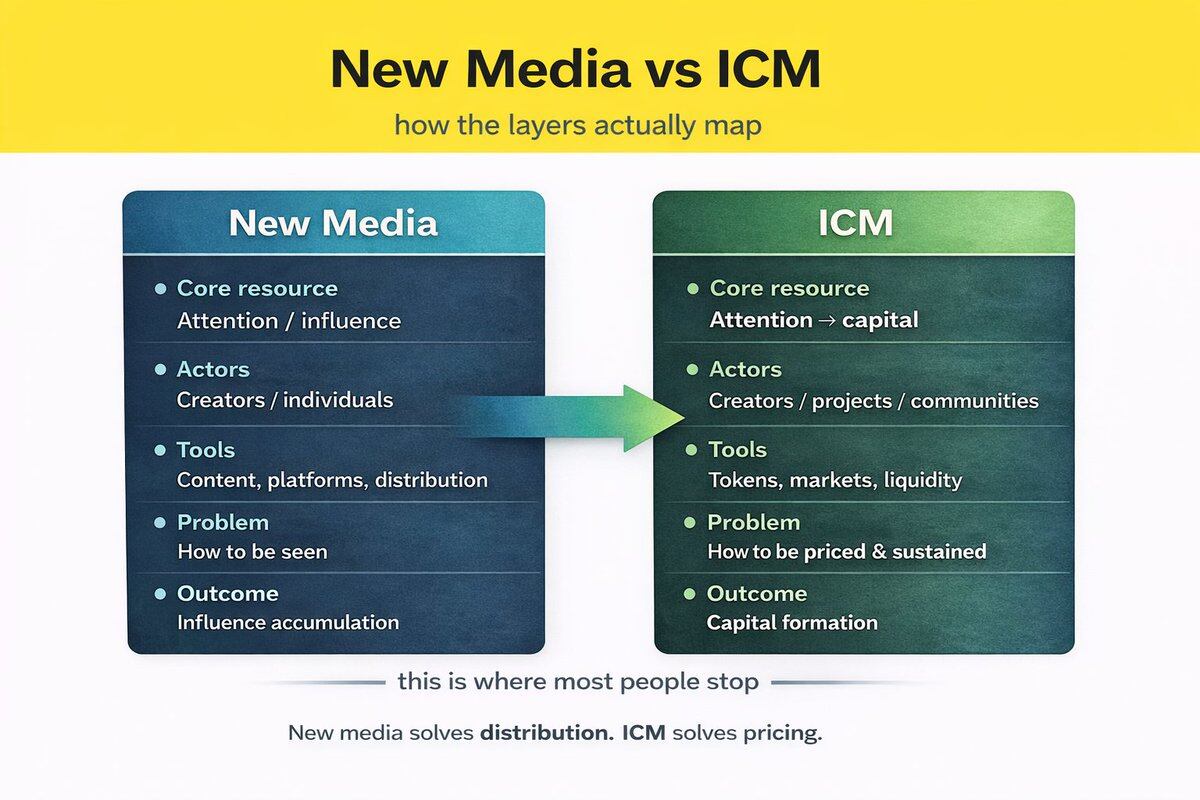
ICM solves the next-step problem for new media:
How is influence priced, traded, and sustained?
To differentiate in one sentence:
- New media: → Who can gain attention
- ICM: → How attention becomes a capital structure
Conclusion:
New media solves "the right to disseminate," ICM solves "the right to price."
The essence of ICM:
- Turning attention → agency → pricing → capital formation
- Not a speculative tool, but coordination infrastructure
Closing
Finally, I'd like to quote my favorite saying from Naval Ravikant to echo this point and conclude the article.
Naval said: Code and media are the leverage behind the new wealthy class.
Indeed, over the past 10 years, Silicon Valley's new rich and big tech companies (internet / software / AI) have essentially relied on "code leverage" to create wealth.
With the proliferation of tools like Cursor and Claude, everyone can vibe code. The ability to write code is gradually becoming less scarce; there are even predictions that all junior programmer jobs will be replaced by AI within the next 10 years.
The truly scarce leverage in the next cycle is new media:
That is, the scalable dissemination of narrative × judgment × taste. Good leverage can continuously generate compound interest while you sleep, influence others in your absence, and help you build "trust + reputation + opportunity gateways."
code is law
New media is the law.


