






X Content Order Reshuffle: Three New Rules Redefining Value Hierarchy


- Core Viewpoint: The X platform is systematically reconstructing its content value system through a series of product and rule adjustments. The core objective is to decouple incentives from low-value interactions and propel content towards becoming structured, consumable information assets.
- Key Elements:
- Incentive Rule Change: Creator earnings are now calculated solely based on views from the homepage timeline. Exposure generated from replies and interactions no longer counts towards earnings, directly targeting arbitrage models reliant on high-frequency, low-quality interactions (e.g., "reply farming").
- Launch of Smart Cashtags: The smart asset tag feature, currently in testing, aims to structure asset prices alongside related discussions. This lays the infrastructure for a "content × finance" interface, enhancing the information density and consumability of financial content.
- Algorithm Open-Sourcing & Distribution Logic Shift: Open-sourcing the recommendation algorithm while shifting content exposure criteria towards "comprehensibility" and "consumability." This means exposure rights are transitioning from "who is more active" to "whether the content itself is easily recognized by the system and absorbed by users."
- Establishment of an Independent Meme Section: Categorizing Meme content separately essentially stratifies content, explicitly defining it as an emotional expression sector, distinct from information asset-type content.
- Overall Strategic Intent: These series of adjustments are not isolated actions. They collectively point towards the platform's desire to reclaim sovereignty over content distribution and establish a new pricing and distribution order centered on the intrinsic value of content itself (rather than interaction volume).
Original | Odaily (@OdailyChina)
Author | Ethan (@ethanzhang_web3)

On January 22, X platform updated its "Global Trends" page. Following a series of adjustments around content and incentive mechanisms, Odaily has observed that the platform has added a separately categorized Meme section. Various memes, humorous images, and short videos are now aggregated and presented, allowing users to intuitively see the Meme themes and sentiment trends currently spreading both on and off the platform.
At first glance, this appears to be a more entertainment-focused content curation. However, when placed within the context of X's recent intensive content governance actions, the emergence of this Meme section seems less "lightweight."
Within X's product logic, content is being re-stratified: which parts constitute emotional expression, and which are considered information assets? The platform is beginning to provide clearer boundaries through its interface and categorization itself.
It is precisely against this backdrop that X has recently tightened creator incentives and API usage rules, explicitly stating that reply interactions no longer count towards earnings, ultimately targeting the InfoFi application model that relies on external incentives to drive posting and interaction. Within the crypto community, this series of changes has been quickly interpreted as a signal—the platform is no longer ceding space to the "high-interaction, low-information-density" content path.
Judging from the detail of Memes being singled out, X's adjustment is not merely about shutting down old mechanisms but is simultaneously building a new content order.
Why Did "Zuilu" Fail? X's Answer is More Direct Than "Throttling"
Over the past week, through a series of mutually reinforcing rule adjustments, X has indicated that: X is redefining what kind of behavior is worth being priced.
The change is first reflected in the creator revenue rules. On January 19, X's Product Lead Nikita Bier explicitly stated in response to user inquiries that current creator earnings are calculated solely based on content views in the Home timeline, and exposure generated from replies is no longer counted towards revenue. This almost directly overturns a long-defaulted growth logic—interaction itself no longer holds monetization value.
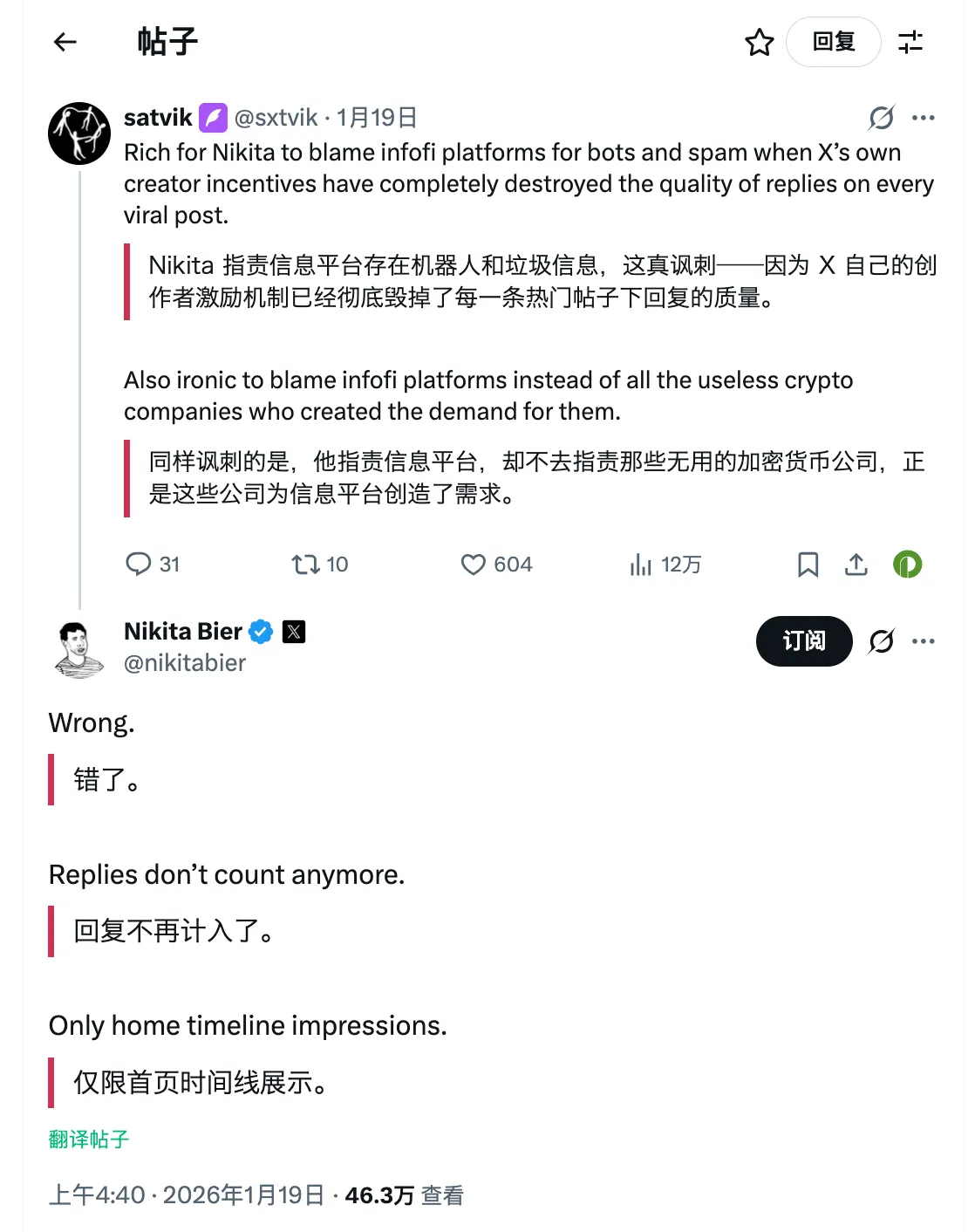
X Product Lead Nikita Bier responds to netizen inquiries on X
Under the new pricing system, whether it's high-frequency replies, concentrated spamming, or maintaining activity with low-effort content like "gm" or "+1," as long as it cannot push content into the Home timeline, it will no longer be considered an effective contribution by the platform.
This change did not occur in isolation. In subsequent explanations, X further elaborated on the logic behind it: the number of posts an average user can realistically view each day is extremely limited. Excessive posting and frequent interaction do not expand influence; instead, they prematurely consume an account's daily exposure quota. When truly important information needs to be posted, the account often has "no quota left."
In other words, in X's judgment, excessive interaction is not being suppressed but is seen as an inefficient or even self-damaging behavioral pattern.
This stance also echoes Nikita Bier's previous public criticism of the crypto community. In his view, the decline in influence of crypto-related tweets is not due to deliberate suppression by the platform's algorithm but is a result of the community's long-term reliance on low-value interactions causing self-consumption.
From the outcome, X did not deny the existence of "Zuilu" but chose a more direct and calmer approach: stop paying for this behavior.
When reply views are entirely stripped from the incentive system, content models that "arbitrage through interaction" naturally lose their foundation. The so-called "end of the Zuilu era" is not a targeted purge but an inevitable result of the adjusted pricing system.
The Real Context Behind Smart Cashtags: X Wants to Turn "Market Sentiment" into a Consumable Object
While reshaping creator incentive rules, X is also advancing another more directional product path—Smart Cashtags.
According to public explanations by X Product Lead Nikita Bier, this feature allows users to directly tag specific tokens or smart contracts when posting content related to market trends or assets. Users clicking the tag in their timeline can view the real-time price of the corresponding asset and all related discussion content on the platform. The feature is still in the testing and feedback phase. The official team has clearly stated that a V1 version will be launched and has provided a relatively clear release expectation (expected next month).
This means Smart Cashtags are no longer just a proof-of-concept but have entered the final polishing stage before feature finalization.

Related tweet and Smart Cashtags test page
Initially, the community largely viewed it as a market data tool to enhance user experience. However, as discussions deepened, the focus of skepticism gradually centered on several more fundamental questions:
— If an asset is not yet listed on mainstream exchanges, does X have reliable data coverage capabilities?
— Will its price and on-chain information rely solely on centralized exchanges?
— Will it further extend to wallet or trade execution layers in the future?
Regarding the first two questions, Nikita Bier provided a relatively clear response. He stated that the API used by X will "be able to process almost anything minted on-chain in near real-time," implying that Smart Cashtags' data sources are not limited to centralized trading platforms but possess the capability to directly interface with on-chain information.
As for whether it will support self-custody wallets or allow trading within X via CEX widgets, he did not respond directly, only brushing it off with a "following" emoji. This deliberately reserved attitude has instead sparked more speculation within the community about X's next moves.
If we place Smart Cashtags back into X's existing strategic trajectory, this "intentional omission" is not out of place.
In 2025, X had already obtained money transmission-related licenses in over 40 US states and was simultaneously advancing the compliance construction of the X Money payment system. At that time, these moves were seen more as part of the "Everything App" narrative, still distant from the content ecosystem.
Entering January 2026, the pace of Smart Cashtags' development began to clarify: the feature was first publicly discussed, followed by supplementary details on the API layer, accompanied by information leaks regarding compliance and legal aspects. By late January, although still in the testing phase, the official team had released clear timing expectations.
Odaily believes this further indicates that Smart Cashtags is not an isolated product experiment but rather X laying the infrastructure in advance for the "Content × Finance" interface.
If considered alongside adjustments like creator incentive rules and the phasing out of InfoFi APIs, its positioning becomes clearer: X is not in a hurry to personally介入 trade execution but is attempting to compress assets, prices, and market sentiment into a single clickable, trackable content node.
Within this structure, the value of content is no longer simply determined by interaction volume but depends on whether it can form a sustained, consumable stream of information and narrative around a specific asset. In this sense, Smart Cashtags is not a tool prepared for "Zuilu" but an entry point reserved for specific content forms.
After the Algorithm's "Lid Was Lifted," Exposure Rights Did Not Become More Democratic
Apart from Smart Cashtags, another frequently mentioned recent change by X is the official open-sourcing of its recommendation algorithm.
In late January, X's engineering team announced that the latest version of the platform's algorithm had been made public, adopting the same Transformer architecture as the Grok model from xAI. Subsequently, Elon Musk直言 that the algorithm is still "quite clumsy," but open-sourcing means users can clearly see its optimization path. For a long time, content throttling and topic suppression were often attributed to the "black box algorithm"; algorithm transparency at least makes the rules no longer hidden and the path traceable.
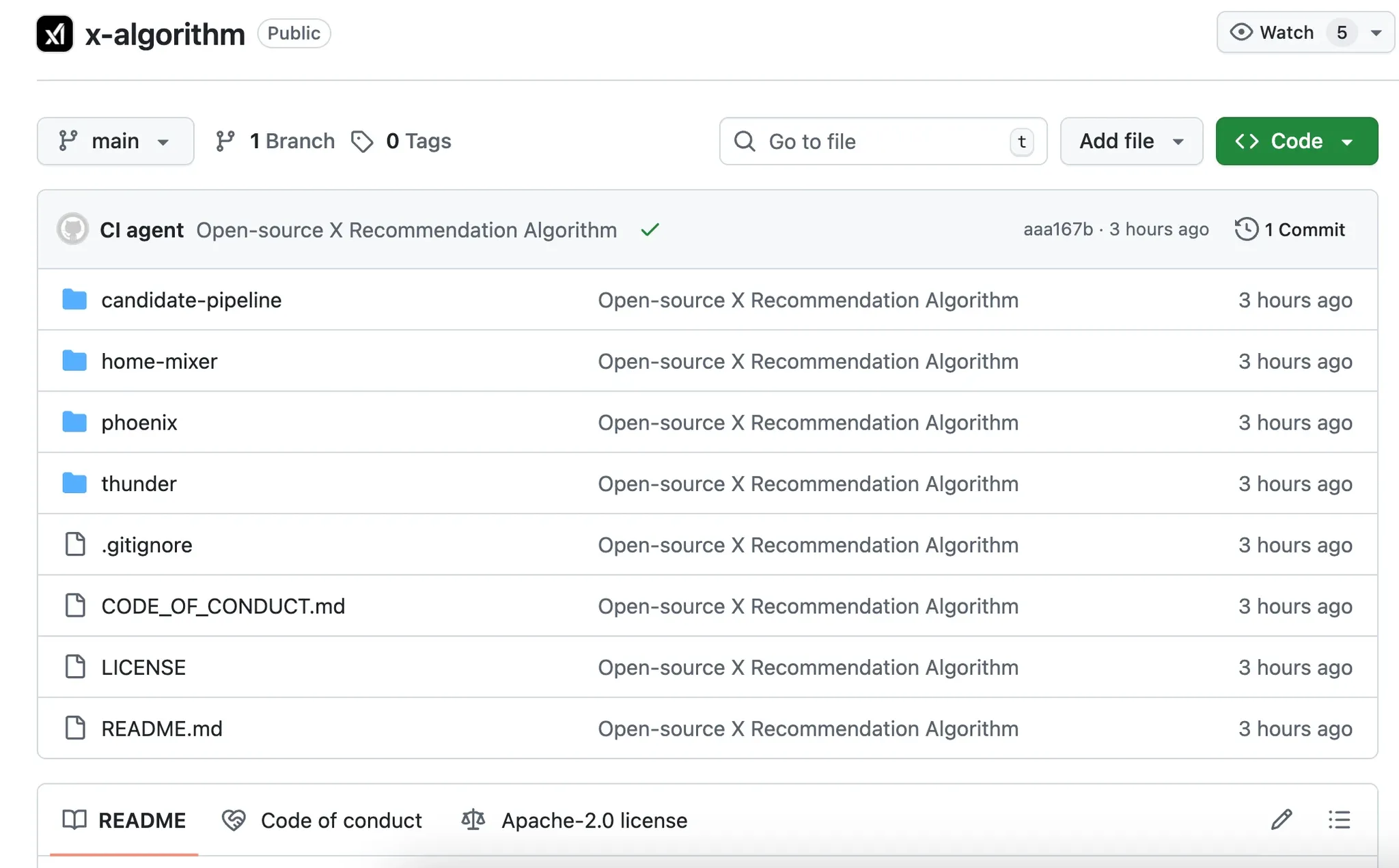
Homepage of the Github repository for X's newly public platform algorithm
However, open-sourcing the algorithm does not mean exposure rights are evenly distributed.
Almost simultaneously, X is advancing a systematic upgrade of its "Interest Discovery" mechanism. The core goal is to help new accounts find content of interest faster, without going through a lengthy follow-filtering process. When organizing timelines, the algorithm is shifting from relying on "who you follow" to "what the system thinks you might want to see."
Under this framework, whether content gains exposure depends on two key criteria: comprehensibility and consumability.
- Comprehensibility: Content has a clear structure, complete information, and is easy for the algorithm to identify and categorize.
- Consumability: Content can be absorbed, understood, and interacted with by users in a short time, forming an effective information flow.
In other words, exposure rights are no longer determined by "interaction volume" but by whether content can be efficiently identified, distributed, and attract an audience by the system. This marks a shift from the previous model of "whoever is more active gets more visibility" to a distribution logic centered on the inherent value of the content itself.
When the platform simultaneously tightens interaction incentives, structures asset narratives, and strengthens interest recommendation mechanisms, a new filtering logic has taken shape. Within such a system, it is no longer surprising that "Zuilu" is naturally excluded from the mainstream exposure path.
Conclusion: This Isn't Anti-Zuilu, It's a Repricing of Content Value
From tightening creator incentive rules and open-sourcing algorithms, to the gradual advancement of Smart Cashtags functionality, and to the separate categorization of the Meme section on January 22, X is gradually piecing together a clear path.
Low-value interactions are being stripped away, assets and sentiment are being restructured, algorithms and interest discovery mechanisms are being brought to the forefront—these adjustments collectively point to one core outcome: the platform is redefining what kind of content is worth being distributed, priced, and seen.
Under the new order, Memes are categorized as emotional expression, while financial and crypto content are required to have clear structure and directionality; exposure rights shift from "who is more active" to "who is easier to understand and consume." The platform also stops paying for noise or mere participation.
As analyzed in a previous Odaily article "X Personally Terminates InfoFi Incentive Model, Zuilu Era Concludes", the end of the Zuilu era is not the终点 but the first perceptible signal of X's content value system reconstruction. As new rules take effect, the platform is building a value system more biased towards content itself rather than interactive behavior.
For creators and the industry, this means: gaining visibility on X in the future will no longer depend on quantity but on whether content can be recognized by algorithms, absorbed by audiences, and form sustainable value. This new order is both a reclamation of platform sovereignty and a profound reshaping of the content ecosystem.
Related Links:
《Deconstructing X's New Algorithm: The Ultimate Guide to Content Gold Mining in 2026》
《X's New Algorithm Exposed: Likes Are Almost Worthless, This Action's Value Multiplies 150x》
《X Personally Terminates InfoFi Incentive Model, Zuilu Era Concludes》


