


Excess block space and the reshuffle of valuation logic


Original title: EXPECTED VALUE IN CRYPTO BUILDING INFINITE BLOCKSPACE
Original author: Michael Dempsey, CompoundVC
Original compilation: Kaori, BlockBeats
Editors note: CompoundVCs MP Michael Dempsey believes that there are currently too many people working on new L1/L2/LST and other infrastructure, while people trying to build new encryption applications are in short supply. So he wrote about his views on the expected value of cryptocurrencies and the construction of unlimited block space. Looking at why this happens, how this happens, and how we can solve this existential problem.
I recently re-read three excellent (and in my opinion canonical) older cryptocurrency posts that have shaped a lot of thinking about cryptocurrency value capture (Fat Protocols, Thin Apps, Crypto Tokens, and The coming era of protocol innovation).
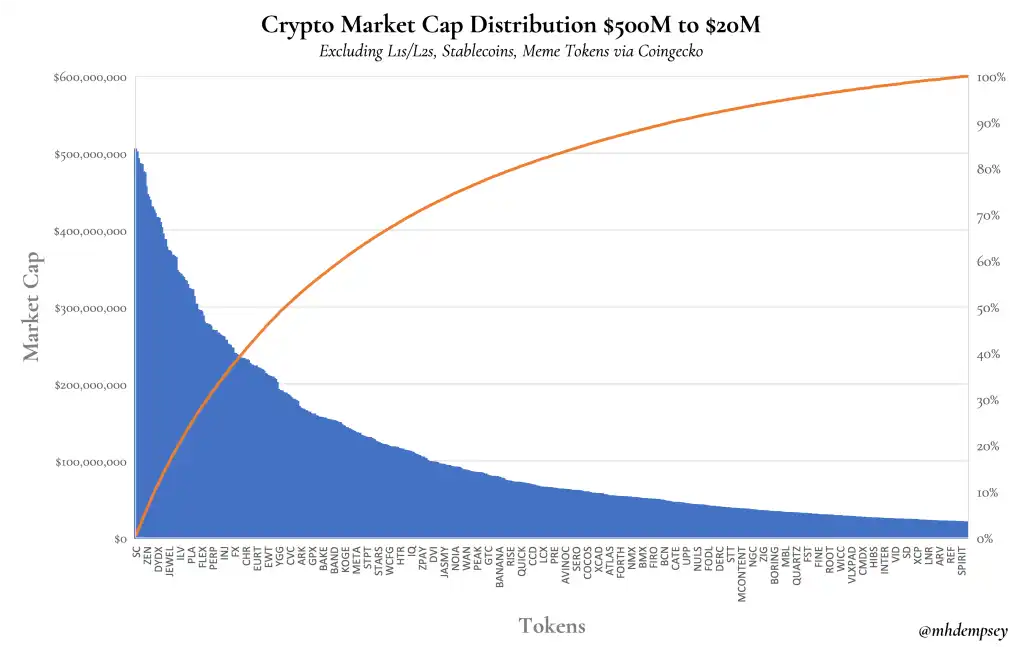
By Power Law and Normal Distribution in Cryptocurrency
The original fat protocol paper was well understood in terms of L1 value accrual, but that also means youre seeing more long-tail dynamics in Dapps, which means that from a % chance of success perspective, the power law is more less (i.e. many tokens will be worth *something*, while few will become 0, as I wrote before).
What we see in the bull market (and perhaps the cryptocurrency market as a whole) is a shift in the way people view expected value.
This leads us to a logical conclusion: today, most developers believe that the most extreme EV (expected value) move is to build a new L1 or L2, rather than Dapps or application-centric protocols, which leads to Further fragmentation of the world and a large amount of useless block space. Then, they took steps to downgrade and build abstraction layers to absorb some of the value in L1/L2, such as in LST.
Some may argue that this dynamic is due to the fee structure and “defensive nature” of block space relative to DApps in cryptocurrency. As the data above shows, L1 and L2 make up the majority of the cumulative economic value captured in cryptocurrencies today. This, combined with a deeper analysis of the blockspace business model, explains the massive FDV of various L1s like Ethereum (and more realistically, at this point, things like insert zombie L1 here As well as smaller scopes dominating L2 like Arbitrum, and also taking advantage of the terminal network premiums gained by cryptographic protocols, speculators are willing to model network size and penetration many years into the future and pay for it today, resulting in high multiples .
That said, when you look at the 365-day fees tracked across all protocols on Token Terminal, this is somewhat untenable in terms of practicality, with the various DeFi protocols far outpacing the more valuable block space.
Of course, 2024 fees are not a perfect measure, as there are many other determinants of value, including defensibility, endpoint scalability, the protocol’s net profit, and even the theoretical ability of the token to capture capital flows.
We saw the latter recently put to the test for the first time with the proposal to enable UNI fee accrual, followed by a wave of transactions for other DeFi protocols as the market reassessed the possibility of worthless governance tokens gaining tangible value. .
So, yes,Blockspace is a good business (perhaps a clean business with low regulatory hurdles), but if we peel back the veil of ignorance, the reality is that today there is a flywheel effect, or so to speak, between founders and investors A vicious cycle of perverse incentives that leads to the continued creation of block space.
big fund phenomenon
Investors raise more capital and need to deploy more capital in search of larger and larger returns. This strategy is most easily implemented by investing in capital-intensive projects. All this capital needs to find returns to justify the creation and liquidity of billions of dollars of FDV.
We can look at the top 100 coins by market cap and see that red represents coins that fall within this framework. As one can see, there are very few multi-billion dollar protocols that are not effectively new types of block space, or that are not siphoning infrastructure value. It doesnt get any better if you use FDV instead of market cap.
For those like me (and our company Compound) who want to see a long-term future for crypto in the world,I believe this cycle of venture capital and founder blockspace inflation will erode the ecosystem (some may argue its already happening) and will most likely lead to a louder monolithic vs. modular chain debate that actually Not important, and little progress was made.

Every cycle we get new block space, some value erosion occurs in underutilized L1 and L2, and maybe every now and then, new value capture that looks a lot like the L1 narrative (data availability, re-staking, etc.) inserts itself to a slightly smaller flywheel, and then a wave of imitators and nth versions of these protocols, descending along the “unbelievable euthanasia roller coaster of billion-dollar FDV tokens.”
The best part is that these tokens may still be more valuable than real applications with real uses and real utility.
This existing dynamic is a net negative for cryptocurrencies for two reasons:
1) Since capital markets prefer the existing playbook and the risk/reward is skewed to the downside, it discourages new experiments.
2) It only slightly increases cryptocurrency adoption.
There was a time when there were many areas in need of innovation at the infrastructure level. We need more block space, faster virtual machines, better fiat-to-crypto rails, better wallet onboarding, etc. to enable new use cases. Now we are in a state where we are no longer limited by technology.
You can basically build anything you want on-chain for early adopter types (of which there are a lot), and soon the tools will be available for early majority/majority type users in most of the world.
Changing expected value
If we take a step back and think about how to change peoples perceptions of the expected value of cryptocurrencies, we can materially change the trajectory of cryptocurrencies rather than just give the industry a slight boost.
There are approximately 3 clear and logical paths to these next steps, which ideally will lead to more diverse ways of capturing value and building meaningful protocols and Dapps.
1. Effective duopoly/oligopoly of the basic chain
With the transformation of smartphones and each OEM having its own operating system and app ecosystem, mobile devices have gone through a similar paradigm to cryptocurrencies now. Blackberry, PalmOS, Windows Phone, Android, iOS, and many other operating systems mean that the desire to have a phone + OS combo is fragmented. Eventually, two dominant ecosystems emerged, iOS and Android.
Many have compared Solana to Ethereum (since Android has various software forks and the value of the Google Play Store accumulates in a similar way to how EVM works, value can accumulate from L2/L3 to the settlement layer of ETH) ETC. ).
What this will lead to +EV doing is developing Dapps that dominate the duopoly (or both), and things like shard solvers like Restake or Arbitrum Researchs Chain-Clusters to capture value.
This is the best outcome for driving the long-term value of cryptocurrencies, as it will structurally force innovation into the application layer and create a flywheel through which DApps and L1 coordinate with each other to achieve growth in the total market value of cryptocurrencies.
2. A decentralized decentralized/centralized/application chain future, Cosmos people may like it because of the application chain theory, and centralized players will like it because of the elimination of trust (how JPMChain is thing)
This is a Frankenstein model of decentralized scope, where value capture can be siphoned off by those actors who orchestrate various “blockchain” shards, perhaps similar to how AWS, Azure, and GCP extract from growth ( and implement) primary value applications in traditional software as well as more novel artificial intelligence software.
Solana Token Extension 4 is another interesting framework in this world that could once again create a stepping stone where we could see cryptocurrencies happen over many cycles in a similar way to what we saw “centralization → decentralization” There will be a bundling → unbundling cycle in dynamic software.
3. We just keep launching new tokens with high FDV and creating new narratives about the block space because of speculation and money

This future sucks and I won’t waste words discussing it anymore, but it is a very real future. I recommend reading Nihilism, which is perhaps a bit roundabout, and uses her as an example.
What needs to happen?
To advance the future that many who truly believe in cryptocurrencies want, a few core things need to change:
1) We must create longer and more complex token lock-ups.
Whether you’re talking to founders or investors, this phrase keeps getting nods…and then very little changes. This leads to the second question:
If we all claim we want to do this, who is responsible for doing it?
Investors said they could not push for longer lock-up periods because they would lose deals with other companies willing to accept shorter lock-up periods. Investors also want shorter lock-in periods, founders say, while longer lock-in periods can make it difficult to retain talent.
In this world, this could be driven jointly by the larger funds/LPs in those funds. There is also the possibility that in a world where your given project could fork with the fast vest token, a subset of the founders might push this as a statement.
The dark horse and most likely candidate is the community, the broader ecosystem that may force change. We saw this recently, with the Starkware team being effectively bullied into changing the unlocking schedule for their team and investors.
In a longer-term, more complex world of token unlocks, if you launch with useless block space, retail and the community often have years to dump their tokens on you before investors and teams are able to capture the value Use the market as a weighing machine. This will make the 100th L1 prohibitive.
Additionally, this will require dapps to consider longer-term product development cycles and value capture, rather than developing star products that are not sustainable or long-term value-added but still allow groups to extract capital from the ecosystem and enrich teams and investors.
In all cases you can tie unlocks to time + (lower playability) milestones to some extent overcome the obvious structural disadvantage that one might assume you have with other tokens that unlock faster There are obvious structural disadvantages compared to the team.
2) We need some breakthrough non-infrastructure protocols.
Aave/Compound/Maker/Uniswap and others have created value from a token perspective and driven new use cases for smart contracts, thus motivating a generation of builders to enter DeFi. This creates an ecosystem of DeFi builders that should compound over multiple cycles.
It may take other massive wins like Helium, RNDR, Livepeer or more to continue scaling beyond 10 B+ FDV (and beyond Zombies L1) to change the tide and make the expected value of DePIN or other builds within the category look worthwhile. I have every confidence in this area, and many others, that price will drive activity, moving from one category to another, with winners paving the way for each category and inspiring new ambitious shots.
3) I find myself returning to superstructure as a concept at times.
While I think these are overly idealistic when considering Eth and Solana or any other oligopoly emerging in the cryptocurrency space, there can be a net increase in the value of the dapp without too much of an unnecessary drag on profits. The idea is interesting.
In other words, if we could simplify the infrastructure and middleware, as we like to do when making the case for smart contracts, we could imagine a world where all the incentives for cryptocurrency builders are in a position to bring real use For users of Dapp-cases and extensions, the choice is not what L1/L2 should be built on, but what tokens the user wants to own to continue to capture the value created by the protocol.
madness or change
The current fragmentation and over-expansion of the block space may just be a natural consequence of early ecosystems figuring out what makes sense and what doesn’t, and the early financialization of cryptocurrencies leading to greater difficulty in the short term. Long-term optimization. We may eventually discover a handful of dominant L1s and L2s, and the token value structure of the past decade will become a unique memory of the “early days” of cryptocurrencies.
Regardless, it is clear to me that as we enter a new cycle of capital flows, user adoption, and rising volumes, the best path for cryptocurrencies is for the expected value to be skewed more towards applications and away from infrastructure. In fact, it is existential.
The end result may look like a more virtuous cycle of infrastructure and application development, similar to the cycle described in the myth of the infrastructure phase.
Finally, we got what we asked for in cryptocurrency.
If L1 and L2 and restaking protocols and the like continue to accumulate the vast majority of resources, we will continue to find applications, use cases, and futures that will never appear.
With this potential outcome, Im reminded of the famous quote:
The definition of insanity is doing the same thing over and over again and expecting different results.





