






比特币ETF决策在即,哪些热门生态项目值得关注?


On January 9, as the approval results of the Bitcoin spot ETF are about to be announced, Bitcoin once exceeded the $47,000 mark this morning, and the encryption market is full of bullish sentiment towards the Bitcoin ecosystem. BlockBeats has screened 10 Bitcoin ecological projects worthy of attention and summarized the contents as follows:
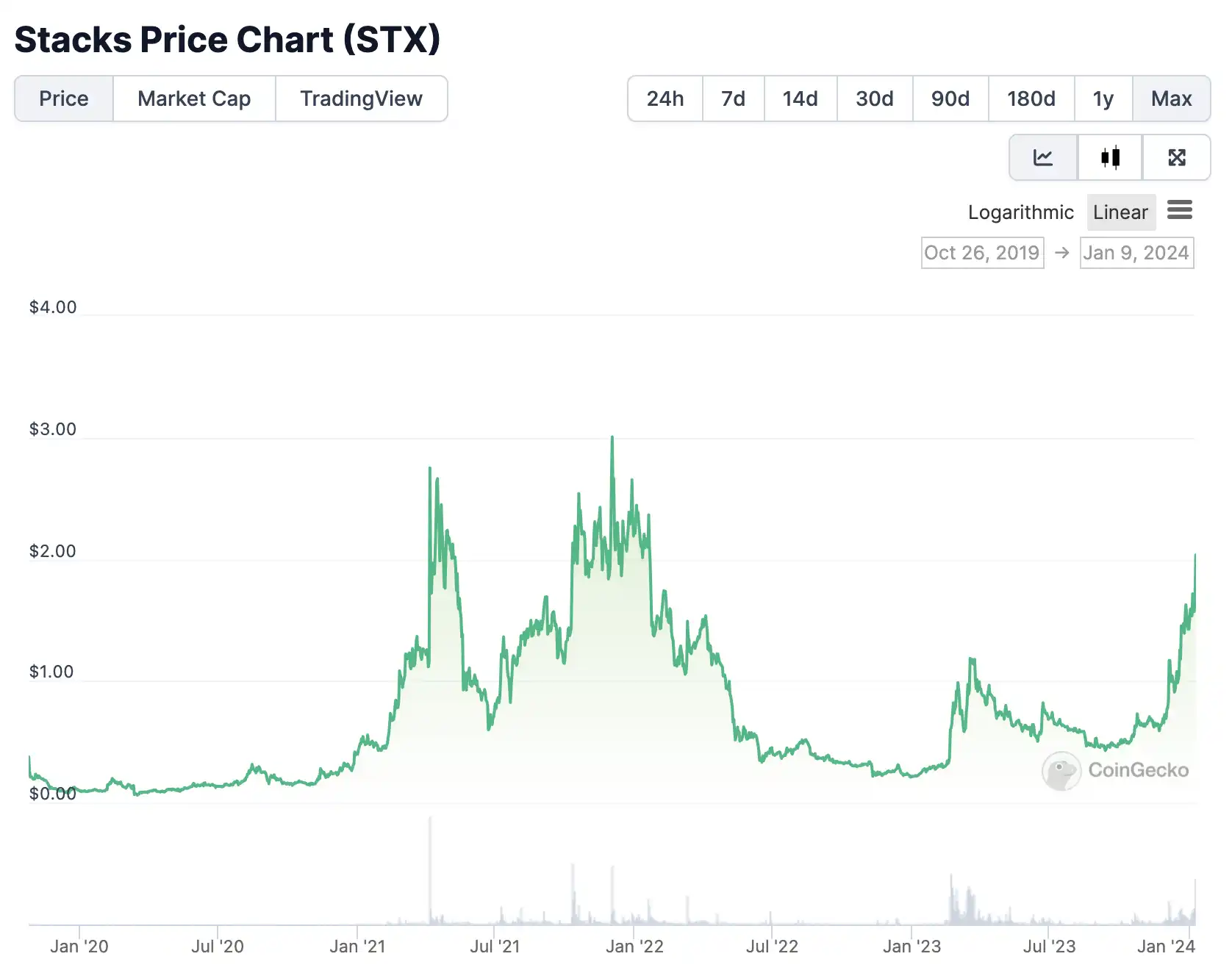
STX
Current price: $2.01
Increase (24 H/7 d/30 d): 21.3% /18.0% /101.2%
Market Cap: $2,876,449,339
Trading volume (24 h): 772, 449, 899 USD
Stacks is a blockchain connected to Bitcoin through a consensus mechanism (called proof of transfer) that spans both chains. This enables Stacks to leverage Bitcoins security and enables Stacks applications to use Bitcoins state. As the most advanced L2 protocol of Bitcoin, Stacks (STX) has undoubtedly gone the furthest at the application level: it has the most Apps, the most complete NFT ecosystem, BTC Naming Service and more DeFi protocols. Coming online in 2023.
With the Bitcoin halving in April this year, Stacks is about to launch an important Nakamoto upgrade. This upgrade will make it easier for apps like Opensea/Uniswap to be built on the second layer of Stacks/BTC. When the Subnet is born, it will support EVM/Solidity, greatly eliminating migration costs. In addition, Nakamoto can also help synthetic BTC be born on Stacks, directly stimulating the prosperity of the DeFi ecosystem on Stacks. Finally, with the completion of the Nakamoto upgrade, Block Time on Stacks will change from the past 10-30 minutes to within seconds.
ALEX
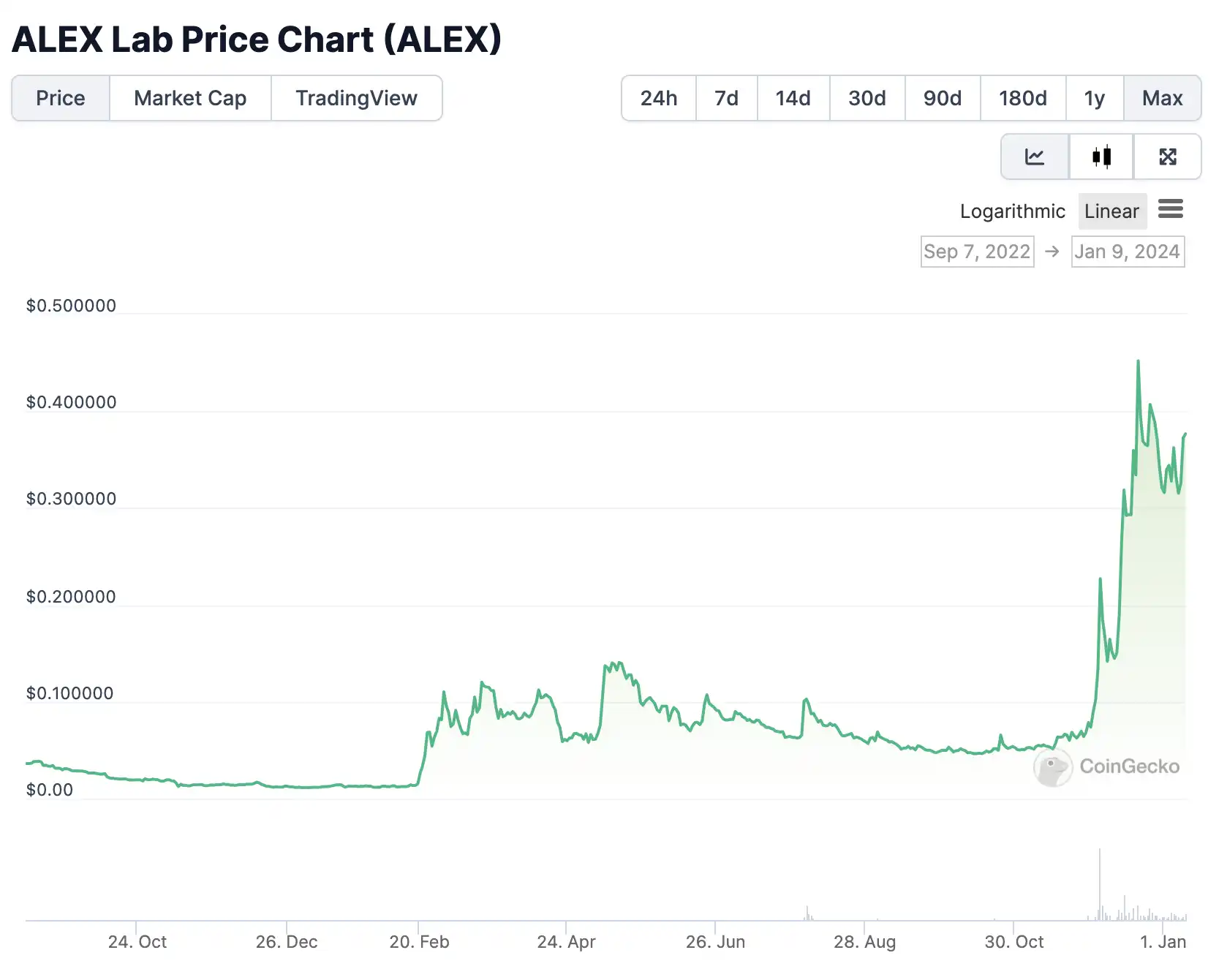
Current price: $0.3781
Increase (24 H/7 d/30 d): 19.8% /-1.2% /157.3%
Market cap: $247, 461, 306
Trading volume (24 h): 11,399,778 USD
ALEX Labs is a Bitcoin ecological DeFi platform based on the Stacks network. The platform was originally established to focus on the concept of Bitcoin finance. Its vision is to eliminate the barriers between Bitcoin L1 and L2 and create a seamless Bitcoin DeFi experience. The total amount of its token ALEX is 1 billion.
Currently, ALEX Labs’ Launchpad feature can be used to launch new projects or deploy, mint, and transfer BRC 20 tokens. The cross-chain bridge function allows users to transfer tokens between EVM and Stacks, as well as transfer tokens between Bitcoin and Stacks. The trading modes include AMM and order book. Users can view and analyze the ecological DeFi economy on ALEX through the dashboard. In addition, the platform will also launch liquidity mining and RWA services. As a Bitcoin ecological DeFi platform, ALEX Labs’ functions can be said to be quite complete.
In December 2023, ALEX launched the Alpha version of the Bitcoin oracle and is expected to complete testing by the end of the first quarter of 2024. This version was developed in collaboration with partners including Domo, BIS, Hiro, UniSat, Xverse and Xlink. The oracle is designed to provide a critical layer of security and efficiency for assets on Bitcoin while maintaining decentralization and high transparency.
T
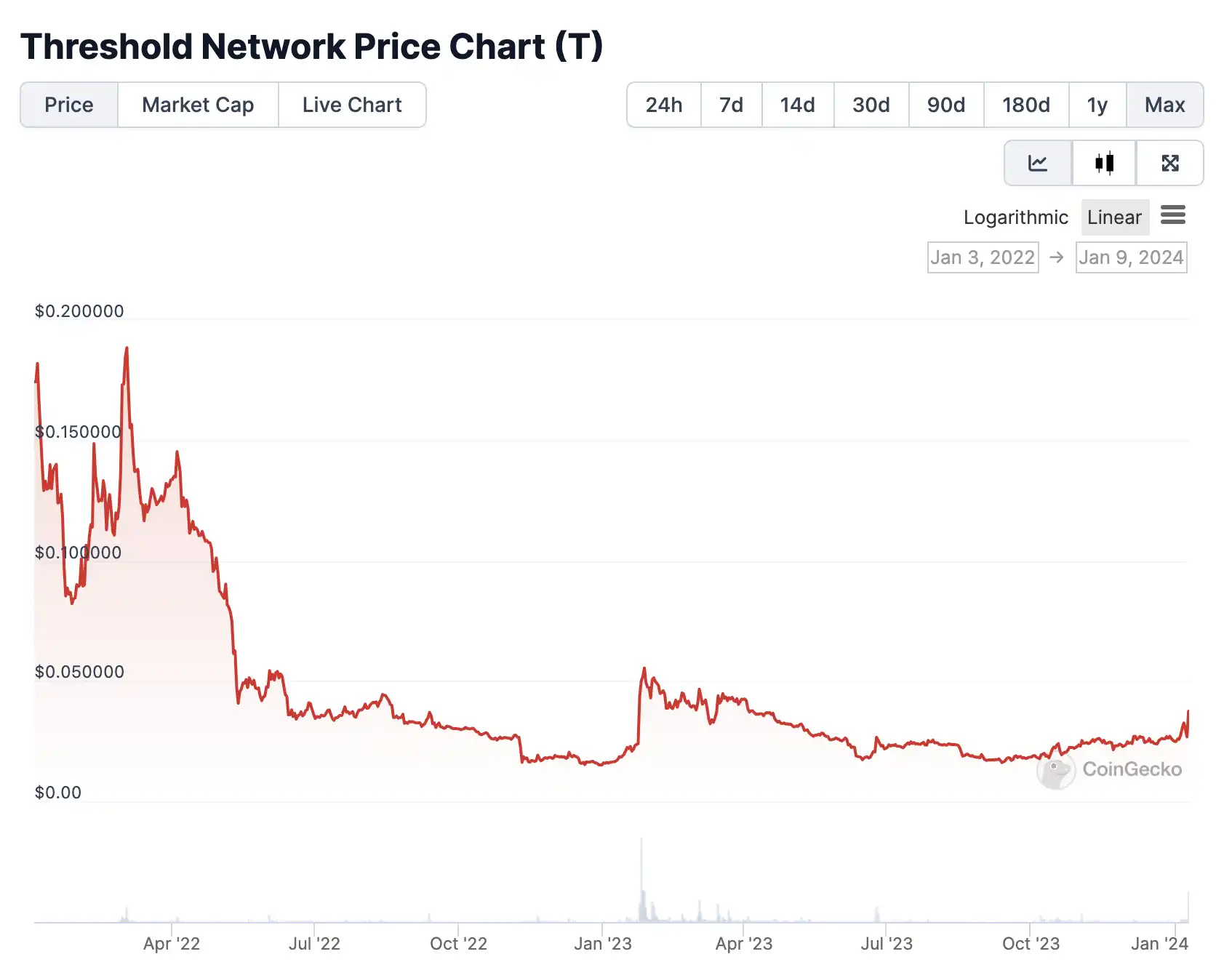
Current price: $0.03603 USD
Increase (24 H/7 d/30 d): 19.0% /37.5% /34.2%
Trading volume (24 h): 513, 669, 469 USD
Threshold Network (T) was launched in January 2022, resulting from the merger of Keep Network and NuCypher. The network combines Keep Networks offline container technology and NuCyphers privacy tools, including proxy re-encryption tools, to ensure data security and privacy. One service provided on Threshold Network is Proxy Re-encryption (PRE). PRE is a cryptographic middleware that enables user privacy protection applications. It uses a scalable end-to-end encryption protocol where nodes on the network act as proxy entities. These nodes securely and collaboratively re-encrypt data for recipients based on access conditions defined by the data owner. PRE is particularly useful for enabling data sharing while maintaining data ownership, such as paid subscriptions to encrypted content or encrypted NFT transfers. Data remains private and encrypted, and data owners can cryptographically enforce access controls.
Another component of the Threshold ecosystem is tBTC v2, enabling a decentralized and permissionless Bitcoin to Ethereum asset bridge. Unlike existing centralized solutions, tBTC v2 allows Bitcoin holders to access DeFi and Web3 without relying on intermediaries. It replaces centralized intermediaries with a randomly selected set of operators running nodes on the Threshold network. Together, these operators use threshold encryption technology to protect users’ deposited Bitcoins. User funds are controlled by a majority consensus among these operators, preventing control by one individual or group. tBTC v2 is permissionless, ensuring everyone can access it.
T is the ERC-20 utility token of Threshold Network, which provides various threshold crypto services, including the decentralized Bitcoin bridge tBTC. T tokens are staked by node operators and also serve as governance tokens. The initial supply of T is 10 billion, of which 4.5 billion are allocated to NU holders, 4.5 billion to KEEP holders, and 1 billion to Threshold DAO. NU and KEEP holders can upgrade their tokens to T indefinitely.
ICP
Current price: $13.41
Increase (24 H/7 d/30 d): 23.7% /1.8% /37.6%
Market Cap: $6,055,739,594
Trading volume (24 h): 454, 489, 183 USD
In December 2022, Internet Computer (ICP) announced that the main network had been integrated with Bitcoin. In April 2023, ICP officially launched Chain.Key Bitcoin (ckBTC). Compared with existing cross-chain or encapsulation solutions, it is a highly liquid and cost-effective twin Token that brings Layer 2 functionality to Bitcoin, making it faster and more secure without compromising security. Trade more cheaply.
The functionality of ckBTC is provided through the interaction of two core components:
ckBTC minting machine.
ckBTC ledger.
The ckBTC ledger is responsible for maintaining account balances and transferring ckBTC between accounts. It provides the following functions:
Allows the ckBTC mint machine to mint and destroy ckBTC.
Allows transfer of ckBTC between users.
The ckBTC mint machine is responsible for the minting and destruction of ckBTC tokens. Tokens are minted when a user transfers Bitcoin to a specific Bitcoin address under the control of the ckBTC minting machine. This Bitcoin address uniquely identifies the owner of the sending Bitcoin, allowing the ckBTC minter to associate minted ckBTC funds with the correct owner. Due to Bitcoins lack of finality, the ckBTC mint waits for a large number of confirmations on all Bitcoin transactions that affect the total supply of ckBTC. When processing a Bitcoin retrieval request, the ckBTC mint machine destroys ckBTC before transferring the corresponding amount of BTC (minus fees) using a regular Bitcoin transaction.
BSV
Current price: $90.91
Increase (24 H/7 d/30 d): 24.3% /-12.1% /73.8%
Market Cap: $1,746,055,608
Trading volume (24 h): 320, 634, 478 USD
Bitcoin SV (BSV) is one of the hard fork products of Bitcoin Cash (BCH) in November 2018. It stands for Bitcoin Satoshi Vision and aims to restore the original protocol and vision of Bitcoin. The hard fork stemmed from a dispute over block sizes and Bitcoin governance, with BSV supporting larger blocks to increase transaction capacity. The core controversy surrounding BSV is that its founder, Craig S. Wright, claims to be the real person behind the pseudonym of Bitcoin inventor Satoshi Nakamoto, but this claim has been controversial due to a lack of conclusive evidence. Especially at the 2018 Deconomy conference, Wrights claim was publicly questioned by Vitalik Buterin, the founder of Ethereum.
Wright has attracted widespread attention from the cryptocurrency community due to his controversial remarks and actions, including threats of prosecution against community members. Former Binance CEO CZ stated on Twitter in April 2019 that Binance would delist BSV if Wright continued to claim that he was Satoshi Nakamoto. After that, on April 15, Binance officially delisted BSV. Binance will launch the BSV U-based perpetual contract with a maximum of 50 times on October 20, 2023.
RIF
Current price: $0.157
Increase (24 H/7 d/30 d): 38.3% /13.7% /14.4%
Market cap: $157, 299, 759
Trading volume (24 h): 31, 320, 143 USD
RIF token is the native token of Rootstock Infrastructure Framework, which is a service layer built on the Rootstock blockchain. Rootstock is a long-standing sidechain on which the Uniswap v3 version is deployed. Rootstock Labs developed the Bitcoin side chain RSK in January 2018. It is an EVM-compatible smart contract platform written in Solidity language. It uses Bitcoin as its native asset and aims to give BTC programmability.
As of now, the circulating supply of RIF is 1 billion, and the maximum supply is not yet clear. RIF is designed to bridge the gap between complex blockchain technology and seamless user experiences, helping organizations create innovative DeFi products and providing the infrastructure and resources to solve key user accessibility challenges.
BADGER
Current price: $3.8
Increase (24 H/7 d/30 d): 17.4% /-17.6% /-13.1%
Market cap: $75,741,702
Trading volume (24 h): 17, 145, 893 USD
Badger DAO, the decentralized autonomous organization behind BADGER, focuses on introducing Bitcoin to DeFi and will launch it in 2023July 26Released the “Purple Paper” of its eBTC protocol and launched a censorship-resistant DeFi synthetic Bitcoin. Users can use Lidos stETH to borrow eBTC with 0% interest, repayment fees and activation fees, which is designed to provide users with efficient and economical access to assets.
It is reported that the eBTC protocol generates revenue by obtaining a certain proportion of staking revenue from the total system collateral, that is, the “protocol revenue share.” To ensure the solvency of the system, eBTC adopts a liquidation mechanism, whereby debt positions are eligible for liquidation if the collateral debt ratio falls below the minimum 110%. In the event that a debt position is not liquidated but its collateralization ratio drops below 103%, the protocol will treat it as undercollateralization and implement debt reallocation.
In addition, in March 2021, Badger DAO also collaborated with the decentralized stablecoin DefiDollar to launch the interest-bearing Bitcoin ibBTC, which was launched on the Ethereum main network.
MUBI
Current price: $0.1708
Increase (24 H/7 d/30 d): 29.4% /-24.7% /143.5%
Market cap: $162, 330, 831
Trading volume (24 h): 27, 612, 358 USD
Multibit is a bridge protocol that emerged in May 2023 to connect BRC 20 assets to the EVM network, allowing users to seamlessly transfer tokens between the ETH chain, BNB chain and BTC network. Multibit completed the IDO auction on the auction platform Bounce Finance on November 12, raising 88 ETH. On November 4, IDO was completed again on the Bitcoin network donation platform TurtSat at the same unit price, raising 4.64 BTC. The total raised between the two rounds was approximately $350,000.
MultiBit simplifies the process of transferring tokens between Bitcoins BRC 20 and EVM networks. First, users transfer BRC 20 tokens to a dedicated BRC 20 address. After confirmation, the Multibit protocol starts working, minting an equal amount of tokens on the Ethereum or BNB chain. Multibit Protocol collects tokens from all distributed unique addresses. The tokens are securely transferred to a unified cold wallet. When a user needs to withdraw tokens, Multibit Protocol will destroy the corresponding number of tokens from the EVM chain. The equivalent value of tokens is then transferred to the user from a secure cold wallet.
The total supply of MUBI is 901, 224, 547 pieces, all of which are currently in circulation.
BSSB
Current price: $3.52
Increase (24 H/7 d/30 d): 63.5% /-16.2% /84.5%
Market value: approximately US$34.3 million
Trading volume (24 h): 6, 486, 474 USD
BitStable (BSSB) is a decentralized asset protocol based on the Bitcoin network that allows anyone, anywhere to generate DAII stablecoins against collateralized assets in the Bitcoin ecosystem. BitStable has a dual-token system and a cross-chain compatible structure, and its tokens are DAII and BSSB.
DAII is a stablecoin whose value and stability come from the robustness of Bitcoin ecosystem assets, including BRC 20, RSK, and the Lightning Network. In addition, in BitStables vision, DAII can also bring the Ethereum community into the Bitcoin ecosystem with its cross-chain capabilities. The total supply of DAII is 1 billion.
BSSB is the governance token of the platform. The community uses it to maintain the system and manage DAII. BitStable will also incentivize BSSB holders through dividends and other measures.
The total supply of BSSB is 21 million, of which, in addition to 50% being publicly sold on Bounce Finance, the team will hold 5% of BSSB (6-month lock-in and 15-month linear unlock), and the airdrop quota will account for 3.5%, staking rewards account for 36.5%, LP accounts for 5% (locked indefinitely).
BitStable launched the native token BSSB on the Bounce Launchpad at 12:00 on November 29, 2023. Users can obtain the corresponding BSSB shares by staking AUCTION tokens or through the auction mechanism. Within two hours after Bounce Finance announced it, the price of AUCTION also achieved an increase of more than 15%.
ORDI
Current price: $75.79
Increase (24 H/7 d/30 d): 16.0% /-4.2% /49.1%
Market Cap: $1,593,687,581
Trading volume (24 h): 634, 890, 979 USD
On March 8, 2023, anonymous developer @domodata launched the BRC-20 inscription protocol based on the Ordinals protocol and deployed the experimental token ORDI, which is the first BRC 20 Token to be deployed. On March 9, ORDI was minted, and the cost of printing one ORDI (1 card contains 1,000 coins) is 2 to 3 US dollars. Binance will list Ordinals (ORDI) at 20:00 on November 7, 2023 (Eastern Eighth District Time) and add a seed tag to it.





